-
-
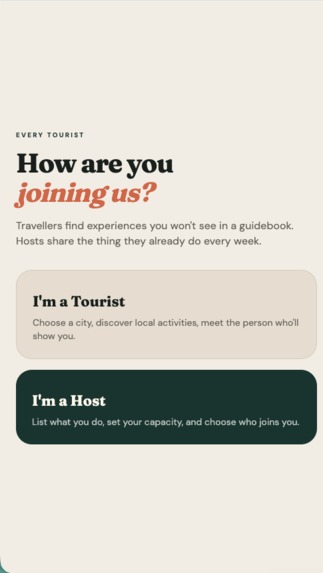
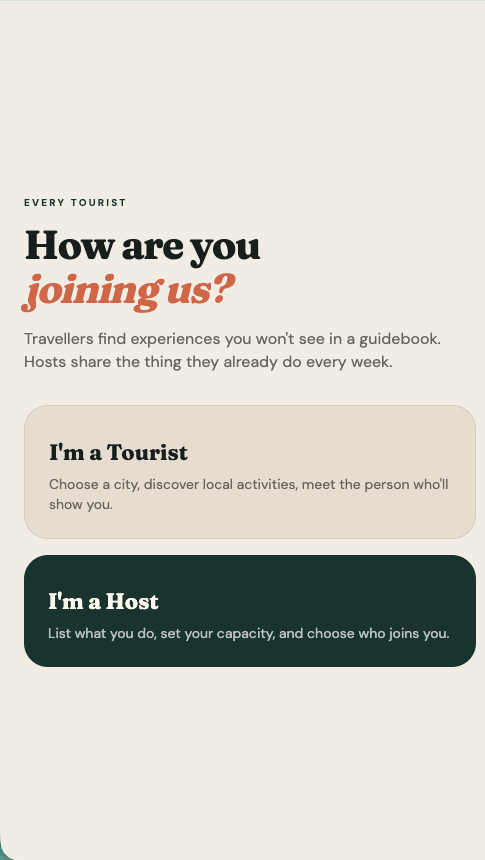
home page - select tourist or host
-
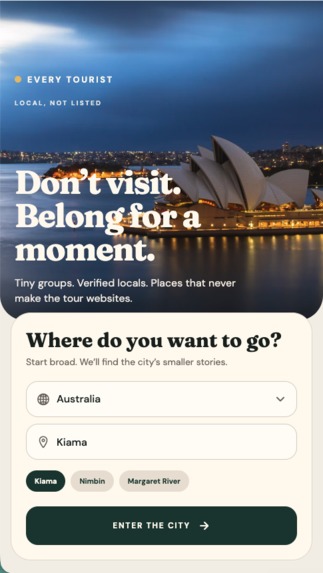
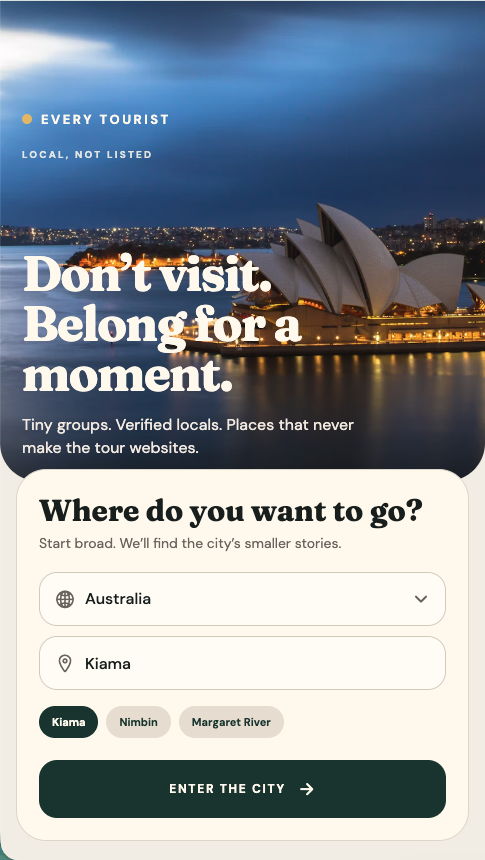
tourist landing page - select destination
-
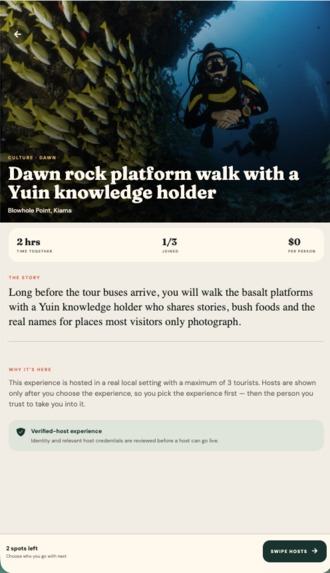
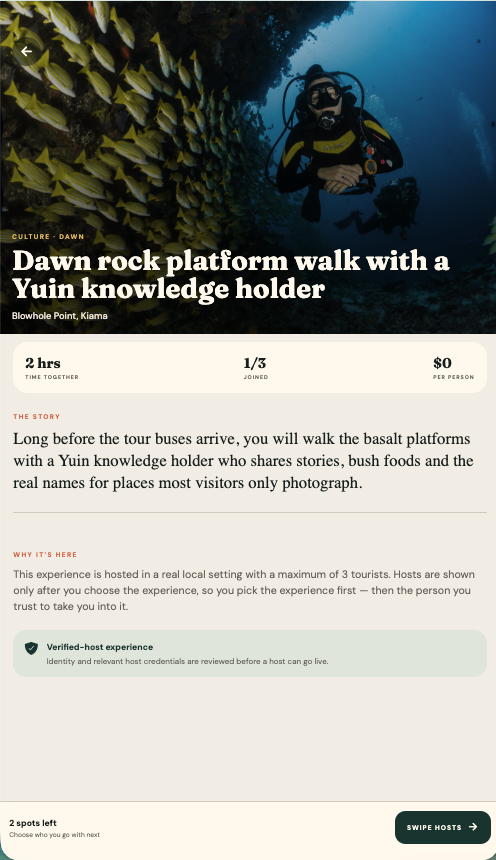
tourist - select activity
-
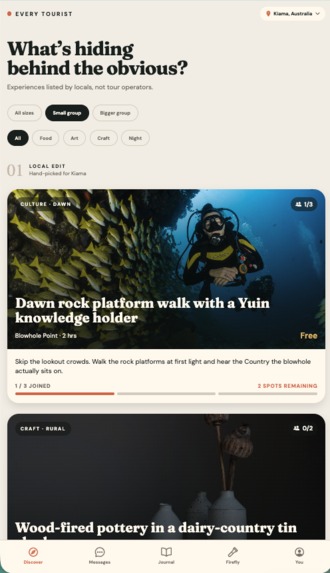
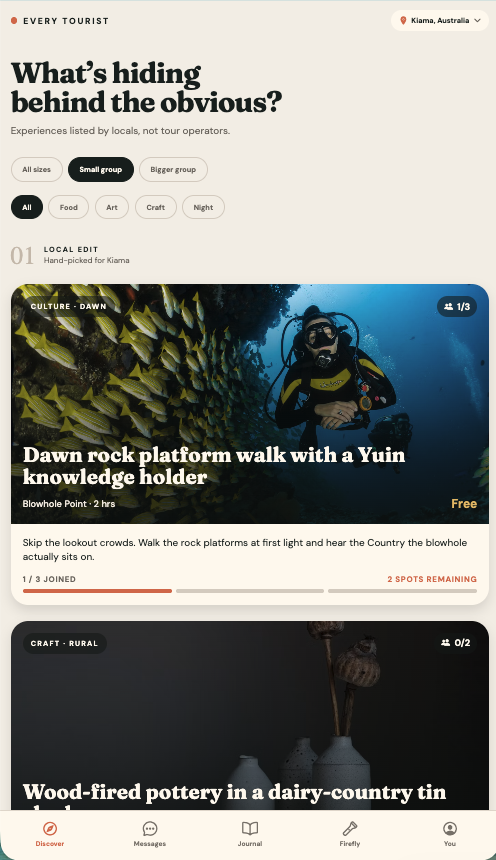
tourist - find activities listed by locals
-
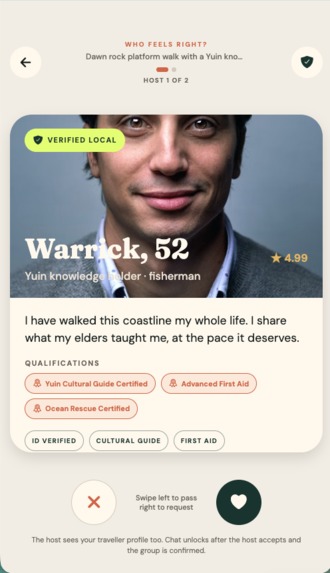
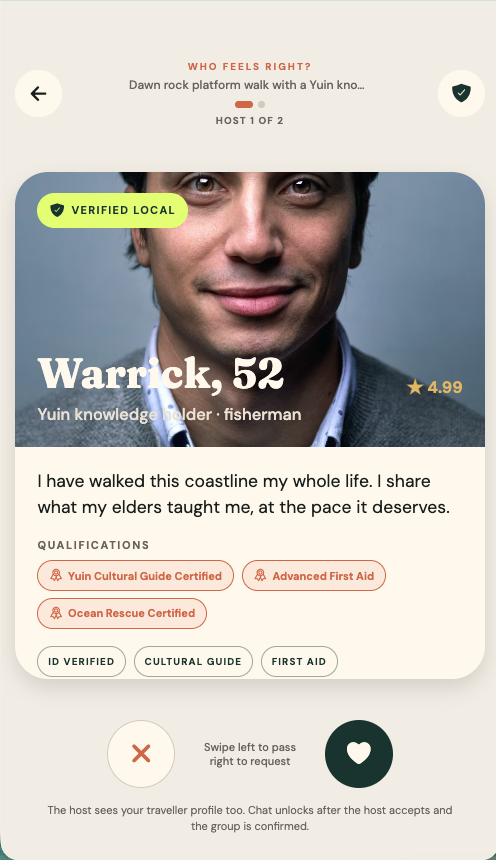
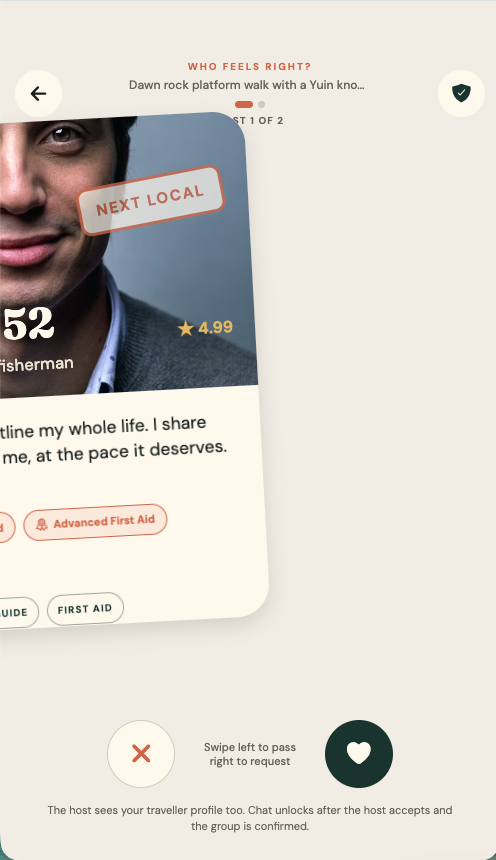
tourist - swipe on locals
-
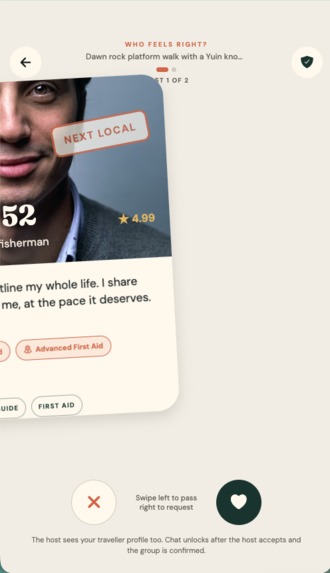
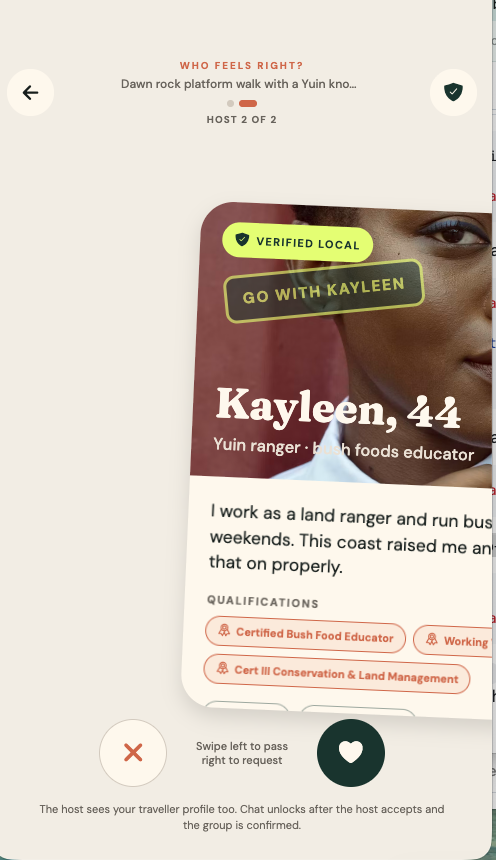
tourist - select another local
-
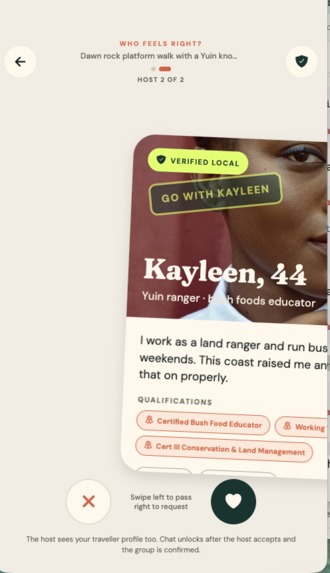
tourist - select this local
-
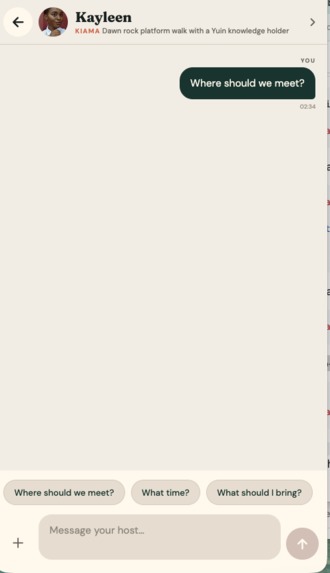
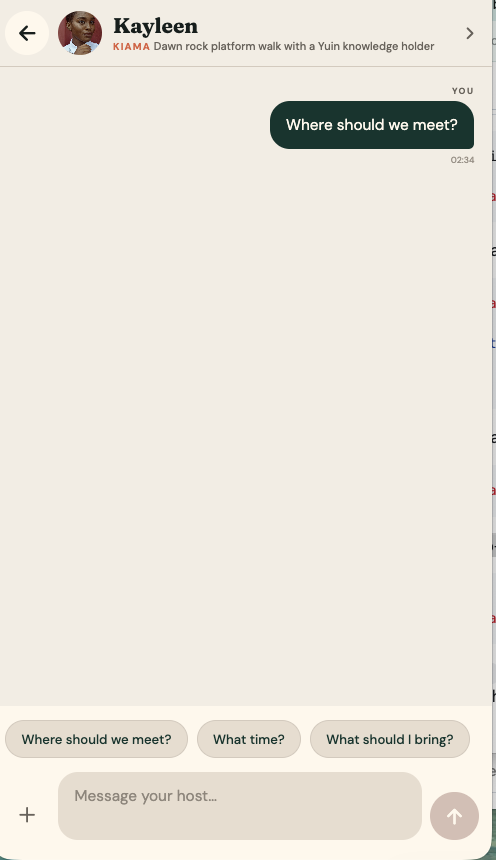
tourist - chat with this local
-
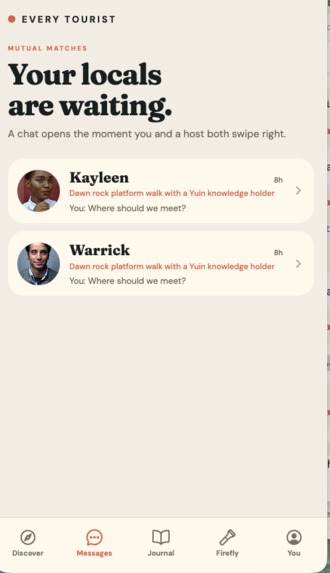
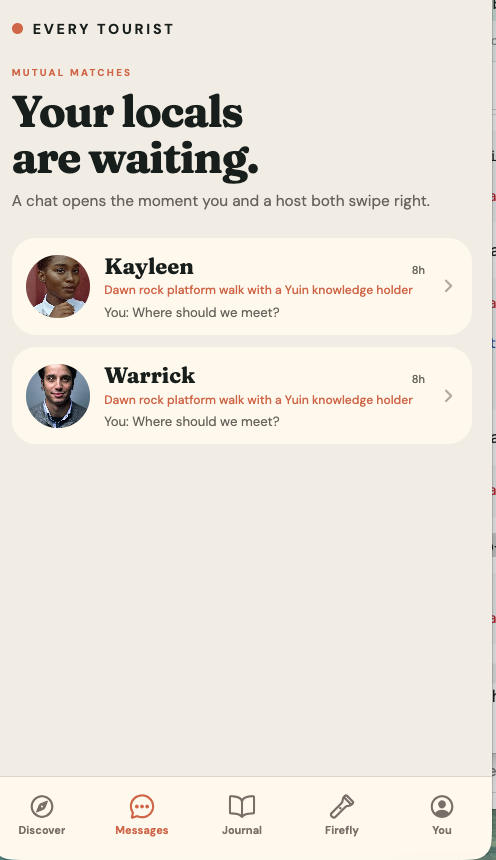
tourist - messaging page
-
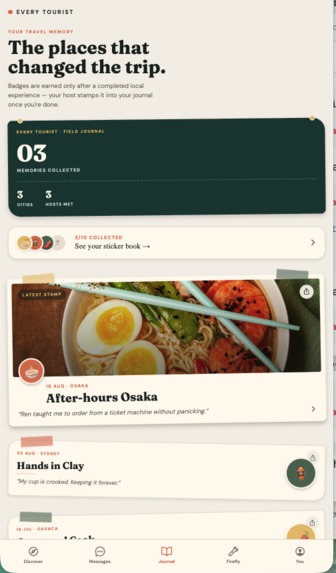
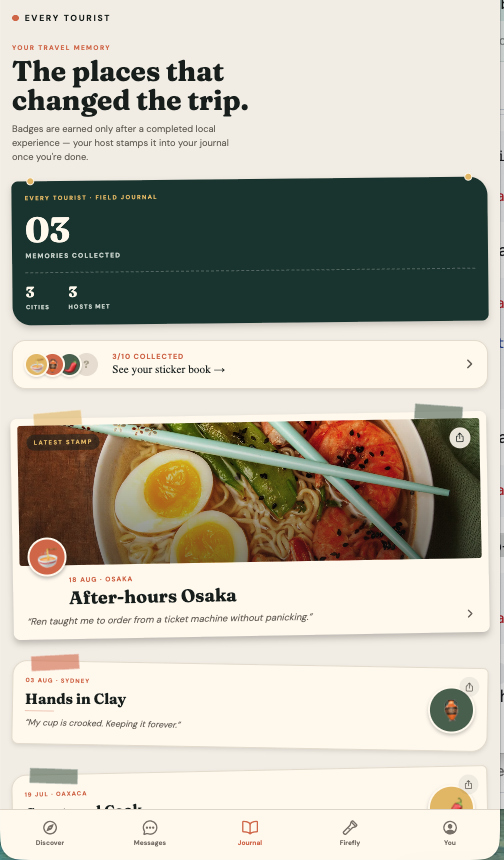
tourist - journal page
-
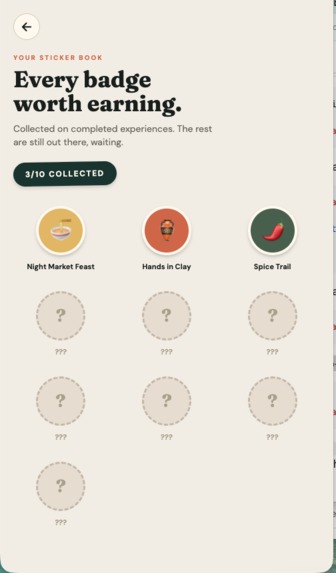
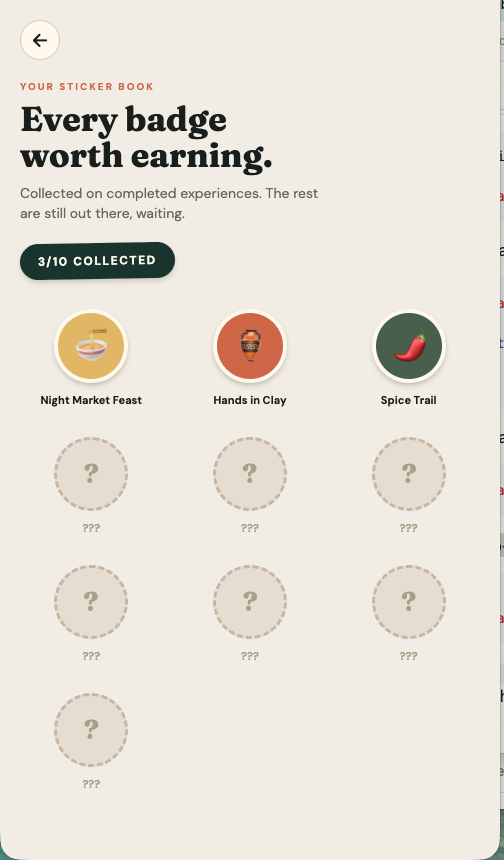
tourist - badge after every successful journal entry and local visit
-
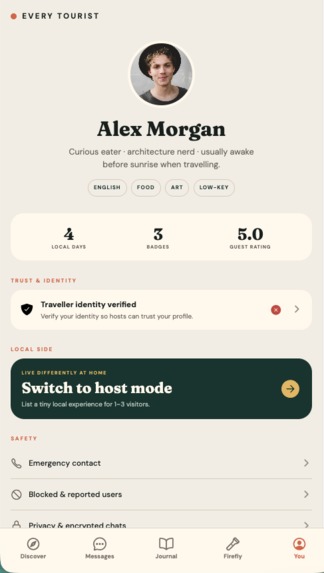
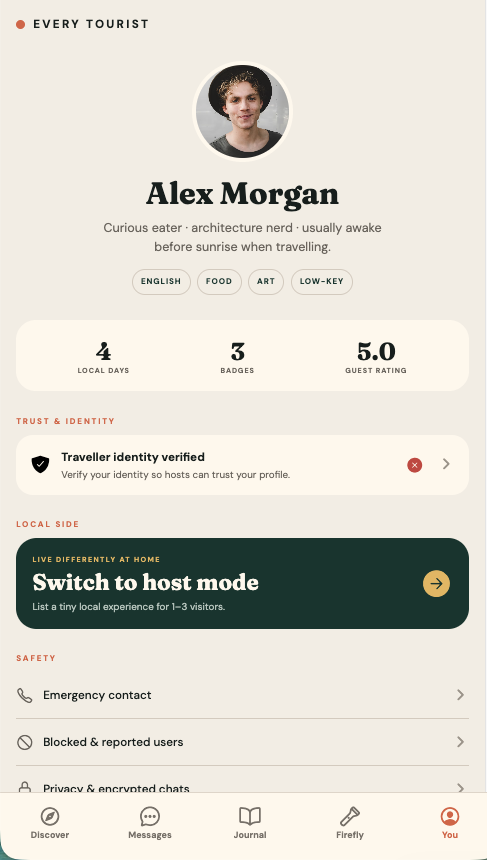
tourist - profile page
-
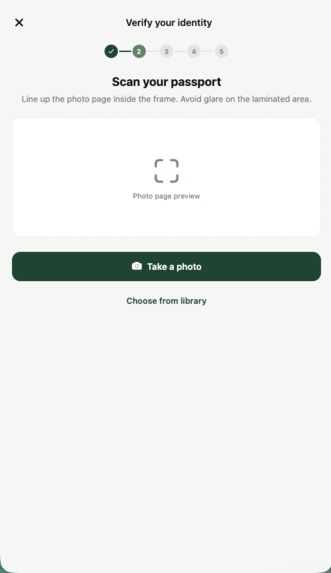
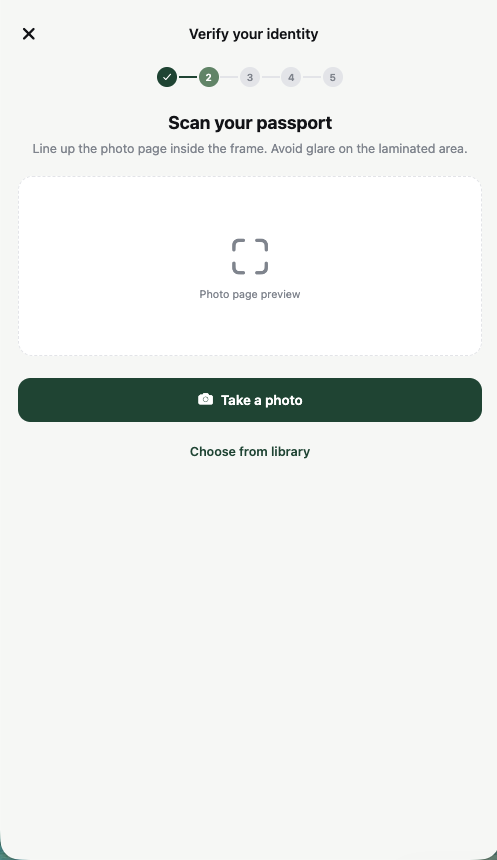
tourist - update verification status in profile page
-
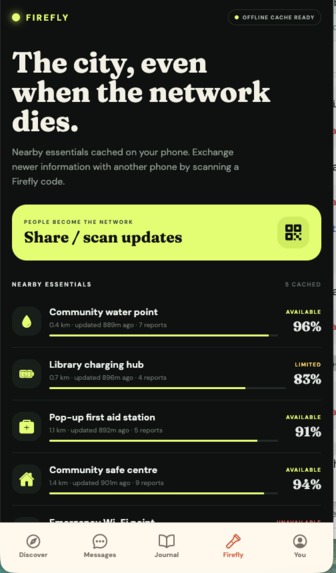
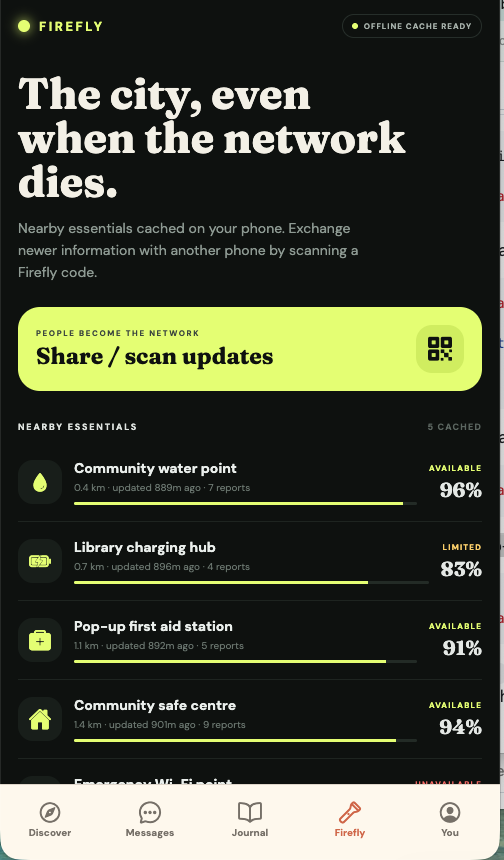
tourist - firefly for help if required
-
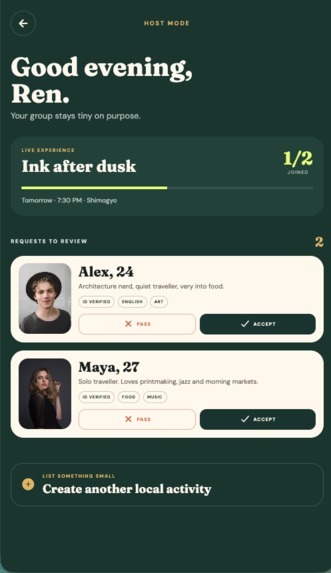
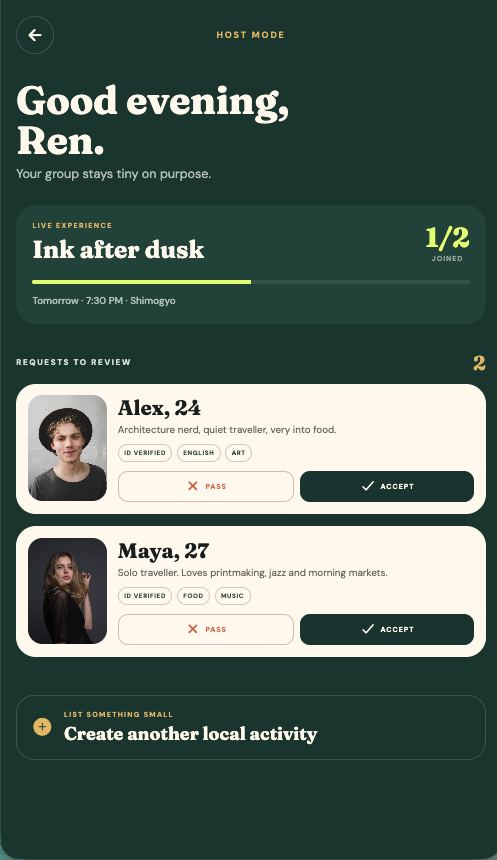
host - accept tourists and add local activity
Inspiration
Every one of us has come home from a trip with a phone full of the same photos everyone else has - the same landmark, the same angle, the same queue of tourists just out of frame. Somewhere along the way, travel got optimised into a checklist: land, see the five things, leave. The version of a city that actually matters - the noodle stall with no sign, the rooftop where the neighborhood watches the sunset - never makes it onto a tour website, because it was never meant to be a product in the first place.
We wanted to build something that flips the transaction. Not "book an experience," but "get let in." A trip measured not in landmarks checked off, but in moments where a local decided you were worth their time. "Every Tourist" is our attempt at that: a small door into a city, opened by someone who actually lives there.
What it does
Excalibur turns cultural connection into something you can actually find, choose, and keep.
Search by country, discover by neighbourhood. Type in where you're headed, and Excalibur surfaces activities hosted by verified locals in that country - not curated tour packages, but niche, small-scale experiences specific to a city: a dumpling-folding morning in someone's kitchen, a night market crawl with a third-generation stallholder, a rooftop pigeon-racing club. Every listing shows exactly how intimate it is - spots available and how many people have already joined so you know if you're about to be part of a group of three or thirteen.
Swipe to choose your host, not just your activity. Once you've found an experience, you meet the humans behind it. Host profiles show their photo and their certifications, and you swipe through them Tinder-style: left to pass and see the next host running a similar experience, right to lock in and join. It turns "picking a tour guide" into something that actually feels like choosing who you want to spend your afternoon with.
Complete the experience, earn the memory. After the activity wraps, you upload a photo of the moment — and Excalibur turns it into a 3D digital badge, stamped into your personal travel journal. It's part passport, part scrapbook: cities visited, hosts met, and a growing collection of tactile, collectible proof that you didn't just pass through — you were there.
Market space & competitor analysis
Before we built anything, we mapped out who else is playing in "travel + people," because the space is more crowded than it looks. Most of it is solving an adjacent problem, not ours.
Social/companion apps (Nomad Table, and Bumble's travel-adjacent use). Nomad Table is the closest analog in spirit - it's built around real-time meetups between solo travelers and digital nomads, letting people join or create casual activities like dinners or sightseeing, and it even matches travelers heading to the same destination into a pre-trip group chat. Its core loop is peer-to-peer - travelers meeting other travelers - with verification treated as optional, and reviewers describe it as feeling like a blend of Meetup, Couchsurfing, and LinkedIn built specifically for a nomad audience.
Bumble (and swipe-based social apps generally) proves the mechanic we borrowed - decisive, low-friction browsing - but it's matching people to people for dating or friendship, with no activity, host verification, or cultural-access layer attached at all.
The gap: these apps get you a companion, not a culture. You still end up guessing where to go and who actually knows the city. The "local" in the room is usually another tourist.
Local-experience marketplaces (Airbnb Experiences, Withlocals, EatWith, Viator/GetYourGuide). This is the more direct competitive set, since they do connect travelers with local hosts. Airbnb Experiences lets guests book activities run by local experts alongside their stays, folded into Airbnb's broader accommodation and travel-booking business. Withlocals operates as a peer-to-peer marketplace spanning eating, touring, and activities, pitching itself as an "Airbnb for travel experiences" that lets locals monetize things like home dining or teaching a niche skill. EatWith focuses specifically on food, positioning itself as one of the largest communities for home-hosted culinary experiences worldwide. Viator and GetYourGuide sit a layer further out - large-scale booking engines for tours and attractions rather than intimate, local-hosted moments.
The gap: these are still browse-and-book catalogs. You scroll a list, read star ratings, and check out - there's no moment where you actually choose the person taking you around, and once the activity is done, the relationship (and the memory of it) usually ends at the review screen. It's also a known pain point on platforms like Withlocals that experience quality swings a lot from guide to guide, since each one operates independently - leaving travelers with no consistent way to vet who they're getting beyond a star rating.
Where Excalibur sits, and what stands out
| Nomad Table | Airbnb Experiences / Withlocals / EatWith | Excalibur | |
|---|---|---|---|
| Who you connect with | Other travelers | A host, chosen by browsing a listing | A verified host, chosen by an active yes/no decision |
| How you choose | Join an open activity feed | Scroll, sort by rating, book | Swipe through host profiles + certifications before committing |
| Depth of listings | Casual meetups (dinner, sightseeing) | Mix of niche and increasingly commercial/scaled listings | Deliberately niche, city-specific, capacity-capped experiences |
| Group intimacy signal | Not emphasized | Rarely shown before booking | Live pax joined vs. spots available, visible up front |
| What you keep afterward | A chat thread | A star review | A photo-verified badge in a personal travel journal |
Three things stand out as genuinely ours:
- The swipe is a trust decision, not a browsing gimmick. Every other platform in this space treats host selection as a side effect of picking an activity. We made it the main event - certifications and a face attached to a real yes/no choice, so travelers feel like they picked someone, not a listing.
- Scarcity as a feature, not a limitation. Marketplaces optimise for filling every seat; we show exactly how few seats there are, because a "tiny group" is the whole value proposition, not an inventory problem.
- The relationship doesn't end at checkout. Nomad Table ends at a chat log. Marketplaces end at a review. Excalibur is the only one of the three that turns a completed, verified experience into something a traveler keeps and looks back on - a personal artifact of having belonged somewhere, however briefly.
How we built it
We split Excalibur into three connected loops - discover, connect, remember and built each to feel physical rather than transactional.
Frontend React Native with Expo Router, styled to feel like a hand-kept travel journal rather than a booking app -washi tape, hand-torn card edges, Fraunces serif headlines paired with DM Sans body text, warm paper tones instead of the usual travel-app blues.
Discovery flow A country-first search surfaces host-listed activities, each carrying live capacity data (spots joined vs. spots available) so scarcity and intimacy are visible up front, not buried in fine print.
Host matching A swipeable card stack (inspired by, and built with similar gesture logic to, Tinder) lets travelers browse verified host profiles - photo, certifications, and activity context with a decisive left/right gesture instead of a dropdown list.
The badge system On activity completion, travelers upload a photo, which the app renders into a unique badge object tied to that specific host, city, and date. Badges live in a "field journal" profile screen, complete with passport-style stats (cities visited, hosts met), a featured "latest stamp" entry, and a sticker-book style collection view for badges not yet earned.
Challenges we ran into
Making "niche" verifiable, not just claimed Anyone can call an activity "local". The hard part was designing host certification and capacity data so travelers could trust an experience was genuinely small and genuinely run by someone from that place, without turning the flow into a wall of paperwork.
Swipe mechanics that feel fun, not flippant Tinder-style swiping works great for quick binary decisions, but we were asking people to choose who leads them through a real-world experience. We spent real time tuning the card stack — certifications and profile depth visible without a tap, so a "right swipe" felt like an informed yes, not a coin flip.
The badge had to feel earned, not decorative It would have been easy to make the badge purely cosmetic. Instead we tied its unlock strictly to a completed, photo-verified activity. The app is explicit that badges are "stamped" by the host, not self-awarded, so the collection actually means something when you look back at it.
Balancing whimsy with usability. The scrapbook aesthetic (washi tape, tilted cards, hand-drawn stats) is core to the emotional pitch, but every rotated card and layered sticker had to still be legible, tappable, and accessible on a real device screen.
Accomplishments that we're proud of
A discovery-to-memory loop that actually closes: search → activity → host swipe → completed experience → collectible badge, all connected in one app rather than feeling like three separate features bolted together.
A host-matching experience that makes choosing a guide feel personal and low-stakes instead of transactional.
A visual identity - journal, passport, sticker book - that we think genuinely makes "did you really connect with a place" feel measurable and worth showing off, without reducing culture to a leaderboard.
Live capacity signals (X of Y spots joined) that make small-group intimacy a visible, trust-building feature rather than a marketing claim.
What we learned
Building Excalibur taught us that connection is a design problem as much as a matchmaking one. The technical challenge of getting swipe gestures and image uploads working was, in some ways, the easy part. The harder problem was constantly asking: does this feature make the traveler feel like a guest, or like a customer? That question shaped almost every decision - from replacing a "book now" button with a swipe, to replacing a checklist with a hand-stamped journal. We also learned a lot about state management across highly visual, gesture-heavy screens, and about how much a consistent visual language (down to rotation angles on a scrapbook card) does for making an app feel trustworthy and considered rather than templated.
What's next for Excalibur
Two-way trust: letting hosts see traveler "journals" before accepting a match, so the swipe becomes mutual rather than one-directional.
Language and cultural-context prompts built into activity listings, so first-time visitors know what to expect before they show up.
Badge rarity and host stories: deeper badge detail pages that carry a short story or voice note from the host, turning each memento into a keepsake of a specific person, not just a place.
Return-traveler paths: surfacing hosts a traveler has already met if they revisit a country, so relationships, not just cities can be revisited.
Community verification: letting past travelers vouch for hosts they've met, building certification from lived experience on top of formal credentials.

Log in or sign up for Devpost to join the conversation.