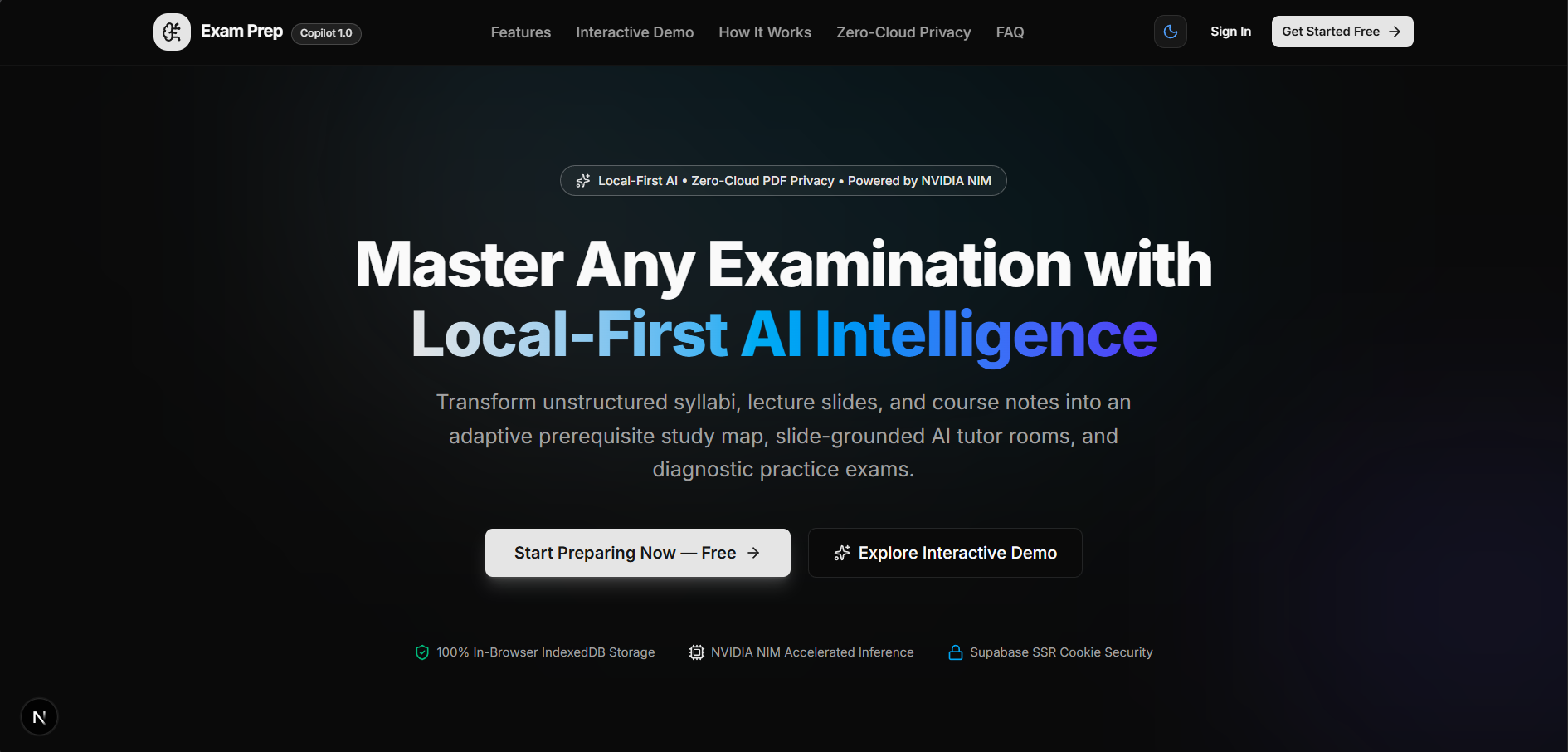
Exam Prep Copilot: Smarter Exam Preparation, Built Around Student Privacy
Inspiration
As students, we know how overwhelming exam preparation can be. Course materials are scattered across PDFs, notes, and online resources, while tight deadlines make it difficult to decide what to study first. Although AI tools can explain concepts and answer questions, students still need to organize their materials, identify important topics, create realistic study schedules, and evaluate their understanding.
We wanted to build something that goes beyond a generic AI chatbot: a personal study companion that helps students manage their entire exam preparation journey.
That idea became Exam Prep Copilot, an AI-powered, local-first platform designed to turn unstructured study materials into a structured, personalized learning experience.
What We Built
Exam Prep Copilot brings essential exam preparation tools together in one place:
- Smart Syllabus Intelligence: Upload a syllabus and transform it into an organized topic tree with prerequisite relationships and study priorities.
- Context-Aware AI Tutor: Ask questions about your course materials and receive answers grounded in your documents, supported by source citations.
- Interactive Practice Quizzes: Generate multiple-choice questions, practice under timed conditions, track scores, and identify mistakes.
- Adaptive Study Planner: Organize preparation into manageable daily tasks based on topic priorities, available study hours, and exam dates.
- Local-First Document Storage: Keep uploaded PDFs, extracted text chunks, and vector embeddings in your browser's IndexedDB instead of maintaining a cloud-based document repository.
Our goal is to make exam preparation more organized, personalized, and accessible without forcing students to give up control over their study materials.
What Makes It Different?
Most AI study tools focus on answering questions. Exam Prep Copilot focuses on the entire learning process: what to study, how to study, how to practice, and how to improve.
Privacy is a core part of our design. We use browser-based storage and local semantic retrieval to keep study documents on the user's device. Hosted AI models provide the intelligence needed for syllabus analysis, tutoring, quiz generation, and study planning.
This is a local-first architecture rather than a claim that every operation happens offline. When users invoke AI-powered features, relevant prompts and context may be sent to the hosted AI service for processing. Our goal is to minimize unnecessary data transfer while making powerful AI capabilities available to students.
How We Built It
We built Exam Prep Copilot using Next.js 16, React 19, TypeScript, and Tailwind CSS to create a modern, responsive student experience.
- AI Intelligence: NVIDIA NIM APIs power syllabus analysis, contextual tutoring, quiz generation, and personalized planning.
- Authentication: Supabase provides secure authentication with email/password and OAuth support.
- Document Processing: PDF.js extracts text from uploaded course PDFs.
- Local Storage: Dexie.js provides a convenient interface for storing documents and related data in IndexedDB.
- Semantic Search: Transformers.js generates embeddings locally, while cosine similarity retrieves relevant passages from stored study materials.
- Contextual Learning: Retrieval-augmented generation (RAG) supplies relevant document passages to the AI tutor, enabling document-grounded answers and source citations.
We designed the application around individual exam workspaces, bringing together a student's syllabus, learning materials, study sessions, quizzes, and preparation schedule.
Challenges We Tackled
One of our main challenges was balancing powerful AI capabilities with a privacy-conscious architecture. Hosted AI services offer sophisticated reasoning, but sending entire documents to external services would undermine our local-first philosophy. We therefore designed a workflow that processes documents in the browser, retrieves relevant passages locally, and uses selected context for AI-powered tasks.
Another challenge was making AI-generated answers useful for actual studying. A generic response is not enough when students need answers grounded in their course materials. Combining document extraction, semantic retrieval, and citation-aware responses helps connect AI explanations to the sources students are studying.
We also needed to bring multiple learning workflows together without overwhelming students. Syllabus analysis, quizzes, tutoring, and scheduling each solve a different problem, so integrating them into a coherent exam preparation experience was an important part of the development process.
What We Learned
Building Exam Prep Copilot helped us explore how large language models, retrieval-augmented generation, browser-based storage, and authentication can work together in a practical application.
We learned that building an AI product involves much more than connecting an API to a chat interface. Reliable document processing, relevant retrieval, privacy-aware data flows, and a useful user experience are equally important.
We also learned to think about AI from the student's perspective. The real value is not simply generating more content; it is helping students make better decisions about their limited study time and understand where they need to improve.
What's Next?
We envision Exam Prep Copilot becoming a comprehensive personal learning environment where students can organize entire courses, understand difficult concepts, track their progress, and prepare confidently for examinations.
Future improvements could include stronger prerequisite mapping, more personalized revision recommendations, richer learning analytics, and expanded support for different document formats and learning resources.
Our vision is simple: make high-quality, AI-assisted exam preparation more organized, accessible, and privacy-conscious for every student.
Exam Prep Copilot — Your syllabus. Your materials. Your AI. Your learning journey.
Built With
- amazon-web-services
- backend
- genai
- javascript
- node.js
- nvidia
- postgresql
- python
- react
- supabase
- typescript

Log in or sign up for Devpost to join the conversation.