Inspiration
Traditional AI tools like ChatGPT or Google Gemini have revolutionized learning, but they suffer from a major educational flaw: they provide immediate, direct answers. When a student is handed a solution on a plate, critical thinking dies, and real learning stops.
Living in India, where exams like JEE, NEET, and Board Exams put immense pressure on students, we noticed that rote memorization is heavily prioritized over deep concept clarity. We wanted to build something that mimics a real-world personal mentor. This inspired ExamMind an AI-Powered Socratic Tutor designed to guide students toward answers by asking the right questions, helping them build true conceptual logic, step-by-step.
What it does
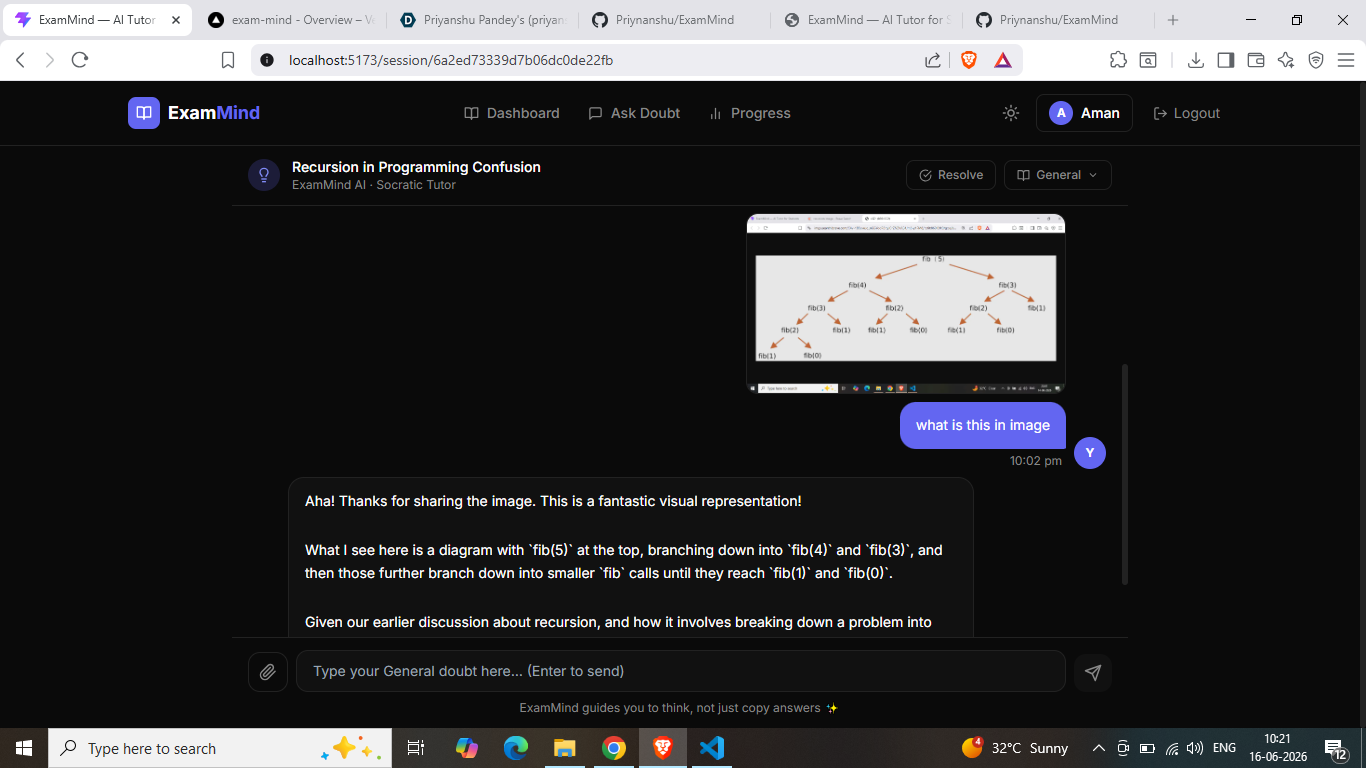
ExamMind is an intelligent, production-ready educational MVP that replaces direct answer-feeding with the Socratic Method of teaching.
- Socratic AI Guidance: Instead of giving the final solution, the AI engages the student in a chat-style dialog, breaking down complex queries into small, intuitive conceptual pieces.
- Deep Personalization: Adapts dynamically to the student's exact academic profile (Class 6 to College level), selected stream (PCM, PCB, Commerce, Arts, Law, Engineering), and preferred language—including full support for Hinglish.
- Indian Curriculum Focus: Tailored contextually around NCERT frameworks, board exams, and rigorous competitive testing patterns.
- Visual Multimodal Learning: Students can instantly upload images of complex math equations or science diagrams to initiate a guided learning session.
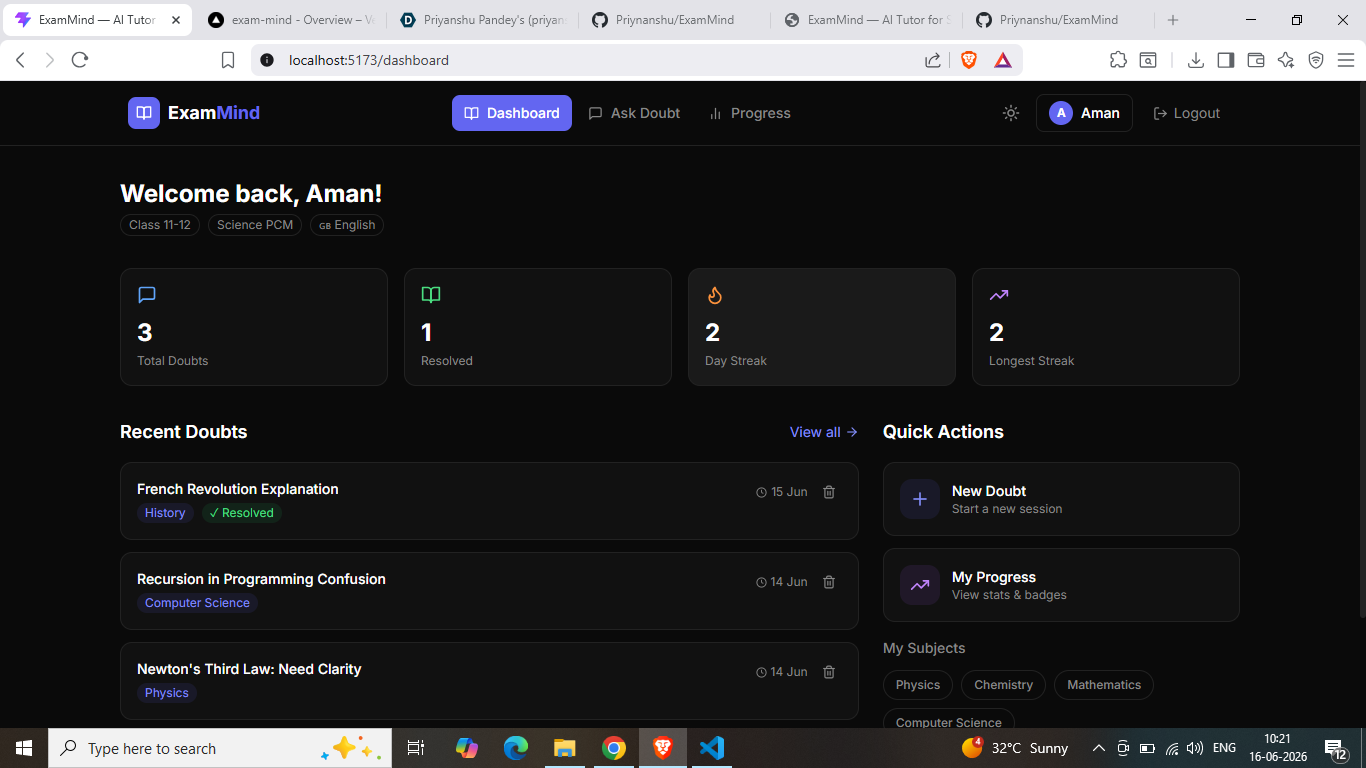
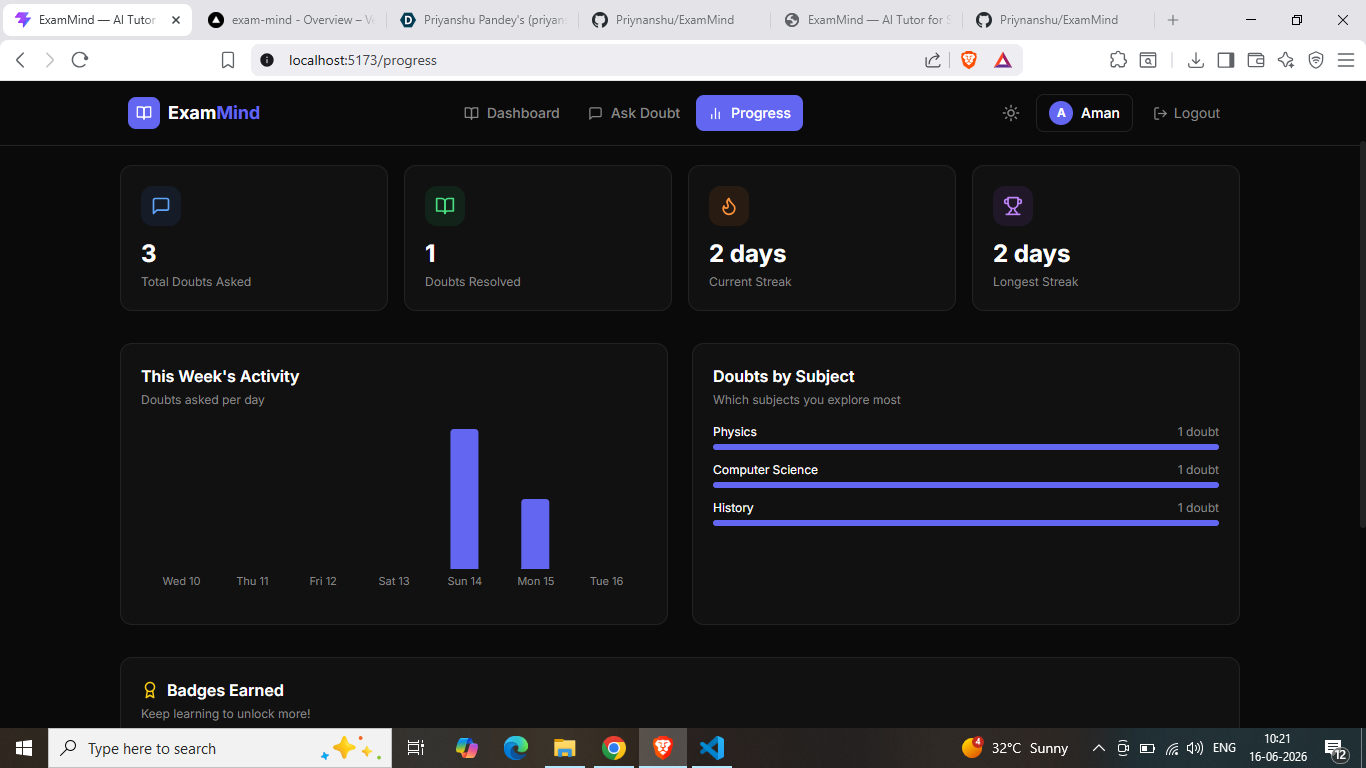
- Gamified Progress Tracking: Keeps students motivated with custom dashboards featuring active day streaks, unlocked badges, and Recharts-powered subject analytical charts.
How we built it
I built ExamMind using a highly scalable and optimized MERN Stack coupled with production-grade backend design patterns:
- The Core Backbone (Backend): Built using Node.js and Express.js following a clean Model-View-Controller (MVC) architecture. We utilized Mongoose to implement schemas for users, active sessions, and progress tracking.
- Intelligent Layer: Integrated the Google Gemini Pro API with a strictly engineered system prompt to enforce the Socratic learning framework consistently without breaking character.
- Caching & Speed Layer: Deployed Redis (ioredis) to handle session token blacklisting, caching repetitive configuration payloads, and establishing rate limits to safeguard system uptime.
- Media Handling: Configured ImageKit cloud infrastructure to support swift image parsing, compression, and delivery for question attachments.
- Fluid User Interface (Frontend): Architected a fast Single Page Application using React.js (Vite), managed state via Redux Toolkit, designed a slick dark/light theme system with Tailwind CSS, and injected engaging micro-interactions using Framer Motion.
Challenges we ran into
- Enforcing the Socratic Constraint: Initially, the AI model would occasionally slip and leak direct formulas or answers when pressured by users. We solved this by implementing strict layered system prompts, conditioning the AI to respond iteratively using analogical reasoning.
- State and Route Synchronization: Managing authentications, persistent light/dark themes, and active chat states simultaneously across page reloads was tricky. We optimized this using Redux Toolkit alongside local storage persistence hooks.
- Handling Math Formula Formatting: Rendering raw mathematical symbols and LaTeX code nicely within a flowing chat bubble was a hurdle. We integrated parsed structural styles to render formulas clearly, utilizing custom formatting layouts similar to mathematical equations: $$\text{Conceptual Clarity} = \frac{\text{Guided Questioning}}{\text{Active Student Engagement}}$$
- Redis Cloud Token Invalidation: Coordinating local Redis instances with hosted cloud endpoints during edge deployment phases required rigorous environment variable testing and proper asynchronous error-handling middleware patterns.
Accomplishments that we're proud of
- True Socratic Flow: Built an agentic chat flow that effectively asks contextual counter-questions (e.g., if a student asks about Newton's Third Law, the AI successfully prompts: "Achha socho—jab tum wall ko push karte ho, toh kya hota hai?").
- High-Performance Architecture: Successfully modularized the entire backend with precise error handlers (
ApiError), structural wrappers (ApiResponse), and efficient asset micro-routing. - Comprehensive Analytics Engine: Developed a complete dashboard tracking system that records real-time streak calculations and maps visual analytics using Recharts.
- Fully Responsive UI: Produced a gorgeous, minimal, high-contrast dark theme that ensures readability and keeps student cognitive fatigue to a minimum.
What we learned
- Prompt Engineering is Core Logic: We learned that defining comprehensive boundaries for LLMs is as critical as writing functional code when building educational agents.
- Production Standards Matter: Moving away from flat file systems to an MVC structure, utilizing async wrappers, and standardizing APIs taught us how large-scale consumer apps are designed.
- The Power of Caching: Implementing Redis taught us how memory caches dramatically optimize standard database operations and scale authentication security.
What's next for ExamMind: AI Socratic Tutor for Students
- Live Voice/Audio Class Sessions: Integrating WebRTC or AI speech-to-speech modules so younger students can conversationally talk to ExamMind instead of typing.
- Peer-to-Peer Cohorts: Allowing classmates to share a Socratic chat canvas to collaboratively solve doubts under AI moderation.
- Automated Syllabus Roadmaps: Implementing generative learning paths where the system analyzes a student’s historical performance charts and automatically designs curated daily micro-quizzes.
Built With
- css3
- express.js
- framer-motion
- google-gemini-api
- html5
- imagekit
- javascript
- jwt
- markdown
- mongodb
- mongoose
- node.js
- react
- recharts
- redis
- redux-toolkit
- tailwind-css
- vite

Log in or sign up for Devpost to join the conversation.