-
-
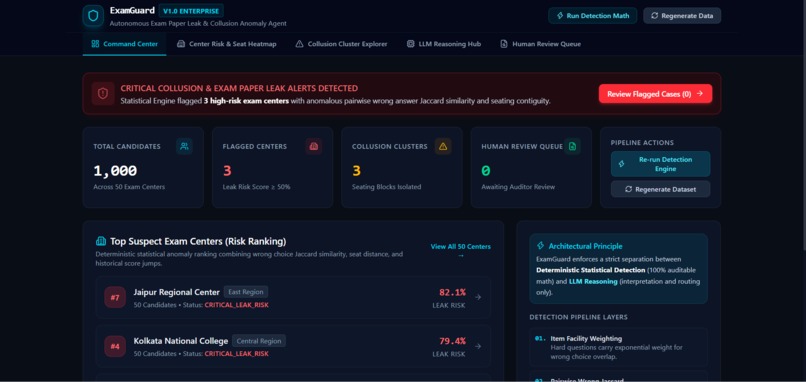
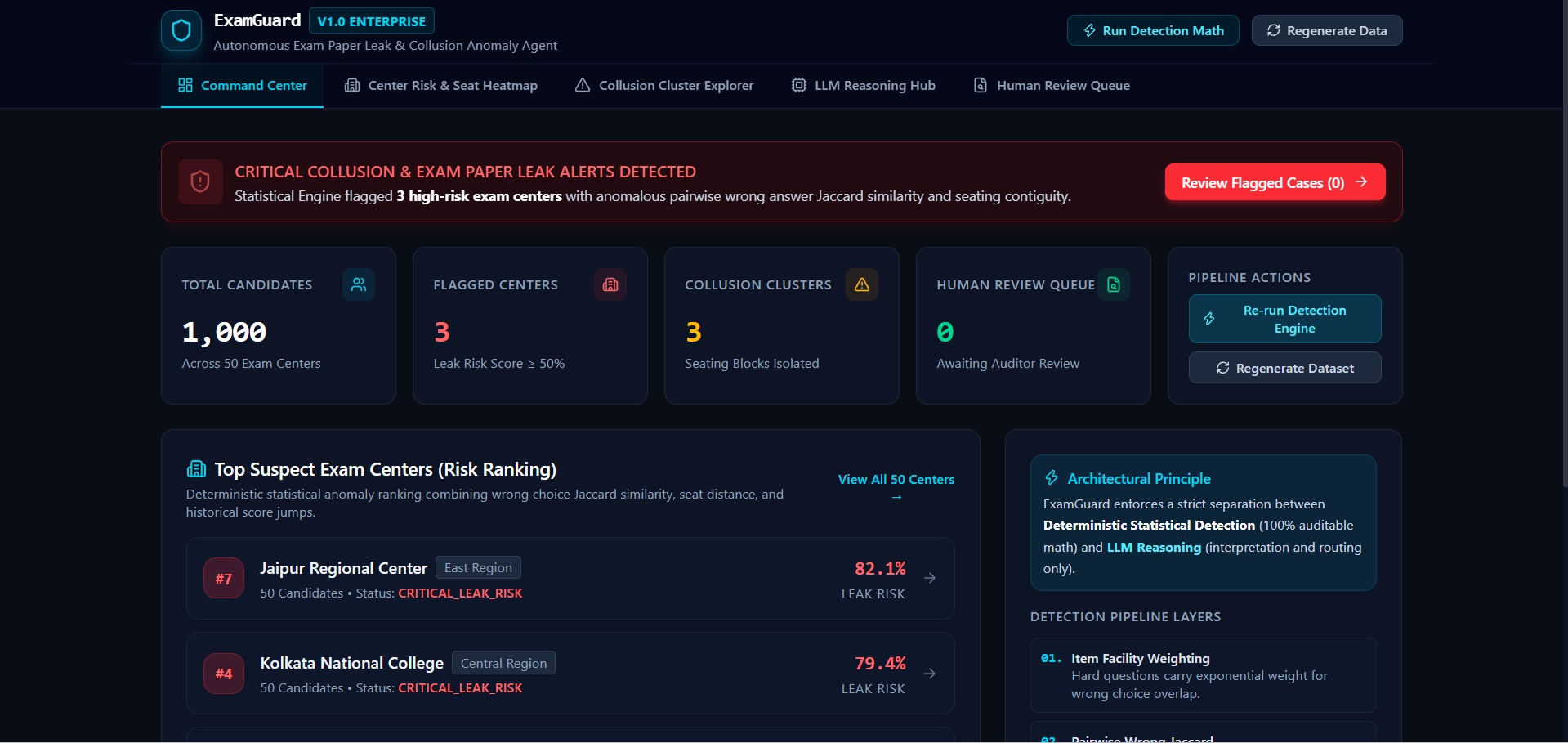
Dashboard of ExamGuard
Inspiration
Exam malpractice — paper leaks and student collusion — is a growing problem, especially in large-scale exams held across hundreds of centers. Traditional proctoring relies on webcams and human invigilators, which are expensive, invasive, and don't scale well. We wanted to build something that could catch cheating patterns using data instead of surveillance — something fair, auditable, and privacy-respecting.
What it does
ExamGuard is an autonomous agent that detects exam paper leaks and candidate collusion across exam centers. It analyzes answer patterns, seating arrangements, and score anomalies to flag high-risk centers and candidate clusters. It combines a deterministic statistical engine (100% auditable math) with an LLM reasoning layer (Gemini 3.6 Flash) that explains the evidence — without ever deciding guilt on its own. Every flagged case goes through a Human Review Queue for final sign-off, keeping a human in the loop at all times.
How we built it
We built the frontend with Next.js, deployed on Vercel, with a dashboard covering five core modules: Command Center, Seat Heatmap, Collusion Cluster Explorer, LLM Reasoning Hub, and Human Review Queue. The detection pipeline calculates Wrong Choice Jaccard Similarity, seating contiguity, and historical performance jumps to generate a Leak Risk Score for each center. Flagged clusters are passed to an LLM reasoning agent that synthesizes the statistical evidence into a readable Case Audit File, which routes to human auditors for the final administrative decision.
Challenges we ran into
- Designing a detection method that avoids false positives while still catching real collusion patterns.
- Balancing statistical rigor with explainability — making sure the math stayed transparent and auditable, not a black box.
- Deciding how to use the LLM responsibly: keeping it strictly limited to reasoning and case-writing, and never letting it make an accusation or final decision.
- Visualizing seating data in a way that's intuitive (the heatmap grid) while still being statistically meaningful.
Accomplishments that we're proud of
- Built a full end-to-end pipeline: from raw statistical anomaly detection to AI-generated case files to human auditor sign-off.
- Achieved a clear separation between deterministic detection and AI reasoning, keeping the system transparent and defensible.
- Created a visual seating heatmap that makes collusion clusters immediately understandable, not just numbers on a page.
- Designed a Human-in-the-Loop governance model that ensures no candidate is auto-accused by the system.
What we learned
We learned how to combine statistical anomaly detection with LLM reasoning responsibly — using AI to explain evidence rather than replace human judgment. We also learned a lot about designing fair, auditable systems for high-stakes decisions, where transparency matters just as much as accuracy.
What's next for ExamGuard — Autonomous Exam Paper Leak & Collusion Anomaly Agent
- Integrate real-time data ingestion from live exam systems instead of simulated datasets.
- Expand detection models to include timing-based anomalies and cross-center pattern matching.
- Add role-based access for auditors, admins, and exam boards.
- Pilot the system with a real institution to validate detection accuracy in the field.
- Build a mobile-friendly view for auditors to review flagged cases on the go.

Log in or sign up for Devpost to join the conversation.