-
-
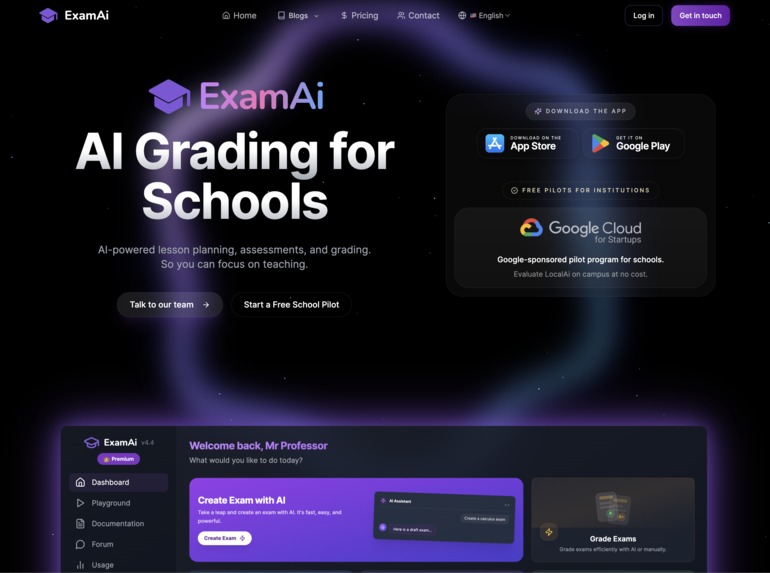
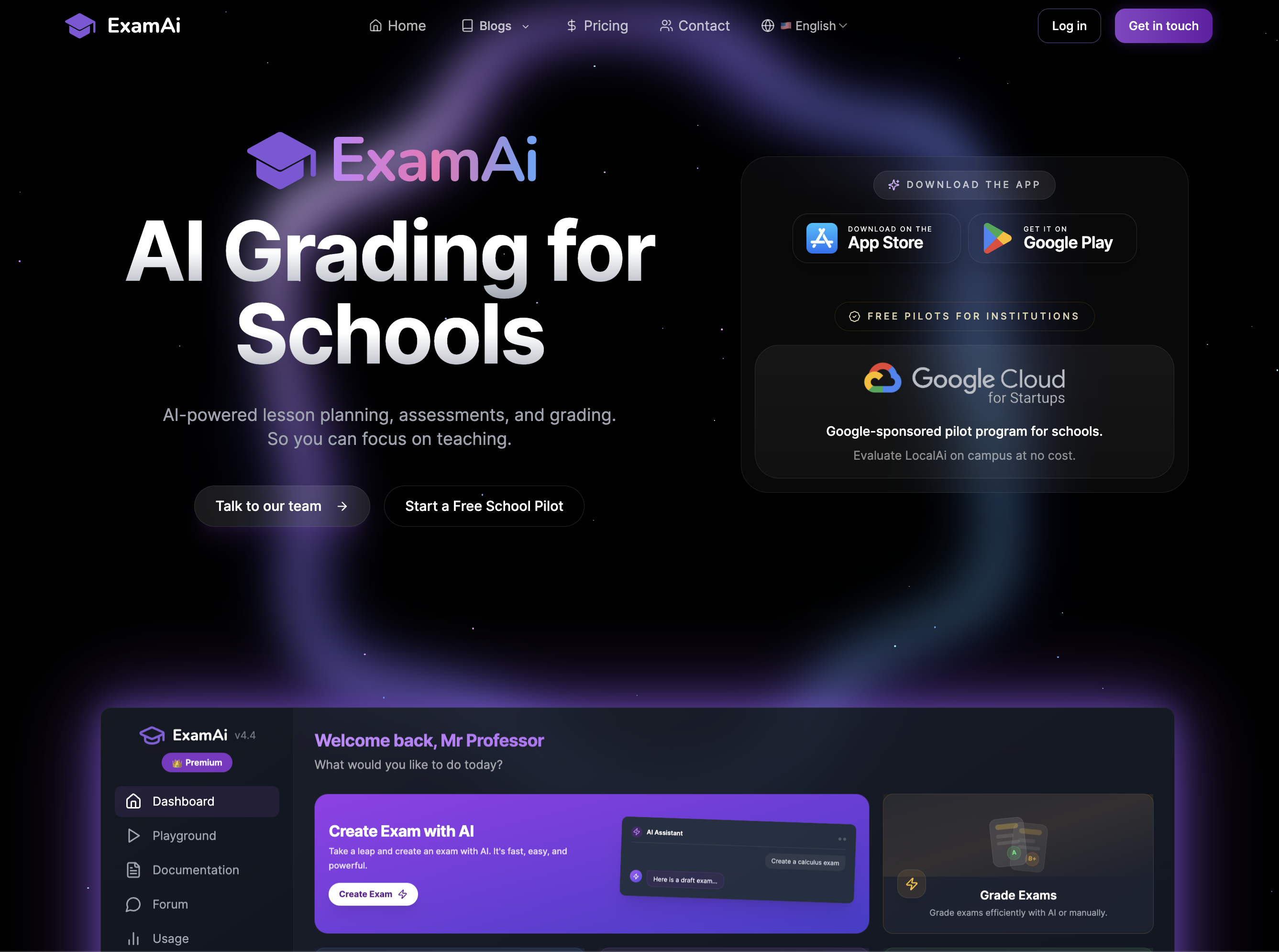
Ai Grading for Schools
Inspiration
I was a teaching assistant at UC Davis. A stack of handwritten exams took me a full weekend, and by the last twenty scripts I was not grading the way I had graded the first twenty.
Every professor knows this. The usual fix is multiple choice, which measures almost nothing worth measuring.
The decision
I built ExamAi for the wrong customer first. It was a consumer product. It grew from about 20,000 users in February to roughly 800,000, and became the second most used product on the Lovable discovery page.
Then I sat in Google I/O on May 19 and heard the terms of this prize. Real business. Real revenue. AI in production.
I went home and looked at our numbers honestly. Huge usage, almost no money, because the people who pay for assessment infrastructure are institutions and we were not selling to institutions at all.
So we shut down single user access. All 800,000 accounts, turned off on purpose, during our best growth month.
What we built in 90 days
The consumer product existed before this competition. I want to be direct about that. What did not exist before May 19 is the business we are submitting. In this window we rebuilt ExamAi as institutional infrastructure, moved our entire inference layer from OpenAI to Gemini, and sold it.
Turbo QR. We generate printable exams with a QR code on every page carrying the student, the question, and the exam (amongst lots of other data that tracks such paper). Institutions print and administer on paper exactly as they always have, with students providing handwritten answers with formulas, text, or even drawings. Then they bulk scan the stack in any order. ExamAi automatically reassembles every page to the right student and question even if the papers were in randomized order, thanks to the information in each QR code. One session handles over 12,000 pages.
Grading. One Gemini agent per question, running in parallel. Ten responses or ten thousand, grading finishes in about 14 seconds. Each agent reads handwriting, diagrams, worked calculations, and multiple choice off the same sheet, then returns a score and written feedback in the language the student wrote in.
The AI does not decide what is correct. Faculty write the rubric. The model applies it the same way to every script, which is the part humans or even any other AI cannot do at volume.
Degree Builder. A department describes a programme, and ExamAi generates the structure. Some institutions have already produced entire college degrees with over 80 courses, each with 30 lessons and matching assessments, in a single run.
Why Africa
This was a commercial decision. American universities are locked into five year contracts with incumbents, so the buying window is closed for most of the decade. In Nigeria, Equatorial Guinea and neighbouring markets, institutions are procuring right now, paper is still how exams happen, and enrollment is outgrowing faculty headcount.
Over 20 institutions signed pilots in this window, including the University of Nigeria Nsukka, the University of Abuja, and AUST Abuja. BANGE Business School in Equatorial Guinea skipped the pilot and paid upfront. Festo did the same in Mexico. Signed agreements are available for verification.
What the AI runs, and what we run
AI runs continuously in production. It scores every submission, reads every scanned page, writes every piece of student feedback, generates exams and lessons from uploaded course material, and analyses question difficulty across cohorts. No human sees a script before a grade is proposed.
Humans handle accountability. I own pricing, contracts and data terms. For this hackathon I partnered with an old colleague, Chidozie Nweze, who is now our Director of Partnerships for Africa and runs institutional conversations.
Inside the product, the AI grades and publishes end to end. Professors set the rubric once, and every result ships with the score, the reasoning, and the student feedback already written. They can review or override any grade, but nothing waits on them. Control stays with faculty; the work does not.
The clearest economic effect is faculty capacity. Departments constrained by grading throughput can teach more sections or raise enrollment without hiring in proportion. Chidozie's role did not exist ninety days ago.
What I learned
Usage is not a business. Eight hundred thousand free users told me the product worked and told me nothing about whether anyone would pay.
The real lesson came from procurement. Committees never asked how accurate the model was. They asked who is accountable when a grade is disputed. That question rebuilt the product, and it is why the rubric belongs to the professor.
Built With
- ai-agents
- computer-vision
- deno
- edge-functions
- edtech
- expo.io
- gemini
- gemini-api
- google-antigravity
- google-cloud
- ocr
- postgresql
- qr-code
- react
- react-native
- resend
- stripe
- supabase
- tailwindcss
- typescript
- vertex-ai
- vite


Log in or sign up for Devpost to join the conversation.