-
-
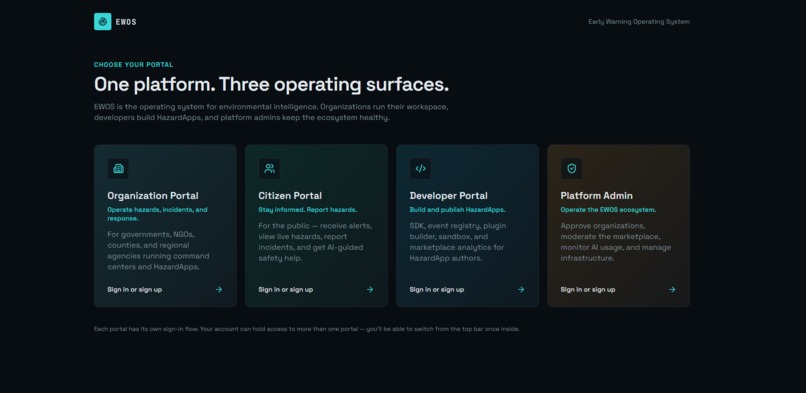
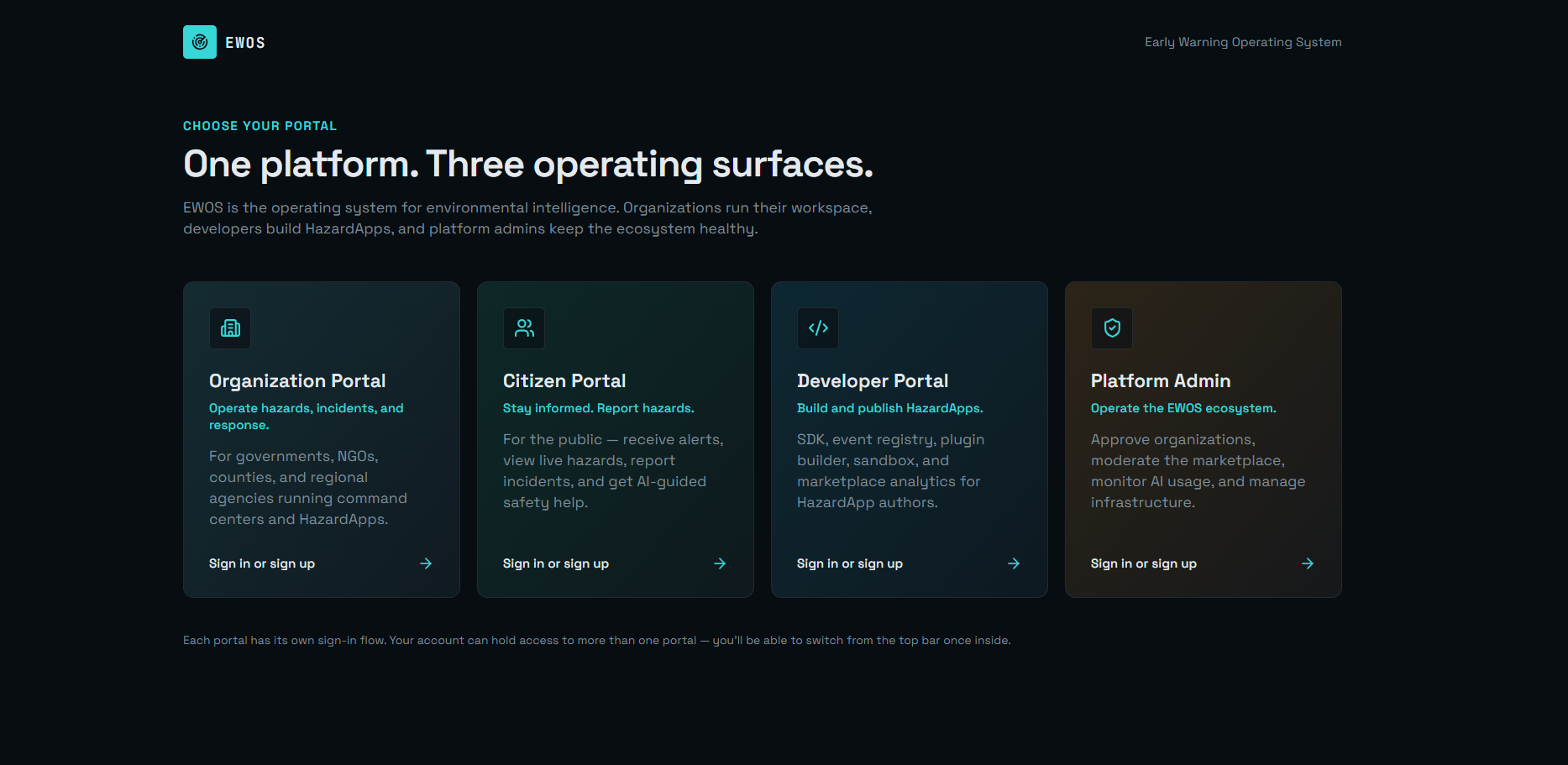
Login page
-
Inspiration
Environmental and disaster-management organizations have invested heavily in Early Warning Systems (EWS) for floods, droughts, wildfires, landslides, air quality, food security, climate forecasting, and other hazards.
The problem is not a lack of innovation.
The problem is fragmentation.
A disaster manager may need to move between multiple portals to understand one evolving situation: a hazard monitoring platform, a drought system, a weather portal, a threshold and triggers system, a community reporting platform, and separate communication tools.
We asked ourselves:
What if we didn't need another Early Warning System? What if we built the platform that connects the ones that already exist?
That question inspired EWOS - Early Warning Operating System.
Our thinking was influenced by how other industries solved similar fragmentation:
- Shopify unified commerce by creating a platform where businesses and third-party applications can operate together.
- ClickUp unified work by bringing multiple work-management capabilities into one workspace.
- M-Pesa unified digital services through Mini Apps, allowing different services to exist within one trusted platform.
EWOS applies the same platform philosophy to environmental intelligence.
One platform. Many warning systems. Connected intelligence.
What it does
EWOS turns disconnected Early Warning Systems into interoperable HazardApps.
Organizations can have one workspace where they discover, install, configure, and operate the environmental capabilities they need.
For example:
ICPAC Workspace
      │
      └── HUSIKA Command Center
             ├── Hazard Watch
             ├── Drought Watch
             ├── Climate Information
             ├── Thresholds & Triggers
             └── Community Reporting
Another organization could create:
County Disaster Workspace
      │
      └── Disaster Operations Center
             ├── Flood Monitoring
             ├── Wildfire Monitoring
             ├── Weather
             ├── Road Monitoring
             └── Citizen Reports
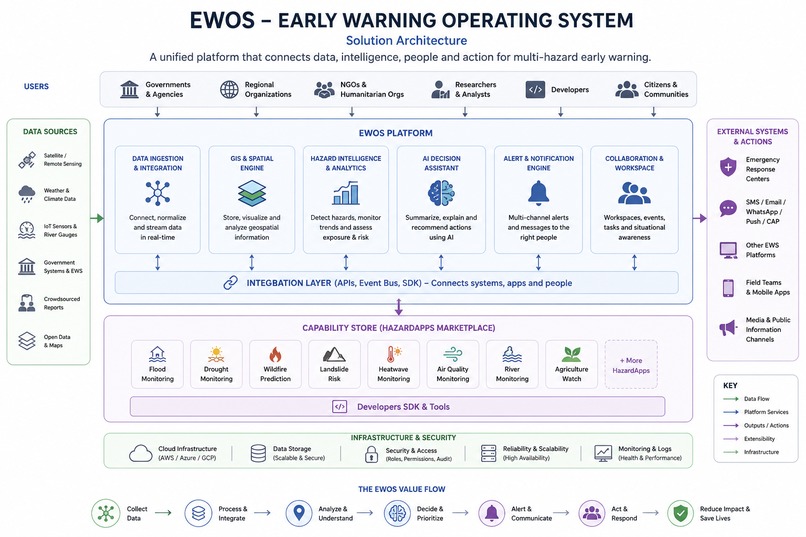
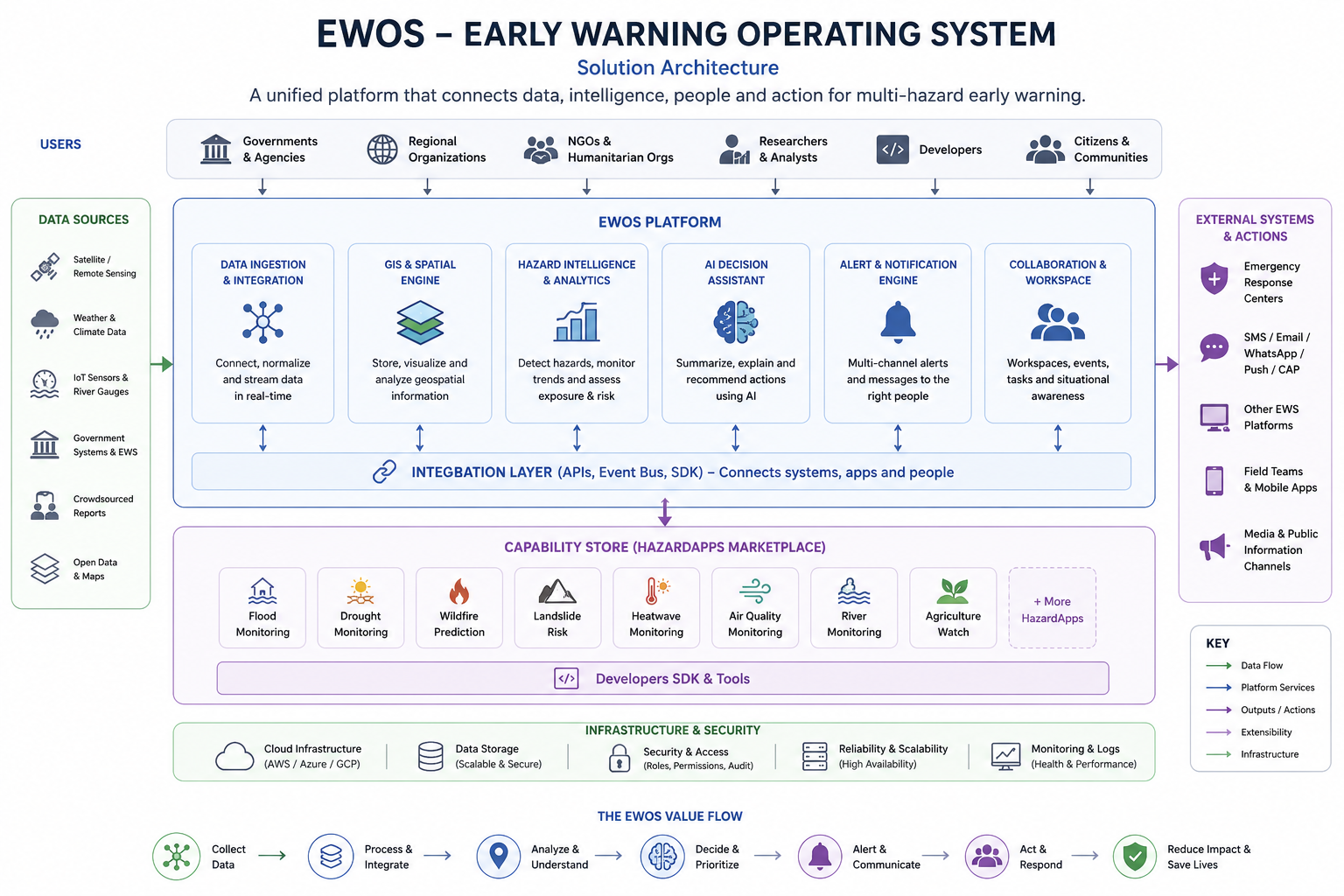
EWOS provides the shared infrastructure underneath these capabilities:
- GIS and mapping
- Authentication
- Organizations and user management
- Notifications
- AI assistance
- Data integration
- Event processing
- Search
- Reporting
- APIs
- Plugin infrastructure
A major part of our interoperability vision is URL-first integration.
Instead of forcing a user to understand the technical architecture behind every external system, EWOS should allow an organization to provide the URL of an existing warning service and begin the integration process from there.
For deeper integrations, developers can build HazardApps using the EWOS SDK and standardized APIs and events.
This creates two paths:
Bring what already exists.
Build what doesn't.
Most importantly, EWOS allows hazards to communicate.
For example:
Drought
   ↓
Vegetation Stress
   ↓
Wildfire Risk
   ↓
Air Quality Risk
   ↓
Health Impact
   ↓
Community Alert
Instead of every system operating as an island, EWOS creates an environment where environmental intelligence can move between capabilities.
How we built it
We approached EWOS as a platform, rather than as another single-purpose hazard application.
We designed four major experiences:
1. Organization Portal
The operational workspace where organizations manage their Command Centers, install HazardApps, monitor hazards, manage incidents, assets, users, notifications, maps, reports, and AI insights.
2. Developer Portal
The ecosystem for developers and researchers to create, test, publish, and maintain HazardApps.
Developers should not have to rebuild authentication, maps, notifications, user management, or other common infrastructure every time they create a warning system.
They focus on the environmental intelligence.
3. Citizen Portal
A simpler public experience for receiving relevant warnings, viewing nearby hazards, interacting with environmental information, and submitting community reports.
4. Platform Administration
The layer responsible for managing organizations, reviewing capabilities, monitoring the ecosystem, and maintaining platform-wide governance.
Underneath these experiences is a shared platform core consisting of the GIS engine, authentication, notification engine, AI assistant, search, and event-driven architecture.
We designed HazardApps as modular capabilities rather than tightly coupled applications.
This means a flood capability can exist independently while still communicating with drought, weather, wildfire, agriculture, infrastructure, or community-reporting capabilities.
Challenges we ran into
The biggest challenge was not building another dashboard.
It was designing a system that could connect systems we did not build ourselves.
Existing warning systems can have different:
- APIs
- data formats
- authentication mechanisms
- spatial references
- update frequencies
- alert structures
- technology stacks
- ownership models
We therefore had to think beyond simply displaying different maps on one screen.
The platform needs an interoperability layer that can translate external systems into a common EWOS environment.
Another challenge was deciding what belongs in the EWOS core and what should remain inside a HazardApp.
Our principle became:
EWOS provides the platform. Developers provide the intelligence.
This prevents every new environmental application from rebuilding the same infrastructure.
We also had to balance the ambition of building an ecosystem with the reality of a hackathon. We focused on demonstrating the platform architecture and the user experience rather than attempting to recreate every existing Early Warning System.
Accomplishments that we're proud of
We are proud that EWOS approaches the problem from a different angle.
Instead of asking:
"How can we build a better flood warning system?"
we asked:
"How can we make flood, drought, wildfire, climate, agriculture, and other warning systems work together?"
We designed a model where an organization can create its own environmental command center and choose the capabilities it needs.
We are also proud of the HazardApp concept.
A developer should be able to build one piece of environmental intelligence without rebuilding the entire software stack.
An organization should be able to install that capability without deploying another completely separate application.
And a citizen should ultimately experience the result as one coherent warning ecosystem.
The most important accomplishment is therefore not a single feature.
It is the architecture and product philosophy behind EWOS:
Don't replace the ecosystem. Connect it.
What we learned
We learned that interoperability is not simply about connecting APIs.
It is also about:
- User experience
- Common data structures
- Identity
- Permissions
- Geospatial standards
- Event architecture
- Notifications
- Governance
- Trust
- Developer experience
We also learned that the number of Early Warning Systems is not necessarily the problem.
The real problem is what happens when those systems cannot easily communicate with each other.
A drought warning can be more valuable when it informs wildfire risk.
A flood warning can be more valuable when it informs infrastructure and health preparedness.
A community report can become more valuable when it is combined with official hazard intelligence.
This led us to think of EWOS not as a collection of applications, but as an ecosystem for environmental intelligence.
What's next for EWOS
The hackathon prototype is only the beginning.
Our next step is to make EWOS genuinely interoperable with existing environmental systems.
We want organizations to be able to:
- Discover existing warning systems.
- Provide a system URL and begin an integration workflow.
- Connect APIs, feeds, datasets, or standards where available.
- Install ready-made HazardApps from the Capability Store.
- Create their own Command Centers.
- Connect multiple capabilities through the EWOS Event Bus.
- Use AI to reason across the resulting environmental intelligence.
For developers, the next step is the EWOS SDK, allowing researchers, universities, startups, governments, and open-source communities to build and publish their own HazardApps.
For citizens, we want to turn complex environmental intelligence into understandable, location-aware warnings, allow communities to contribute observations back into the ecosystem, and remove the hustle of mastering more than 5 hazard app URLs by giving them what they need at the right time on one screen.
Our long-term vision is simple:
Africa has already built valuable environmental intelligence. EWOS should make it easier to connect it, reuse it, and scale it.
We don't want to build the 61st disconnected Early Warning System.
We want to build the platform where the other 60 can work together.
Built With
- analysis
- analytics
- apis
- assessment
- automation
- climate
- cloud
- disaster
- early
- environmental
- geospatial
- gis
- integration
- monitoring
- observation
- predictive
- real-time
- remote
- resilience
- sensing
- spatial
- systems
- warning

Log in or sign up for Devpost to join the conversation.