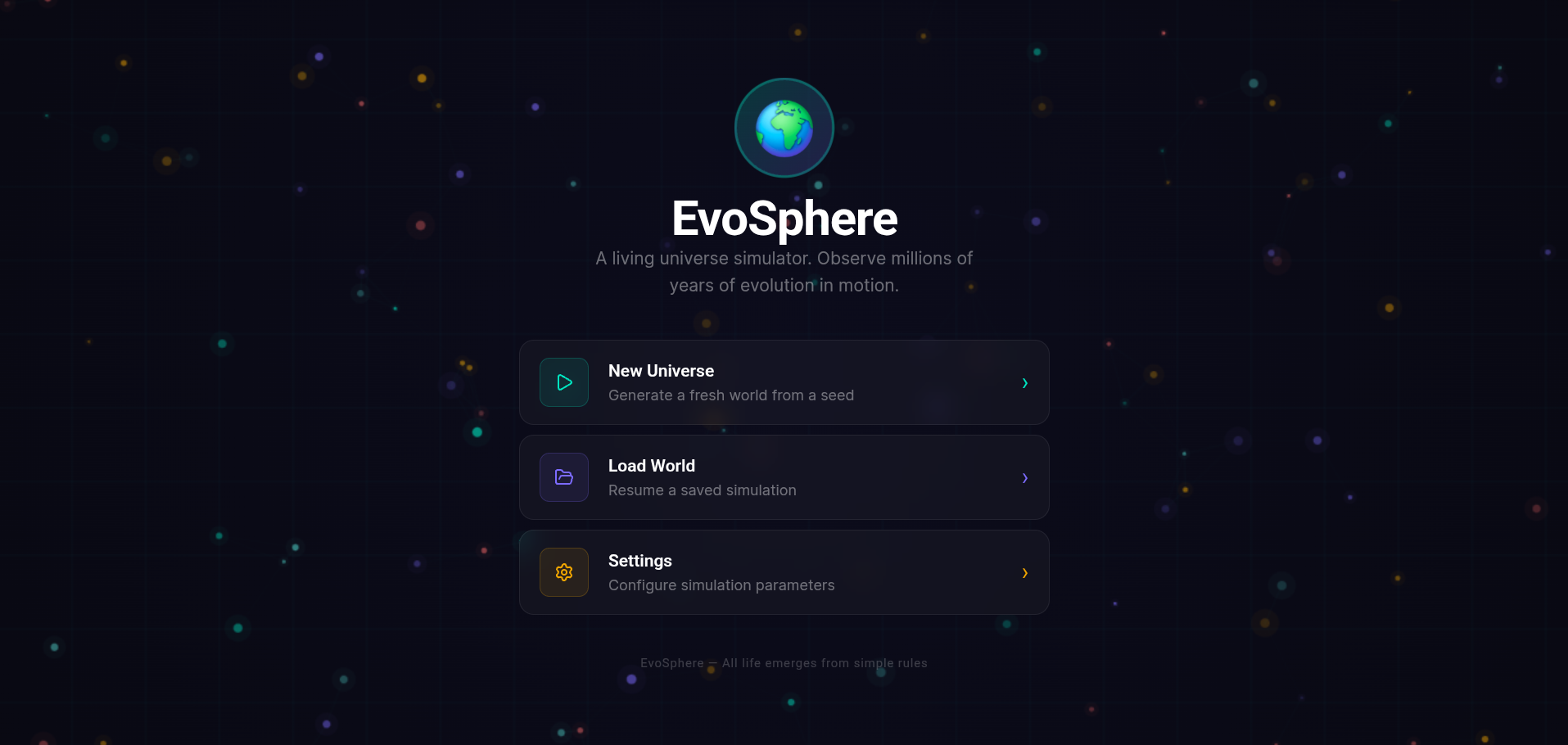


EvoSphere: A Living Universe Simulator & Evolution Sandbox
Inspiration
The inspiration for EvoSphere stems from a profound fascination with emergent systems, ecology, and the elegant complexity inherent in evolutionary biology. The project was conceived as a "living universe" sandbox—a digital terrarium where the user acts not as a direct participant, but as a geologic force observing the grand theater of life. The primary objective was to capture the resilience of biological systems, demonstrating how simple behavioral rules—such as foraging, mating, and evasion—can coalesce into the rise and fall of entire species across deep time.
What it does
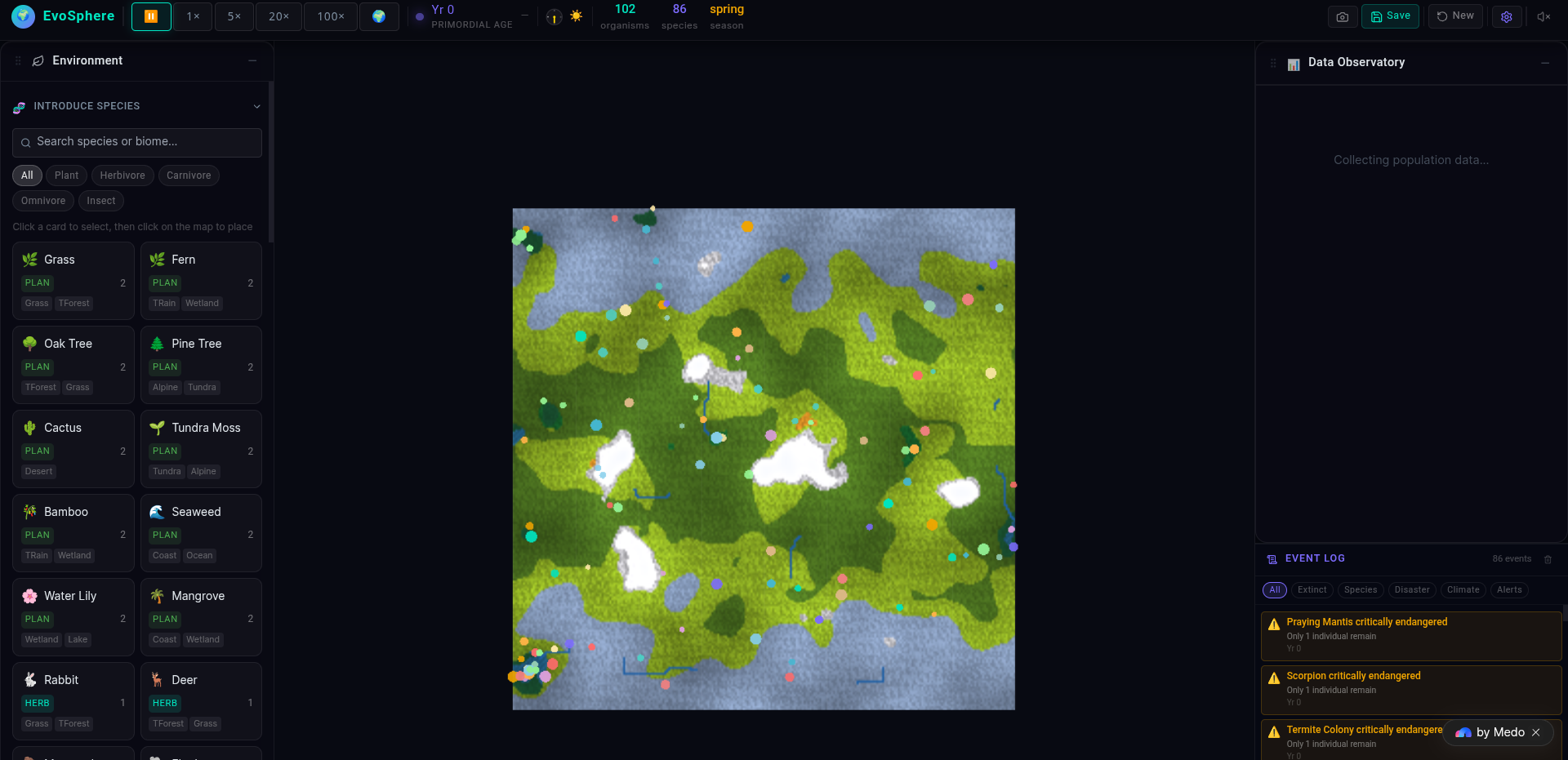
EvoSphere is a sophisticated browser-based evolution simulator that provides a dynamic environment for life to emerge, compete, and evolve. At its core, the application generates a unique 256×256 procedural planet governed by elevation, moisture, and temperature profiles. This world is populated by over 95 distinct species, each managed by a real-time AI engine that simulates complex ecological interactions including hunting, speciation, and extinction.
The simulation environment is characterized by its high degree of interactivity and data depth. Users can manipulate environmental variables, trigger catastrophic events, and monitor the health of the ecosystem through an integrated suite of visualization tools.
| Feature Category | Description |
|---|---|
| Procedural Generation | Seed-based world generation with 11 distinct biomes and realistic terrain features. |
| Evolution Engine | Real-time tracking of genetic drift, speciation events, and extinction cause attribution. |
| Climate Systems | Dynamic day/night cycles, climate shifts, and six unique natural disaster types. |
| Data Visualization | Live population charts, biomass trends, and detailed event logs for scientific analysis. |
How we built it
The technical architecture of EvoSphere was designed to handle high-concurrency simulation logic while maintaining a responsive user interface. The frontend is built on React 19 and TypeScript, providing a robust framework for managing complex application states. The core simulation engine operates on a tick-based loop, intentionally decoupled from the UI layer to ensure that heavy computational tasks do not degrade the user experience.
| Layer | Technology |
|---|---|
| Frontend Framework | React 19 + TypeScript |
| Canvas Rendering | PixiJS v8 (WebGL) |
| State Management | Zustand |
| Procedural Terrain | Simplex Noise + Custom Octave Synthesis |
| Persistence | IndexedDB (Autosave and Session Recovery) |
Challenges we ran into
The most significant technical hurdle was maintaining performance at scale. Rendering thousands of independent agents while simultaneously processing climate dynamics and AI state machines threatened to saturate the main thread. To address this, we implemented GPU-efficient batching within PixiJS, grouping organism entities by color to minimize draw calls and maximize throughput.
Furthermore, integrating a high-performance WebGL canvas with a modern React DOM required meticulous event management. We developed a typed EventBus to facilitate communication between the simulation engine and UI components. This architecture ensured that interactive elements, such as the Biome Legend and FPS counter, could exist as React overlays without triggering unnecessary re-renders that would otherwise disrupt the 60fps canvas performance.
Accomplishments that we're proud of
We are particularly proud of the visual and atmospheric depth achieved through our day/night tinting system and procedural audio ambience. These elements transform the simulation from a data exercise into an immersive experience. Additionally, the successful implementation of a speciation engine that accurately tracks evolutionary history and extinction causes provides a level of depth rarely seen in browser-based sandboxes. The modularity of the architecture—where disaster effects, disease dynamics, and climate shifts are synchronized yet decoupled—stands as a testament to our rigorous engineering standards.
What we learned
Throughout the development process, we gained significant insights into canvas-first UI integration. Managing the intersection of WebGL contexts and React components taught us valuable lessons in z-index layering and pointer-event propagation. We also discovered that high-quality, readable terrain can be generated using 2D canvas ImageData modulation and organic noise overlays, proving that visual depth does not always require expensive custom shaders. Finally, the project reinforced the importance of deterministic logic; replacing random modifiers with density skips in the hot render path was crucial for minimizing garbage collection pressure and maintaining long-term stability.
What's next for EvoSphere
The roadmap for EvoSphere focuses on expanding the complexity of the biological simulation and enhancing community engagement. We plan to introduce advanced genetics, allowing for detailed gene-trait mapping where players can observe the direct impact of metabolic and physical mutations. Furthermore, we aim to implement multi-planet simulation, enabling the transfer of life between different generated worlds. To foster a collaborative ecosystem, we will introduce social sharing features for "World Seeds" and "Species Templates," alongside continued optimizations for mobile browser performance to ensure accessibility across all devices.
Built With
- html
- indexeddb
- javascript
- lowcode
- medo.dev
- pixijs
- react
- typescript
- zustand

Log in or sign up for Devpost to join the conversation.