-
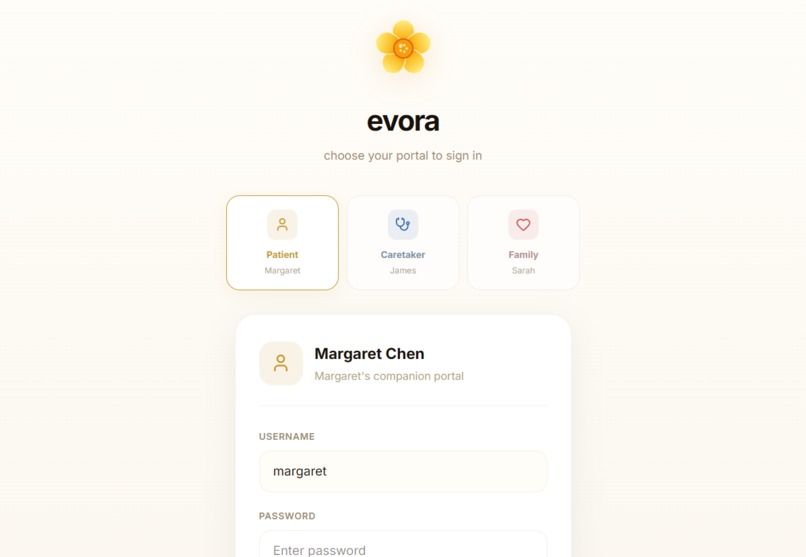
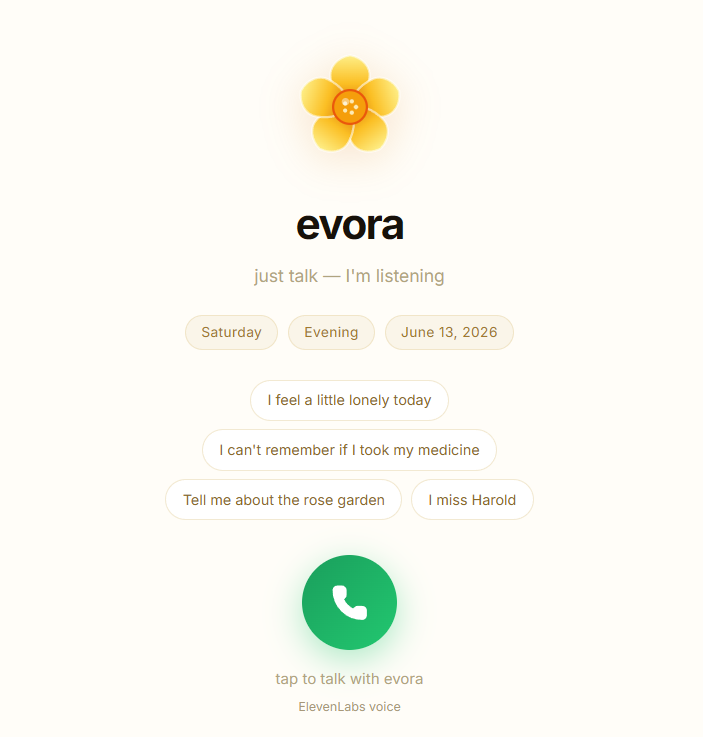
welcome screen
-
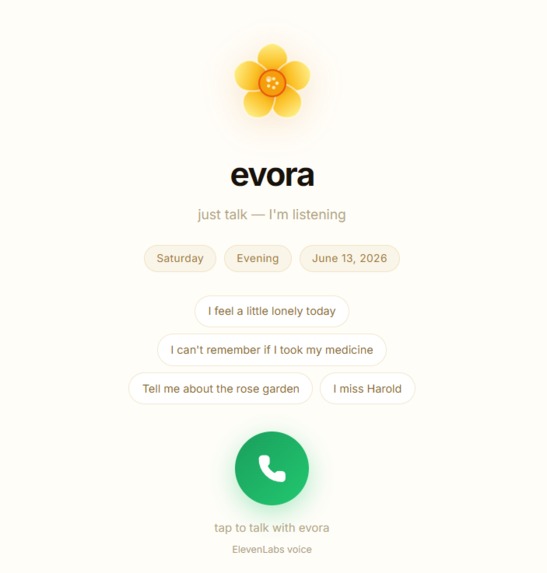
calling assistant
-
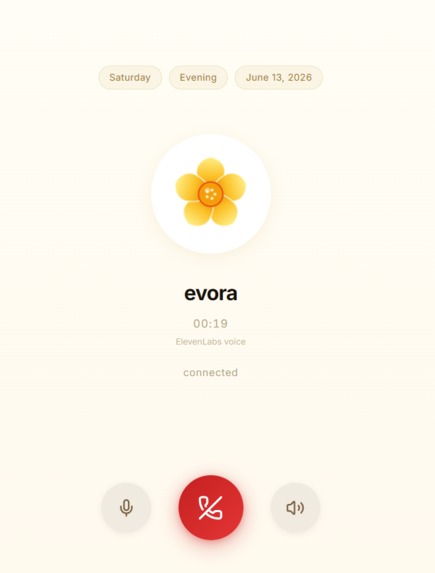
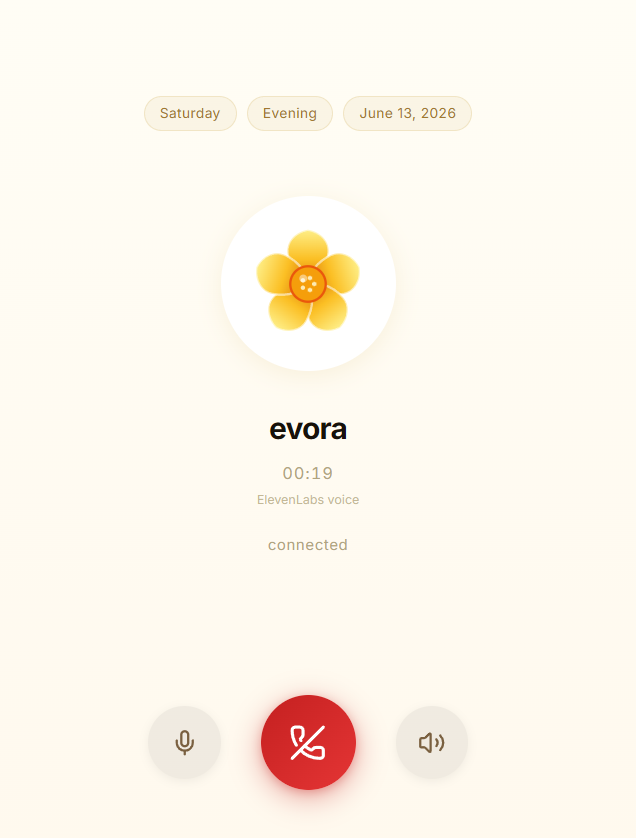
conversing with assistant
Inspiration
Dementia does not only take memories. It takes company, confidence, and calm at the exact hours when the world feels loudest and loneliest. We built Evora for people like Margaret Chen: someone who deserves to feel heard, not managed. Her daughter Sarah wants to stay close from afar. Her son James carries the weight of watching for decline without being in the room every hour. We asked a simple question: what if the gentlest technology in her life was not another screen or reminder app, but a voice that remembers how she likes to be spoken to, notices when she is looping or lonely, and quietly keeps her family in the loop? Evora is named for that idea. A steady companion on the phone and in the browser, warm enough for Margaret, useful enough for James, and open enough for Sarah to send love into the conversation.
What it does
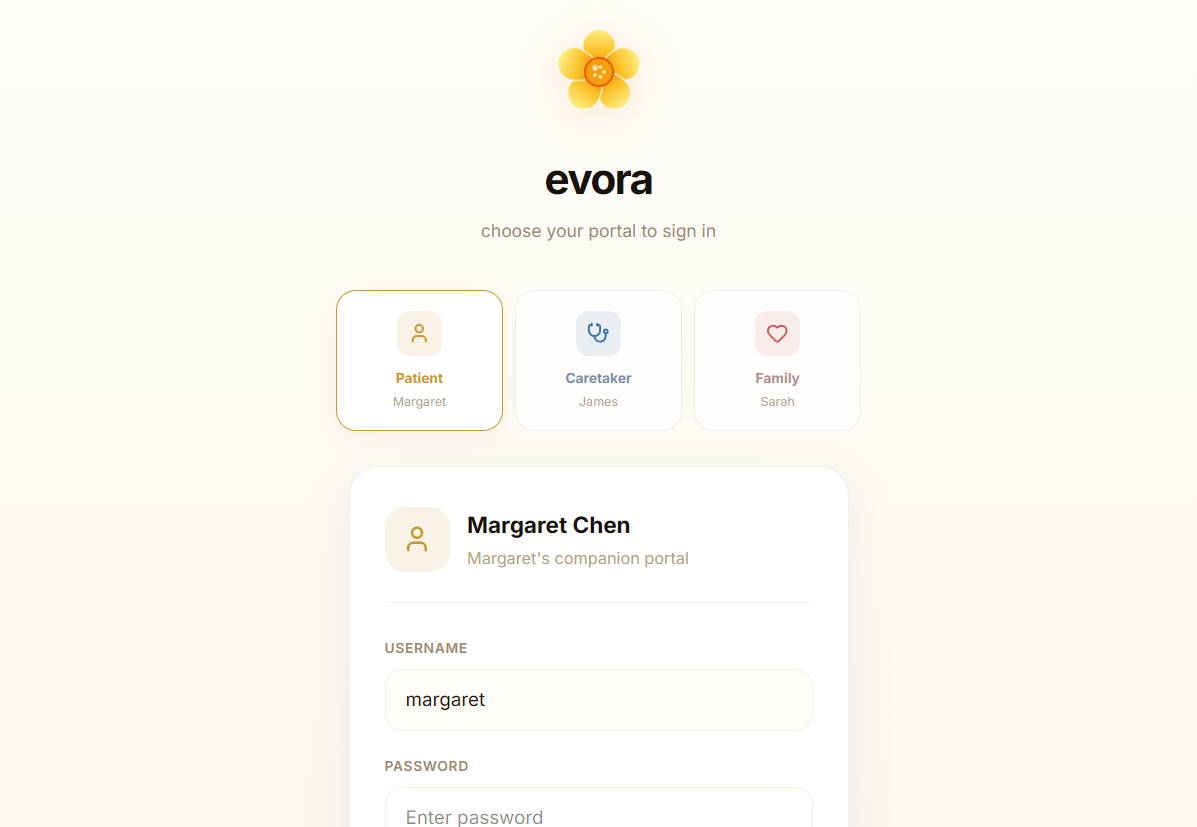
Evora is a dementia companion with three connected portals. Margaret, the patient, taps to talk with Evora in a voice first interface. She speaks naturally. Evora listens, responds with a warm conversational tone, and draws on memory anchors like the rose garden, Harold, and family messages. If distress or repetition rises, Evora can escalate to the caregiver dashboard without breaking the emotional safety of the call. James, the caretaker, gets a clinical oversight view: live conversation sync, emotional tone over time, topic memory map, loop detection, cognition reports, and the ability to trigger check in calls that brief him on Margaret’s day before opening a real two way phone conversation. Sarah, the family member, writes notes that Evora weaves into Margaret’s calls and chats, so distance does not have to mean silence. Beyond the app, Evora places outbound phone calls through Twilio. On check ins and demos, Margaret and James can actually talk back. Evora hears them, Grok generates a friend like reply, and ElevenLabs speaks it naturally. Scheduled morning, sundown, and evening calls support the windows when confusion and loneliness often peak.
How we built it
We built Evora as a Next.js application deployed on Vercel, with Grok from xAI powering live conversation, escalation summaries, and phone call replies. ElevenLabs Flash provides low latency, human sounding speech in the browser and on phone calls. Browser speech recognition and Grok STT handle patient input, with fallbacks when the mic or network misbehaves. Twilio handles outbound calling. Interactive calls use webhook driven TwiML: Evora speaks, gathers speech, calls Grok, synthesizes audio, and loops for several turns before a warm goodbye. Inngest runs background workflows for proactive check ins, session logging, and caregiver notifications on medium and high severity escalations. Supabase stores messages, family notes, and alerts so data survives restarts and syncs across portals. A demo auth layer separates patient, caretaker, and family experiences while sharing one live session for Margaret. We iterated heavily on voice UX: sage green listening states, turn based mic control, streaming replies with early TTS chunking, and prompts written for spoken English rather than chat text. The caretaker dashboard translates conversation into a memory map and emotional timeline caregivers can act on quickly.
Challenges we ran into
Phone calls were harder than the in app experience. Twilio needs a public HTTPS URL for two way conversation, and invalid SSML initially caused the dreaded “application error” message on answer. We simplified TwiML, sanitized speech text, and routed dynamic replies through ElevenLabs playback URLs on Vercel. Latency was another fight. Patients with dementia need pauses, but long gaps feel like abandonment. We tuned streaming so Evora starts speaking before the full reply is written, send speech to the model as soon as the browser finalizes a phrase, and throttle ElevenLabs prefetch to stay within concurrent request limits. Getting the tone right mattered as much as the stack. Early replies sounded like a nurse or a FAQ. We rewrote system prompts around reflection, short sentences, and family like warmth, and separated phone prompts for Margaret versus James so each call felt appropriate. Family notes and live sync exposed a classic hackathon gap: in memory state disappears on deploy. Moving messages, memories, and alerts into Supabase made Sarah’s messages real for Margaret, not just a demo illusion on one browser tab.
Accomplishments that we're proud of
We are proud that Evora feels like a companion, not a chatbot wearing a medical mask. Margaret can open the app, hear a natural voice, share something vulnerable, and get a response that validates before it questions. We are proud of the full loop from patient voice to caregiver insight. A lonely afternoon, a repeated question about medicine, or a mention of Harold becomes visible emotion, topic signal, and optional alert, without Margaret ever feeling surveilled. We are proud of two way phone calls where Evora does not hang up after a script. She greets, listens, answers with Grok, speaks with ElevenLabs, and keeps talking like a friend on the line. We are proud that Sarah has a place in the system. Family notes are not an afterthought. They are part of Evora’s voice.
What we learned
We learned that for dementia care, conversation design is clinical design. Loop detection, sundown aware scheduling, and escalation rules only help if the patient experience stays patient first. We learned that voice stacks are integration stacks. TTS, STT, telephony, streaming LLMs, and persistence each fail in different ways. Graceful fallbacks are not optional. We learned that caregivers need compression, not more data. A memory map update on a phone call, an emotional timeline, and a short cognition report beat a raw transcript when someone is tired and worried. We learned that the best demos are multi portal. When Sarah sends a note, James sees the session shift, and Margaret hears it from Evora, the product tells its own story.
What's next for Evora: A Gentle Voice for Fading Memories
Next, we want real authentication and per household isolation in Supabase, with row level security so each family’s data stays private. We want deeper personalization: voice clones or consistent family timbre for reminders, medication routines tied to gentle confirmation flows, and richer reminiscence triggered by photos or music Sarah uploads. We want smarter escalation that learns James’s preferences for call versus text, and integrates with EHR or care team workflows where appropriate.
We want to measure what matters: time to calm after sundown, reduction in repetitive distress loops, caregiver hours saved, and moments of genuine connection Margaret initiates herself.
Evora started as a hackathon answer to loneliness and fading memory. We want it to become infrastructure for dignity: a gentle voice that stays on the line when memories fade, and keeps love within reach.
Built With
- cursor
- grok
- node.js
- supabase
- typescript
- vercel
- xai

Log in or sign up for Devpost to join the conversation.