-
-
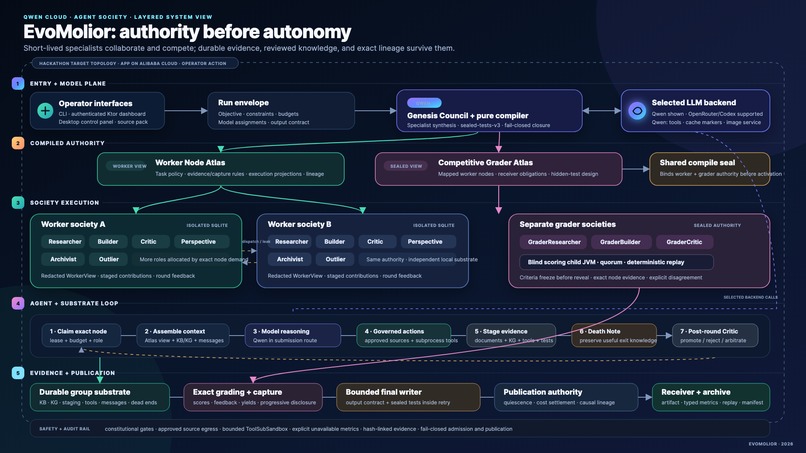
Architecture overview
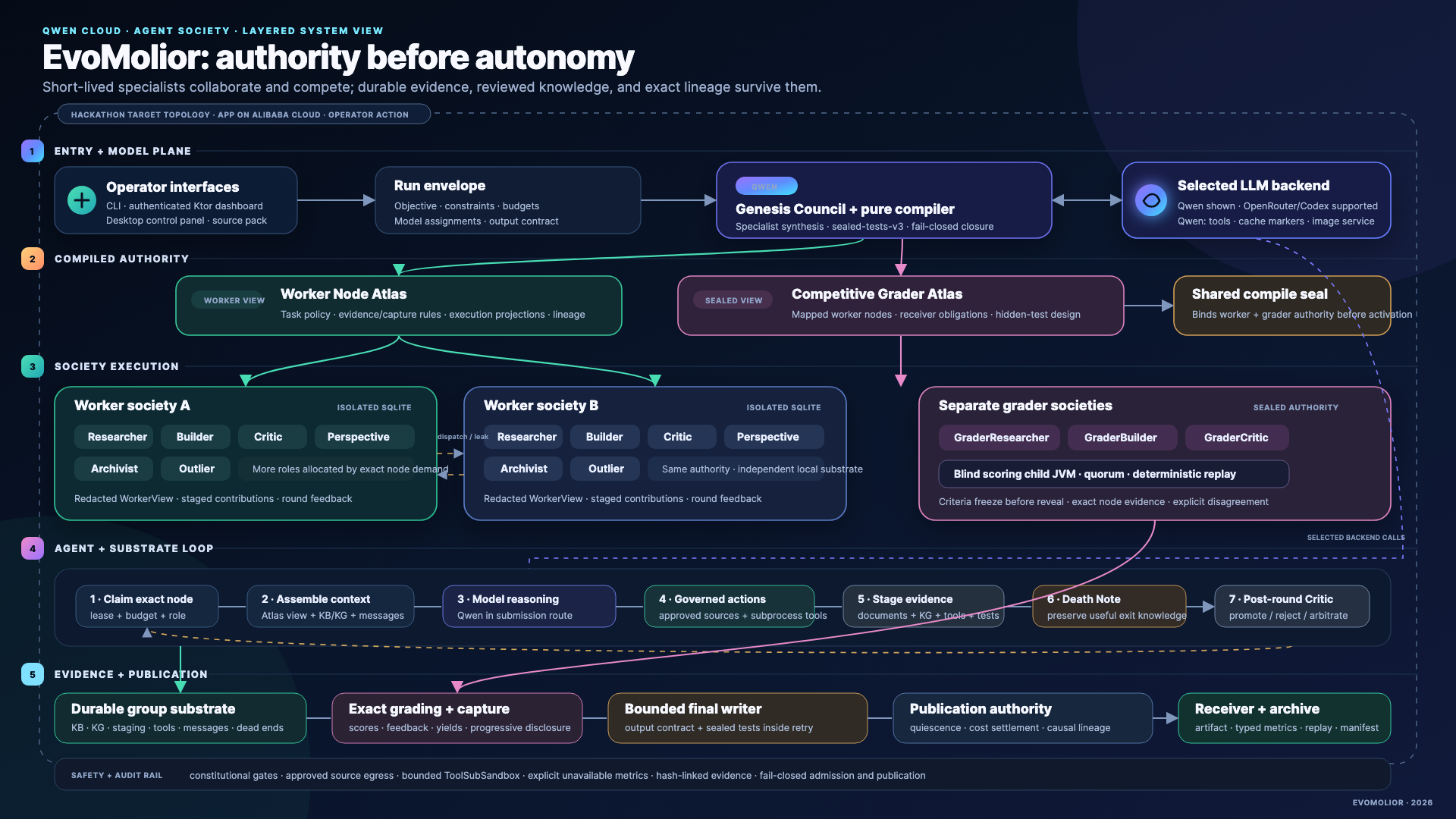
Track
Agent Society
Short Description
EvoMolior is a Qwen Cloud-powered multi-agent runtime for evidence-heavy work. A Genesis Council decomposes an objective into a sealed Node Atlas; competing groups of short-lived specialist agents research, build, critique, and preserve knowledge in isolated persistent substrates. Separate grader societies evaluate exact node evidence, progressive disclosure controls what each group learns next, and a hash-linked publication pipeline produces an inspectable receiver artifact and replayable archive.
What, Who, And How
What
EvoMolior turns a difficult objective and source pack into a structured, evidence-grounded deliverable. It delivers not only the final answer/report, but also reviewed knowledge, rejected work, dead ends, tool executions, scores, provenance, and explicit unavailable metrics.
Who
It is designed for research, policy, technical strategy, diligence, and other teams where an answer must be inspectable.
How
- A Genesis Council converts the objective into typed roles, tests, disclosure stages, and a sealed Worker Node Atlas plus a separate Grader Atlas.
- Multiple isolated societies receive redacted views and assign nodes to specialised agents such as Researchers, Builders, Critics, Archivists, Outliers, and Perspective Takers.
- Agent contributions enter staging. Critic authority promotes, rejects, or arbitrates KB, KG, tool, and deliverable work.
- Grader societies freeze criteria before reveal, evaluate exact evidence bundles, and feed node-level results into capture, rewards, and the next round.
- Progressive disclosure reveals only authorized information. Outliers can propose shadow nodes, and promoted tools or simulations can influence later evidence.
- Final synthesis must satisfy the publication contract and sealed tests before EvoMolior emits a receiver artifact, run metrics, replay, and a hash-verifiable archive.
Inspiration
Most agent systems concentrate capability in one long-lived context window. When that agent exits, its reasoning, mistakes, and useful intermediate work are difficult to recover. Most agent workflows are either linear or agent graphs with task splitting.
EvoMolior starts from the opposite premise: the agent is disposable; the substrate is not. Collective intelligence should live in a reviewed state: knowledge, evidence, tools, tests, lineage, and dead ends, rather than in the memory of one model invocation.
What It Does Differently
- Persistent civilization, mortal agents: useful work survives individual agent termination.
- Competition with controlled cooperation: groups work independently while dispatch and progressive-disclosure authorities control cross-group information flow.
- Separate grader societies: grading has its own sealed Atlas, private criteria, exact bundle cardinality, and isolated scoring process.
- Node-level accountability: evidence, cost, grades, capture, downstream reuse, and final publication are linked to exact task nodes.
- Fail-closed execution: malformed Council output, non-executable tests, missing grader quorum, unsettled cost reservations, publication failures, and manifest drift stop the run instead of becoming hidden success.
- Honest comparison: the benchmark harness records wins, ties, failures, latency, and unavailable cost values instead of treating more agents or more artifacts as automatic improvement.
How We Use Qwen Cloud
Qwen Cloud is a first-class runtime backend, not a hidden proxy:
- direct DashScope/OpenAI-compatible chat-completions integration through JetBrains Koog;
- supported Qwen Cloud model IDs include
qwen3.7-plusandqwen3.6-flash; - native function/tool calling with mandatory tool choice for tool-enabled agent turns;
- structured JSON output transport and schema-aware decoding;
- explicit ephemeral cache markers on long repeated system/user context;
- response token metadata captured into runtime observability;
- optional final-deliverable image generation with
qwen-image-2.0-pro; - maintained direct single-Qwen benchmark baselines for comparison with society runs.
Some configurations can also route deepseek-v4-flash through Qwen Cloud. The system should work best with diverse model families or models with variable weights(but that part would take a lot more time and budget to implement and measure).
Significant Updates During The Contest Period
Between May 26 and July 20, 2026, the project was substantially expanded and hardened:
- added the direct Qwen Cloud backend, Qwen-native model routing, tool-call compatibility, explicit cache markers, usage telemetry, and optional Qwen image generation;
- built the runnable CLI, benchmark harness, Docker image, authenticated remote dashboard, and persistent run archive;
- introduced the authoritative versioned Node Atlas and separate competitive Grader Atlas;
- added redacted worker views, exact leases, mortality records, contribution commits, and useful-exit telemetry;
- connected exact node evidence, blind grading, capture, delayed yields, progressive disclosure, Outlier shadow nodes, Atlas amendments, tool promotion, simulation records, and later-agent reuse;
- added causal contribution/cost/publication lineage, deterministic score replay, run manifests, and a privacy-preserving observability catalog;
- replaced arbitrary executable-test JSON with typed
sealed-tests-v3, a pure compiler, exact historical regressions, and pre-activation executability checks; - added acceptance profiles, immutable runnable distributions, an exclusive acceptance lock, admission control, startup rejection artifacts, source/binary drift checks, and typed Section 18.2 metric export;
- moved complete final-output validation inside the bounded writer retry loop so publication fails closed without wasting available correction attempts.
Before the hackathons start, this was barely a project skeleton without any meaningful outputs.
Challenges
The hardest part was defining authority.
I had to make exact decisions about which state is canonical, what workers are allowed to see, when grader criteria freeze, how a test definition becomes one deterministic execution plan, how tool use influences later evidence, and what must be true before a run may call itself complete.
Provider behavior added another layer: tool calls, structured output, thinking mode, long contexts, and retries do not compose reliably unless the runtime treats them as explicit contracts. Several failed acceptance runs became permanent negative evidence and drove typed, fail-closed fixes rather than looser parsing.
Each complex run produces a ton of logs while taking a while to finish, and grounded fixes/improvements in the final stage were tied to real run outputs.
Accomplishments
- A real multi-group society with specialised mortal agents and durable substrate state.
- Competitive worker and grader Atlases with progressive disclosure and exact evidence authority.
- Role-gated tools, bounded subprocess execution, source approval, and constitutional interception.
- Replayable result bundles with final-output lineage, score replay, typed metrics, and manifest verification.
- A Qwen Cloud backend with tool-enabled execution, structured output, context cache markers, token metadata, and image generation.
- Narrow Qwen Cloud benchmark wins reported alongside ties and large latency penalties.
- A Dockerized authenticated dashboard ready for Alibaba Cloud hosting.
Benchmark Evidence
The strongest defensible Qwen Cloud result is deliberately narrow:
- On FRAMES questions 19–21, the EvoMolior society scored 2/3 strict exact versus 1/3 for a
direct
qwen3.7-plussingle-agent baseline. Both had evidence-path coverage1.0. - On hard FRAMES question 537, EvoMolior scored 1/1 versus 0/1 for the direct Qwen baseline.
These samples are small and the society was materially slower. On MetaSyn task-24 and task-419 candidate subsets, the society tied direct Qwen baselines on objective metrics. Provider-cost telemetry is unavailable in those retained reports. We therefore claim auditable orchestration, artifact structure, and narrow demonstrated gains, not broad superiority.
I had quite a limited budget(also including the time) to run this on a bigger subset of benchmarks, so it stays thin for now.
What We Learned
- More agents do not guarantee a better answer. It highly depends on the specific task and the correctness of compounding mechanics.
- The useful unit of work is an evidence-bearing task node, not a model message.
- A failed or unavailable result can be valid evidence when represented explicitly.
- Grading must be isolated and frozen before evidence reveal.
- Structured output needs a typed compiler/evaluator ABI; “valid JSON” is not enough.
- Trustworthy agent systems need negative evidence, exact replay, and an honest unavailable state.
What's Next
- Try basing running on the fast open-source model and implement proper weight adjustments(try utilising LoRA selection, runtime adapter loading, and resolver plugins)
- Run the deferred matched iterative-single-agent comparison on the accepted exact task authority.
- Expand comparisons across larger benchmark samples.
- Add optional cumulative run-credit ceilings and mandatory claim ledgers for evidence-heavy profiles.
- Qualify additional grader model families while retaining explicit independence labels.
- Continue improving operator experience.
Current Limitations
- Small benchmark wins do not establish broad agent-society superiority.
- Research-synthesis comparisons currently tie direct Qwen baselines and take much longer.
- Normal agents run in-process for now; Shuru microVM execution is an optional alternate branch which is abandoned for now to speed up the dev iterations. Generated tools do execute in bounded subprocesses.
- Publication contracts validate shape, provenance, and sealed tests; they do not explicitly guarantee factual truth.
- Cross-task learning is explicit through continuation routing, not automatic across every run.


Log in or sign up for Devpost to join the conversation.