-
-
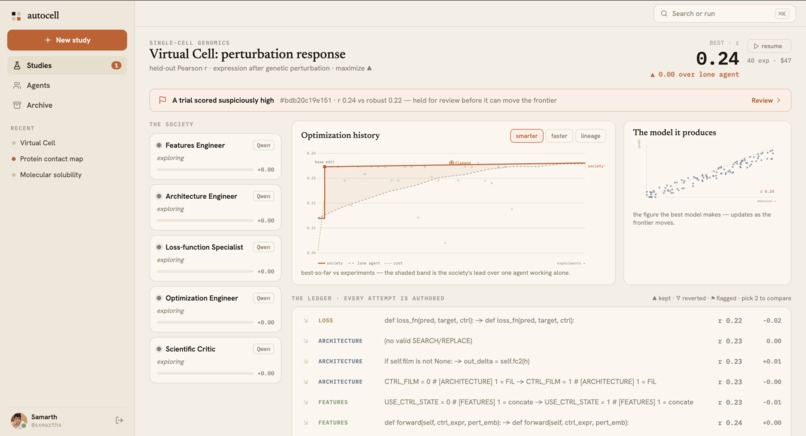
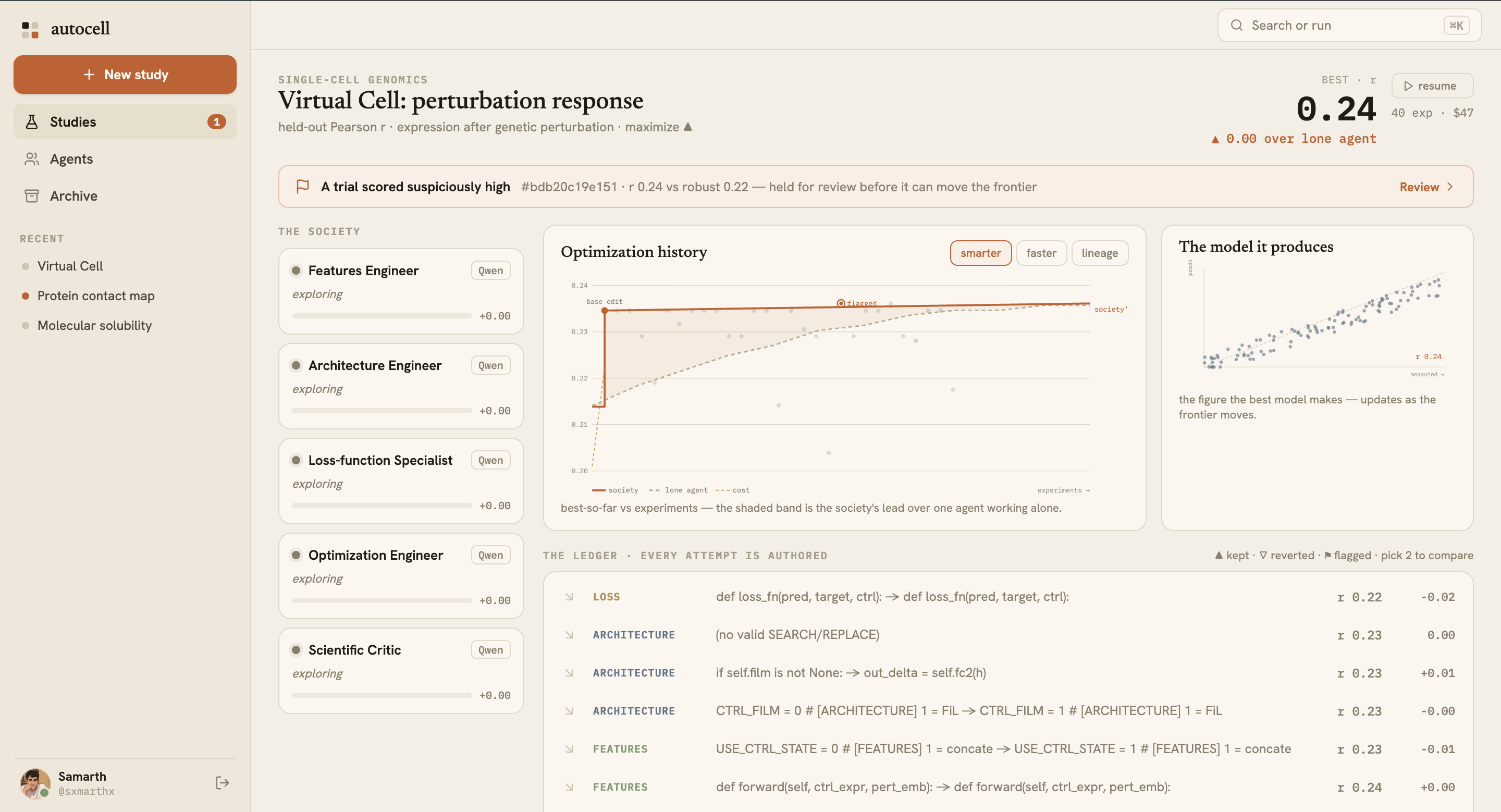
Live run
-
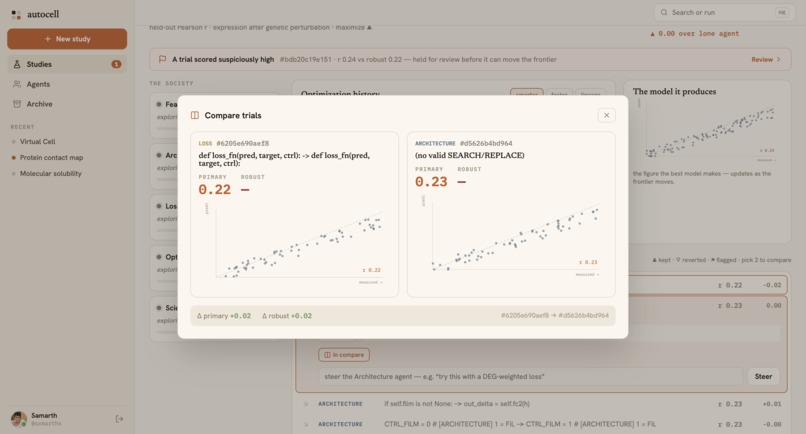
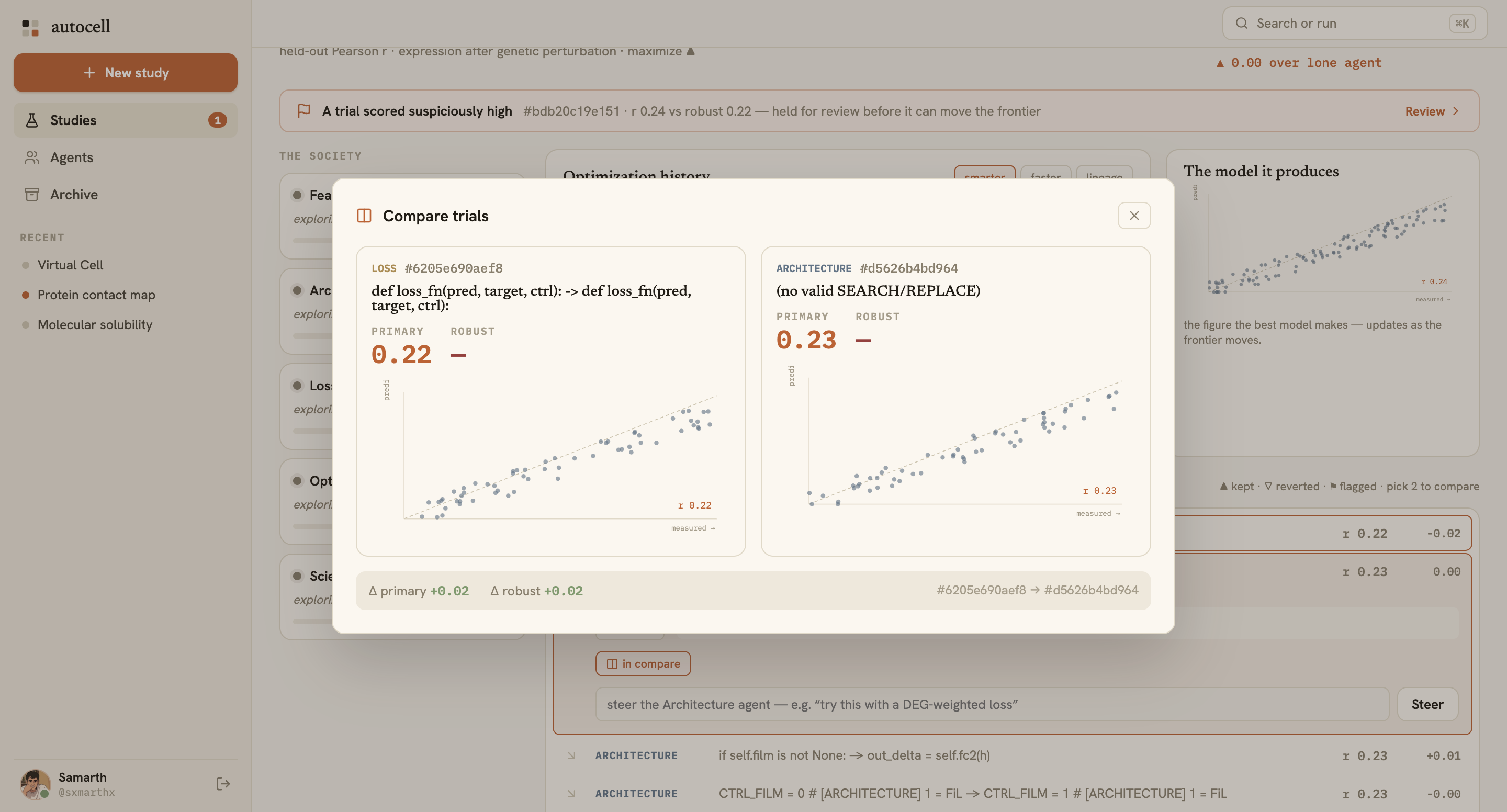
Compare, and steer
-
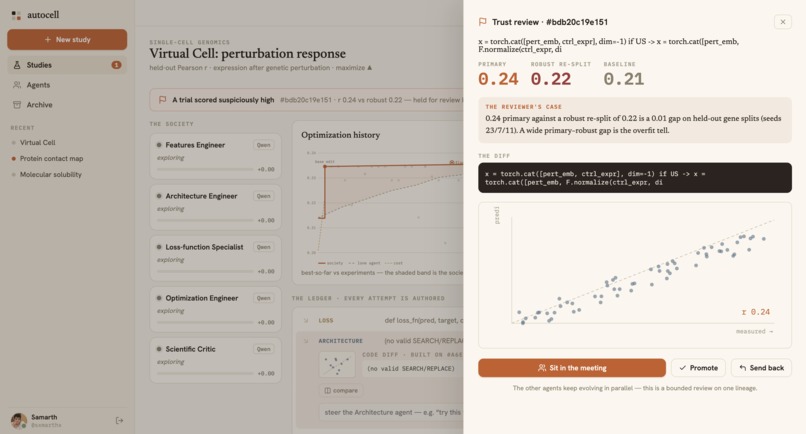
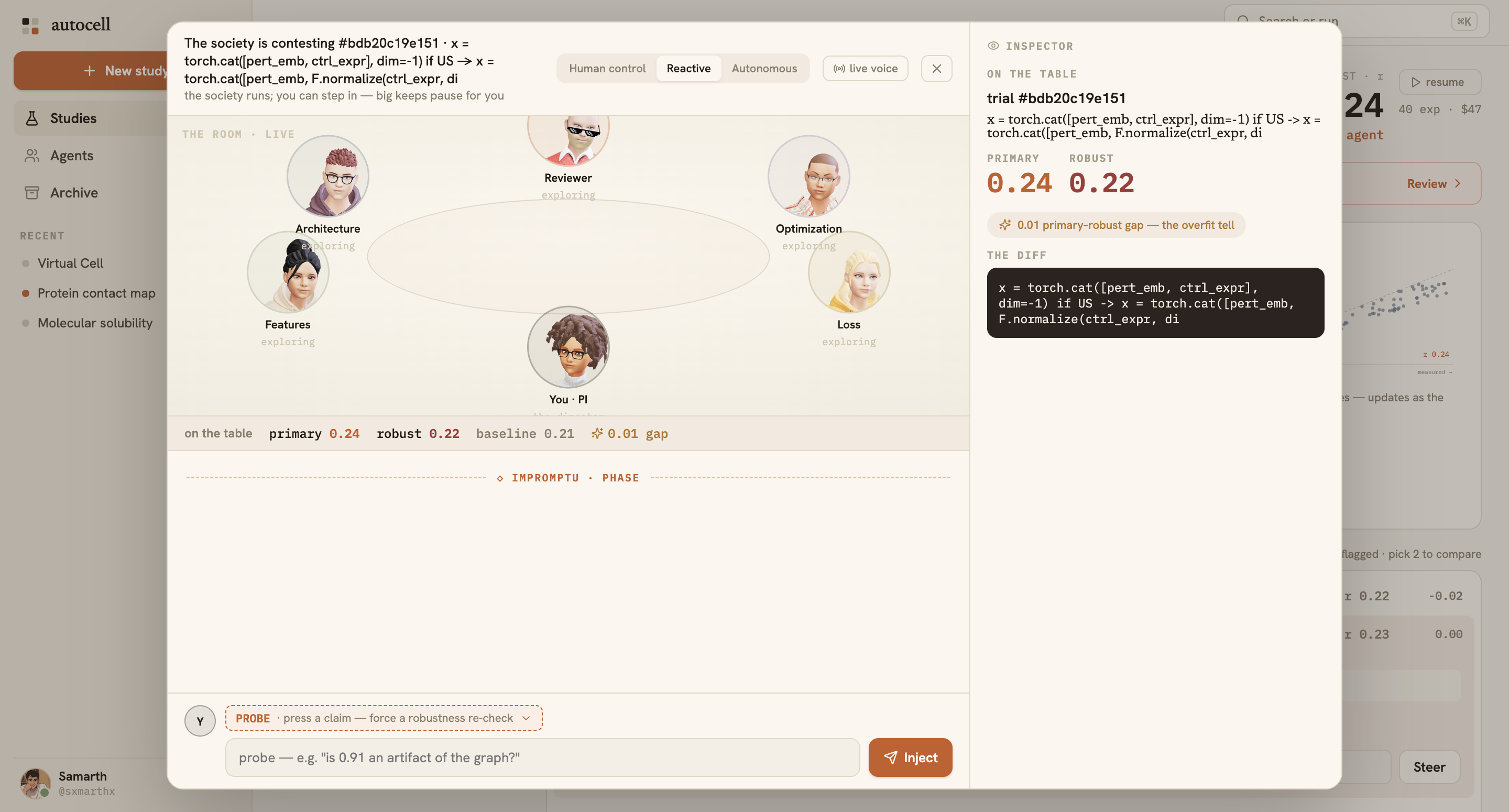
Sit in the meeting!
-
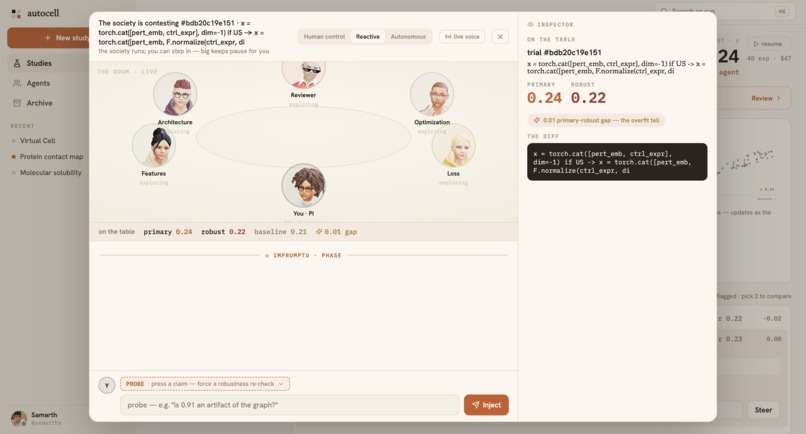
Interact with them with voice
Inspiration
Agent-based modelling goes back to Schelling’s segregation model from the 1970s; Schelling, a social scientist, who won the Nobel Prize. From there on, we have progressed a lot to solve hard sciences with it, like designing SARS-CoV-2 antibodies during COVID-19.
I wanted an Agent Society that solve hard problems, and most important thing I found is the modelling of Virtual Cell. Inspired, in general, from Cellular automaton theory by John von Neumann, I named it AutoCell.
What it does
AutoCell orchestrates agent society towards a single goal so they can collaborate to unlock parallelism, and then these agents have meeting as different scientists and engineers would do in a lab, making the system's process and results more interpretable.
There had been notably many work done around this (AlphaEvolve, Autoresearch), but this is first of its kind where agents evolve and run meetings. More importantly, it demonstrates training foundation models of cellular state and function(Virtual Cell) by an Agent society to its true essence.
How we built it
AutoCell runs several agents at once, all improving the same model.
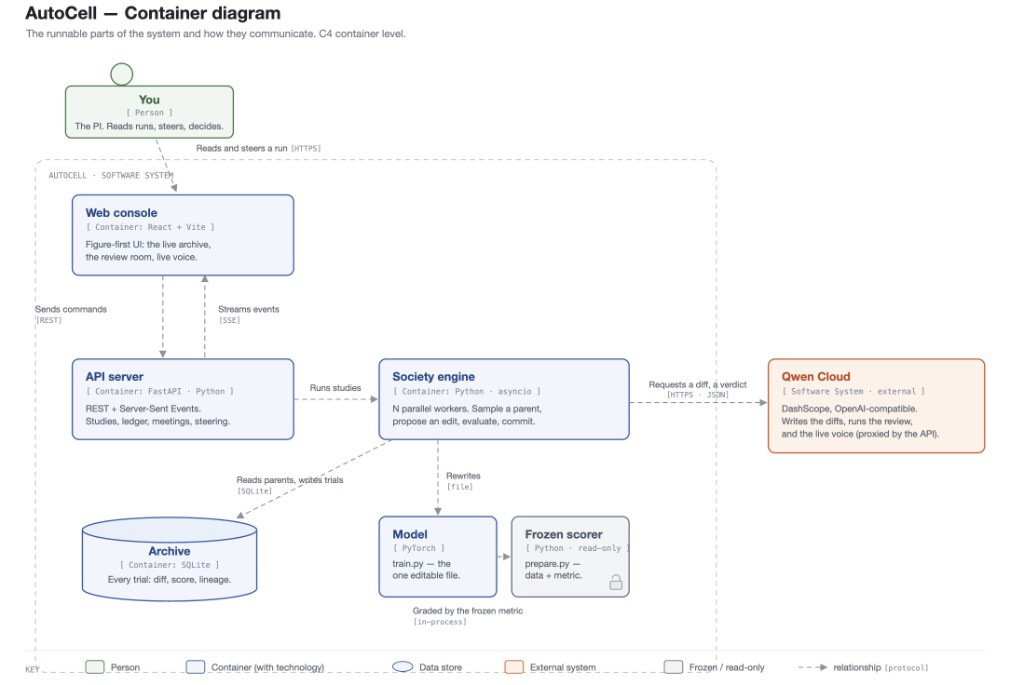
Each agent:
- picks a model from a shared archive,
- changes one part of it,
- trains and scores the result,
- writes it back to the archive.
The agents never message each other. The archive is their shared memory, so a later agent builds on what an earlier one found.
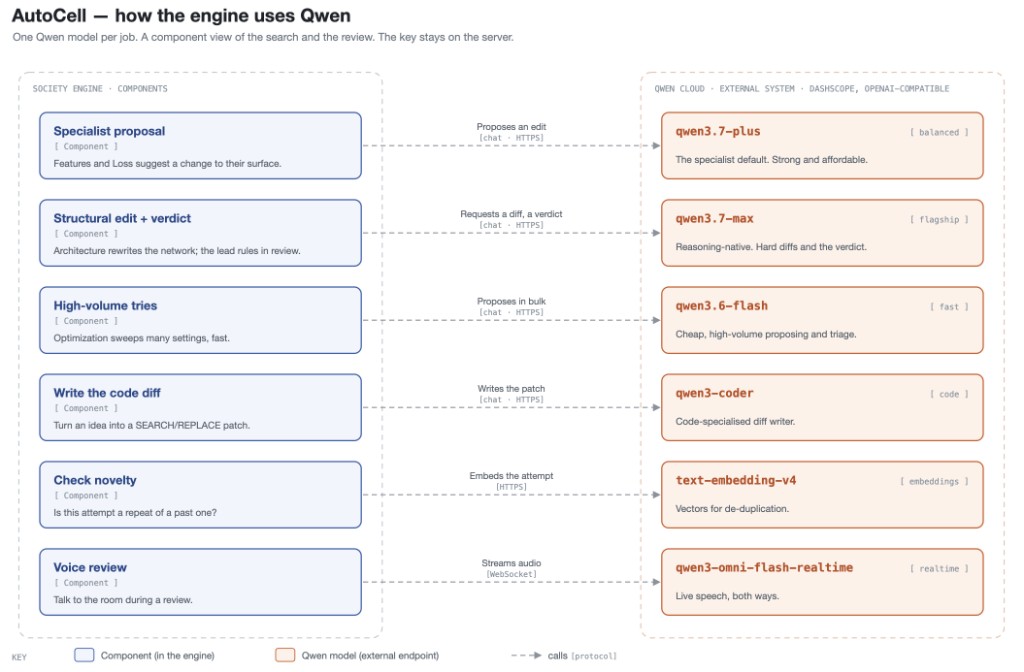
Each role runs on a different Qwen model, matched to the work.
Agents can edit only the model file: its features, architecture, loss, and optimization. The data and the scoring metric stay out of reach, so the only way to score higher is to build a better model.
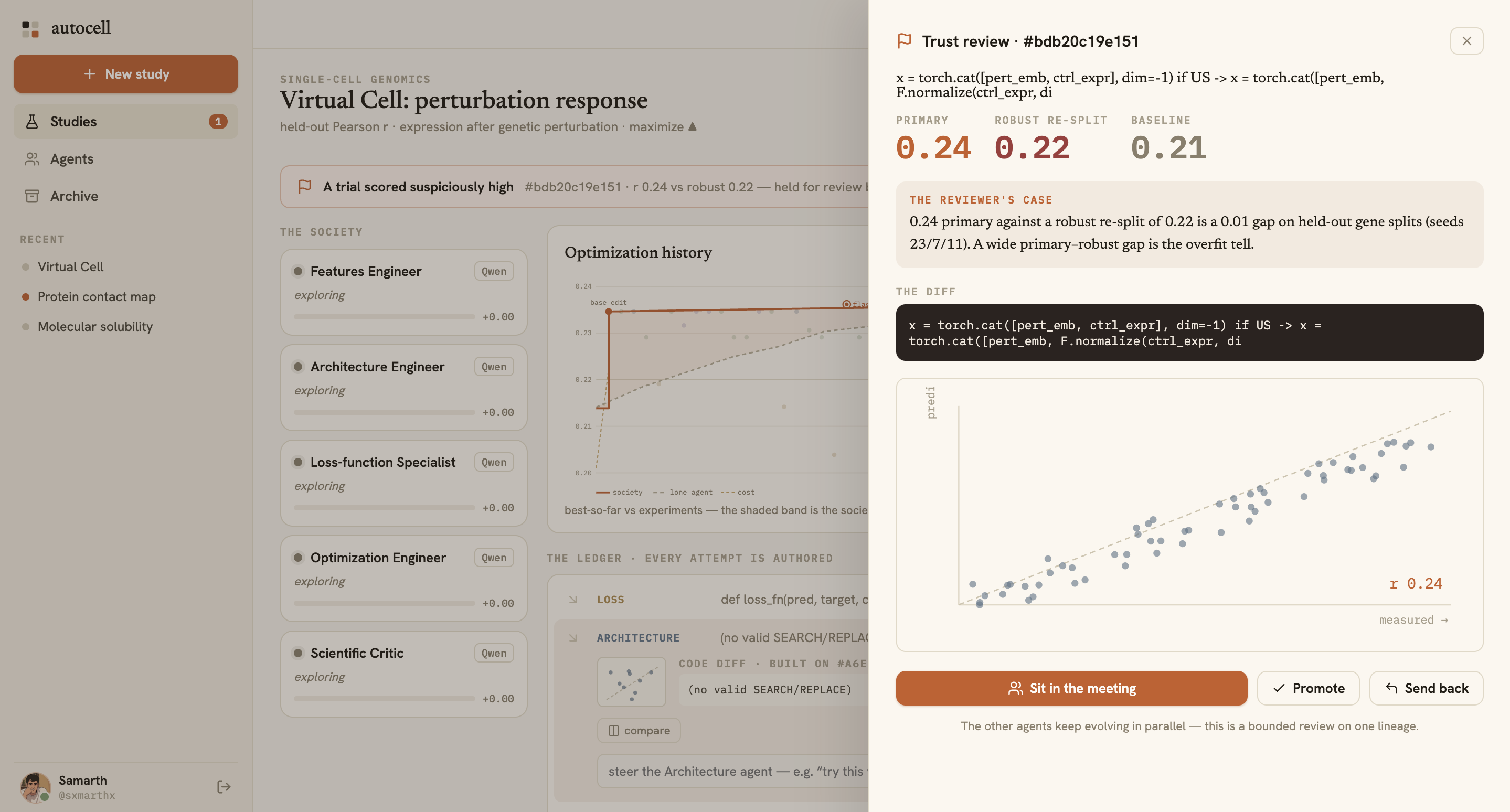
When a result looks too strong, AutoCell holds a review. One agent defends the change, another re-tests it on different data, and a third decides.
A web console lets you follow the experiments, inspect a change, watch the debate, and keep or drop the result. The review can also run aloud, over Qwen's real-time voice model.
Challenges we ran into
Proving the society is better. On easy problems a single agent keeps up. We ran both at the same budget and compared them on unseen data, where the gap shows.
Preventing cheating. An agent that can reach the scorer will edit the test instead of the model. We isolated the data, the metric, and the evaluation code, and left only the model editable.
Making parallel work readable. Many agents produce results fast. Coordinating their writes to one database, and turning the event stream into something a person can follow, was the hardest part.
Accomplishments that we're proud of
- The agents do not only search; they review and explain what they found.
- At the same budget, the society beat a single agent on held-out data across three seeds.
- AutoCell works end to end: real code, a frozen Virtual Cell scorer, a live console, and voice reviews.
What we learned
- Parallel agents help most when the problem and its search space are hard.
- Trust has three separate parts: cheating, overfitting, and human judgment.
- Watching agents disagree can teach you more than the final score.
What's next for AutoCell
- Point AutoCell at harder cellular and scientific problems.
- Let review agents run evaluations, inspect data, and make figures during a meeting.
- Scale to more agents with smarter model routing, cost-aware search, and better sharing of what each finds.
The longer goal is a society that improves not just the model, but the way it does the research.
Built With
- qwen
- qwencloud
- qwenliveapi


Log in or sign up for Devpost to join the conversation.