Inspiration
Today's AI agents execute predefined workflows but rarely improve from experience without human intervention. We wanted to build a system where agents continuously learn from every execution—evaluating their performance, adapting their strategy, and evolving autonomously. Inspired by biological evolution, we asked:
What if AI agents could become better after every task without requiring humans to rewrite prompts or workflows?
What it does
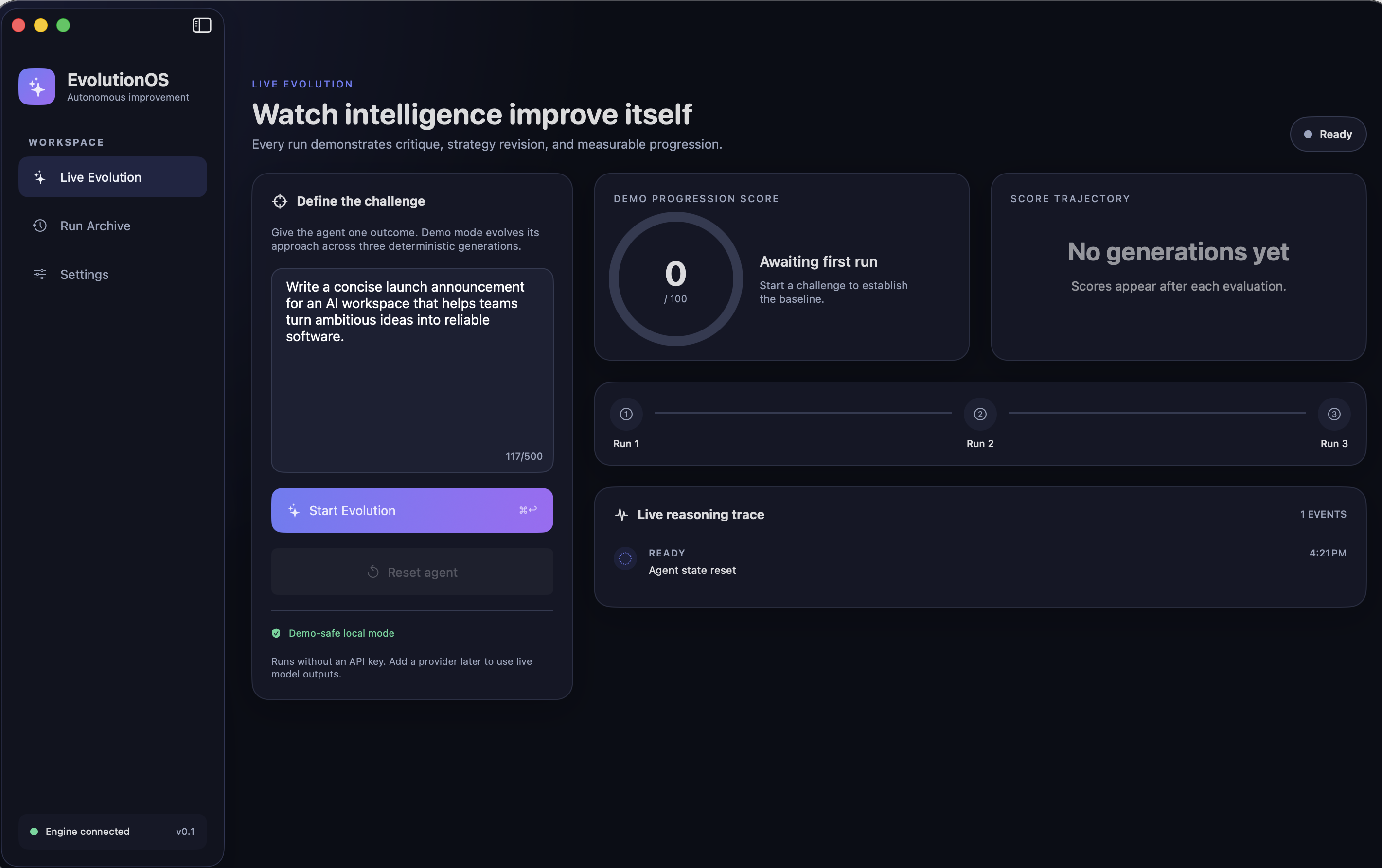
EvolutionOS is an operating system for self-evolving AI agents. Instead of repeating the same workflow, agents automatically evaluate their performance, critique their decisions, refine their planning strategy, prompts, memory, and tool selection, then execute the task again. Every iteration makes the agent more capable, creating a continuous evolution loop instead of static automation.
How we built it
EvolutionOS is built as a modular multi-agent runtime composed of specialized agents working together.
- Planner Agent breaks down complex goals into executable tasks.
- Executor Agents perform the work using AI models and external tools.
- Evaluator Agents benchmark results against predefined success metrics.
- Critic Agents identify weaknesses and generate actionable improvements.
- Evolution Engine mutates prompts, planning strategies, memory, and tool selection before launching the next iteration.
The system combines autonomous feedback loops, long-term memory, benchmarking, and multi-agent collaboration to enable continuous self-improvement.
Challenges we ran into
The hardest challenge was making evolution reliable instead of random. We needed objective evaluation metrics, meaningful feedback loops, and safeguards to prevent agents from reinforcing bad strategies. Balancing exploration with stability was essential so agents could improve without becoming unpredictable.
Accomplishments that we're proud of
- Built a true self-evolving agent loop instead of another static AI workflow.
- Created autonomous planning, execution, evaluation, and self-improvement.
- Designed a modular architecture that supports multiple AI models and tools.
- Enabled every completed task to improve future performance automatically.
- Demonstrated continuous quality improvements across multiple execution cycles.
What we learned
We learned that the future of AI agents isn't bigger models—it's better feedback loops. The most important capability is not generating an answer, but evaluating outcomes, learning from failures, and adapting strategies autonomously. Reliable evaluation is the foundation of self-evolving intelligence.
What's next for EvolutionOS
We're expanding EvolutionOS into a production-ready operating system for autonomous AI agents.
Our roadmap includes:
- Distributed multi-agent collaboration
- Adaptive long-term memory
- Automatic tool discovery and optimization
- Continuous benchmarking and self-evaluation
- Enterprise deployment and observability
- Persistent agent evolution across projects
Our vision is simple:
Static AI agents are the past. Self-evolving agents are the future.
Built With
- anthropic-claude-api
- asynchronous-api)-*-**agent-management/mlops:**-`guild.ai`-(for-tracking-runs
- fastapi
- guild-ai
- in-memory
- json
- macos
- managing-experiments
- openai-api
- python
- rest-api
- storing-agent-configurations/strategies)-*-**llm-integration:**-openai-api
- swift
- swiftui
- websockets
- xcode

Log in or sign up for Devpost to join the conversation.