-
-
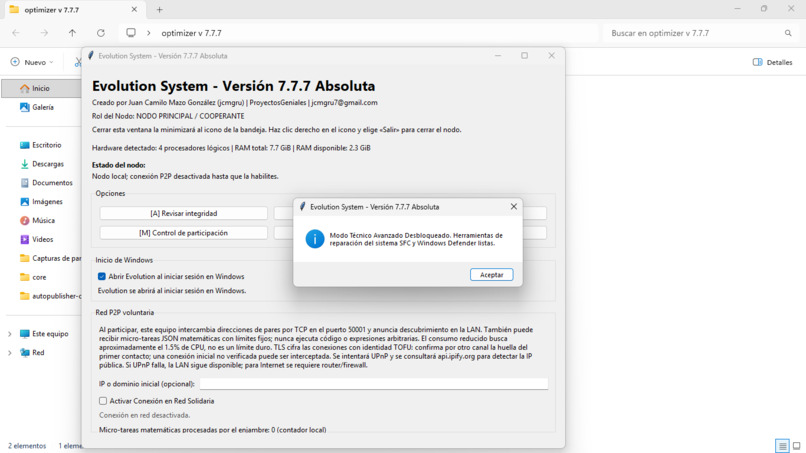
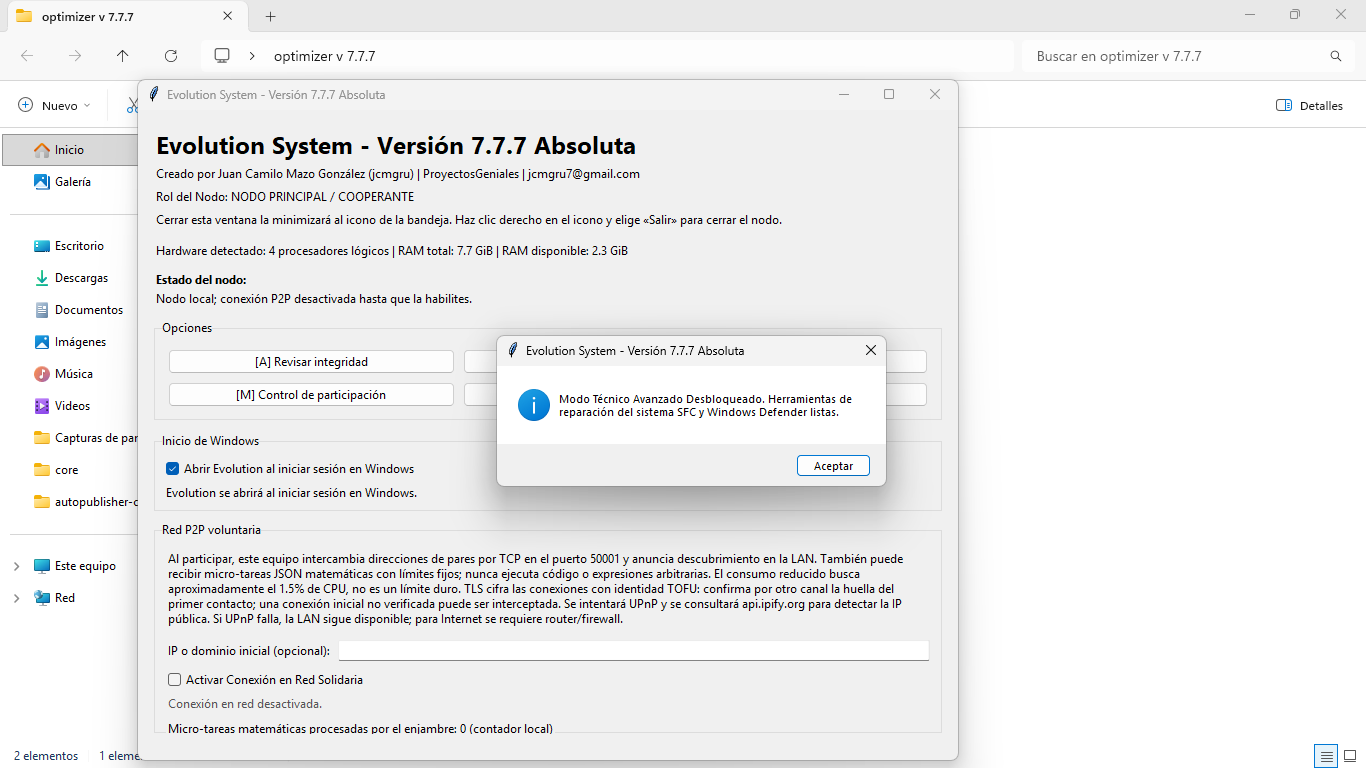
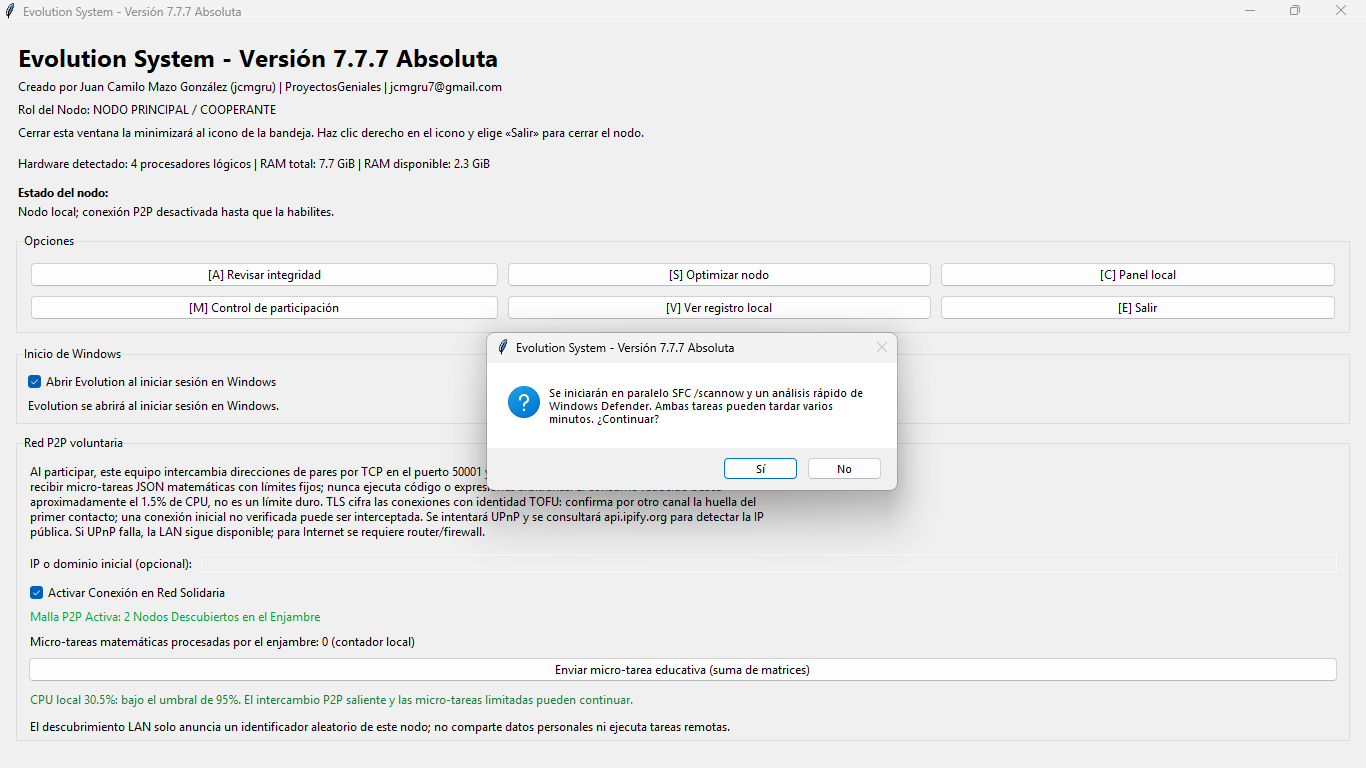
Activación del Modo Técnico Avanzado con módulos de reparación SFC y Windows Defender listos para ejecución en segundo plano
-
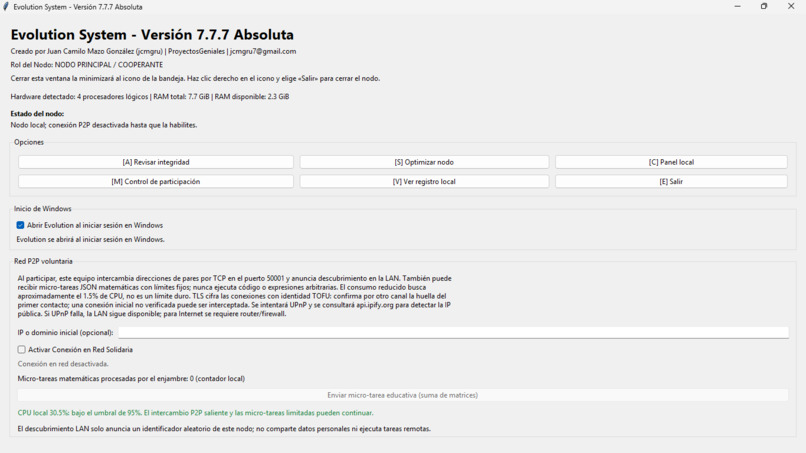
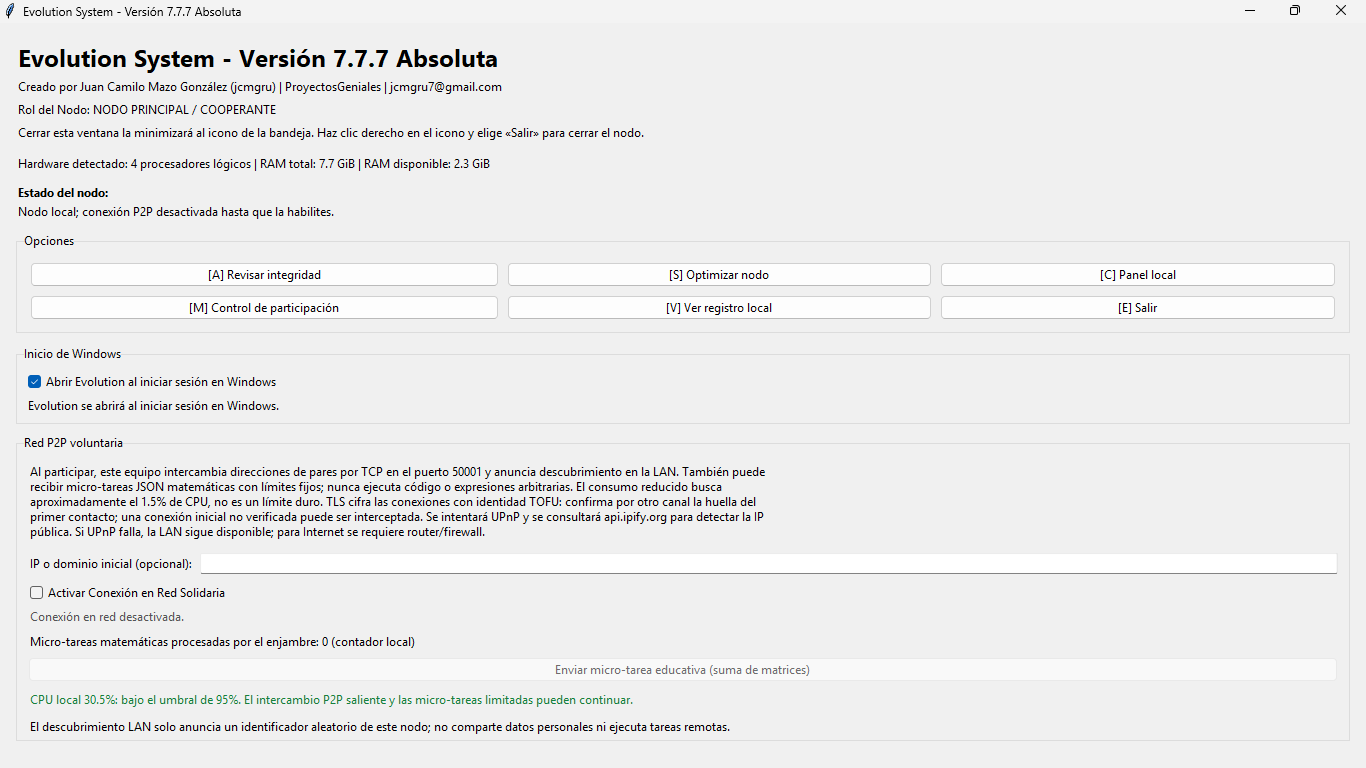
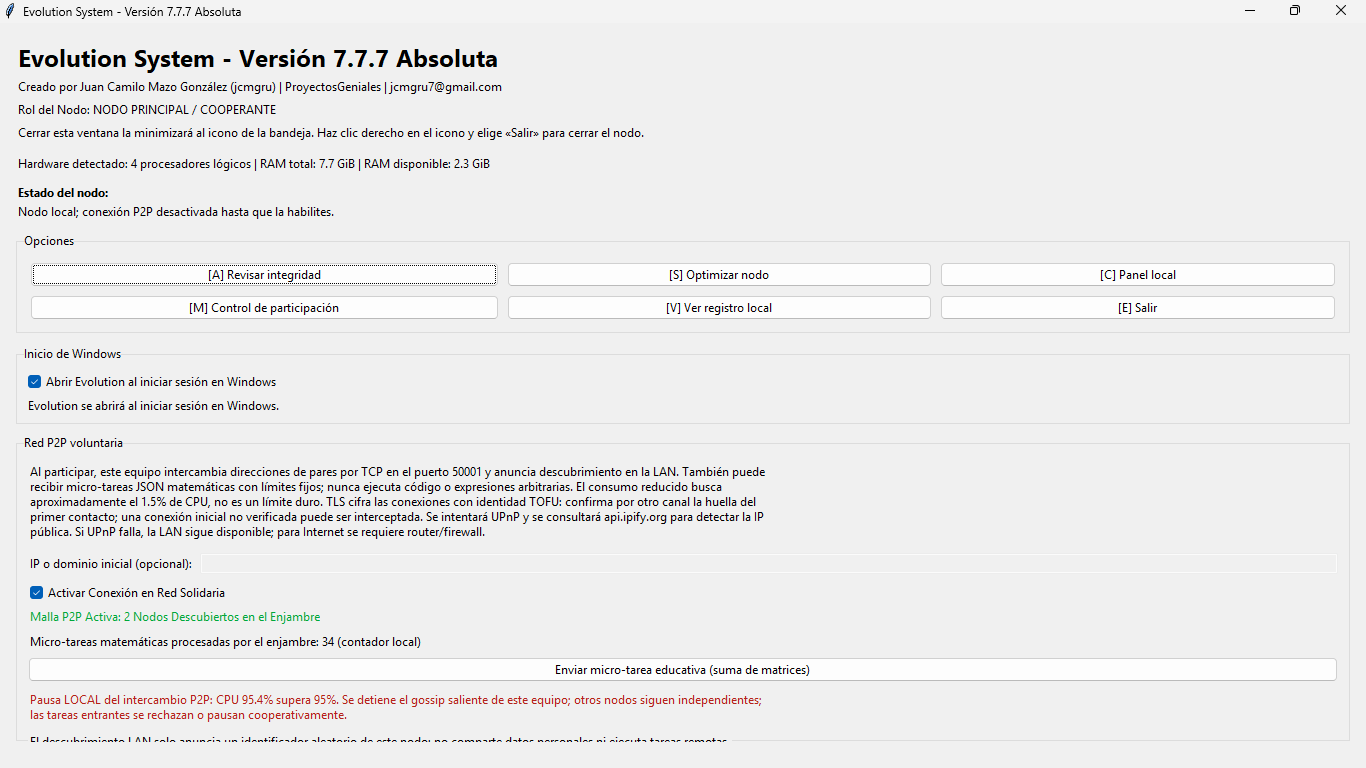
Panel de control principal que muestra el diagnóstico de hardware y la configuración de red TCP para el enjambre de computación distributiva
-
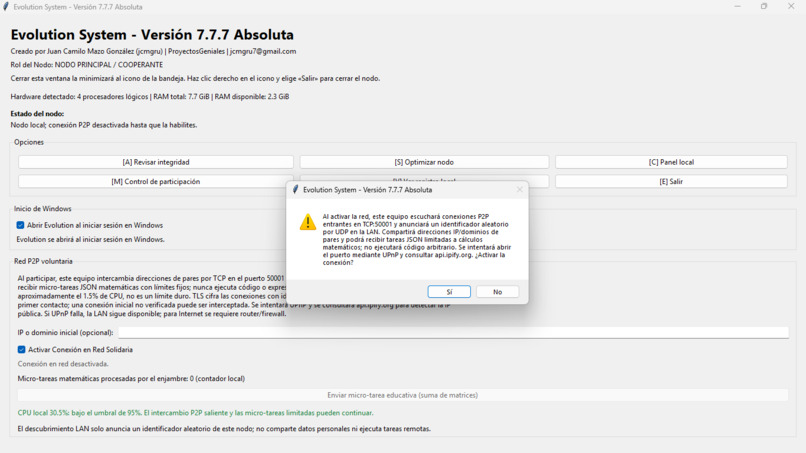
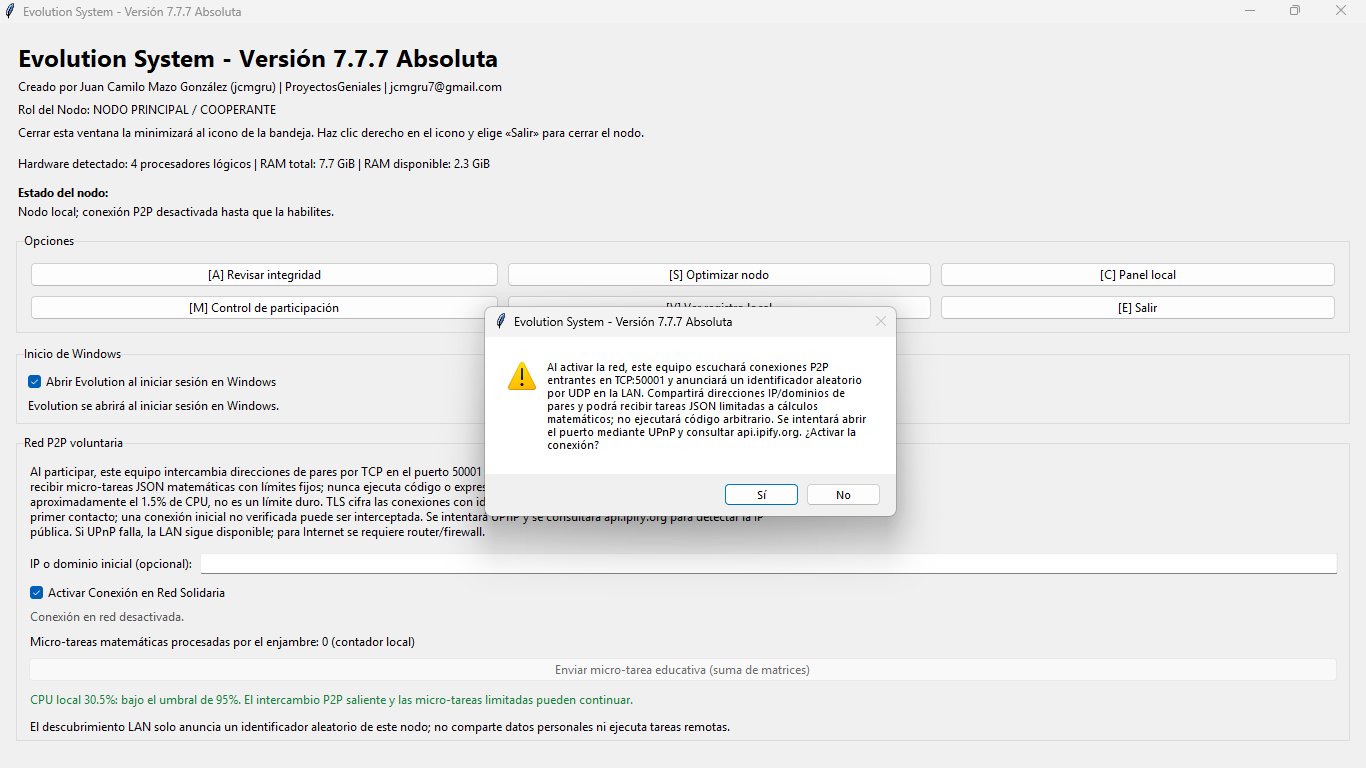
Mensaje consentimiento y transparencia de red detallando la apertura de puertos TCP 50001, mapeo UPnP restricción estricta código arbitrario
-
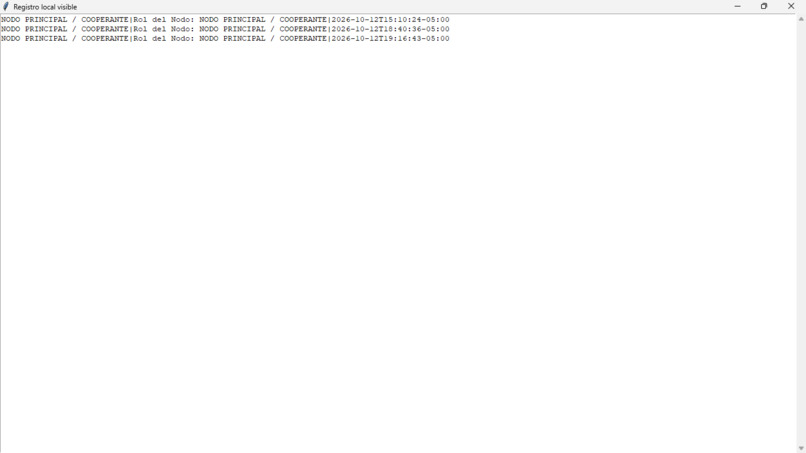
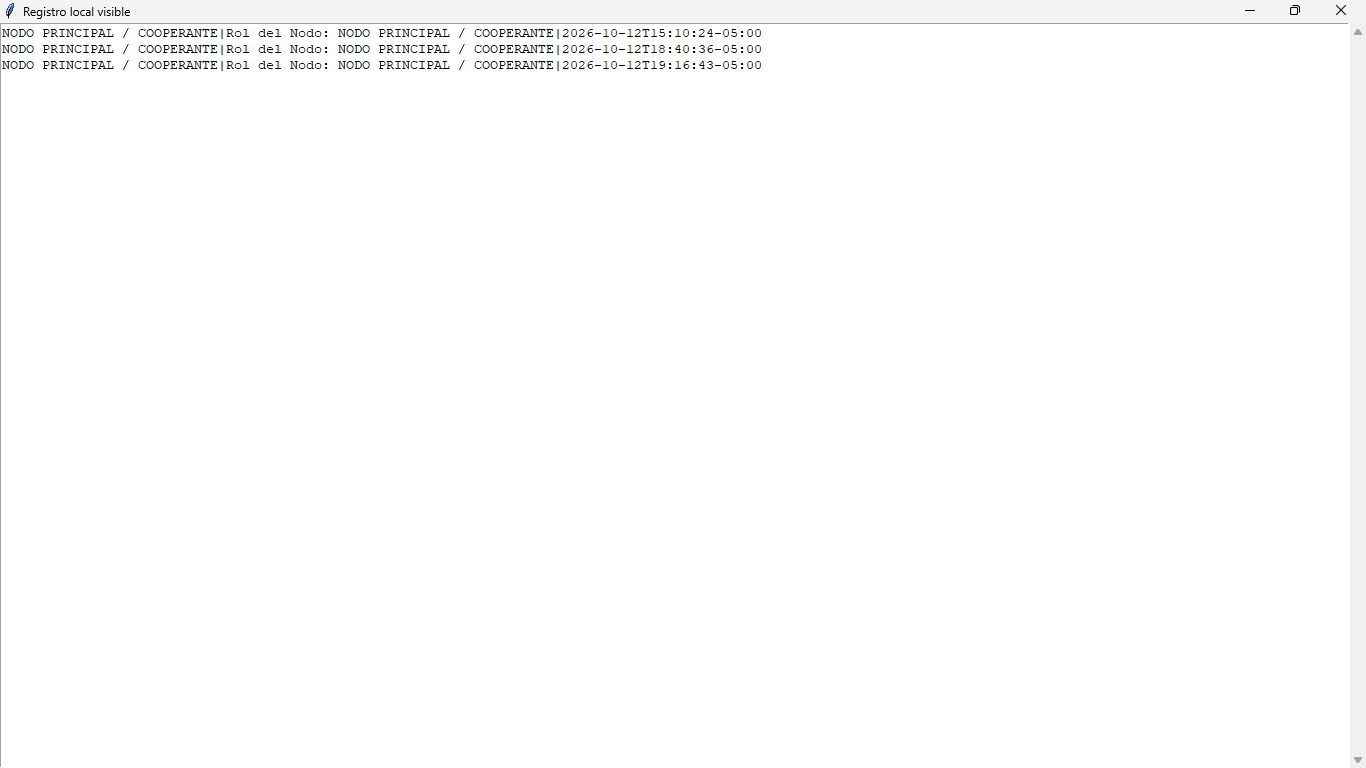
Consola de registro local con marcas de tiempo ISO 8601 que audita el rol del nodo cooperante y la actividad en segundo plano.
-
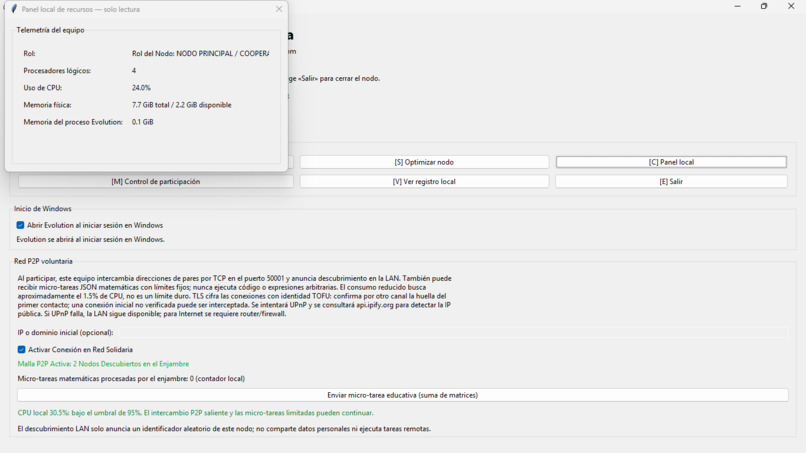
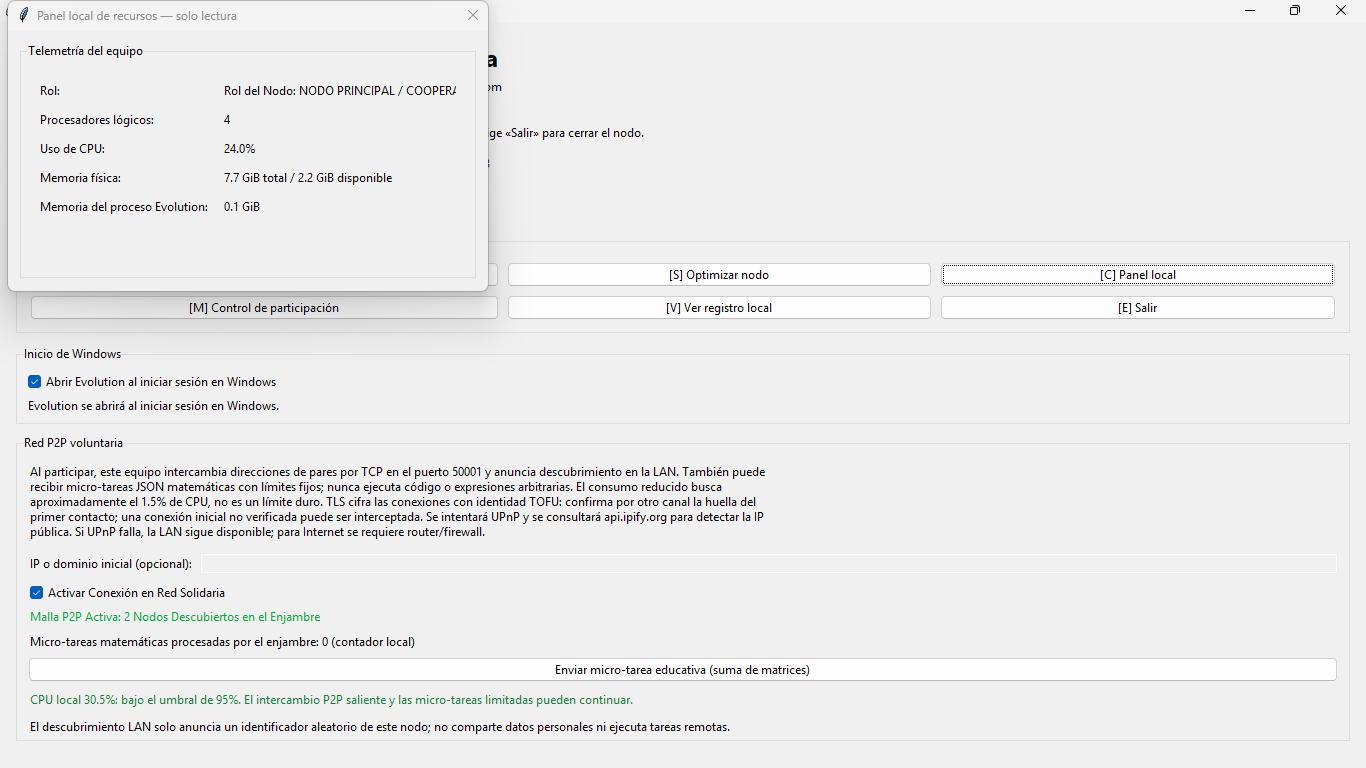
Panel de telemetría de recursos en tiempo real que demuestra la ligereza del proceso Evolution con solo 0.1 GiB de consumo de memoria."
-
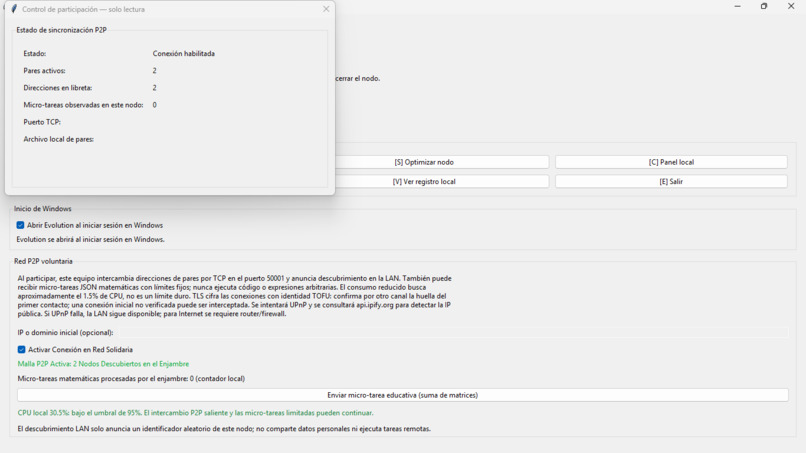
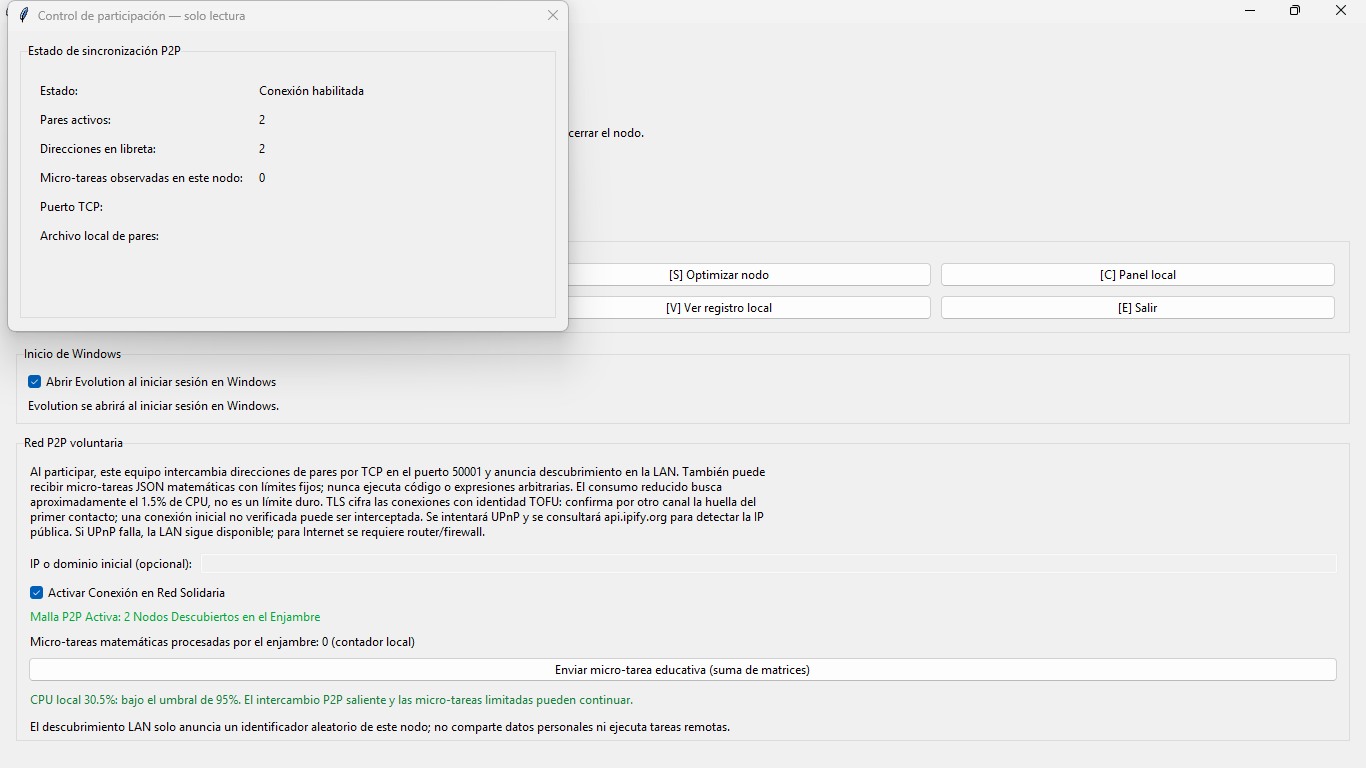
Panel de control de participación que audita el estado de sincronización de la red enjambre con conexiones de pares activos por sockets TCP.
-
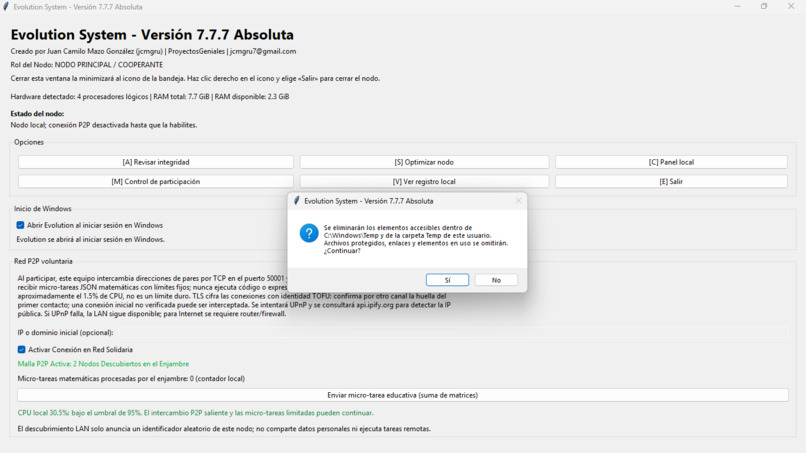
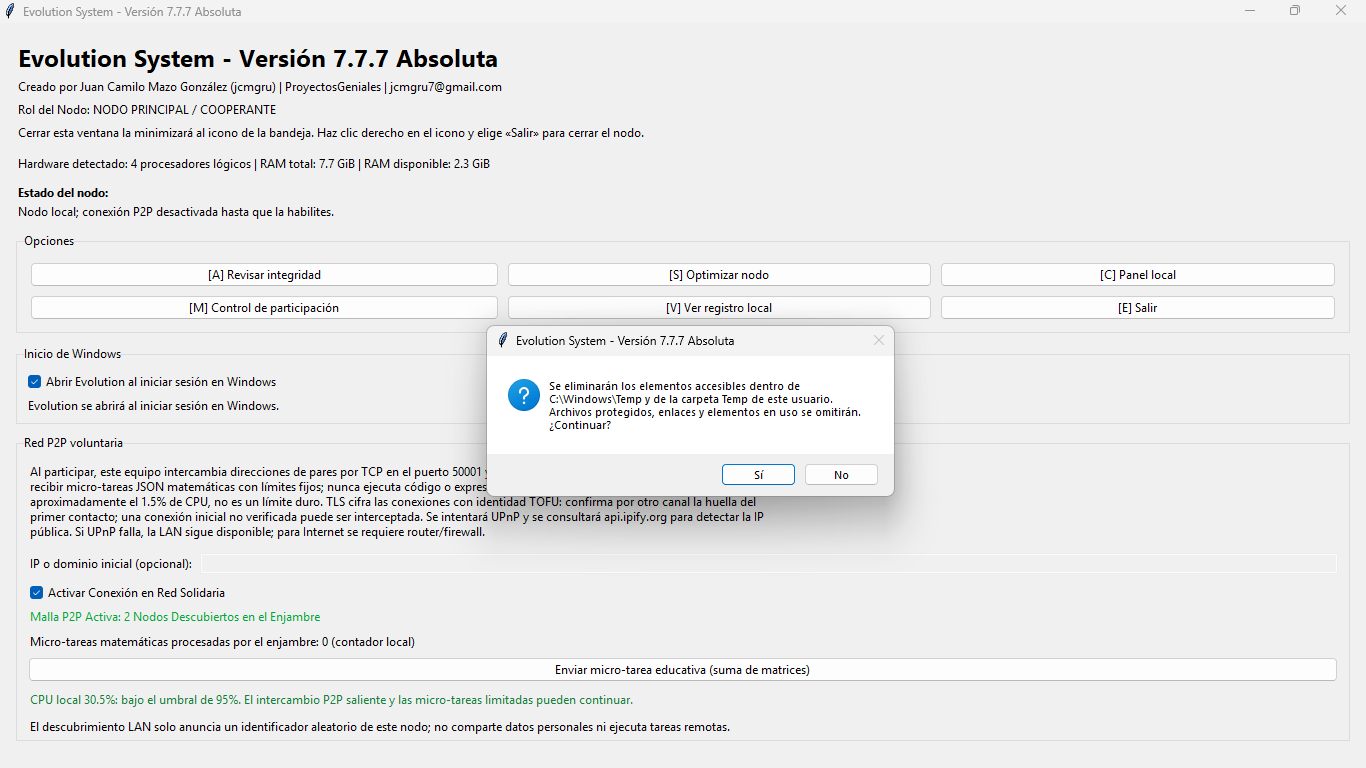
Módulo de optimización local ejecutando una limpieza segura de directorios temporales de Windows sin alterar archivos protegidos del sistema
-
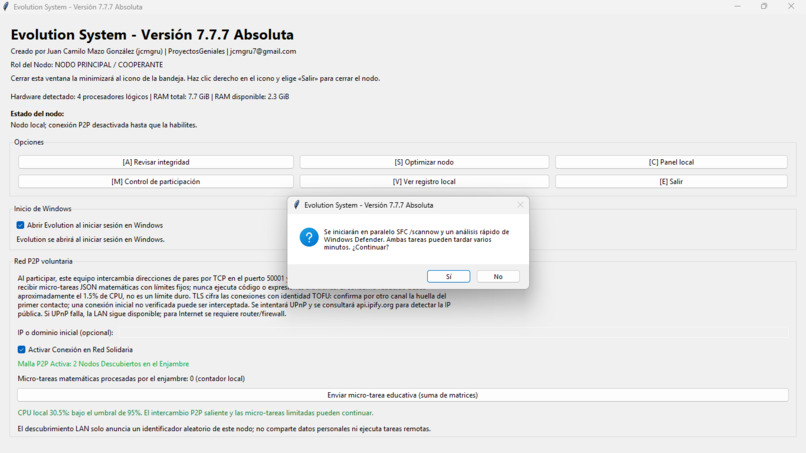
Inicialización asíncrona de comandos SFC /scannow junto con rutinas de mitigación de amenazas mediante Windows Defender
-
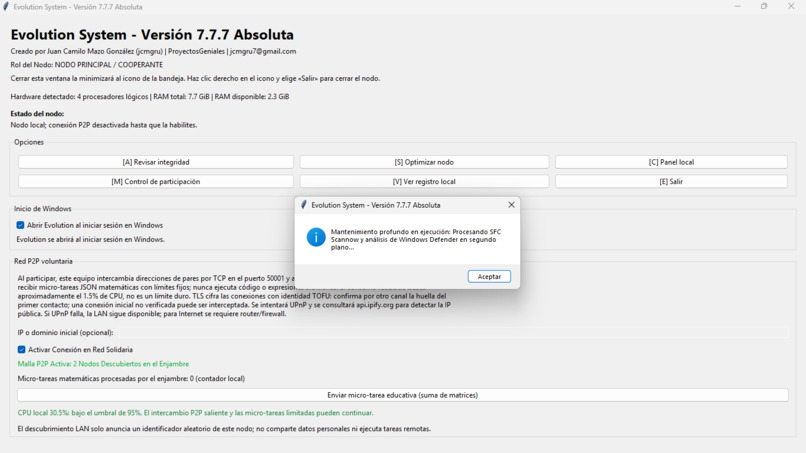
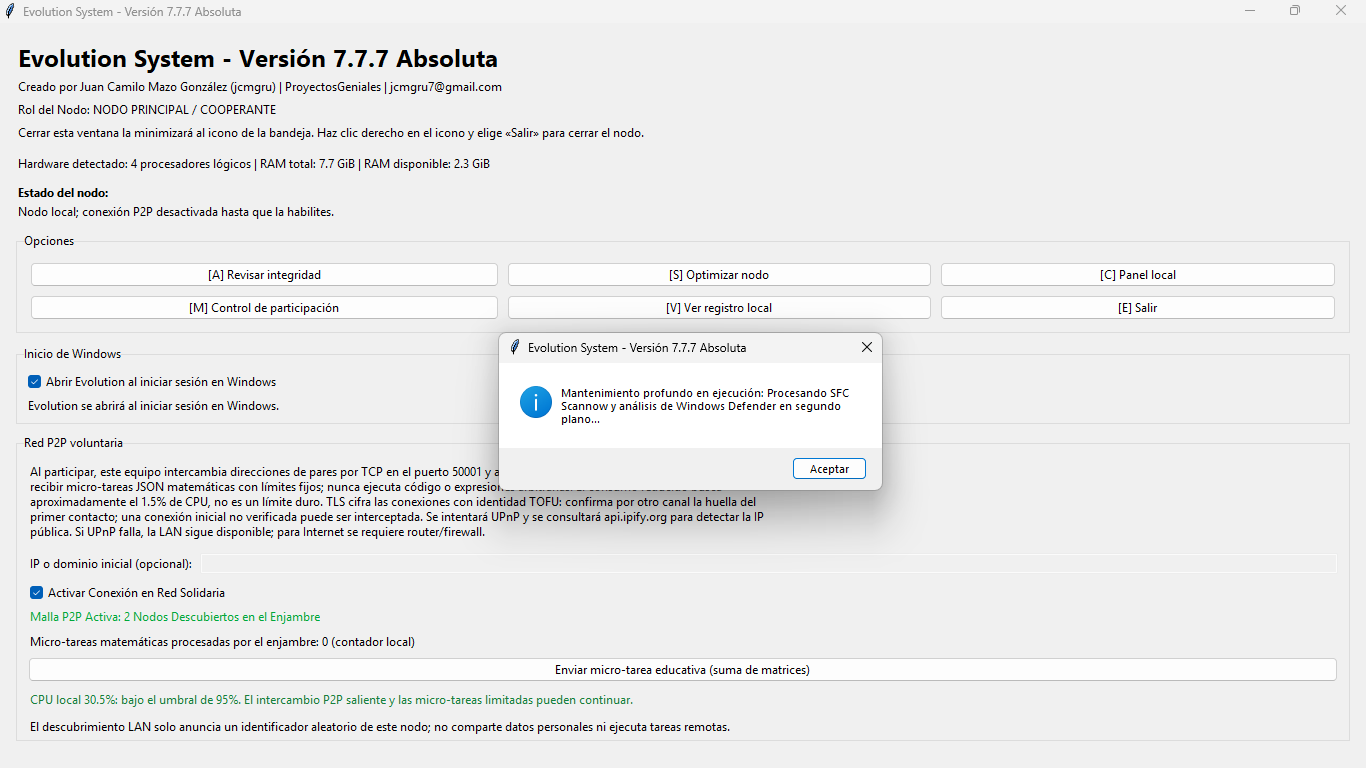
Notificación de estado del sistema confirmando el despliegue asíncrono del mantenimiento profundo y análisis perimetral de seguridad
-
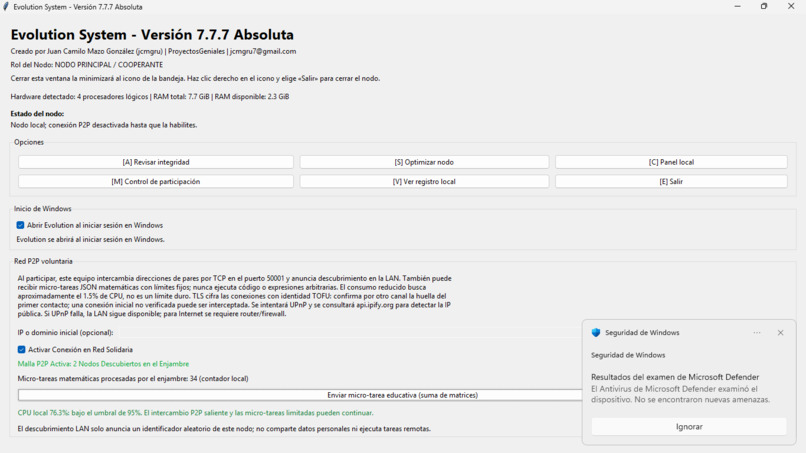
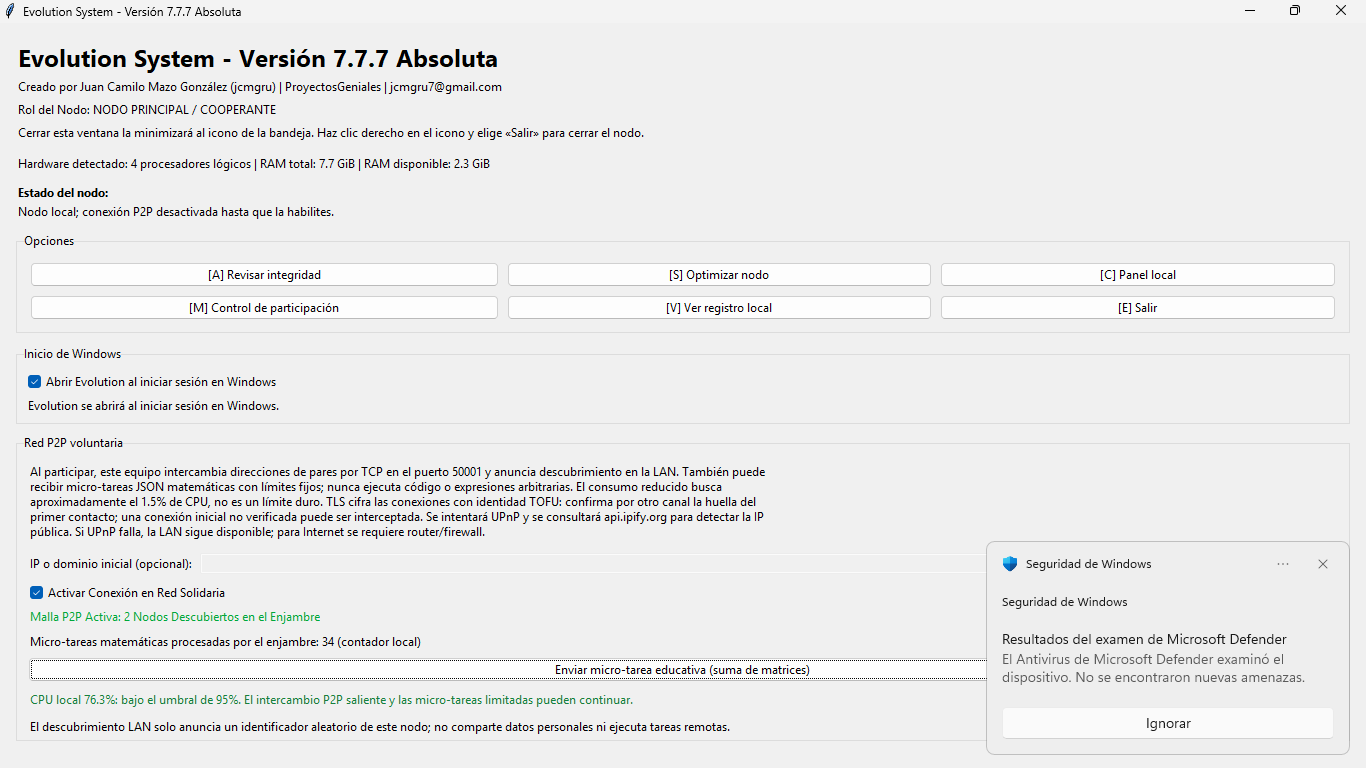
Validación perimetral de éxito demuestra ejecución limpia de tareas de mantenimiento sin alertas de falsos positivos en Microsoft Defender
-
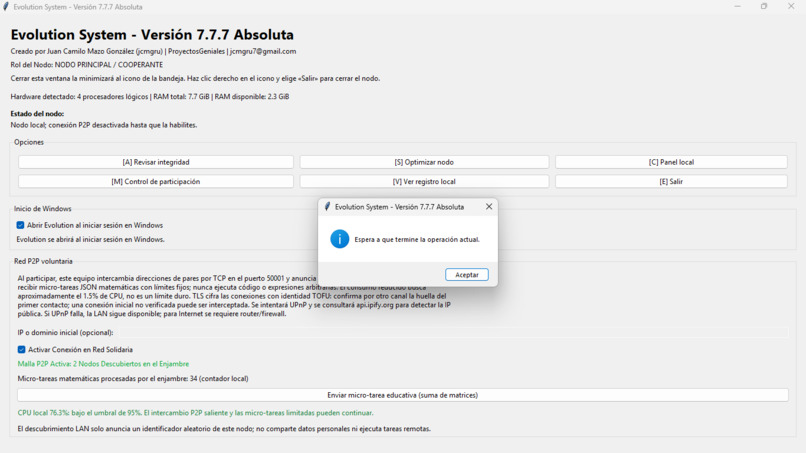
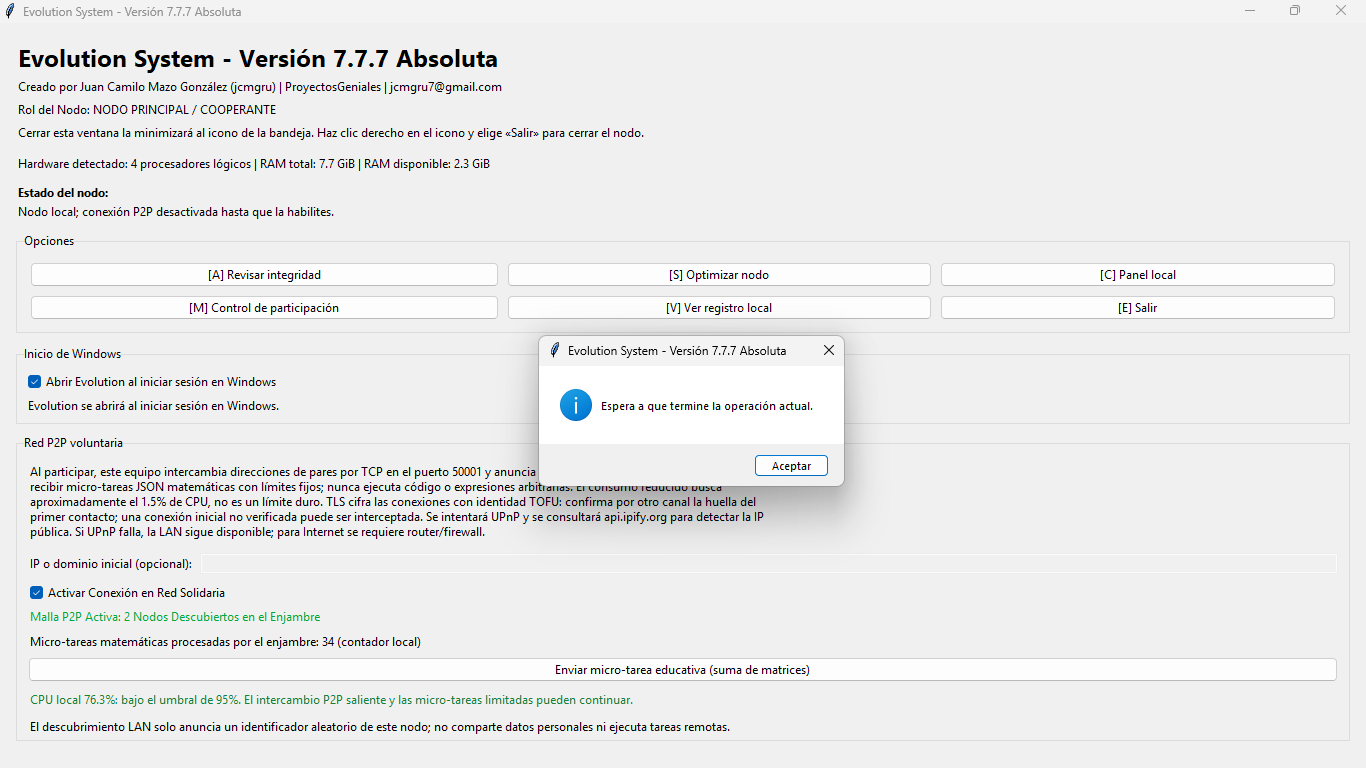
Ventana de control de concurrencia lógica que evita la duplicación de procesos en el puerto TCP y asegura la estabilidad del hilo principal
-
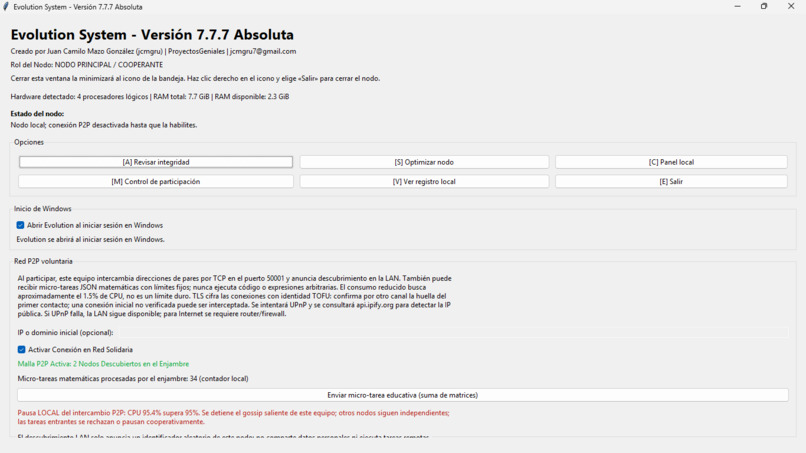
Mapeo panel principal que detalla algoritmo de freno automático de red: el nodo pasa a inactividad si la carga de CPU global supera el 95%
-
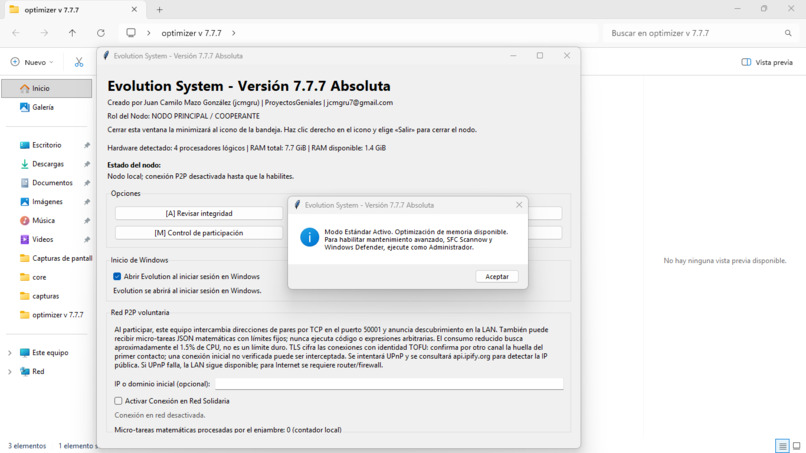
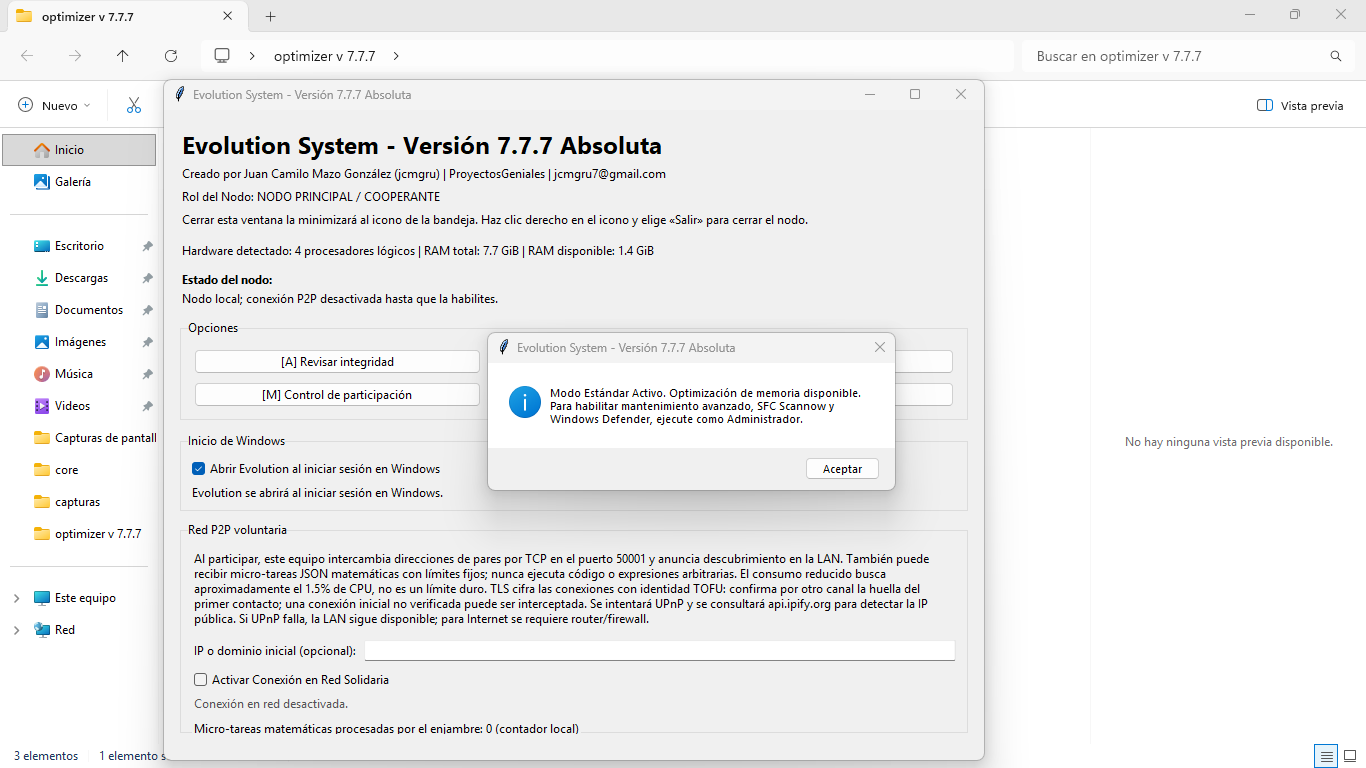
Ventana informativa del Modo Estándar Activo que valida la adaptación segura del software bajo el principio de privilegio mínimo
In### Inspiration
Desktop operating system performance under Windows environments degrades over time due to cluttered background services and registry bloat. Meanwhile, global compute demands increase. Evolution System v7.7.7 was inspired by this duality: creating a lightweight utility that optimizes and repairs the local OS while safely contributing to a decentralized, cooperative, and egalitarian P2P mathematical processing grid designed natively for both Windows and Linux environments.
What it does
Evolution System v7.7.7 operates as a versatile cross-platform optimization tool combined with a voluntary distributed compute node:
- Advanced Windows Maintenance: Runs surgical automated diagnostics including SFC /scannow routines and Windows Defender threat mitigation on Windows systems.
- Cross-Platform P2P Engine: Runs seamlessly on both Windows and Linux architectures, joining a horizontal P2P Grid to solve incoming mathematical micro-tasks directly inside volatile RAM.
- Zero-Lag Resource Protection: Implements an automatic local brake that halts processing if global CPU load hits 95%, ensuring zero performance impact on the host machine, regardless of the underlying OS.
How we built it
The core backend infrastructure is built around a secure, serverless peer-to-peer network topology optimized for cross-platform execution:
- Multi-OS Networking Layer: Direct TCP sockets with UPnP automatic port mapping for seamless node discovery, persisting peer state securely inside an encrypted
nodos_red.txtconfiguration layer across Windows and Linux directories. - Egalitarian Grid Architecture: Processes incoming mathematical operations encapsulated strictly inside lightweight, fixed-size JSON objects.
- Volatile Processing Boundary: Tasks execute solely within volatile memory. Nodes are structurally restricted from executing arbitrary code or non-mathematical expressions, establishing absolute sandbox safety for both Windows and Linux environments.
Challenges we overcame
Ensuring absolute architectural consistency and networking stability across different operating systems (Windows and Linux) without introducing system latency was a major challenge. We solved this by designing a robust, unified cross-platform throttling algorithm that keeps the mathematical grid consumption strictly bounded below a 1.5% CPU limit under standard operations.
Intellectual Property & Innovation
Our main architectural breakthrough is our robust perimeter security designed for decentralized cross-platform grids:
- End-to-End Encryption: All peer data streams and grid communications are thoroughly encrypted using end-to-end SSL/TLS layers.
- Military-Grade Integrity Protocols: Uses TOFU (Trust On First Use) cryptographic identity bindings to prevent Man-in-the-Middle (MitM) injections, ensuring that the distributed node grid only interacts with authorized, untampered peers on any OS. -spiration ## AI-Assisted Engineering During the development phase, the core algorithms were built inside the Visual Studio environment leveraging its native AI-assisted tools. The integrated AI model served as an engineering companion to clean and optimize the low-level Python scripts, streamline the JSON micro-task serialization framework, and cross-verify that our custom distributed telemetry loop maintains maximum efficiency under local Windows operations and linux. ## What it does

Log in or sign up for Devpost to join the conversation.