-
-
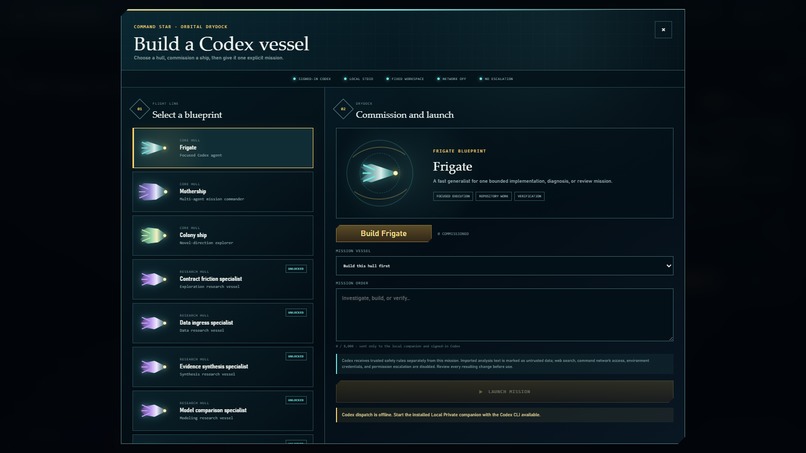
Build novel codex agents as spaceships with custom prompts
-
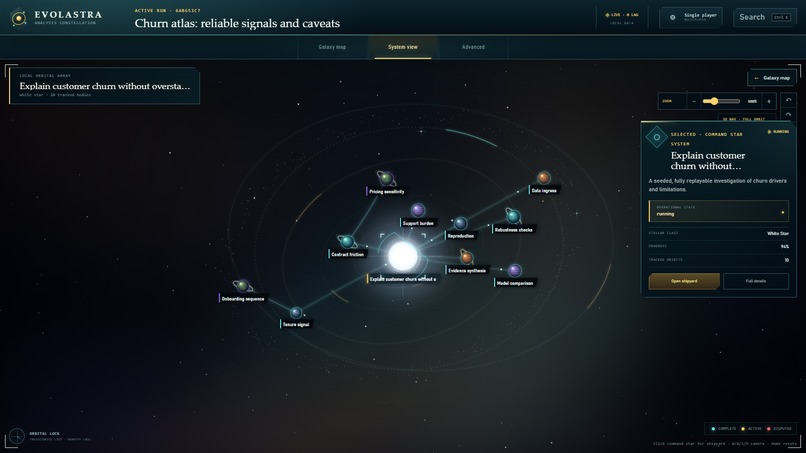
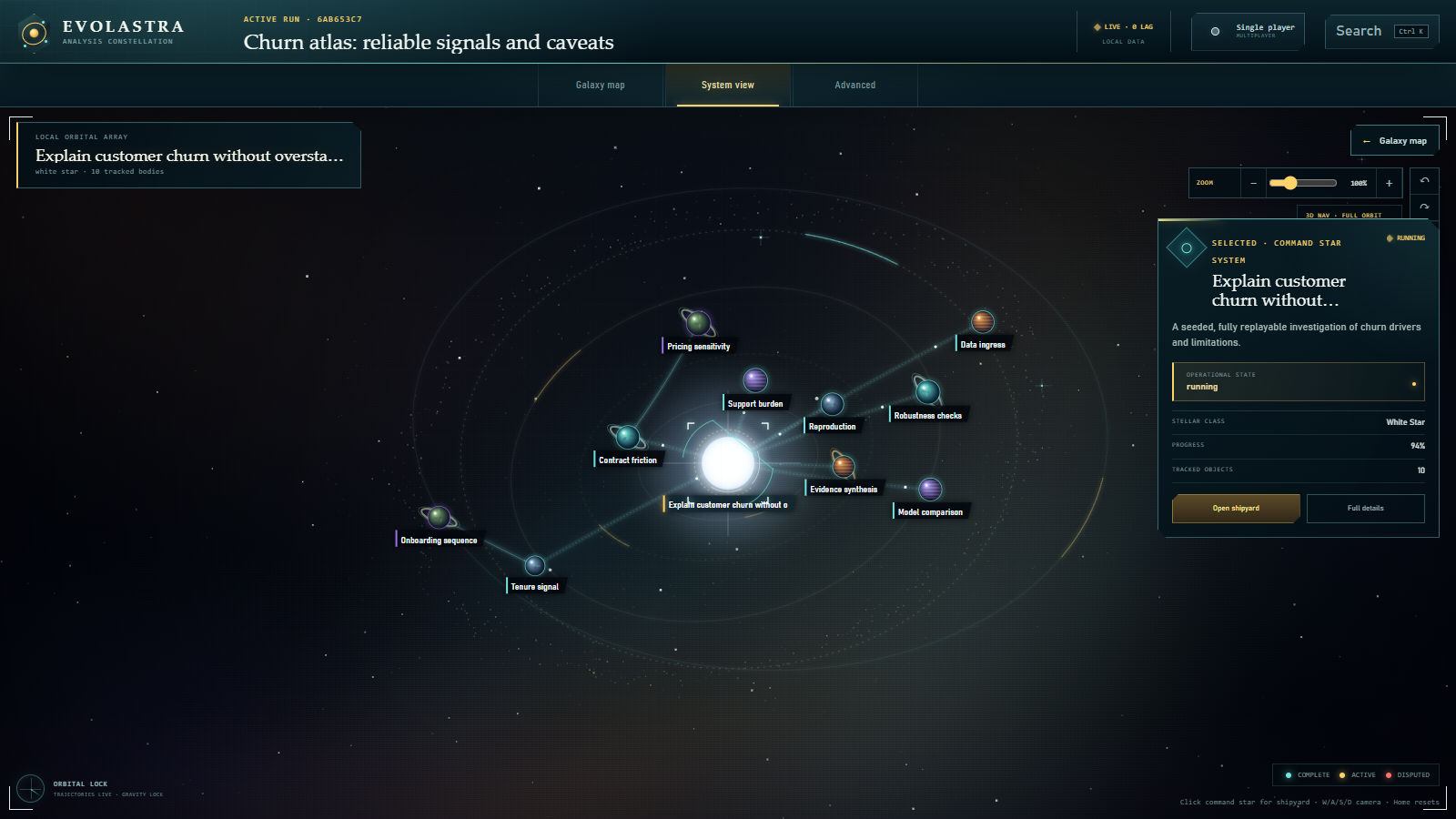
System map for a given scientific hypothesis and related figures
-
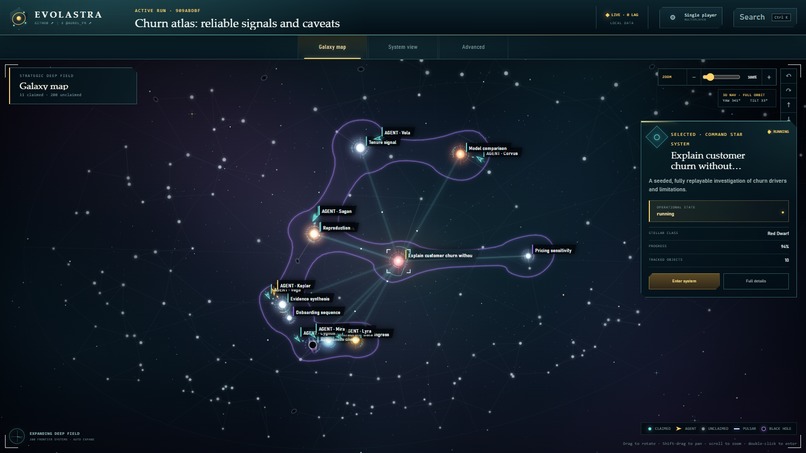
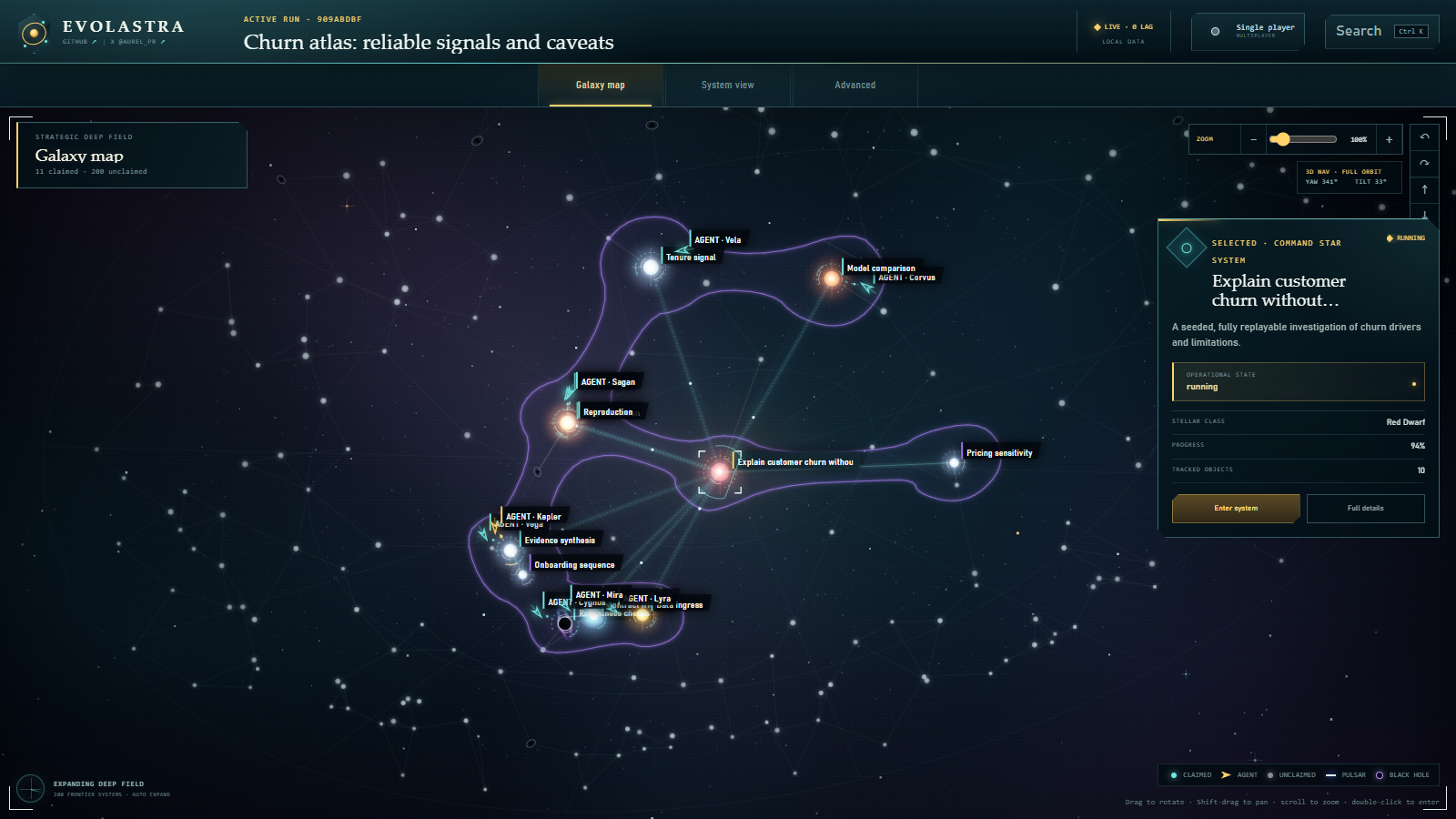
Galaxy map for the wider research
Inspiration
EvolAstra was inspired by my experience playing space real-time strategy games like Stellaris and X4 and my work with scientific data analysis as a computational biologist postdoc. I wanted to explore what would happen if AI agent activity was not displayed as another list of logs, tasks, or chat messages, but as a living strategy-game universe.
Scientific analysis is naturally exploratory. A researcher starts with an objective, investigates different hypotheses, gathers evidence, finds anomalies, and follows promising directions. That process felt similar to exploring a galaxy, establishing new systems, and expanding an empire. EvolAstra turns that analogy into an interactive interface where Codex agents appear as ships, research tasks become missions, hypotheses become star systems, and evidence becomes planets and orbital objects.
What it does
EvolAstra is a local-first observatory that visualizes Codex agents on a space RTS game map while they perform scientific data analysis.
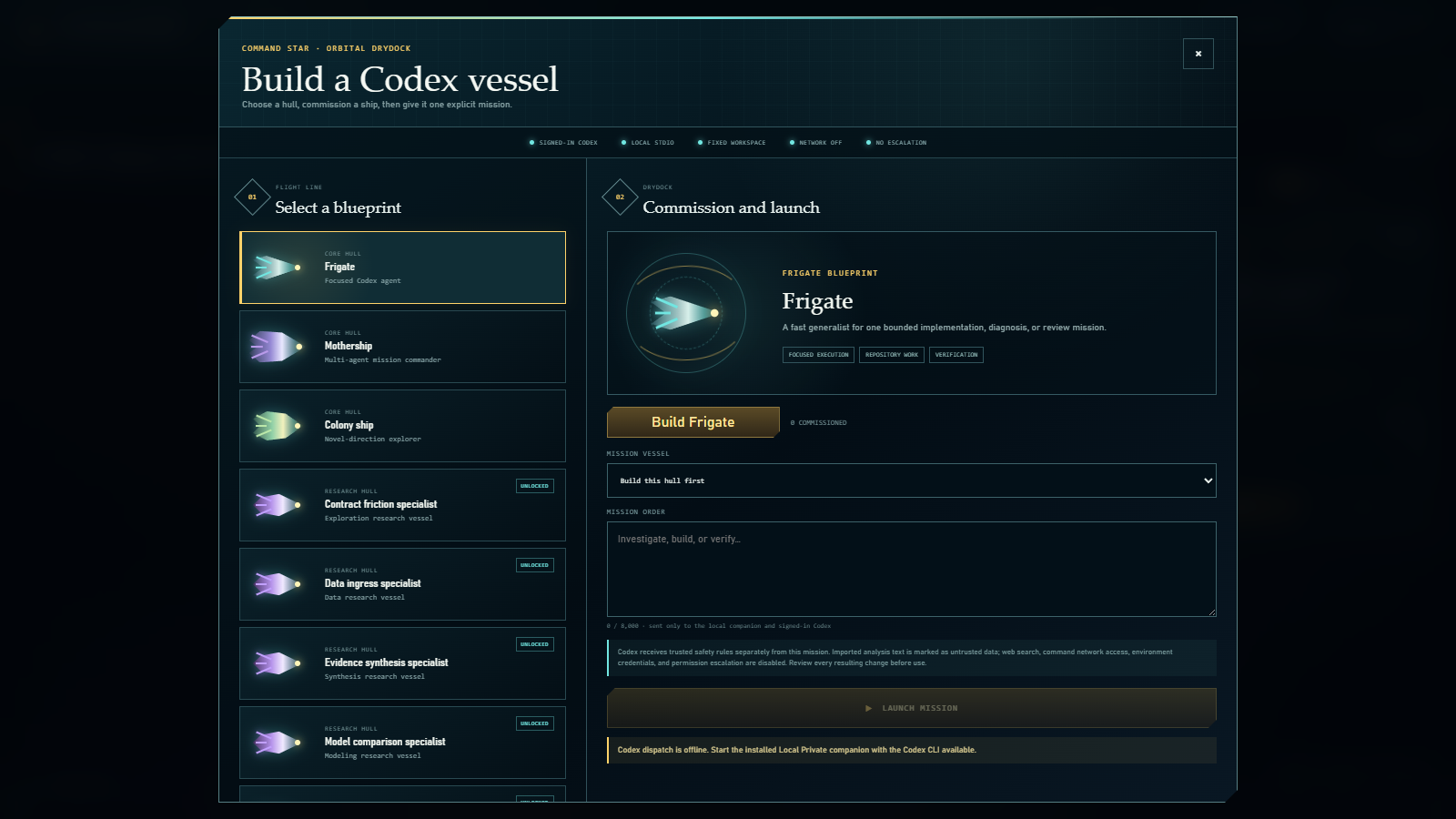
The user begins with a dataset and an analytical objective represented by a command star. From there, they can commission different types of ships and assign research missions in plain language. Frigates handle focused tasks, motherships coordinate larger investigations, and colony ships explore new testable directions.
As Codex agents inspect data, test hypotheses, produce figures, and validate results, the galaxy expands around their work. Users can enter individual systems to inspect evidence, artifacts, findings, tool calls, anomalies, metrics, and data lineage. They can also replay the complete history of an investigation and compare different analytical runs.
How we built it
I began by defining the product concept, domain model, visual direction, and the relationship between scientific analysis and strategy-game mechanics. I then used ChatGPT to turn the concept into a detailed development plan that could guide Codex during implementation.
Codex supported the full development lifecycle, including the Python backend, React and TypeScript frontend, interface design, 3D visualizations, ship and star models, automated testing, continuous integration, documentation, and Netlify deployment. I directed the system architecture and decided how the analytical concepts should be represented, including modeling agents as ships and hypotheses as research systems.
The backend uses FastAPI and an append-only local event log. Validated events are converted into a deterministic semantic projection that powers the live galaxy, system views, replay functionality, and portable exports. The frontend uses React, Vite, TypeScript, and a canvas-based renderer to present the interactive space environment.
Challenges we ran into
I had a lot of trouble keeping the layout exact, so that the agents only claim star systems that are already there, while keeping the original coordinates. Also making sure that the user can connect their codex session to the frontend was not trivial.
Accomplishments that we're proud of
The app works, but not without bugs. Nevertheless, I'm very happy that codex helped me to build it so fast, soemthing that I'll actually use for my data analysis in the future. And it looks cool.
What we learned
End-to-end development of a POC tool with all the frontend and backend elements, under 3 days and every little detail related to it. Also honestly it looks awesome to create something so fast that works and visualizes nicely.
What's next for EvolAstra - Codex Agents visualized in a Space RTS
I'd like to open source the project. I want this to be not just a tool to visualize agents, but to foster collaboration between researchers to find signal in their data in a multiplayer, collaborative setting.
Built With
- chatgpt
- codex

Log in or sign up for Devpost to join the conversation.