Inspiration
Most AI tools respond with text, even when the user is trying to make a decision. Teams still have to translate that text into dashboards, checklists, plans, and documents manually.
We wanted to explore a different interaction model: what if every AI prompt became a useful visual object that could evolve over time?
EvoDeck was inspired by the way real teams work, through conversations, changing assumptions, incomplete information, and competing possible futures.
What it does
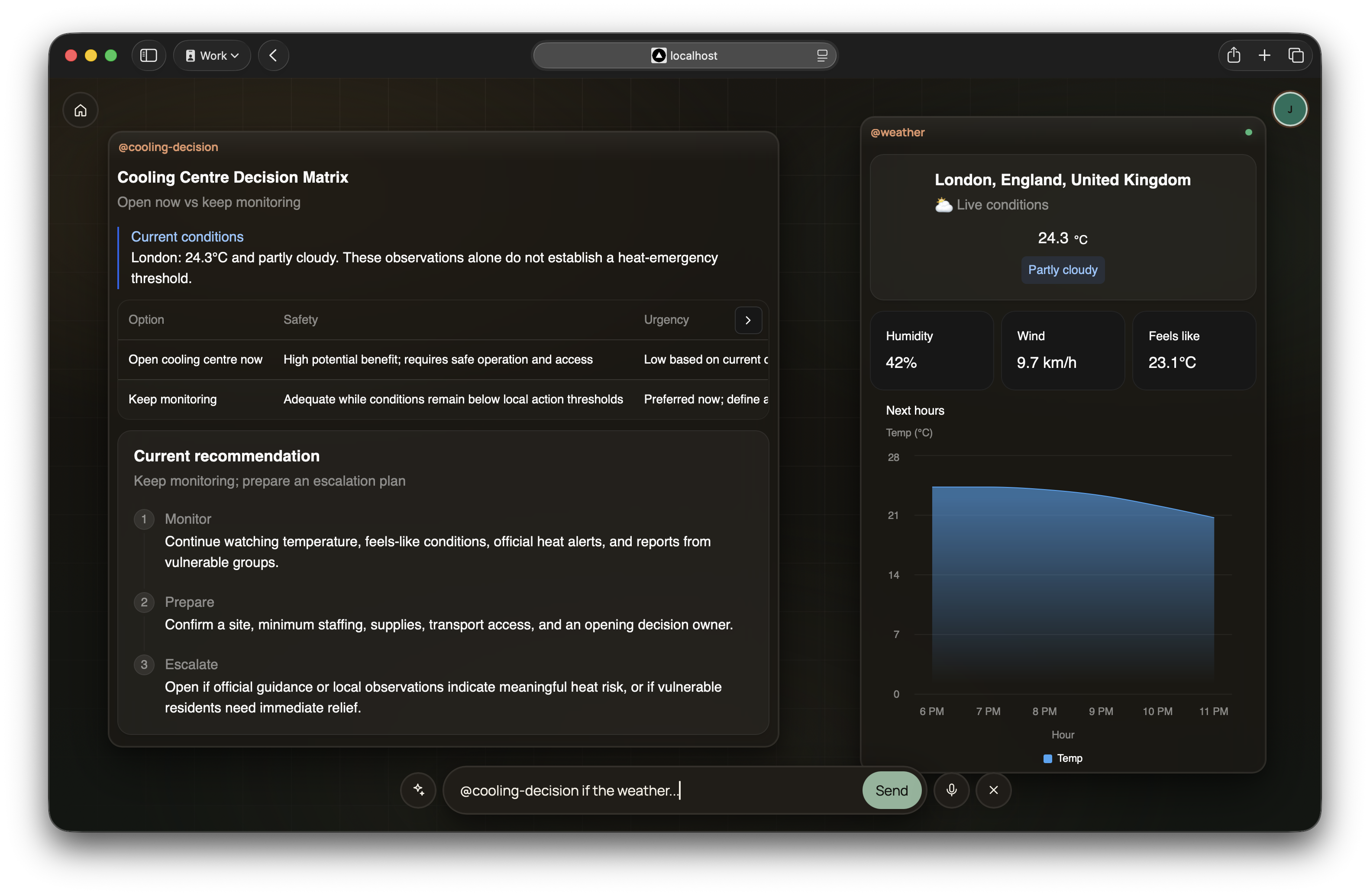
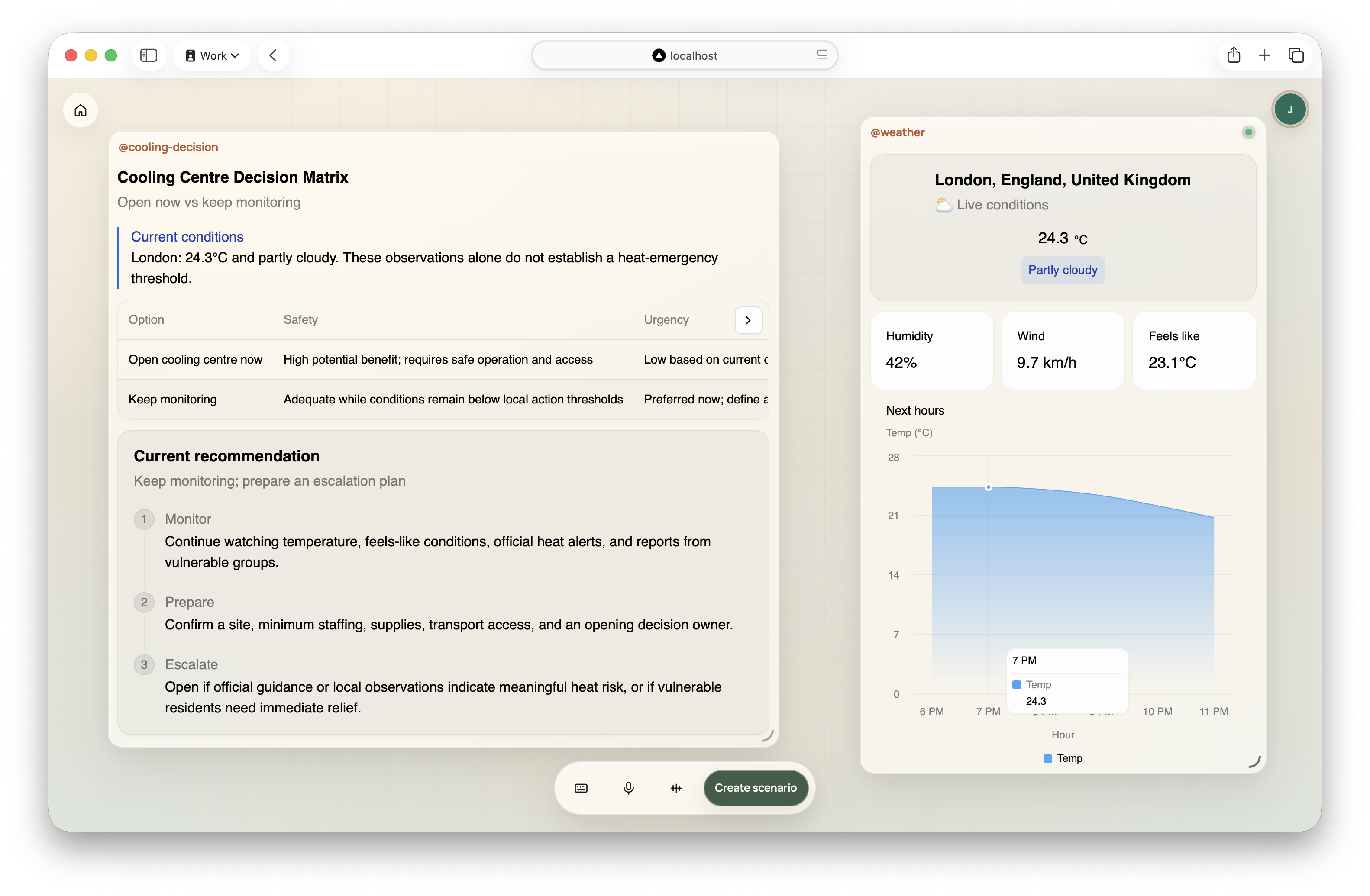
EvoDeck is an AI-native collaborative canvas for making decisions.
Users describe what they need in natural language, and EvoDeck creates interactive visual widgets such as:
- Charts and benchmarks
- Checklists
- Decision matrices
- Risk tables
- Forms and controls
- Flowcharts
- Live-data dashboards
Users can target individual widgets with @mentions, for example:
@launch-benchmark update support readiness to 78% and recalculate the score
Instead of returning another paragraph, EvoDeck updates the visual workspace.
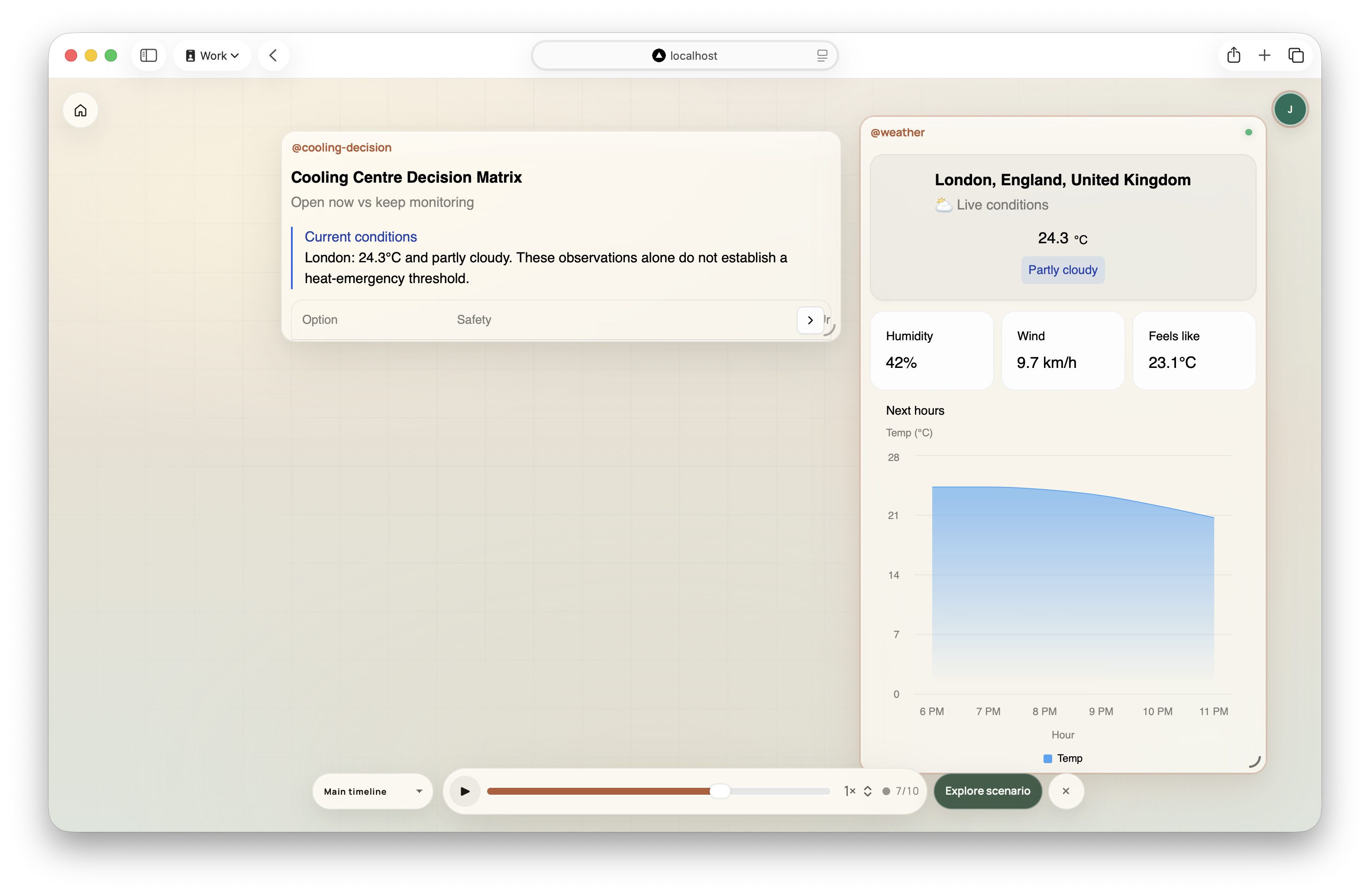
Every meaningful change becomes a timeline revision. Users can rewind to an earlier state and create alternate scenario branches without overwriting the original decision trail.
How we built it
EvoDeck is built with Next.js, React, TypeScript, PostgreSQL, Drizzle ORM, and OpenUI.
The main architecture includes:
- A visual canvas for interactive widgets
- Structured AI operations for adding and updating widgets
- OpenUI-generated interfaces for charts, tables, forms, and checklists
@mentiontargeting for precise edits- PostgreSQL persistence for workspaces, users, messages, revisions, and branches
- An append-only timeline for preserving decision history
- In-workspace scenario branches for exploring alternate futures
- Optional live-data integrations through ClickHouse and external source adapters
- Presence and collaboration features for shared workspaces
The AI does not directly rewrite the canvas. It produces validated operations such as add_widget, update_widget, and move_widget. Those operations are checked against a schema before being applied.
Challenges we ran into
The first challenge was preventing AI-generated interfaces from becoming unpredictable. Natural-language output is flexible, but a canvas needs strict structure. We solved this by using typed widget schemas and validating every AI operation before it reaches the workspace.
The second challenge was making edits precise. A request like “change the launch plan” should not replace the entire canvas. The @mention system lets users target one widget while preserving everything else.
The most difficult product challenge was handling history. Editing a previous timeline frame can destroy later decisions. We redesigned the system around append-only revisions and in-workspace branches, allowing users to explore alternate futures while keeping the original path intact.
We also had to balance visual richness with speed. A large workspace should be useful after one prompt, but the demo should still show the canvas evolving one visual decision at a time.
Accomplishments that we're proud of
We are proud that EvoDeck turns conversational intent into interactive UI instead of static text.
We are especially proud of:
- Building a canvas that evolves through natural language
- Making individual widgets addressable with
@mentions - Preserving every meaningful change in a timeline
- Adding scenario branches without duplicating workspaces
- Supporting live, structured visual responses
- Creating a product that can demonstrate its value in under two minutes
A simple product-launch demo can begin with an empty canvas, generate a benchmark widget and a decision matrix, update one assumption, rewind the timeline, and explore a separate launch scenario, all without losing the original reasoning.
What we learned
We learned that the most valuable AI response is not always an answer. Sometimes it is a new interface, a comparison, a checklist, or a visual model that helps the user think.
We also learned that history is not just a technical feature. It changes how people interact with AI. When users know they can rewind and branch safely, they are more willing to experiment.
Finally, we learned that AI feels more useful when it operates at the same visual level as the work itself.
What's next for EvoDeck
The next major feature is a Decision Arena that compares scenario branches across measurable dimensions such as cost, speed, risk, customer impact, and confidence.
We also want to add:
- Automatic branch comparison and visual diffs
- “Compared with main” impact summaries
- AI devil’s-advocate challenge branches
- Evidence links showing why a widget changed
- Assumption tracking and confidence indicators
- Branch merging with conflict explanations
- More live-data connectors
- Exportable decision replays for stakeholders
Our long-term vision is for EvoDeck to become a visual decision layer for teams: a place where conversations become interfaces, assumptions become explicit, and possible futures can be explored before expensive real-world decisions are made.
Built With
- nextjs
- typescript

Log in or sign up for Devpost to join the conversation.