BlackSnow Engine ❄️
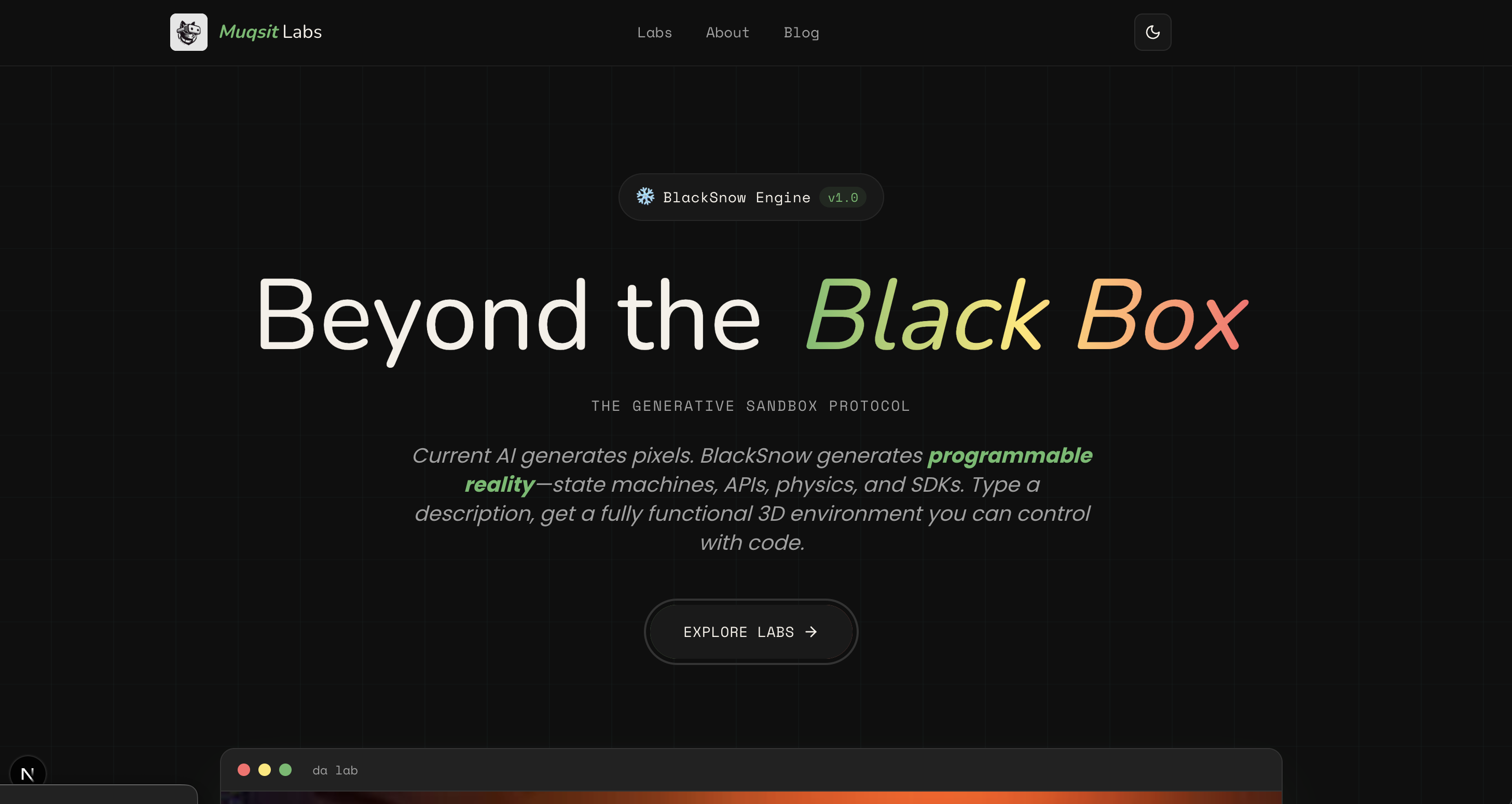
The Generative Sandbox Protocol
Moving beyond the black box to programmable reality.
💰 The Billion-Dollar Gap
The generative AI market is projected to reach $1.3 trillion by 2032. Models like Sora and DALL-E have mastered the art of generating static media—stunning videos and images.
However, they suffer from a fatal flaw for engineering and science: They cannot create functional, programmable systems.
- If you ask for a circuit board, you get a PNG. You cannot connect wires to it.
- If you ask for a smart home, you get a video. You cannot write code to control the thermostat.
- You cannot measure voltage. You cannot debug logic.
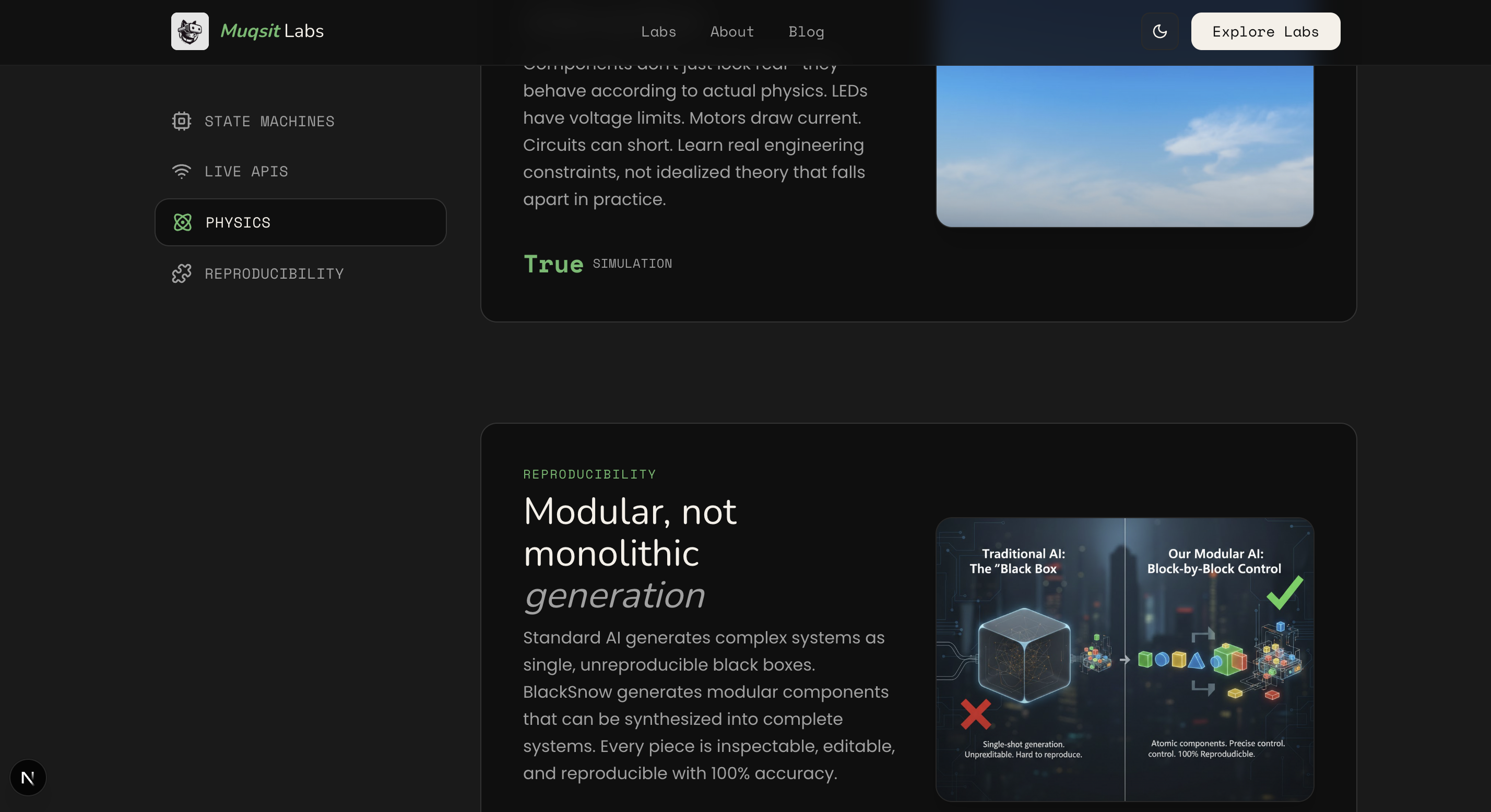
This is the "Black Box" Problem. It blocks entire industries—industrial simulation, defense, healthcare, and education—from utilizing Generative AI. The company that solves programmable generation unlocks all of them.
🌍 The Inspiration: A View from East Africa
We are from Tanzania, where the barrier to engineering education is physical access. This is known as the "Hardware Gap."
- A Raspberry Pi kit costs more than a month's wages.
- A chemistry lab setup is nearly impossible to import.
- Talented students are stuck reading about engineering instead of doing it.
We watched the AI revolution unfold and asked: What if Generative AI could solve the Hardware Gap? What if we could generate not just pictures of equipment, but working simulations of them?
This question became BlackSnow Engine—a protocol for generating programmable, reproducible Functional Micro-Worlds.
💡 The Solution: Programmable Generation
BlackSnow Engine changes the output of AI generation from "Media" to "Environment." Instead of generating pixels, we generate Systems.
- State Machines: Every object (LED, motor, sensor) has a readable/writable state.
- APIs: Each generated world exposes REST + WebSocket endpoints.
- Physics: Objects interact according to real-world rules, not hallucinations.
- SDKs: Auto-generated client libraries let developers control the world via code.
🎓 The Application: Revolutionizing Engineering Education
For this hackathon, we applied the BlackSnow protocol to a specific mission: Democratizing Engineering Education.
We built a platform where a student in Dar es Salaam can:
- Open a browser on a $50 smartphone.
- Type "Create a traffic light system."
- Receive a 3D interactive traffic light + full API documentation.
- Write Python or JavaScript to control it.
- See their code affect the "physical" world in real-time.
The Demo Labs
We built functional proofs-of-concept for the following scenarios:
| Lab | Description |
|---|---|
| The AI Circuit Designer | Describe a circuit in natural language → AI generates it on a 3D breadboard with accurate wiring. |
| Arduino LED Lab | Control an LED via code—teaching digital output logic. |
| Push Button Input | Read button states programmatically—teaching digital input. |
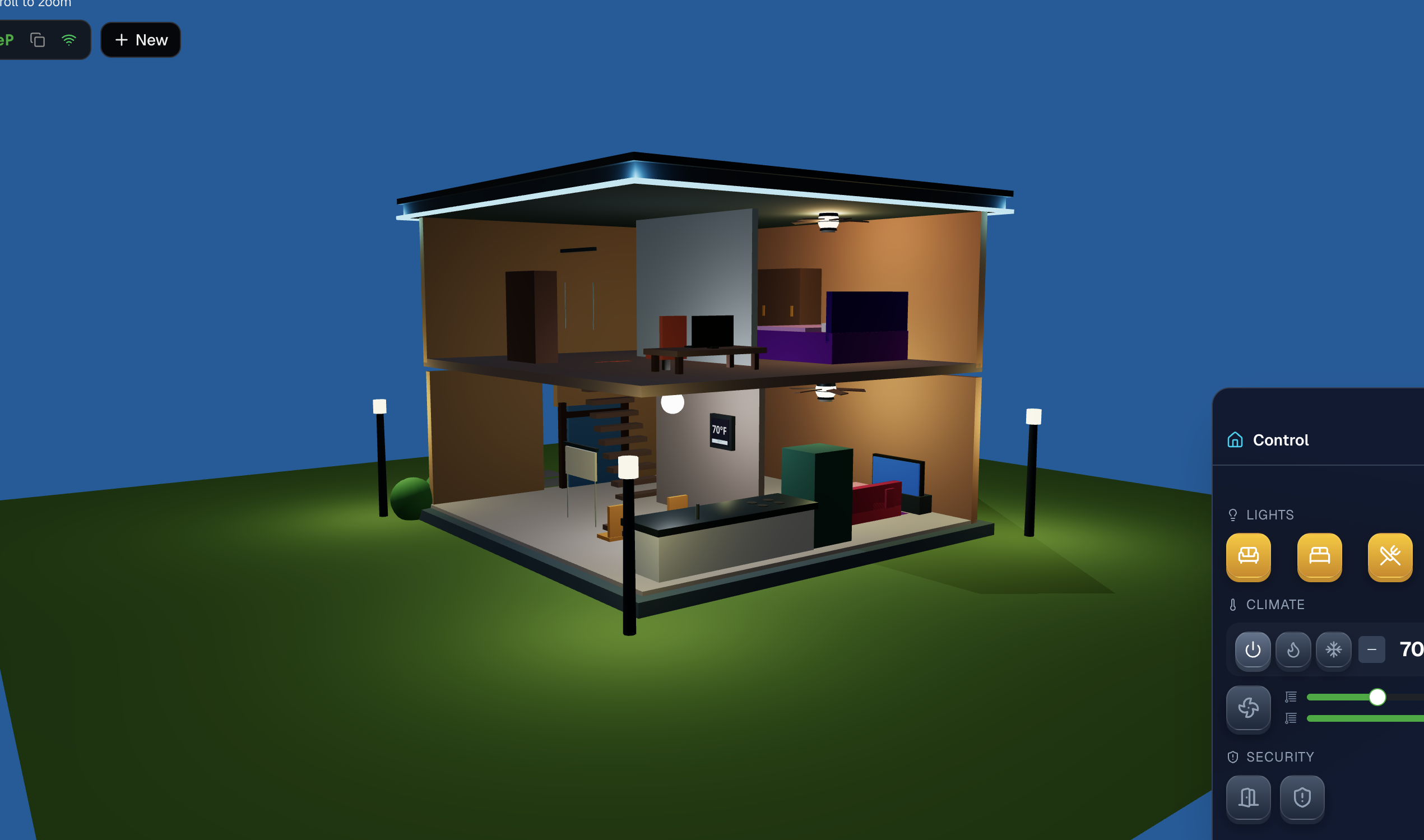
| The Smart House | A full home simulation (lights, doors, thermostat, blinds, alarm) controllable via API. |
🛠️ How We Built It
Architecture
BlackSnow operates on a "Architect → Builder → Runtime" pipeline:
- Natural Language → Blueprint: User describes a world → AI generates a deterministic
blueprint.jsonspecification. - Blueprint → 3D Scene: React Three Fiber renders the scene using Draco-compressed GLB models.
- Blueprint → API: The engine auto-generates REST endpoints for each controllable object.
- Real-time Sync: Socket.io broadcasts state changes to all connected clients.
Tech Stack
- Framework: Next.js 16, React 19, TypeScript
- 3D Engine: Three.js via React Three Fiber (R3F)
- AI Generation: Vercel AI SDK (Anthropic Claude, OpenAI GPT-4o, Google Gemini)
- Real-time: Socket.io (WebSocket) for bidirectional state sync
- Database: Turso (Edge SQLite) with Drizzle ORM
🧗 Challenges & Learning
1. 3D Precision at Scale
Placing LEDs on a breadboard sounds simple until you realize a breadboard hole is 2.54mm wide. We had to reverse-engineer breadboard meshes and compute mathematical bases for component placement. One pixel off meant the circuit looked "broken."
2. AI Output Unpredictability
Claude, GPT-4o, and Gemini all format JSON differently. We built a robust parser with regex fallbacks to ensure the generated blueprint.json is always valid, regardless of which model generates it.
3. Real-time State Synchronization
Having multiple students control the same traffic light creates race conditions. We implemented optimistic client-side updates with server-authoritative state reconciliation via Socket.io to keep the simulation smooth.
🚀 Accomplishments
- AI-to-3D Pipeline Works: You can type "place a red LED on A5" and watch it appear on a realistic breadboard in seconds.
- Real Working APIs: Every generated world actually exposes functional endpoints. Call
POST /api/circuit/led/toggleand the LED turns on in the 3D scene. - Production-Ready 3D: using Instanced Rendering and dynamic loading for smooth performance on mobile devices.
- Multi-Provider Support: Switch between Claude, GPT, and DeepSeek instantly to compare generation quality.
🔮 Roadmap
Short-term:
- Public Beta: Open the platform to educators in Tanzania.
- LMS Integration: Plugins for Canvas and Google Classroom.
Long-term: BlackSnow Engine isn't just for education. The core technology—generating stateful, API-driven environments—has applications in:
- Industrial Training: Simulate factory failures without risking equipment.
- Defense: Reproducible mission scenarios.
- Digital Twins: Create controllable simulations from specs.
👥 Team — Muqsit Labs
| Name | Role | Institution |
|---|---|---|
| Ignas Kamugisha | Co-Founder & Lead Engineer | Junior, Case Western Reserve University |
| Blessing Masanga | Co-Founder & Product | Freshman, Case Western Reserve University |
Built with ❄️ from Tanzania to the world.
Built With
- ai
- blender
- llm
- nextjs
- python
- sqlite
- three.js
- typescript


Log in or sign up for Devpost to join the conversation.