-
-
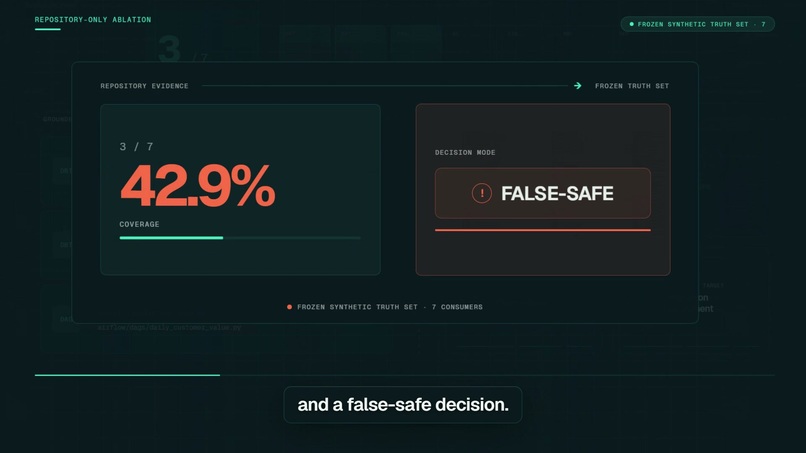
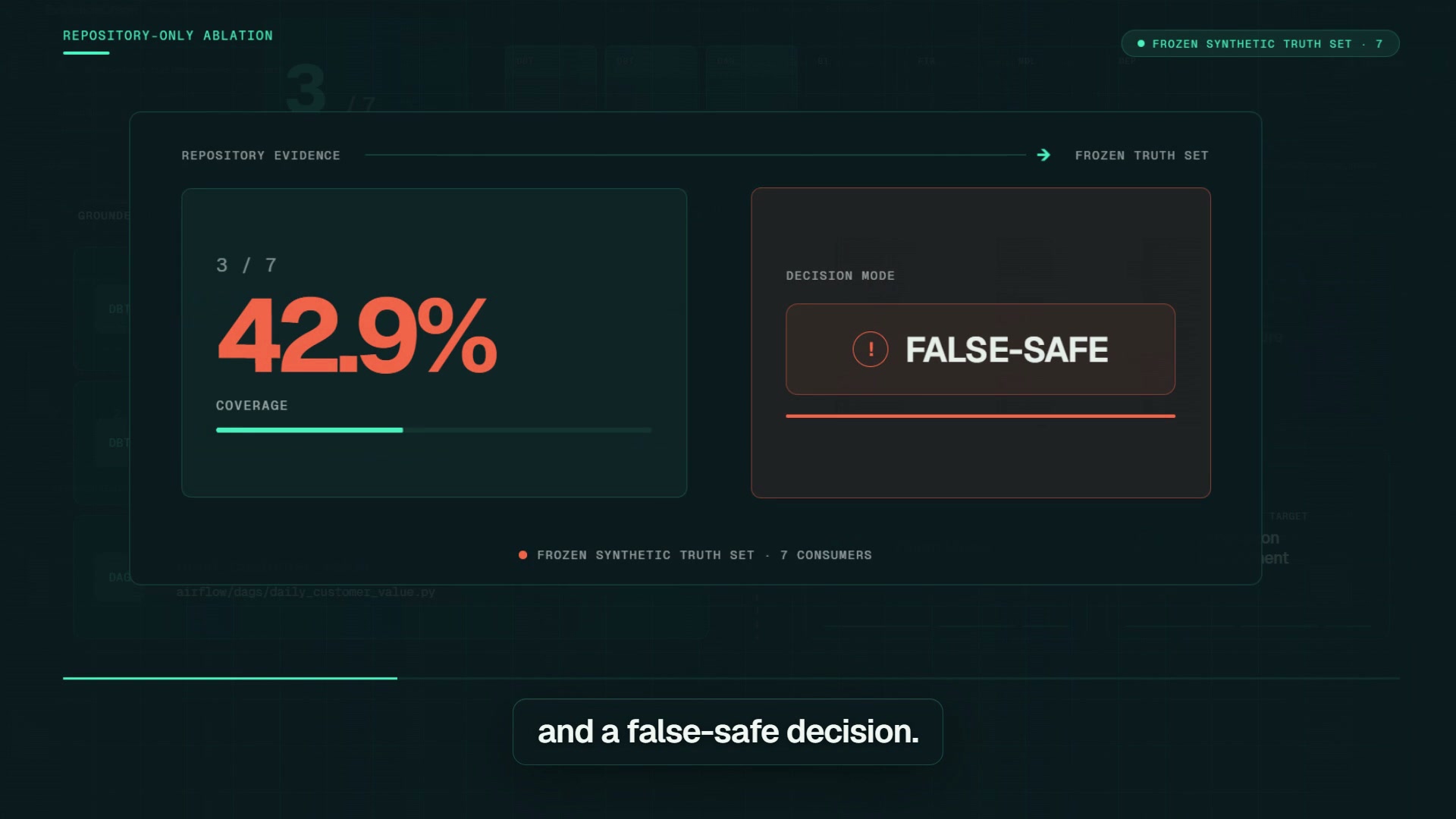
Repository-only analysis finds 3/7 consumers and produces a false-safe decision in the declared truth set.
-
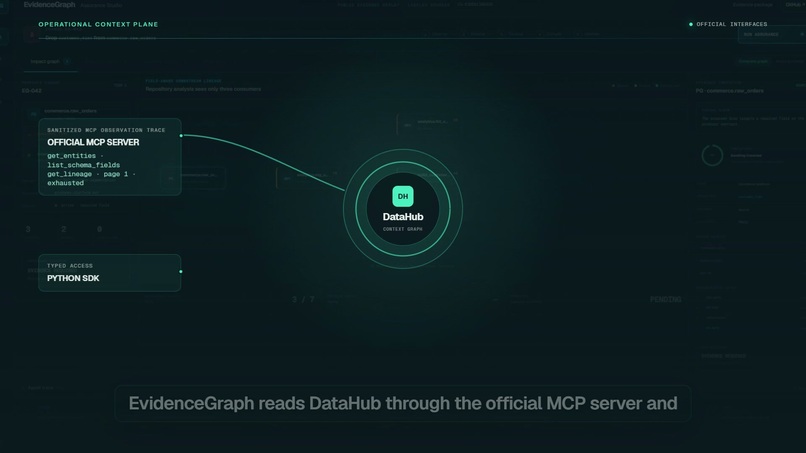
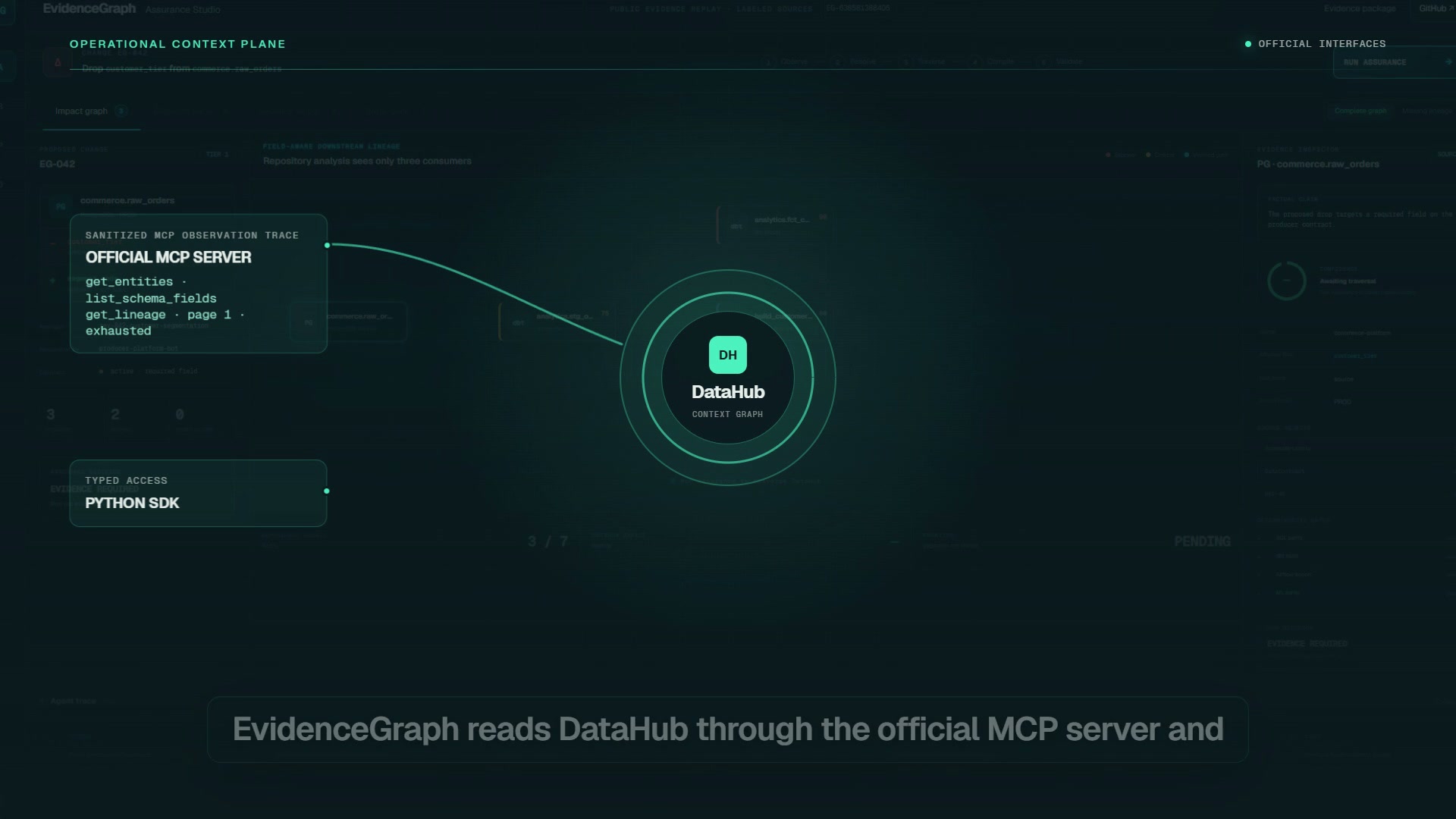
Official DataHub MCP and SDK calls bind schemas, ownership, lineage, contracts, BI, and ML into one operational graph.
-
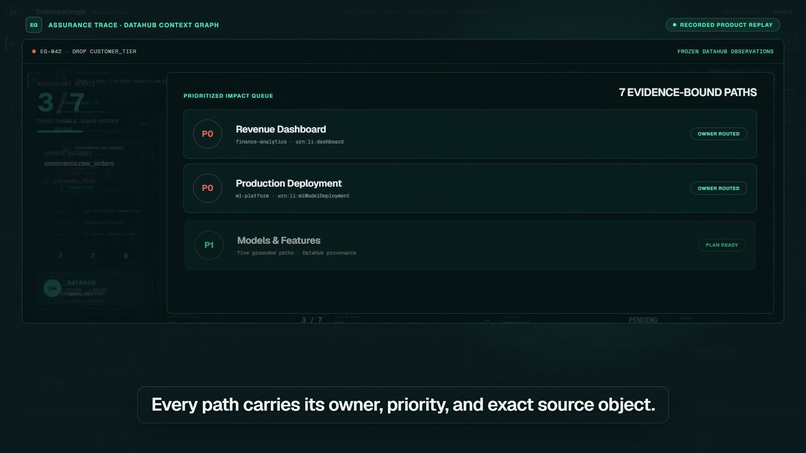
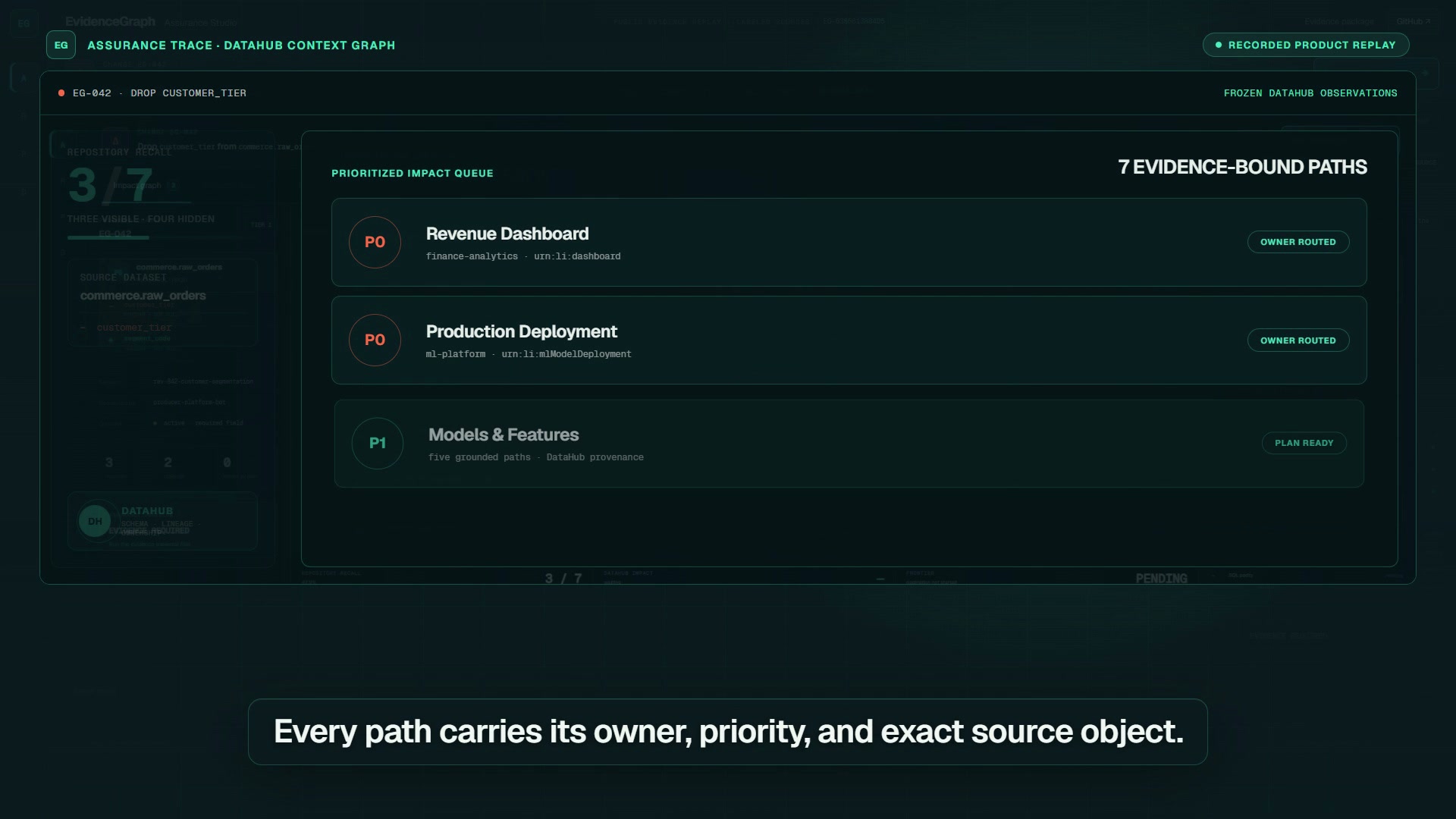
DataHub grounds all 7 declared impacts with owners, priority, and exact source-object evidence.
-
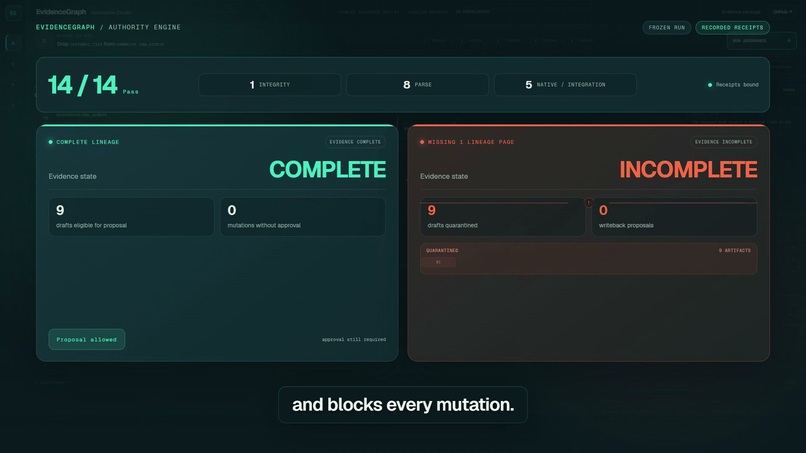
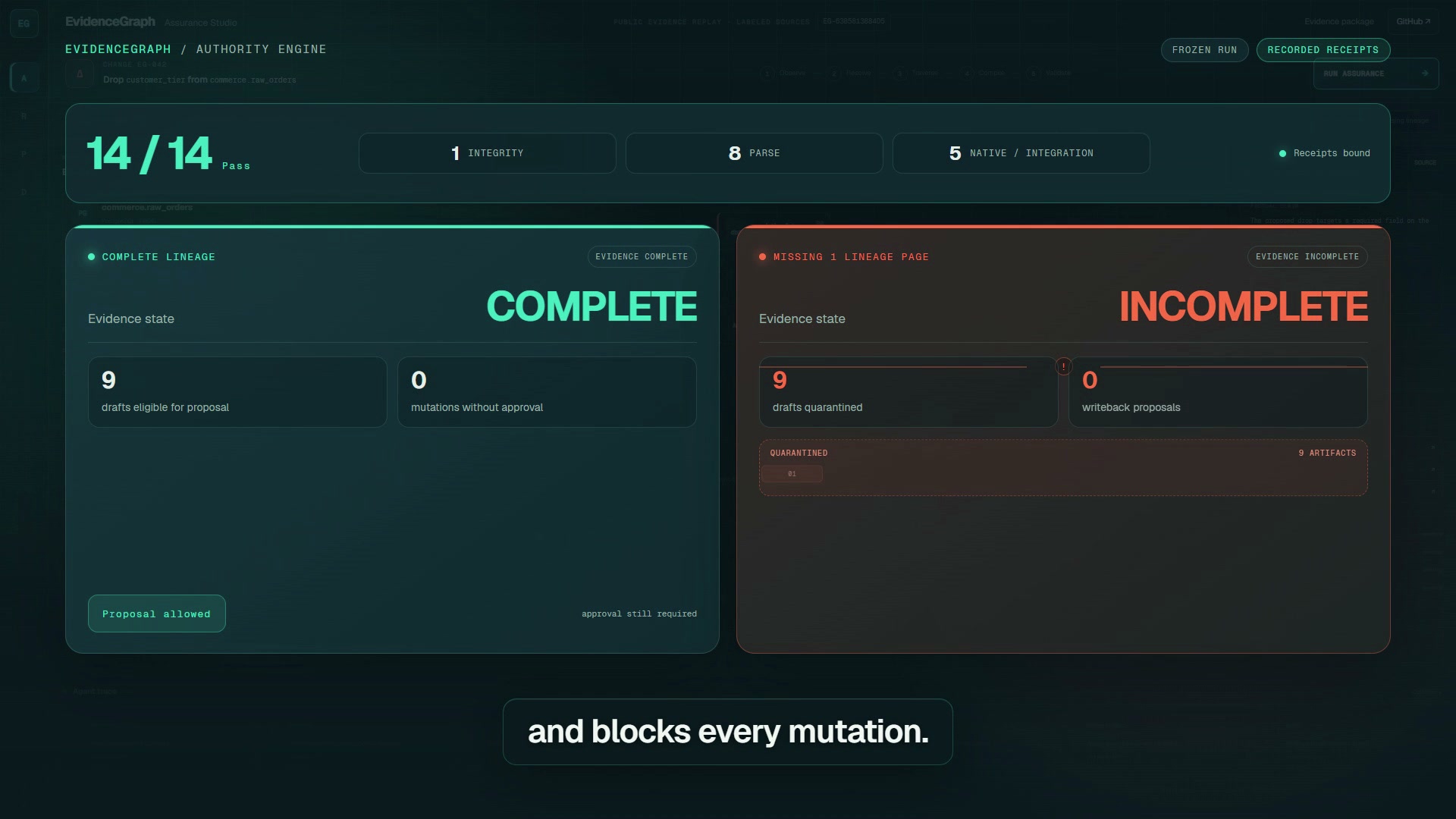
Fourteen deterministic gates cover Git, DuckDB, dbt, Airflow, parsers, integrity, and ML parity.
-
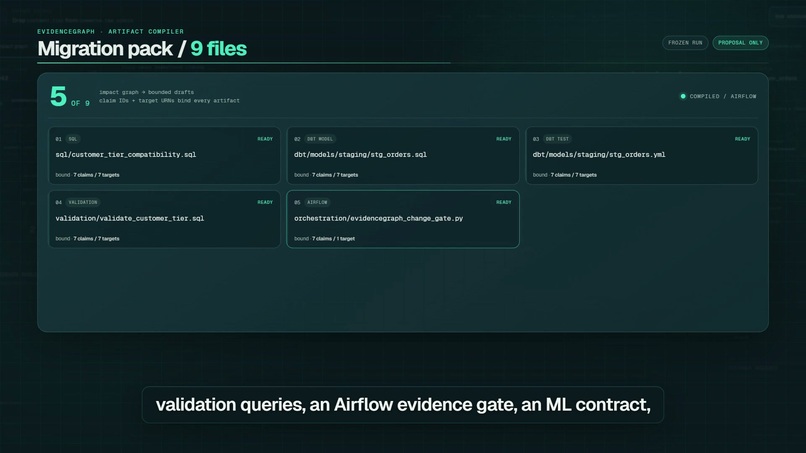
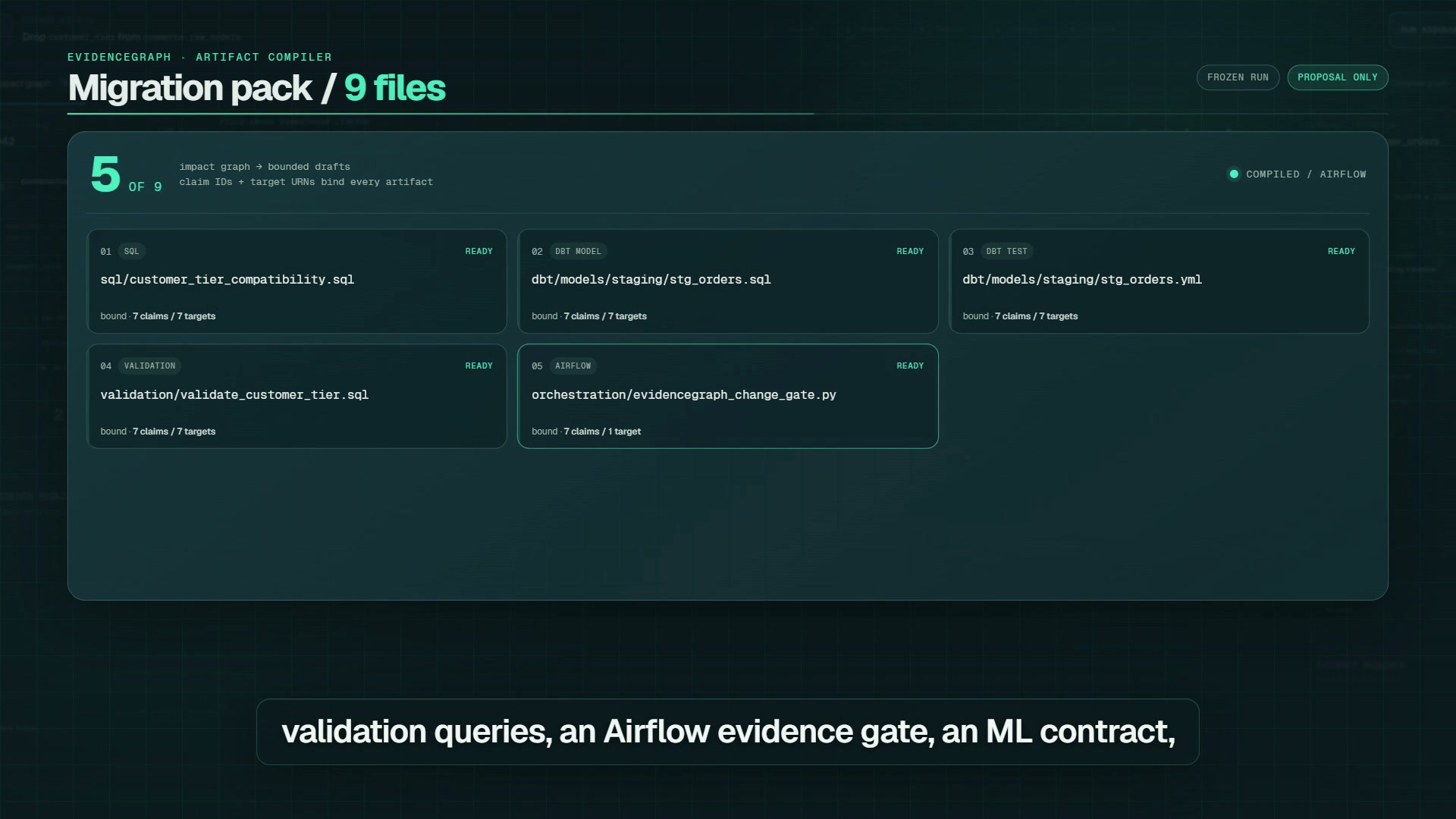
Nine reviewable artifacts span SQL, dbt, Airflow, ML, planning, and a real unified diff.
-
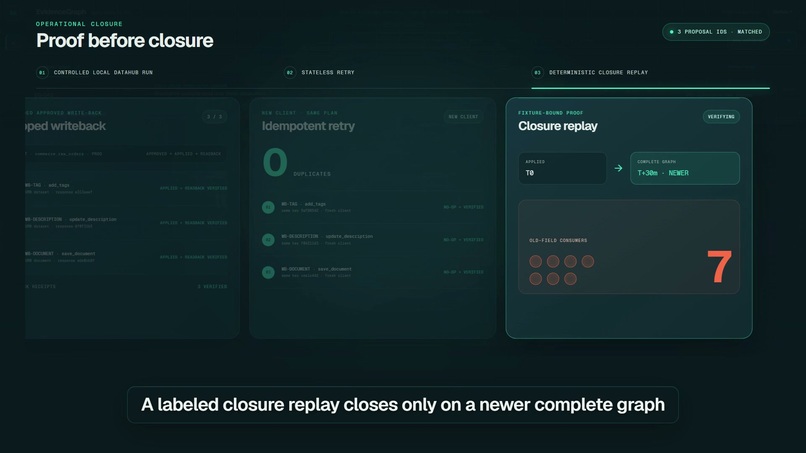
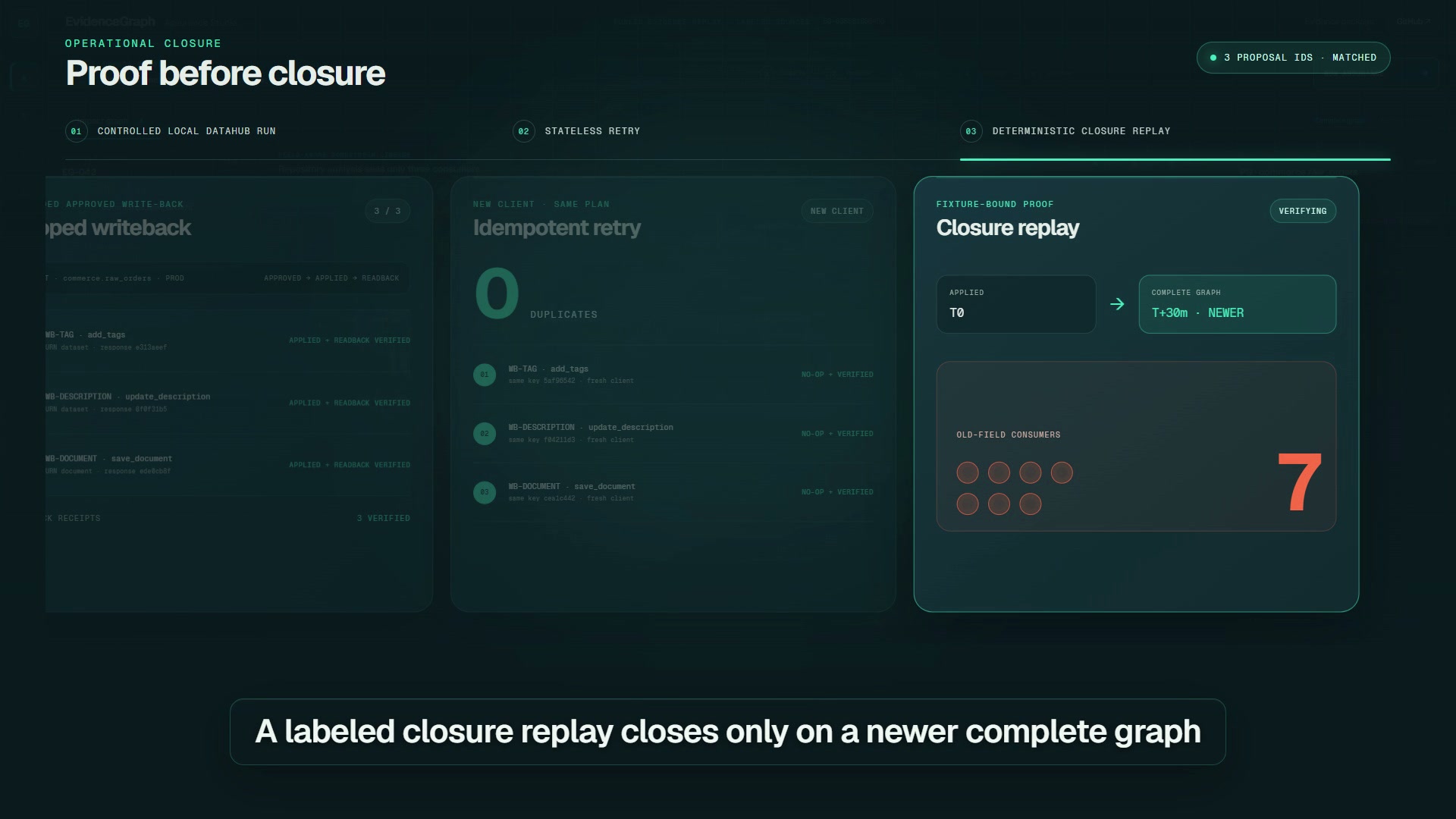
Controlled local write-back verifies by readback; retries no-op, and closure requires newer complete evidence.
-
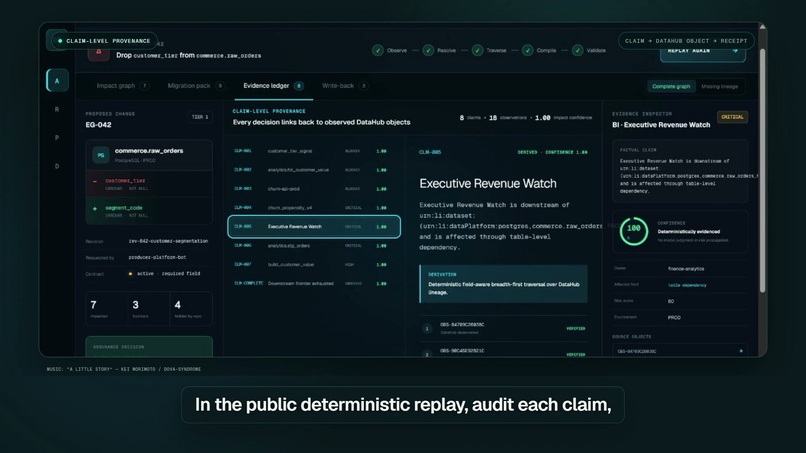
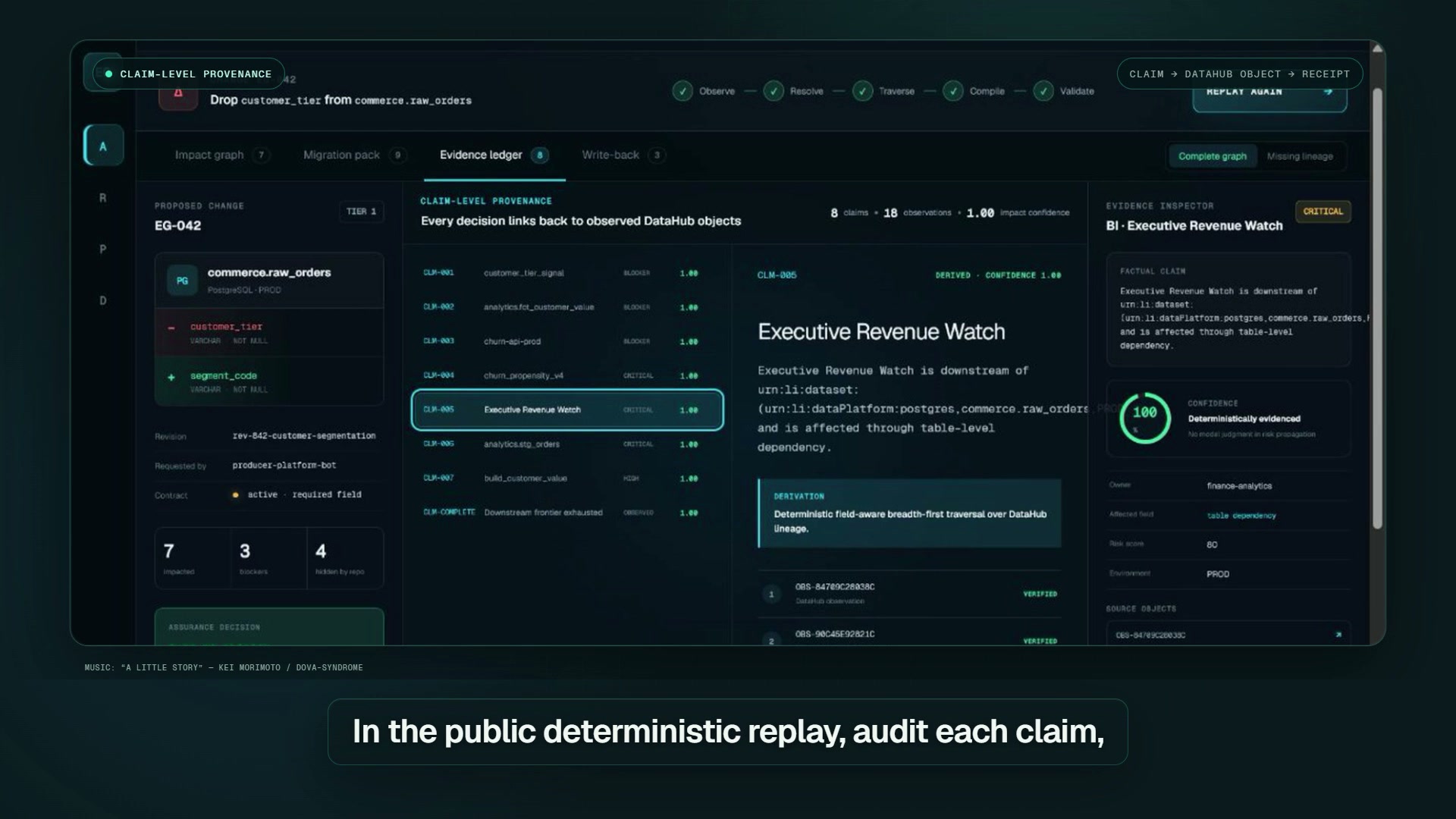
The evidence ledger binds every claim to source objects, confidence, tests, and unresolved risk.
EvidenceGraph
60-second judge path
- Open the public demo and click Replay assurance: repository-only coverage expands from 3/7 to DataHub-grounded 7/7, then 14 deterministic gates execute.
- Click Remove lineage: confidence is capped at 0.65, all nine drafts are quarantined, and write-back falls to zero.
- Click Inspect evidence: review claim-to-URN provenance, source objects, artifact hashes, receipts, and unresolved risks.
Latest reviewed source: main at 5757113. CI passes on Python 3.11/3.12, public replay, and secret scan.
EvidenceGraph uses DataHub's context graph to turn breaking data changes into impact maps with explicit completeness verdicts, validated migration code, and evidence-backed go/no-go decisions.
Inspiration
A column removal can look safe in a pull request while breaking an executive dashboard and a production model that live outside the repository. Catalog search can find metadata, but safe change automation needs more: complete path evidence, ownership, contracts, deterministic validation, and a refusal path when the graph is incomplete.
We built EvidenceGraph as a data-change assurance compiler. It makes DataHub context executable, testable, and auditable instead of merely summarizing a catalog page.
What it does
EvidenceGraph accepts a proposed schema, contract, pipeline, or ML feature change and runs a bounded workflow:
- collect schemas, ownership, documentation, tags, contracts, dataset and column lineage, dashboard dependencies, and ML metadata from DataHub;
- prove whether the requested downstream frontier is complete;
- compute affected assets and evidence-backed risk priorities;
- generate a cross-system migration bundle;
- run a deterministic 14-gate suite with native and integration receipts;
- issue a go/no-go decision with unresolved risks; and
- optionally write an allowlisted evidence marker and document back to DataHub after explicit safety gates.
Every impact claim links to DataHub URNs and recorded observations. Every generated file links to the claim IDs and target objects it used. Every validation result links to an artifact hash and a structured receipt. A missing lineage page, unresolved field, owner gap, evidence conflict, or failed validator blocks write-back and safe-to-merge status.
Flagship scenario
Our miniature commerce platform models a source dataset, two dbt datasets, an
Airflow job, an executive Looker dashboard, an ML feature, a churn model, a
production model deployment, owners, documentation, and a governed contract.
The proposed removal of customer_tier crosses every one of those boundaries.
A repository-only scanner finds 3 of the 7 affected assets. With DataHub, EvidenceGraph finds all 7 of 7. The additional context recovers the executive dashboard plus the ML feature, model, and deployment: a 57.1 percentage-point recall improvement against the frozen truth set and the difference between an unsafe approval and an evidence-backed plan.
EvidenceGraph generates nine artifacts, including a compatibility SQL view, a dbt model and tests, a real unified diff, validation SQL, an Airflow publication gate, an ML feature compatibility contract, a risk-ranked migration plan, and an artifact manifest.
The frozen flagship bundle passed 14 of 14 deterministic gates: one artifact-integrity and evidence-binding check, eight structured-file parser checks, and five native or integration checks—Git patch application, DuckDB parity, dbt build, Airflow DagBag and dependency-gate execution in the official container, and ML feature parity. dbt Core 1.12.0 built the generated model and passed 7 of 7 tests. DuckDB executed the SQL compatibility plan. The generated DAG passed DagBag import and dependency assertions inside the official Apache Airflow 3.3.0 Linux container. The ML parity check reported a 0.0 mismatch rate across the four synthetic rows.
Why DataHub is essential
DataHub is the operational context graph, not a decorative lookup layer. Removing it changes the result: EvidenceGraph loses four non-repository consumers, owner routing, governed context, and the evidence needed to authorize action.
DataHub changes both scope and authority. With the recorded complete graph, EvidenceGraph grounds 7 of 7 declared impacts and permits write-back proposals only after all 14 gates pass. In the paired missing-lineage replay, one unavailable page caps confidence at 0.65, quarantines the same nine drafts, and reduces write-back proposals to zero.
The official DataHub MCP Server is the runtime boundary for search, entity
context, schemas, dataset lineage, column lineage, and governed mutations. The
demo pins [email protected]. The official DataHub Python SDK
(acryl-datahub==1.6.0.6) provides the narrow aspect reader used for document,
contract, ML-property, and modeled deployment relationships that MCP 0.6.0 does
not expose as lineage nodes. DataHub Core v1.6.0 stores the heterogeneous graph
and the bounded write-back.
How we built it
EvidenceGraph is a Python application with a typed context-provider boundary, a deterministic impact engine, risk planner, artifact generator, validation harness, policy gate, evidence ledger, and allowlisted write-back executor.
The official MCP server provides inspectable agent tools. Pydantic models keep observed, derived, incomplete, failed, and unsupported evidence states distinct. DuckDB executes the synthetic warehouse plan, dbt validates the generated transformation, and an official Airflow container validates the DAG and its publication gate. Artifact and response hashes make the run inspectable without storing secrets.
No external LLM key is required. The safety-critical reasoning and validation path is deterministic so an optional model cannot invent facts or override a failed policy gate.
Challenges we solved
- Treating pagination exhaustion and traversal bounds as evidence, instead of assuming that a successful first page proves completeness.
- Normalizing heterogeneous DataHub assets while retaining their original URNs and observation hashes.
- Keeping BI and production ML consumers in the same change decision as SQL, dbt, and orchestration code.
- Validating generated work in disposable native environments without allowing those tools to inherit DataHub credentials.
- Separating useful read-only analysis from a tightly governed metadata mutation boundary.
What we learned
The most important lesson is that zero results are not evidence of zero impact.
An operational agent needs to represent not queried, read failed,
incomplete, and unsupported separately. DataHub becomes most valuable when
its context changes the agent's plan and authority, not just its prose.
We also learned that generated code is only as credible as its receipts. A reviewer should be able to move from a risk score to a lineage observation, from an artifact to its evidence claims, and from a success badge to the exact tool, version, exit code, and output digest.
Current limitations
The measured 7-of-7 result is scoped to the declared synthetic graph. The
current artifact strategy is intentionally narrow and supports the flagship
customer_tier removal with an approved compatibility mapping. EvidenceGraph
does not modify production systems or merge code.
Fresh-graph closure is demonstrated as a labeled deterministic before/after replay, not as a mutation performed by the hosted public demo. A controlled local run applied and read back the three allowlisted DataHub metadata operations; a new MCP client retried the identical proposal set and verified three no-ops. This does not prove transactional rollback after an interrupted multi-step write. The anonymous public demo has no mutation path.
What's next
Next steps include more schema-change strategies, pull-request integration, first-class BI semantic validation, additional ML registries and orchestrators, and transactional recovery for interrupted metadata writes.
Data and privacy
All demonstration records, assets, teams, and business names are synthetic. The project uses no customer data, private tenant metadata, or personal information.
Try it
- Public demo:
https://evidencegraph-datahub.liu891855.chatgpt.site - Public repository:
https://github.com/agentic-build-lab/evidencegraph-datahub - Sample evidence package:
https://github.com/agentic-build-lab/evidencegraph-datahub/tree/v0.2.0/examples - Demo video:
https://youtu.be/qnPR0Y6kENE - Release:
https://github.com/agentic-build-lab/evidencegraph-datahub/releases/tag/v0.2.0
Built with
DataHub Core, DataHub MCP Server, DataHub Python SDK, Model Context Protocol, Python, Pydantic, Typer, DuckDB, dbt, Apache Airflow, Docker, SQLGlot, PyYAML, Rich, and pytest.

Log in or sign up for Devpost to join the conversation.