
EvidenceCheck AI — Trace the Evidence. Question the Claim.
Inspiration
Misinformation is increasingly difficult to identify, especially when AI-generated explanations sound convincing but lack verifiable sources.
We wanted to build something more transparent than a chatbot that simply labels a statement "true" or "false."
EvidenceCheck AI is an evidence investigation platform that shows how a conclusion is reached, which sources support it, what challenges it, and whether the quotations used as proof actually match retrieved evidence.
What It Does
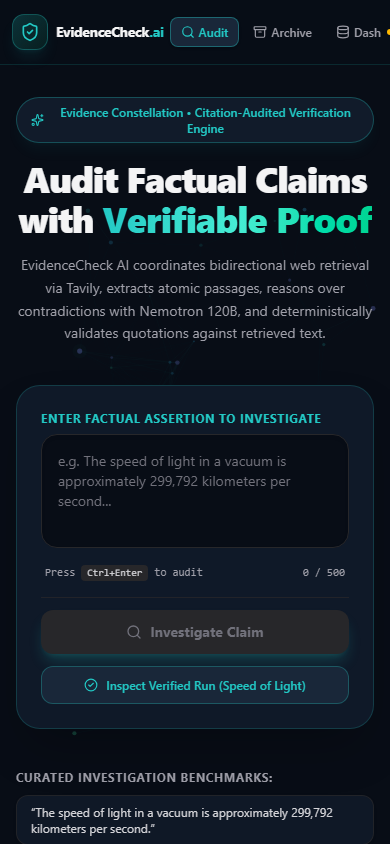
EvidenceCheck AI allows users to enter a factual claim and receive a structured investigation backed by real web search results.
Its core capabilities include:
- Bidirectional research: Searches for both supporting evidence and potential counterevidence.
- AI-powered analysis: Uses NVIDIA Nemotron to interpret retrieved passages and identify their relationship to the claim.
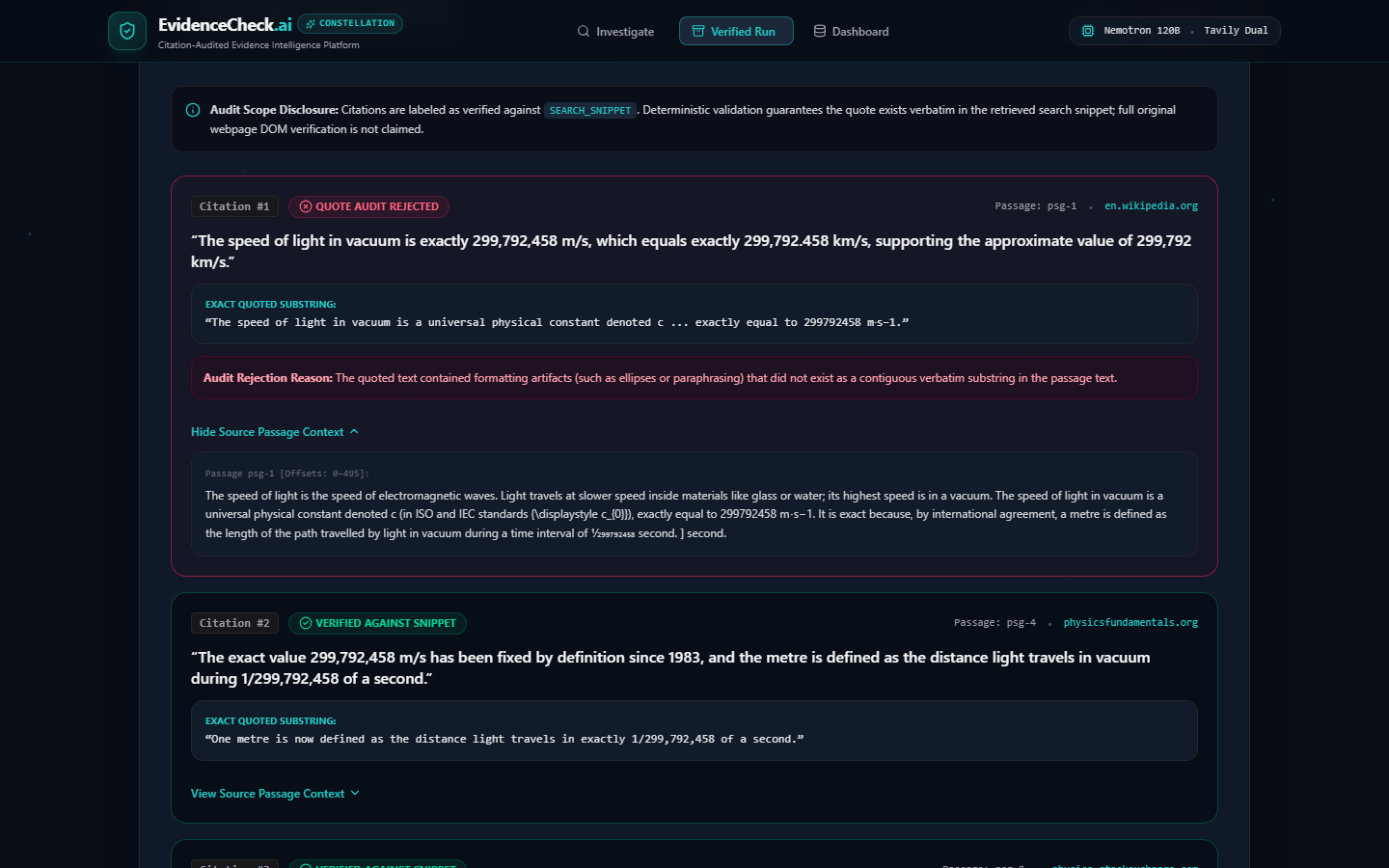
- Citation auditing: Checks AI-generated quotations against the exact text of retrieved search passages.
- Contradiction awareness: Identifies conflicting evidence and avoids unsupported certainty.
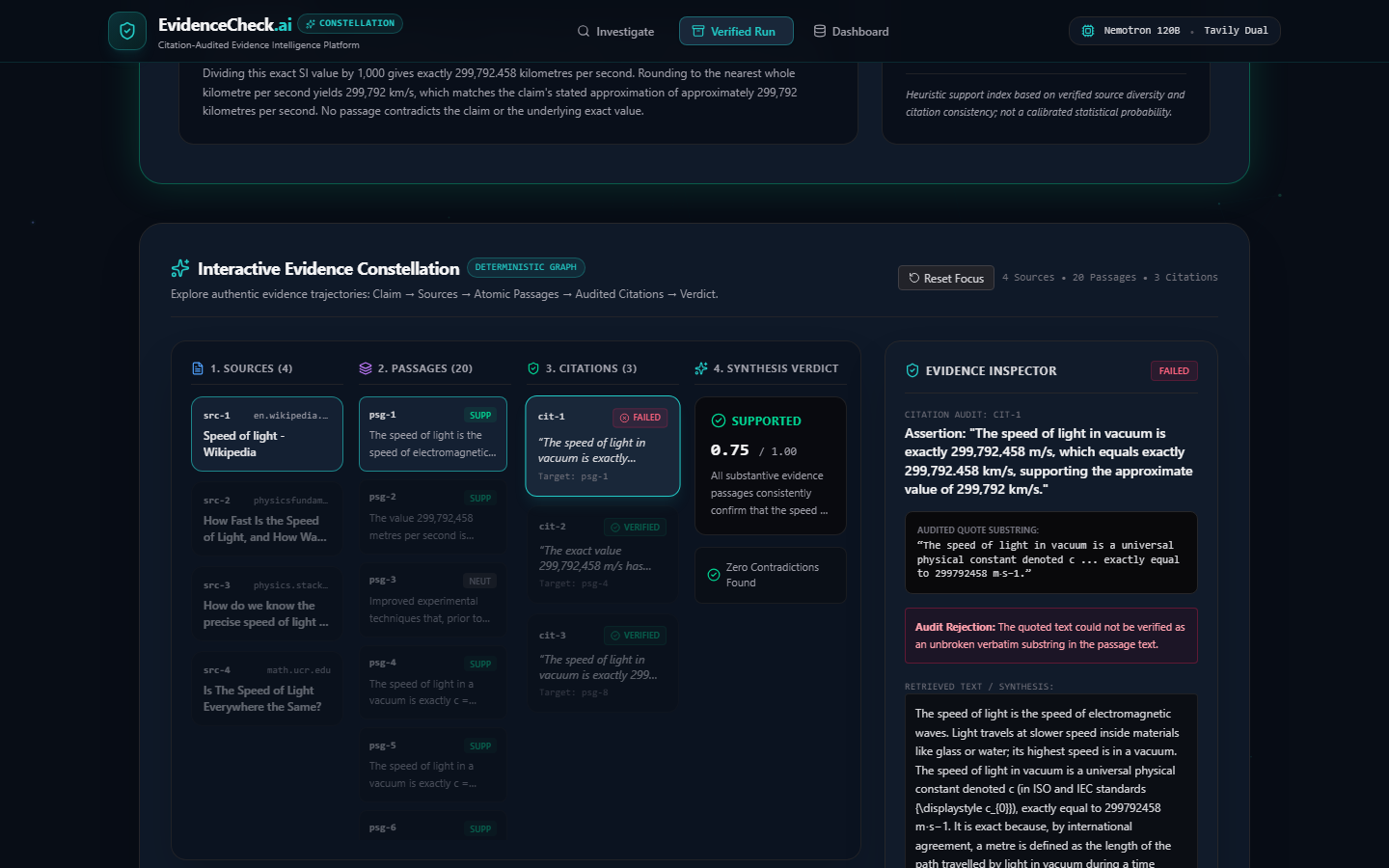
- Evidence Trail: An interactive graph connecting sources, passages, audited citations, and the final verdict.
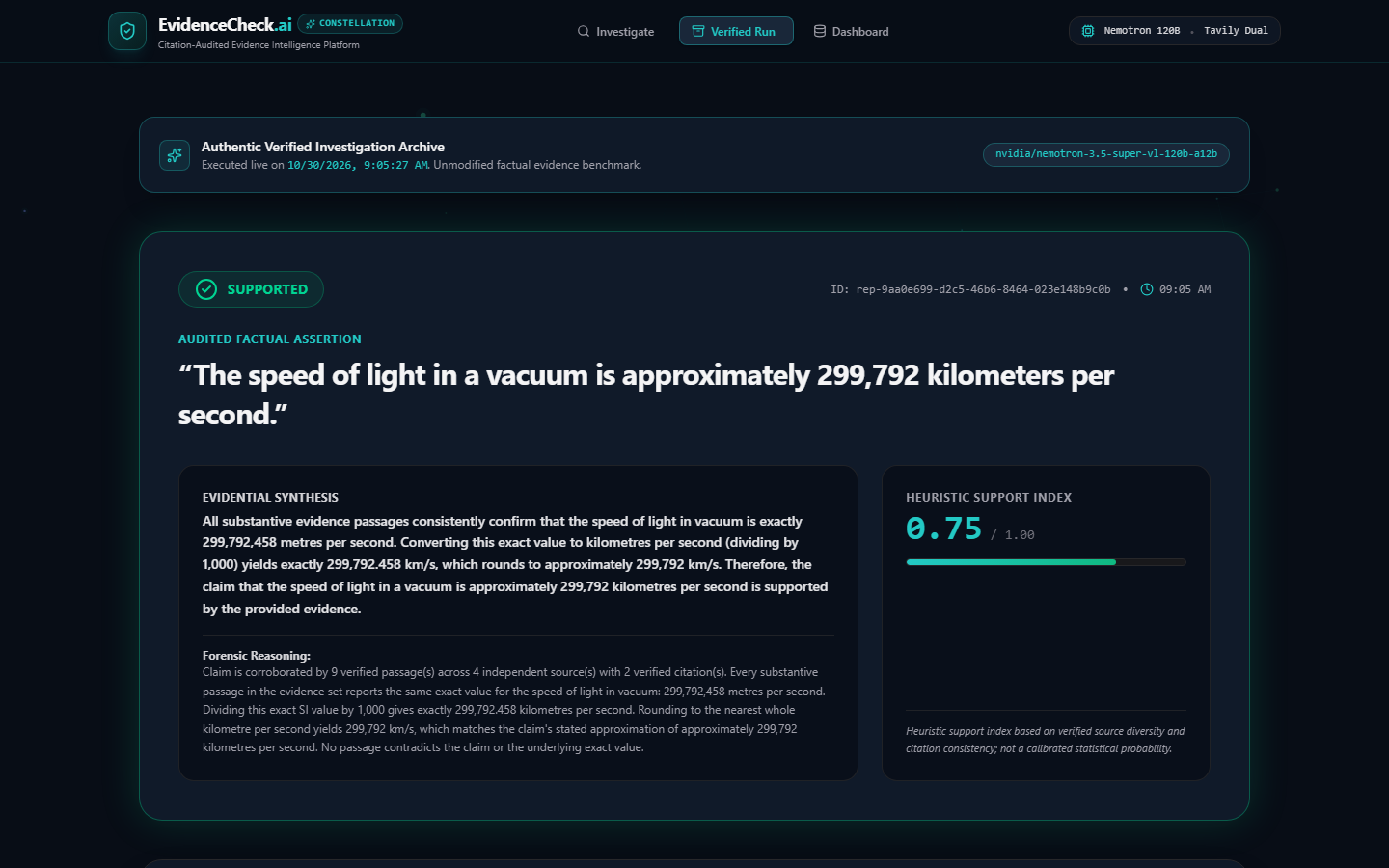
- Transparent verdicts: Reports Supported, Refuted, Contradictory, or Insufficient Evidence.
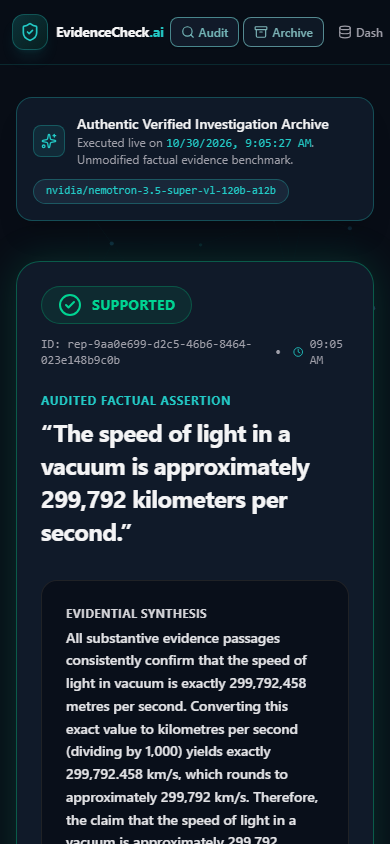
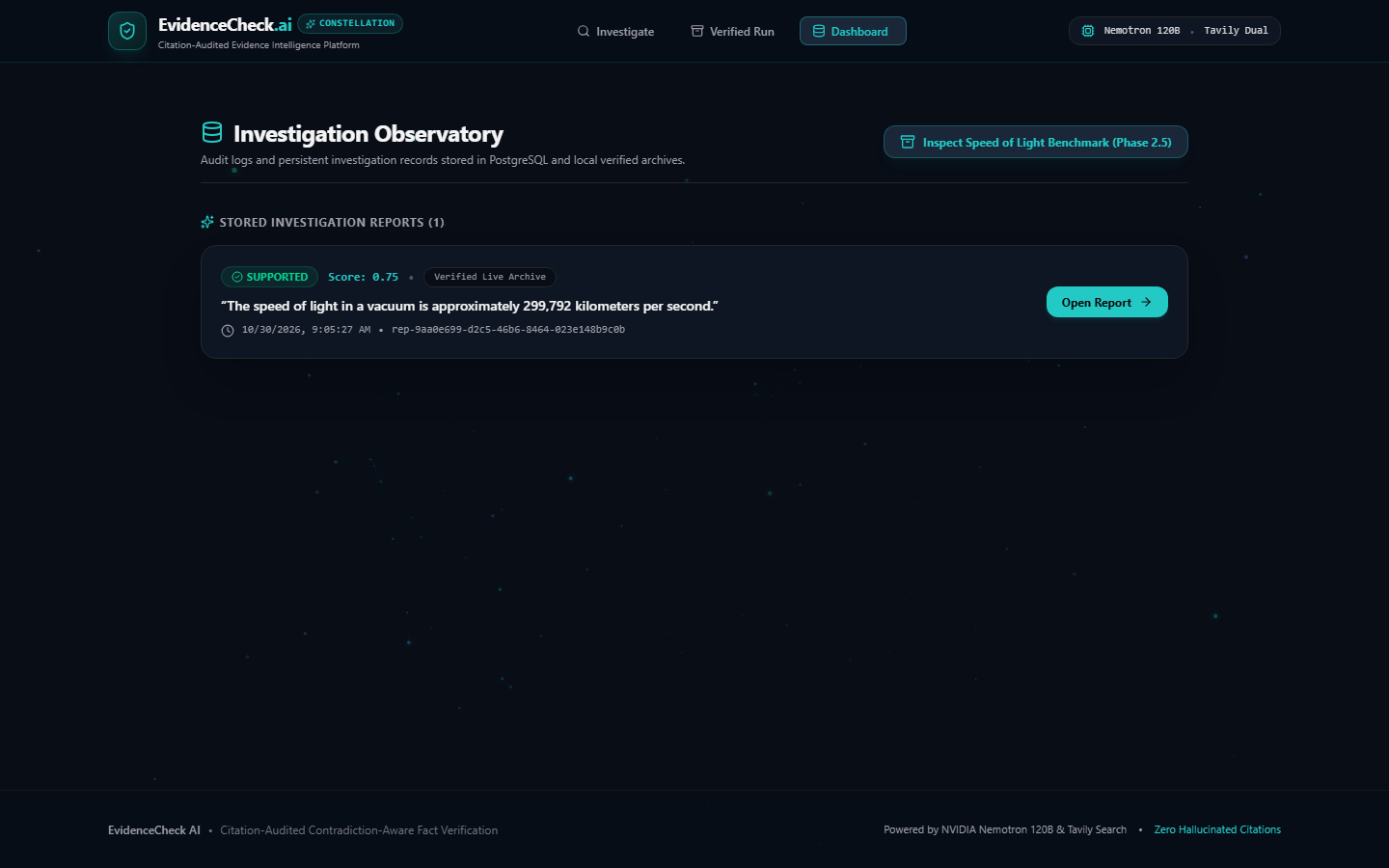
The interface includes an interactive evidence constellation, source explorer, citation inspector, and responsive investigation dashboard.
How We Built It
The application was developed using Next.js, React, TypeScript, and Tailwind CSS.
Our investigation pipeline works as follows:
- A user submits a factual claim.
- NVIDIA Nemotron generates supporting and challenging research queries.
- Tavily Search retrieves real external sources.
- The system divides retrieved content into identifiable evidence passages.
- NVIDIA Nemotron analyzes the passages and proposes evidence-backed conclusions.
- A deterministic citation auditor checks proposed quotations against the retrieved passage text.
- A verdict engine evaluates corroboration and contradictions.
- The report appears in an interactive Evidence Trail, where users can inspect the underlying evidence.
We used structured schema validation to enforce predictable outputs and built safeguards around provider requests, rate limits, and API-credit usage.
Challenges We Faced
Integrating NVIDIA Nemotron: Early API calls produced errors because of request serialization and response-format handling. We resolved these issues and verified the integration through a successful real API request.
Preventing fabricated citations: Our model sometimes proposed a quotation containing an ellipsis that did not match a continuous passage substring. Instead of silently accepting it, the deterministic citation auditor rejected it.
Balancing research quality with API costs: We limited each investigation to two research searches and two model completions, while retaining supporting and challenging research perspectives.
Building a usable evidence interface: We created an interactive evidence graph rather than displaying a verdict with a disconnected list of links.
Frontend styling and performance: We corrected a Tailwind/PostCSS configuration issue and developed lightweight constellation graphics without relying on large 3D assets.
Accomplishments
We completed a real end-to-end investigation of the claim:
"The speed of light in a vacuum is approximately 299,792 kilometers per second."
The pipeline successfully executed two NVIDIA model requests and two Tavily searches, retained four sources, processed twenty passages, and audited three citations. Two quotations passed deterministic verification, while one was rejected.
The system returned a Supported verdict with an inspectable evidence report.
The project also passed 57 automated tests, and its interactive interface was tested locally on desktop and mobile.
What We Learned
The most important lesson was that generating an AI answer is not the same as verifying evidence.
A trustworthy investigation requires source traceability, citation checks, clear uncertainty, and the ability to reject unsupported model output.
We also learned how to integrate hosted AI models, control external API costs, validate structured outputs, and transform a research pipeline into an interactive product.
What's Next
Our planned improvements include:
- Verification against full original webpages rather than only retrieved search snippets.
- Stronger source-quality and independence assessment.
- Persistent investigation history.
- Public deployment with database-backed usage limits.
- A browser extension for investigating claims directly from webpages.
Our Vision
EvidenceCheck AI aims to make factual investigation transparent, interactive, and understandable—so users can examine the evidence rather than simply trust an AI-generated verdict.
Built With
- javascript
- next.js
- nvidia-nemotron
- postgresql
- react
- tailwind-css
- tavily
- typescript
- zod

Log in or sign up for Devpost to join the conversation.