-
-
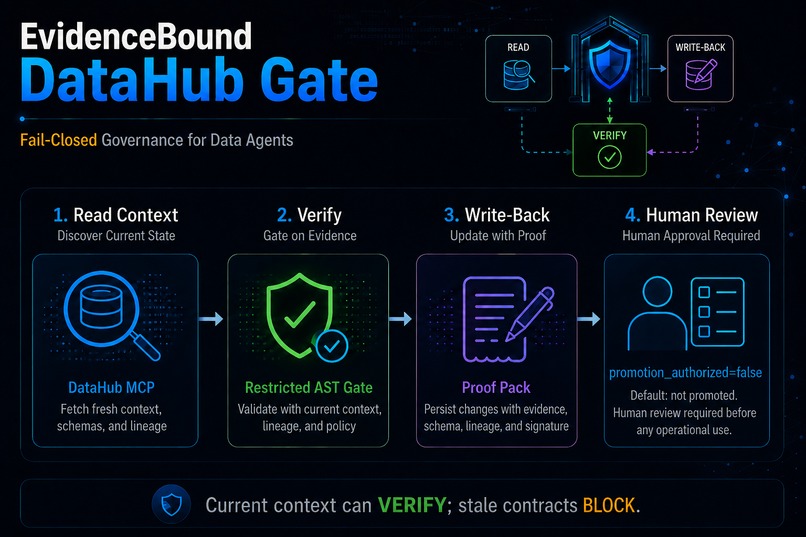
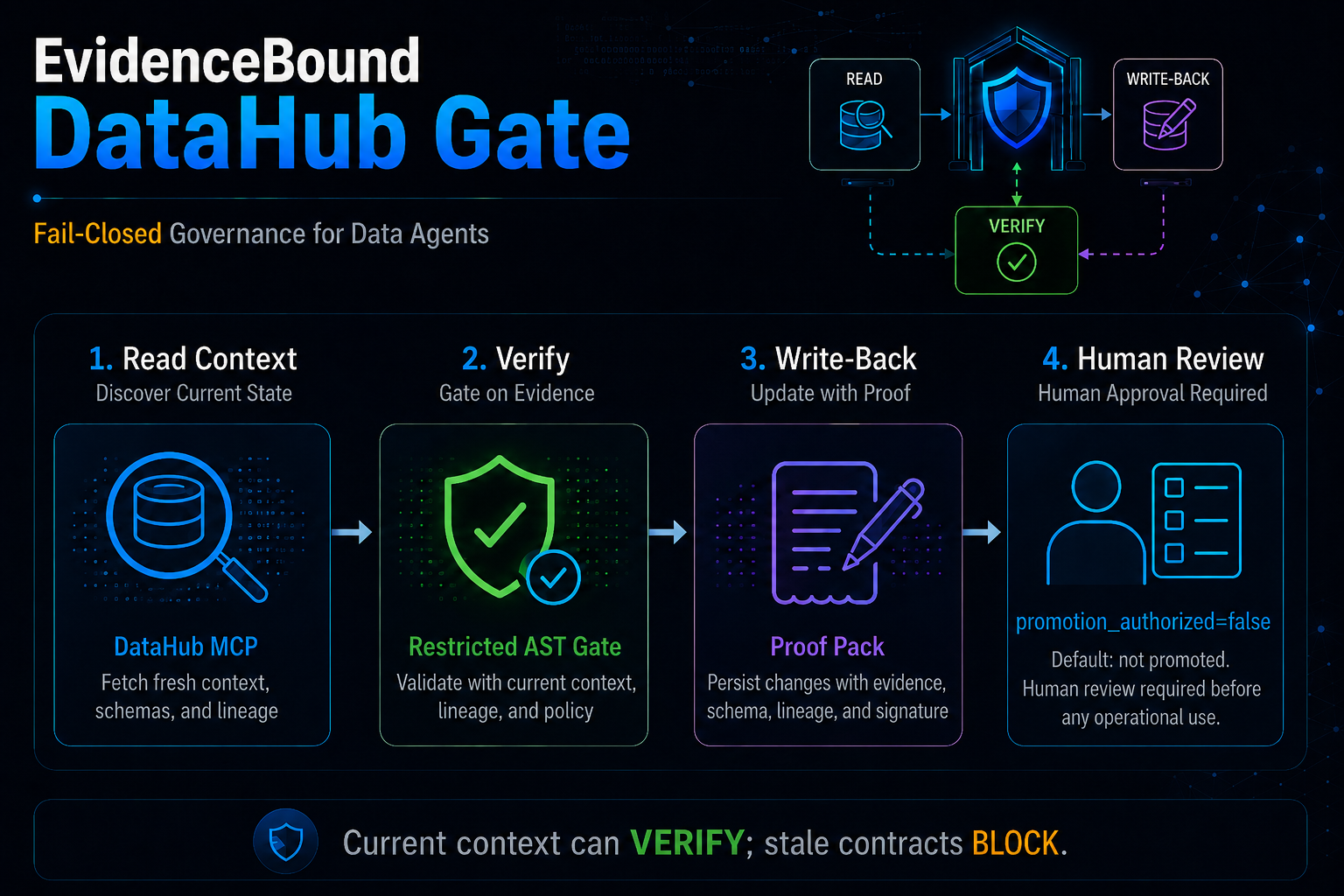
The governed workflow: DataHub MCP context reading, deterministic AST verification, evidence-backed write-back, and mandatory human review.
-
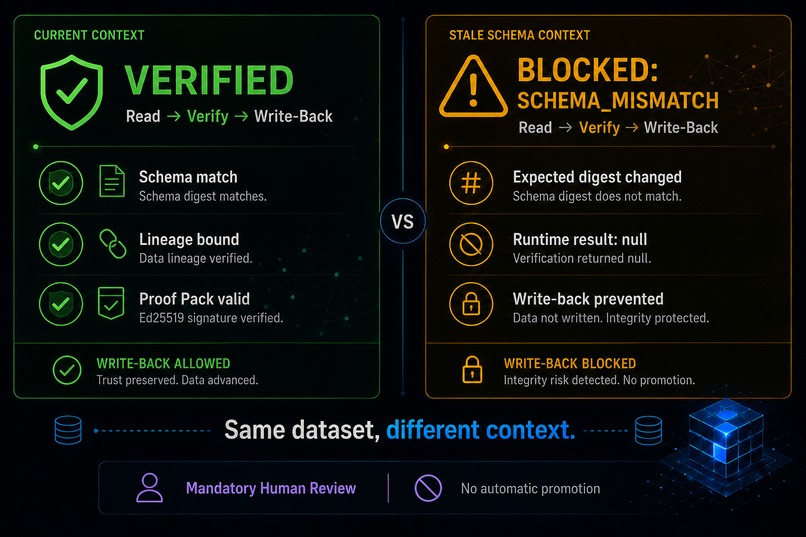
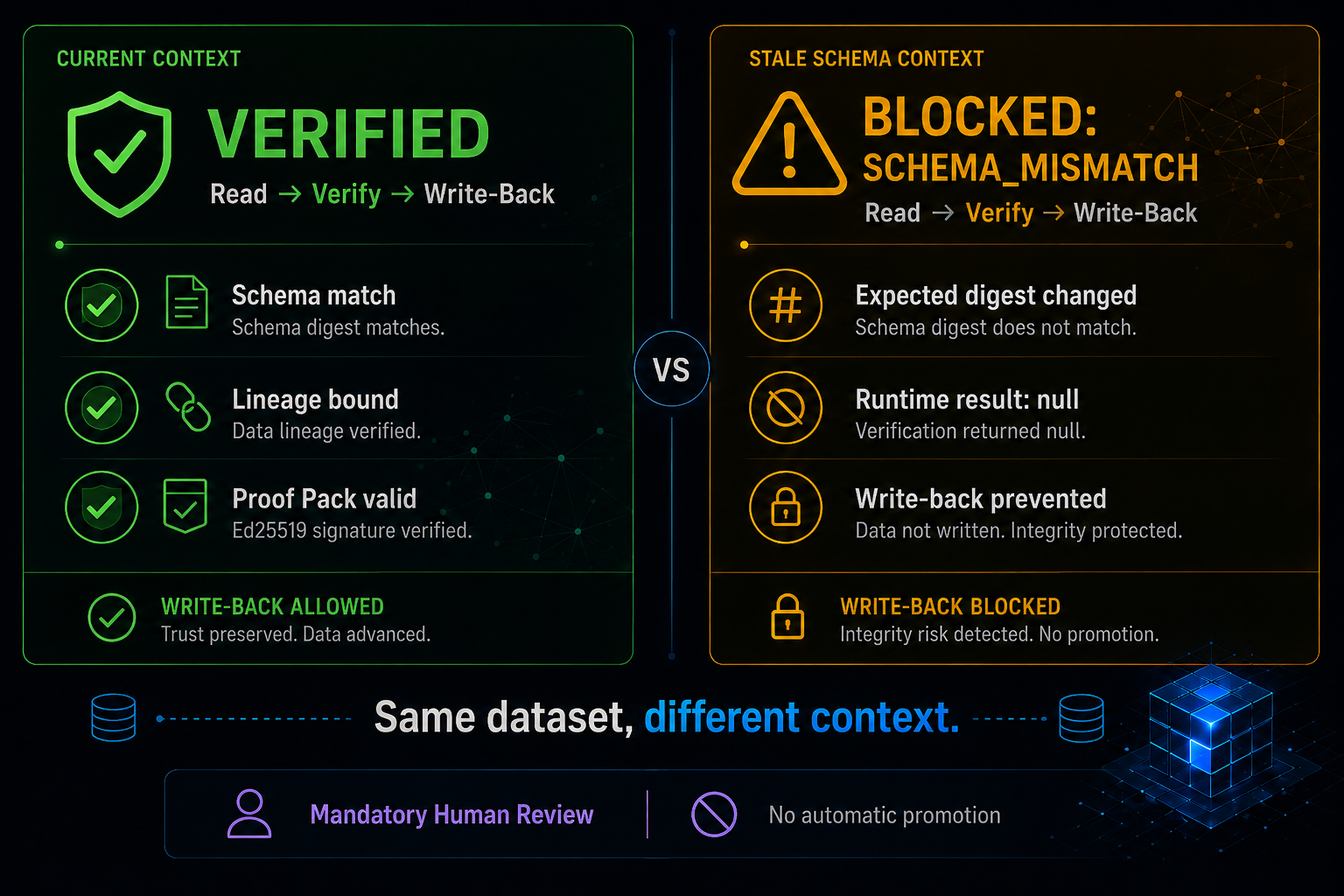
The same dataset produces different outcomes when the candidate is bound to current versus stale schema context.
-
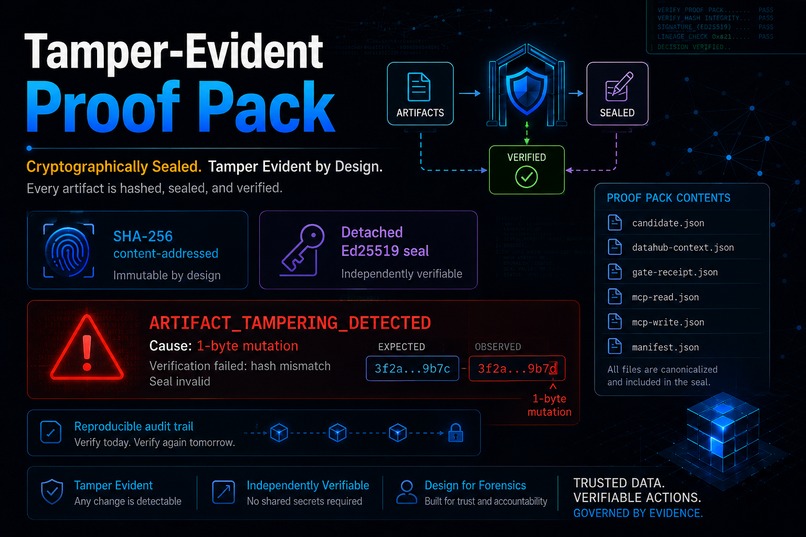
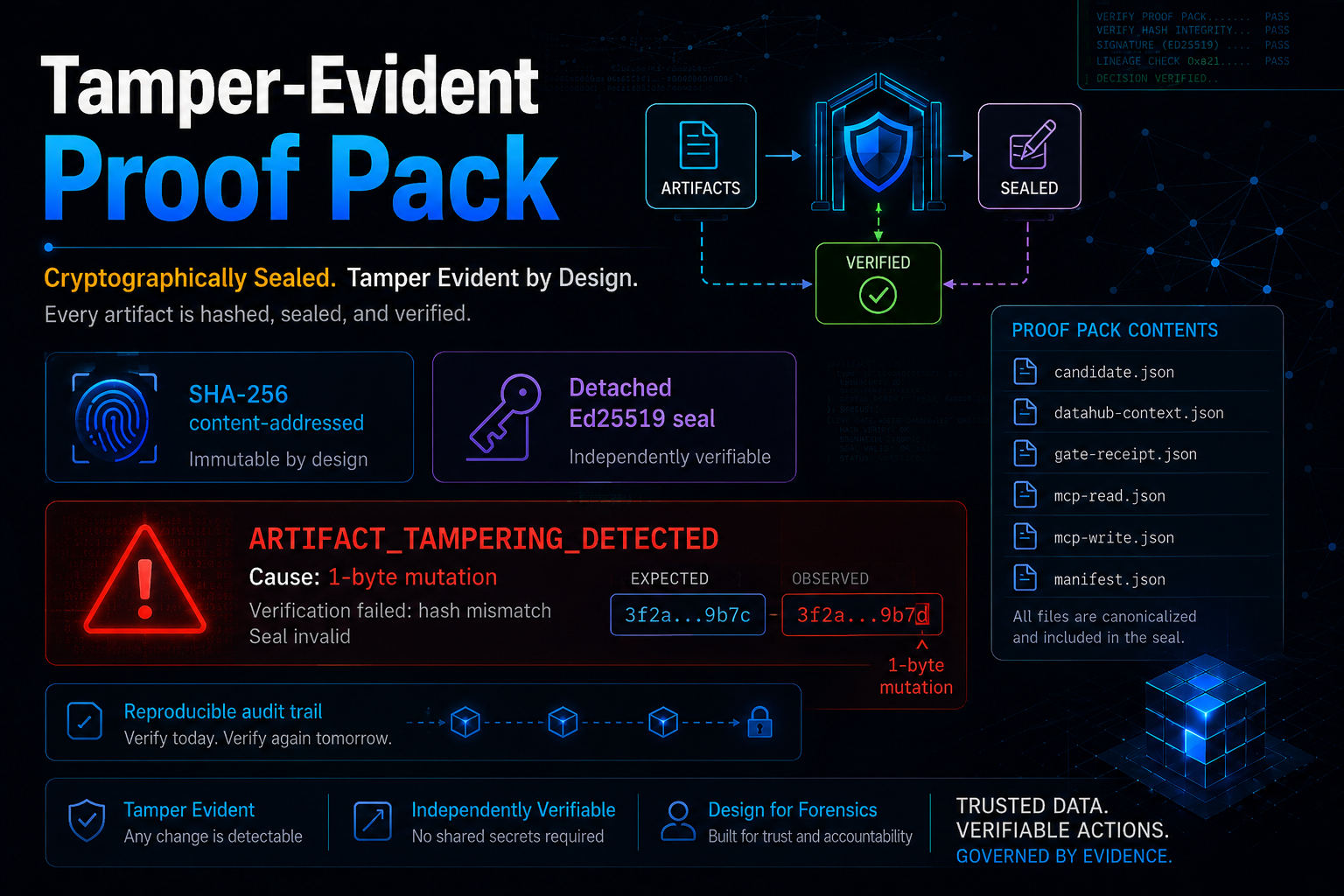
Content-addressed Proof Packs reject a one-byte artifact mutation and support detached Ed25519 verification.
-
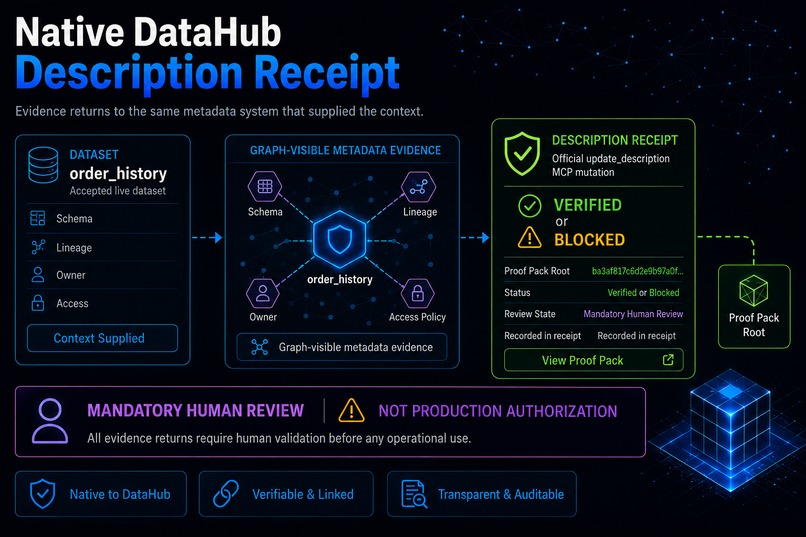
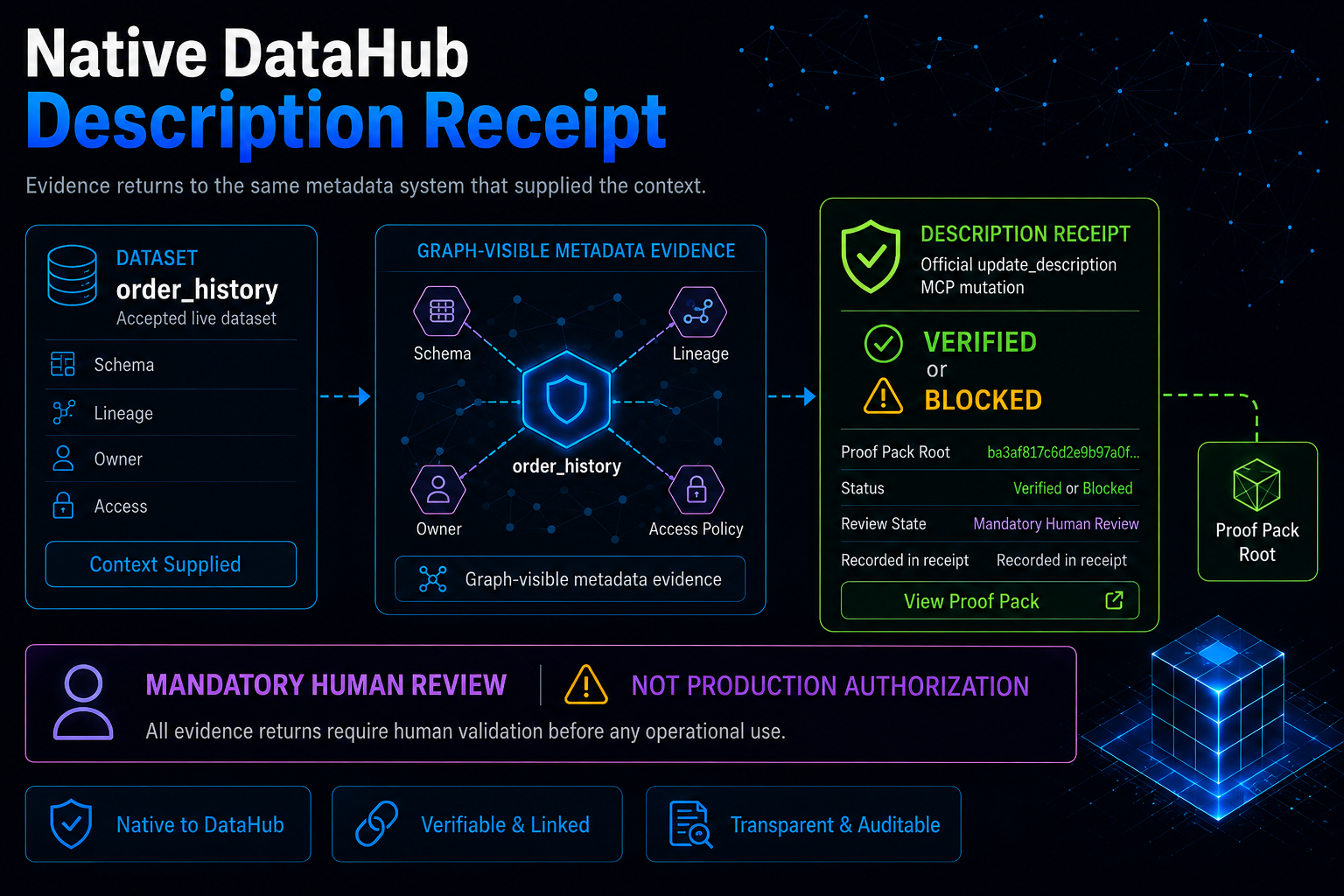
VERIFIED or BLOCKED evidence returns to DataHub through the official update_description MCP mutation, with a bound Proof Pack root
Inspiration
Data agents can generate actions that are syntactically valid but bound to stale schemas, incomplete lineage, or unsupported claims. A successful tool call does not prove that the exact candidate is ready for human review, and asking the same model to certify its own action does not create independent, reproducible evidence.
EvidenceBound DataHub Gate was built around a narrower question:
Before a human approves an agent-generated data action, can the exact candidate be bound to current DataHub context, evaluated deterministically, retained as reproducible evidence, and returned to the metadata graph without implying production authorization?
The project creates a deterministic, fail-closed review boundary between current DataHub context, agent-generated code, and human approval.
What it does
Read Context → Restricted AST Gate → Tamper-Evident Proof Pack → Native DataHub Write-Back → Mandatory Human Review
1. Read current DataHub context
The official DataHub MCP Server discovers the dataset, reads its exact identity and current schema fields, and retrieves a bounded one-hop lineage edge. EvidenceBound canonicalizes that observed context and derives schema and lineage digests.
The accepted live dataset was:
urn:li:dataset:(urn:li:dataPlatform:dbt,b2fd91.ORDER_ENTRY_DB.analytics.order_history,PROD)
Lineage reads are deliberately bounded to one hop and at most five results. The adapter checks upstream first and skips the opposite direction after a visible edge is found. Missing lineage still blocks the selected candidate path.
2. Bind and verify the candidate deterministically
The candidate is bound to:
- the selected dataset identity;
- the observed schema digest;
- the observed lineage digest;
- a versioned Restricted AST Policy;
- explicit evidence references for material claims.
Unsupported syntax and capabilities are rejected. Permitted operations run in a Fail-Closed Bounded Interpreter without arbitrary exec.
A candidate reaches VERIFIED only when dataset identity, schema and lineage digests, Restricted AST Policy, bounded execution, and claim-to-evidence references all pass.
Changing only the expected schema digest produces:
BLOCKED: SCHEMA_MISMATCH
runtime_result: null
promotion_authorized: false
The stale candidate is blocked before runtime interpretation.
3. Export a reproducible Proof Pack
Every result becomes a SHA-256 content-addressed Proof Pack containing the candidate, observed DataHub context, typed receipt, MCP read and write evidence, manifest, and checksums.
Reproduction rejects:
- changed artifacts;
- non-canonical JSON;
- symlinks;
- missing files;
- unexpected files.
The retained mutation test appends one byte to a temporary gate-receipt.json and requires:
ARTIFACT_TAMPERING_DETECTED
The retained controlled VERIFIED and BLOCKED Proof Packs also contain detached Ed25519 seals under the published release key:
key_id: evidencebound-datahub-hackathon-2026
public_key_sha256: fdf31b458136d39b3c22fe041e9ae7c986365c40275383d09e8a38ae81f0680d
Both retained packs reproduce:
SIGNATURE_VALID
trusted_public_key_matched: true
PINNED_KEY_MATCHED
A valid signature proves possession of the matching private key. The repository-published public key makes verification reproducible, but independent signer identity still requires comparison of the fingerprint through a separately trusted channel.
4. Return evidence to DataHub
Both VERIFIED and BLOCKED outcomes are appended to the same DataHub dataset through the official update_description MCP mutation.
Each Native DataHub Description Receipt records:
- the verdict;
- Proof Pack root;
- schema and lineage digests;
- verification reasons;
- mandatory human-review state;
promotion_authorized=false.
This is graph-visible metadata evidence. It is not production approval, transaction authorization, or permission to deploy.
Read-only verification and write-back are intentionally separate evidence classes. A read-only recording is never represented as if it performed metadata mutation.
Why DataHub is essential
A local source-code checker can inspect syntax, but it cannot prove that a candidate is bound to the current cataloged dataset and its observed relationships.
DataHub provides both sides of the governed loop:
- Current organizational context — dataset identity, schema fields, and bounded lineage through the official DataHub MCP Server.
- Durable knowledge returned to the graph — Native DataHub Description Receipts through the official
update_descriptionMCP mutation.
The next human or agent can inspect the verdict and evidence identity in the same metadata system that supplied the context.
How we built it
The implementation uses:
- Python 3.11;
- DataHub OSS and the official DataHub MCP Server;
- FastMCP and the DataHub SDK;
- a Restricted AST Policy;
- a bounded no-
execinterpreter; - canonical JSON and SHA-256 content addressing;
- optional detached Ed25519 attestation;
- Docker for the local DataHub quickstart;
- pytest, Ruff, and Mypy;
- GitHub Actions for deterministic validation and clean-clone reproduction;
- GitHub Pages for the static public Judge Explorer.
The live adapter deliberately bounds lineage reads to one hop and at most five results. Missing lineage remains visible and blocks verification rather than being replaced with fabricated context.
The public Judge Explorer presents retained VERIFIED, BLOCKED, tamper-detection, and signature-verification evidence. It is explicitly editorial: it does not execute DataHub, represent live DataHub UI, create new acceptance evidence, or authorize deployment.
Challenges we faced
Deterministic evidence around variable write-back
DataHub write responses and timestamps can vary. We had to retain the native MCP write result without creating a circular hash or weakening deterministic Proof Pack reproduction.
Bounded lineage
A broader lineage expansion exceeded the local GMS timeout. We constrained the adapter to one hop and at most five results while preserving fail-closed behavior when no lineage evidence is available.
Evidence-class separation
Controlled Proof Packs, live MCP read-only evidence, and retained native write-back evidence are different evidence classes. The repository, Judge Explorer, and final video keep them separate rather than combining them into one generic PASS.
Preserving the approval boundary
Every path records promotion_authorized=false. VERIFIED remains narrowly scoped to the exact candidate, observed context, policy, evidence references, and bounded execution. Mandatory Human Review remains outside automation.
Cryptographic trust boundaries
The retained controlled packs are Ed25519-signed, but a repository-published key is not independent identity attestation. The final release exposes the exact key fingerprint and states this limitation directly.
Accomplishments we are proud of
- A complete DataHub read → verify → write-back loop using DataHub OSS and the official DataHub MCP Server.
- Exact dataset, schema, and bounded lineage binding.
- Deterministic current-context
VERIFIEDand stale-schemaBLOCKED: SCHEMA_MISMATCHpaths. - Restricted AST enforcement and bounded interpretation without arbitrary
exec. - Material claim-to-evidence references.
- Reproducible SHA-256 content-addressed Proof Packs.
- Executable one-byte tamper rejection with
ARTIFACT_TAMPERING_DETECTED. - Detached Ed25519 verification for both retained controlled Proof Packs.
- Native graph-visible DataHub Description Receipts.
- A one-command controlled judge path.
- A fresh-clone independent reproduction workflow.
- A public static Judge Explorer deployed through GitHub Pages.
- Explicit human-review, production-authorization, and signer-identity boundaries.
What we learned
Deterministic governance should sit outside the LLM context when approval depends on exact metadata evidence. Agent self-evaluation is not independently reproducible.
An external fail-closed gate can bind the candidate to current context, expose missing or stale evidence, retain an auditable receipt, and keep the final decision with a human.
We also learned that provenance requires more than a successful tool response. Useful governance evidence must bind the candidate, catalog context, policy, execution result, and write-back receipt into one reproducible artifact set.
Real-world usefulness
The target users are data-platform, AI-platform, governance, and risk teams reviewing agent-generated data actions.
Their recurring job is not simply “generate more code.” It is:
Decide whether the exact generated candidate is bound to current metadata context and ready for human review without hiding stale, missing, or unsupported evidence.
EvidenceBound provides:
- an explicit deterministic verdict;
- visible block reasons;
- evidence references;
- a reproducible Proof Pack;
- a durable DataHub receipt;
- a fail-closed promotion state.
Potential operating measures include stale-contract block rate, Proof Pack reproduction success, tamper-rejection success, claim-reference coverage, and human-review latency. These are proposed measurement targets, not production customer metrics already achieved.
How judges can verify it
Controlled reproduction without DataHub
git clone https://github.com/moneyparking/evidencebound-datahub-gate.git
cd evidencebound-datahub-gate
make test-repro
Expected terminal states include:
VERIFIED
BLOCKED: SCHEMA_MISMATCH
REPRODUCED
ARTIFACT_TAMPERING_DETECTED
SIGNATURE_VALID
Independent fresh-clone reproduction
make independent-repro
Full local DataHub MCP path
make live-datahub-smoke
The first full run downloads and starts DataHub containers, so no fixed clean-install duration is claimed.
What's next
- Independent reproduction by an external reviewer.
- Broader mutation and human-comprehension testing.
- Additional supported AST constructs only when fail-closed semantics remain enforceable.
- Evaluation of structured multi-hop lineage contracts with bounded reads and explicit timeout behavior.
- Exploration of DataHub Actions or Custom Aspects for structured tamper alerts, subject to schema design, tests, live acceptance, UI evidence, and rollback validation.
- Non-production design-partner evaluation.
These are future directions, not claims of current production readiness, enterprise readiness, certification, or customer acceptance.
Pre-existing work disclosure
The broader EvidenceBound concept and earlier open-core and private verification work predate this hackathon.
The DataHub MCP adapter, DataHub-bound candidate contract, bounded demo runtime, Native DataHub Description Receipt flow, DataHub-specific Proof Packs, tests, Judge Explorer, and submission materials were newly authored during the submission period.
Explicit claim boundary
VERIFIED means only that the exact candidate matched the observed DataHub context, passed the Restricted AST Policy, executed in the Fail-Closed Bounded Interpreter, and bound material claims to schema or lineage evidence.
This project does not claim:
- transaction blocking;
- production or deployment authorization;
- data truth or model accuracy;
- regulatory certification;
- immutable storage;
- automatic promotion;
- a custom DataHub badge or aspect;
- that every new or live Proof Pack is Ed25519-signed;
- independent signer identity solely from the repository-published key;
- completed customer acceptance or enterprise production readiness;
- an embedded LLM integration.
Mandatory Human Review always remains required. Inspiration

Log in or sign up for Devpost to join the conversation.