-
-
Home Page
-
Home Page
-
Editor Page
Inspiration
Writing university research papers often becomes a tedious process of hunting down exact page numbers to support specific arguments. Standard citation generators only format text. They do not verify if the cited text actually supports the claim. I wanted to build a tool that acts as an academic auditor to ensure evidence integrity and prove that every statement is backed by real data.
What it does
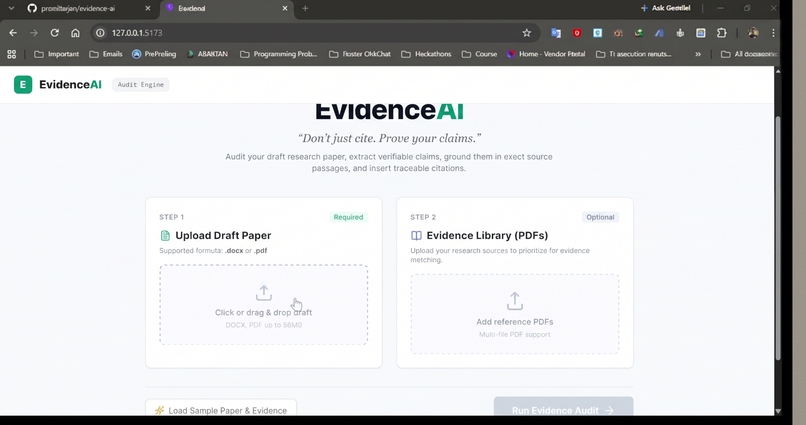
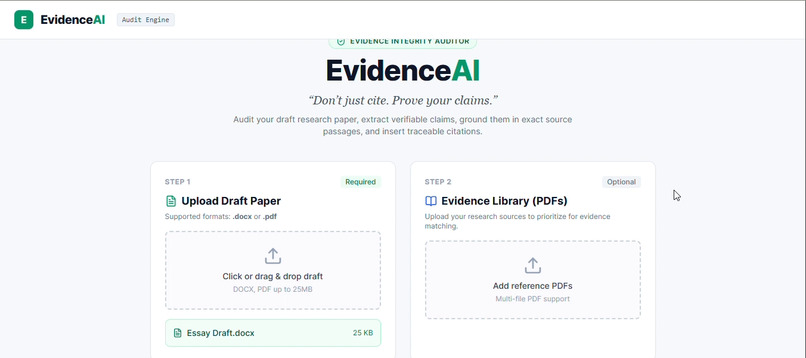
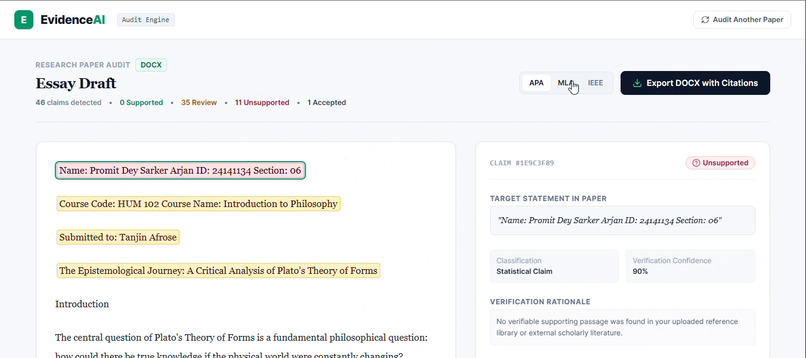
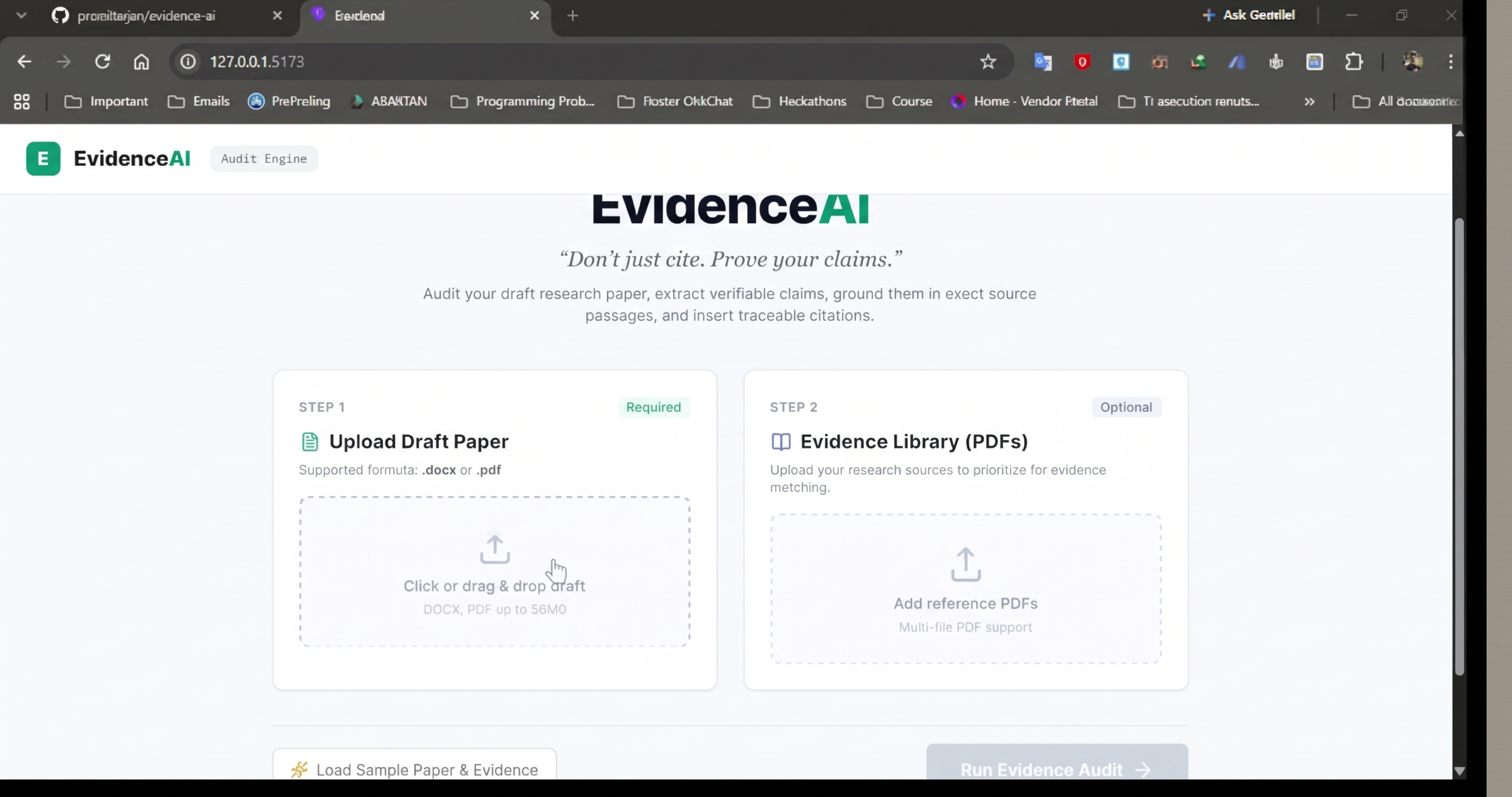
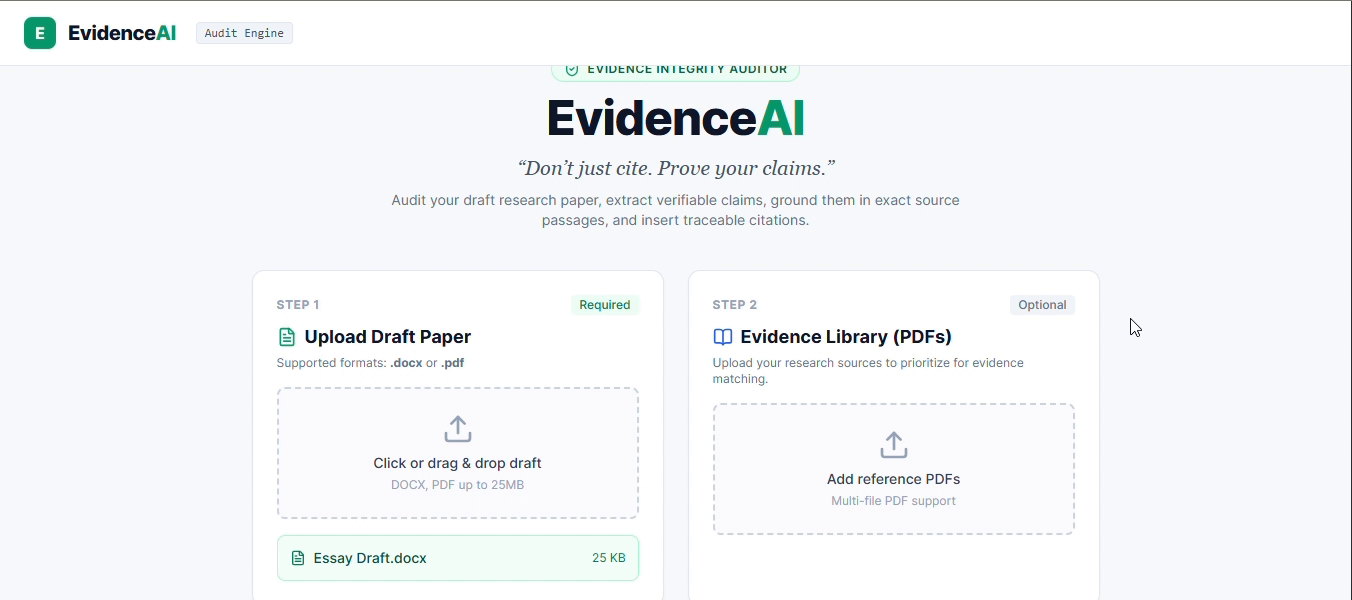
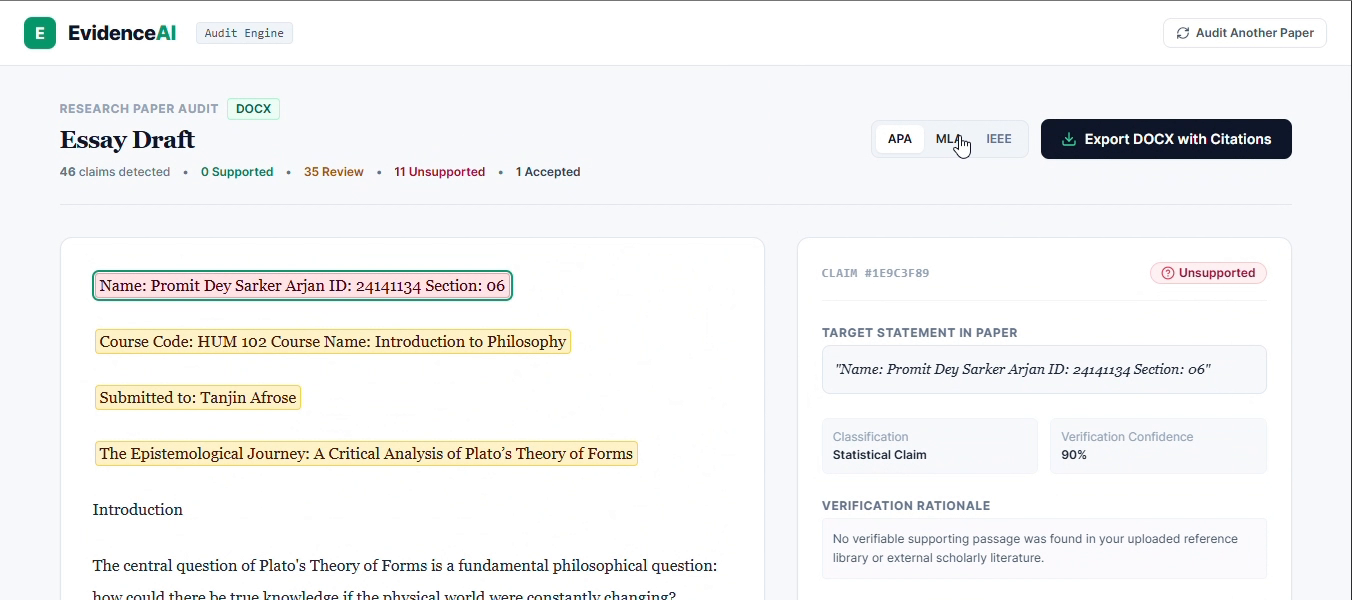
EvidenceAI is an automated verification system for academic writing. Users upload their draft research paper along with their source PDFs. The application extracts verifiable claims from the text and color-codes them based on the strength of the evidence.
Clicking on a claim opens the Evidence Inspector to reveal the exact verbatim passage and page number from the uploaded sources. If a local source is missing, the system searches the OpenAlex scholarly database for external verification.
Users can then accept the citations in APA, MLA, or IEEE formats and download a clean, verified DOCX file.
How we built it
The frontend is built with React 19, TypeScript, and Tailwind CSS to create an interactive split-screen dashboard. The backend is powered by Python and FastAPI.
I integrated the Google Gemini API using strict Pydantic schemas to ensure reliable structured JSON outputs for claim extraction and support grading. For document processing, I utilized python-docx to parse paragraph boundaries and export the final Word document seamlessly.
Challenges we ran into
One major technical hurdle was inserting inline citations into the Word document without corrupting the original run-level styles, fonts, and headings.
Another challenge was preventing JSON parsing errors during AI generation. I solved this by enforcing strict structured outputs through the Gemini SDK and building deterministic heuristic fallbacks so the application remains stable even if the AI output shifts.
What we learned
I learned how to effectively combine AI spatial reasoning with traditional deterministic code.
Building the split-screen workspace also provided great experience in managing complex frontend UI states, specifically tracking which text nodes are highlighted and dynamically updating the live bibliography as citations are accepted.
Future Plans
LaTeX and PDF Export Integration
Implementing the .tex and .pdf download functionality will be the most immediate technical addition, as this was deliberately scoped out of the initial prototype to meet the submission deadline and was highlighted as a future feature in the demo.
Expanded Citation Frameworks
The current selection of APA, MLA, and IEEE can be expanded by updating the formatting utilities to automatically handle Chicago, Harvard, and Vancouver styles for broader academic utility.
Cloud Deployment
Migrating the application from a local development environment to the web will allow researchers to access the tool instantly without running local terminal commands.
The React frontend can be hosted on platforms like Vercel, while the FastAPI backend and Python document parsers can be containerized and deployed to services like Render or Railway.
Advanced Scholarly Integrations
Enhancing the external evidence fallback system by integrating additional academic databases like arXiv, PubMed, or Semantic Scholar alongside OpenAlex will significantly improve the tool's verification capabilities for highly specialized claims.
Built With
- css
- fast-api
- gemini-api
- html
- python
- scholarly-database
- typescript

Log in or sign up for Devpost to join the conversation.