-
-

Mobile proof: the four-stage workflow stacks vertically, keeping source, unit and caveat readable without horizontal scrolling.
-
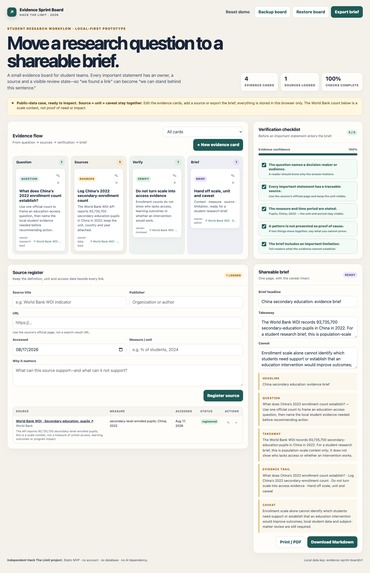
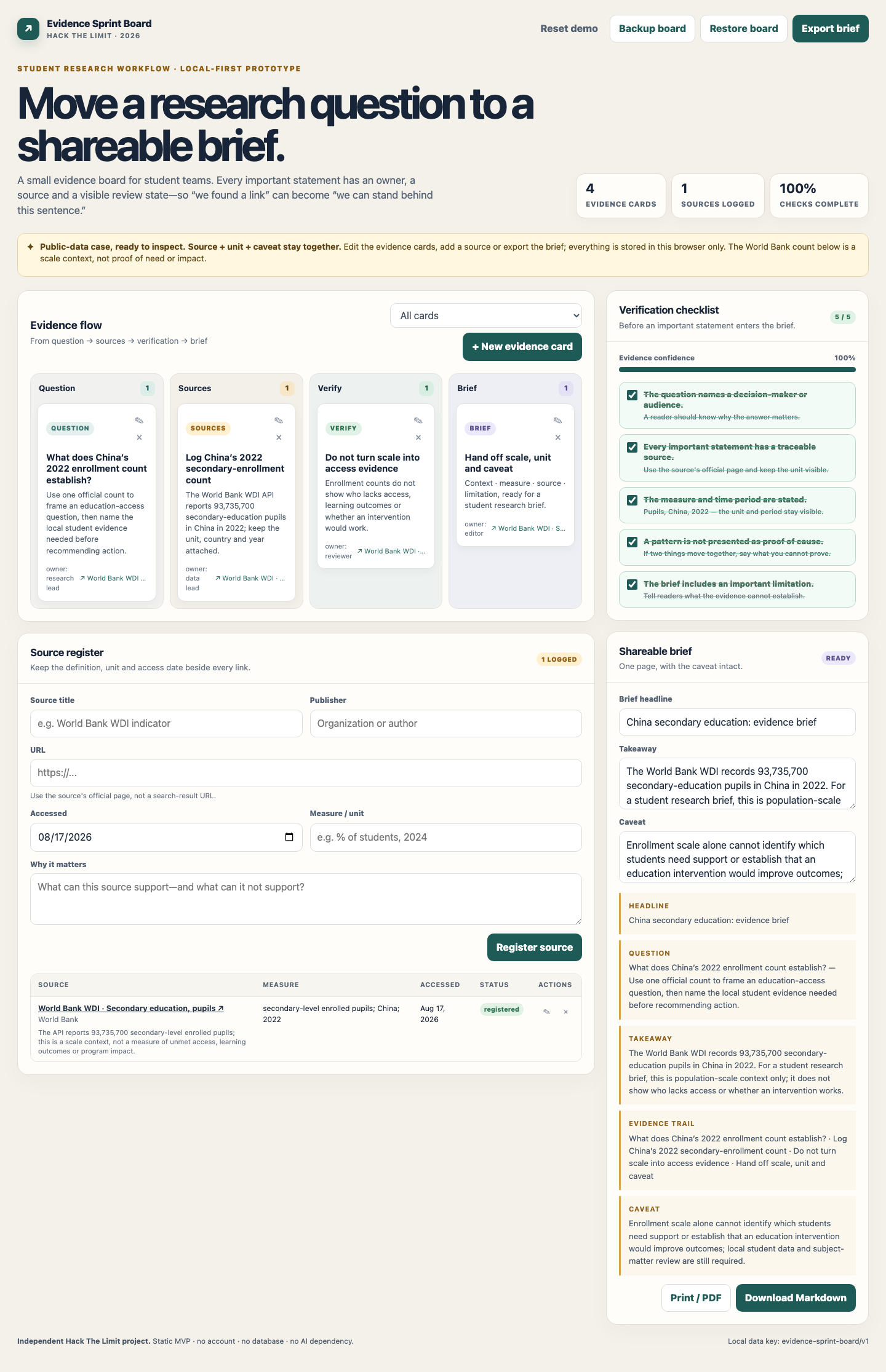
Desktop proof: the evidence flow connects a research question to a source, unit, verification checklist and caveated brief.

Inspiration
Student teams often collect many links but still cannot answer three basic questions: What exactly are we claiming? Where did the number come from? What can the evidence not tell us?
Evidence Sprint Board was inspired by this last-mile problem. Moving from research to a safe, shareable brief is often a coordination problem rather than a search problem.
What it does
Evidence Sprint Board gives student teams one focused evidence hand-off flow:
- Frame a research question in Question.
- Register canonical sources with publisher, access date, measurement unit and limitation in Sources.
- Run a short verification checklist in Verify.
- Edit a takeaway and caveat, then export a Markdown brief in Brief.
The demo uses a bounded World Bank WDI case: 93,735,700 secondary-education pupils in China in 2022. The source, country, year, measurement description and caveat stay attached to the hand-off. The example deliberately does not treat enrollment scale as proof of unmet access, learning outcomes or program impact.
How we built it
The MVP is a single static page built with semantic HTML, responsive CSS and vanilla JavaScript. Browser localStorage keeps cards, sources, checklist progress and brief text available without an account or backend.
We also added validated HTTP(S) source registration, JSON backup and restore, Markdown export, print/PDF output and responsive layouts for desktop, tablet and mobile.
Challenges we ran into
The main challenge was keeping the workflow lightweight while still preserving evidence quality. A generic task board is easy to build, but it can lose the source definition, unit, date or limitation when work changes hands.
We also had to make the public-data example useful without overclaiming what the statistic proves. The caveat is therefore treated as part of the deliverable rather than an afterthought.
Accomplishments that we're proud of
We built a complete path from research question to shareable brief in a small, understandable MVP.
The project now has a public GitHub repository, an HTTPS demo, responsive desktop and mobile layouts, a source register, verification checklist, Markdown export, backup/restore and print/PDF support.
Our central design choice is that source, unit and caveat travel with the claim into the final brief.
What we learned
A task board can show what needs to happen next, but it does not necessarily preserve what a claim means or what it cannot establish.
The most valuable hand-off is not only ownership and status. It is ownership plus source, unit, date and limitation.
What's next for Evidence Sprint Board
We will use further student feedback to refine the checklist and backup flow. Collaboration and synchronized workspaces should only be added if real users show that local-first storage is the main limitation.
Built with
- Semantic HTML
- CSS Grid
- Responsive CSS
- Vanilla JavaScript
- Browser localStorage
- World Bank WDI API
- GitHub Pages
Built With
- css
- github
- html
- javascript
- localstorage
- world-bank

Log in or sign up for Devpost to join the conversation.