


Inspiration
We started with a report, not an idea. Reading the India Incubator Kaleidoscope and the IIT Madras / IIM Bangalore incubation study, one number stopped us: only 8.2% of the 1,110+ startups in that sample appeared in any incubator record. India has 2,07,135 DPIIT-recognised startups, roughly half of them outside the major metros. The support system exists. The visibility doesn't.
Then we looked at where that gap actually bites. Every founder we spoke to described the same loop: build a deck for one programme, rebuild it for the next, retype the same company details into a new portal, and explain your traction again to a mentor who has no context from the previous conversation. A mentor's verdict lives in a WhatsApp thread. A jury's approval lives in an email that nobody can find six months later. Nothing compounds.
The more we looked, the clearer it became that the problem isn't a shortage of mentors or programmes. It's that everything we know about a founder is scattered across documents and conversations that don't talk to each other. So we stopped trying to build another directory and started building a receipt.
What it does
Evidence Passport turns a founder's raw documents into portable, verifiable proof.
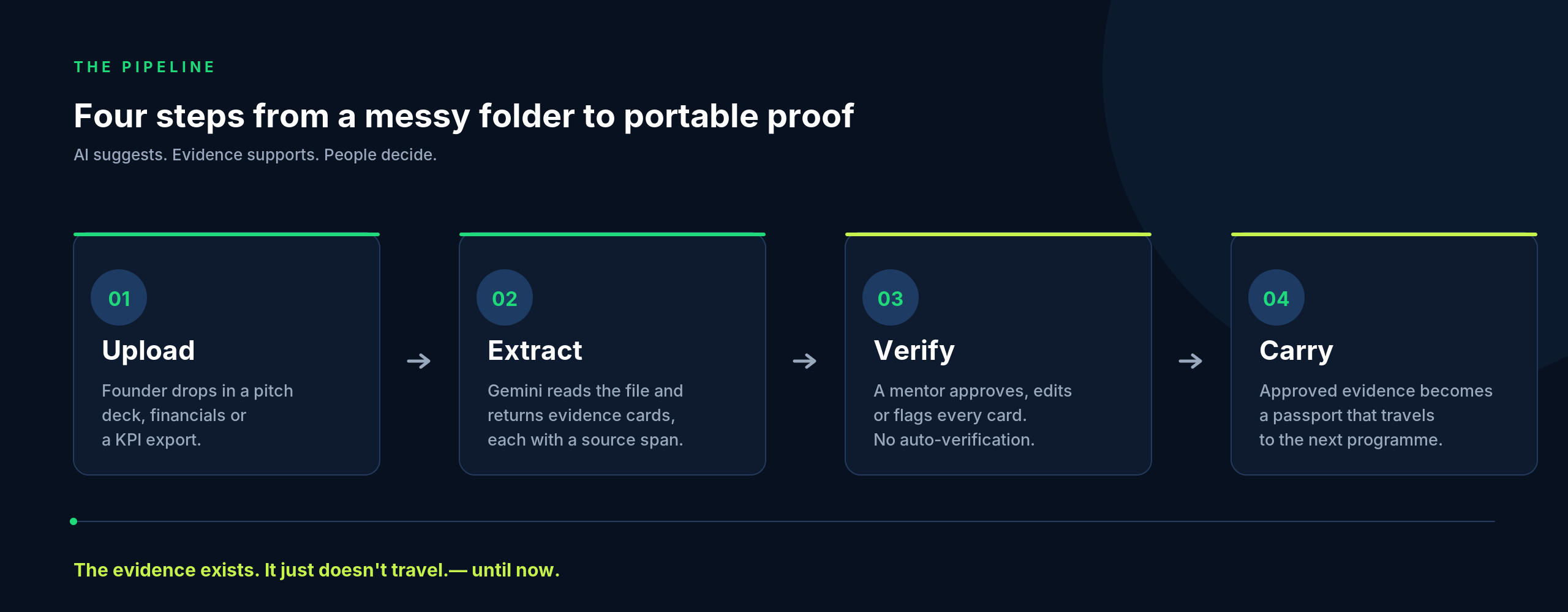
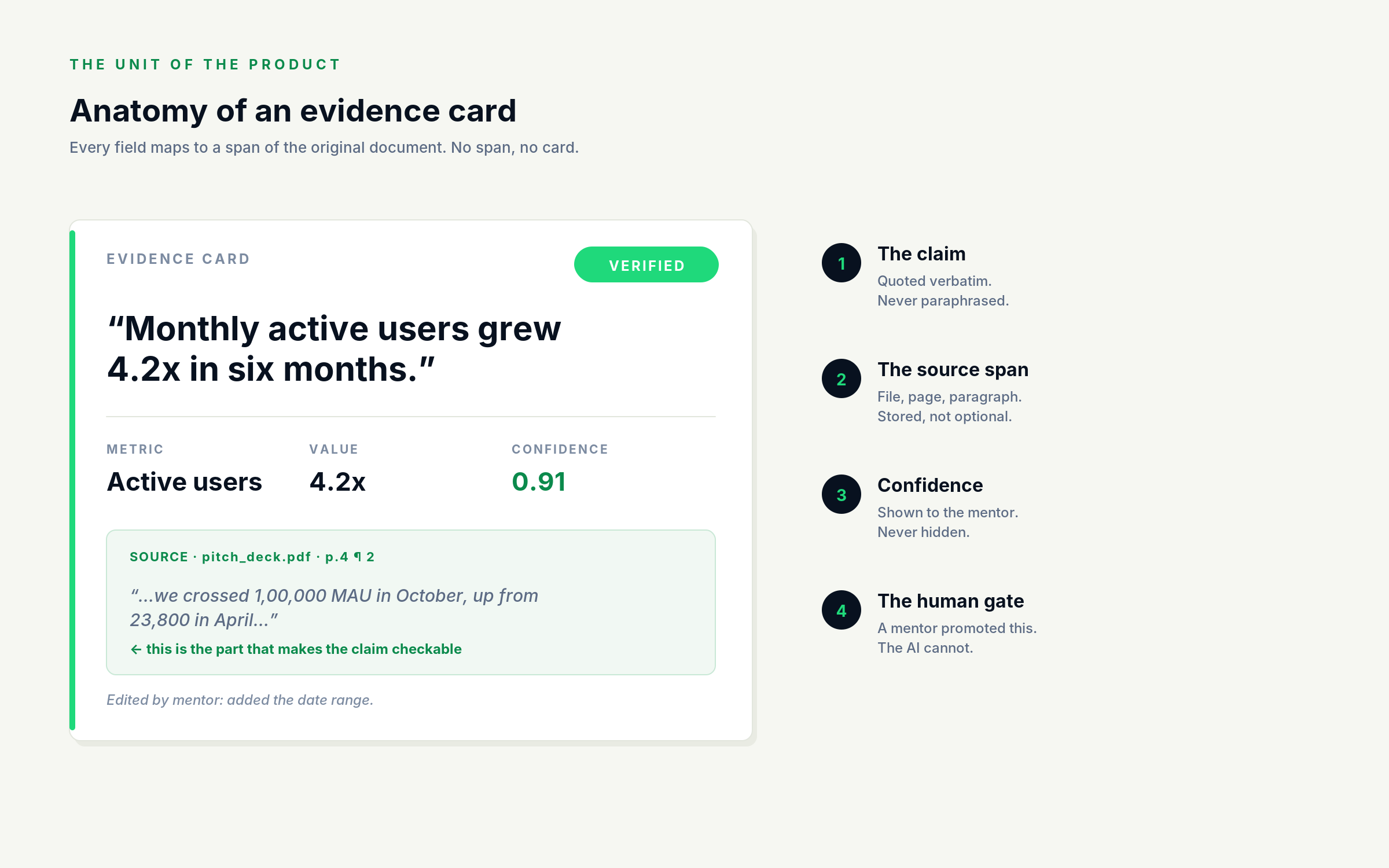
A founder uploads what they already have — a pitch deck, financials, a KPI export. Gemini 3.6 Flash reads the document natively, with no OCR chain, and returns structured evidence cards. Every card carries its exact source: the file, page and paragraph the claim came from. If the model cannot point at a span of the original document, the card is rejected before it ever reaches a human.
A mentor then reviews each card and approves, edits or flags it. Only approved evidence enters the founder's passport. AI suggests; evidence supports; people decide.
The output is a single shareable passport page — a timeline of verified milestones, each traceable back to both the source document and the person who approved it. It travels with the founder between programmes instead of being rebuilt for each one.
How we built it
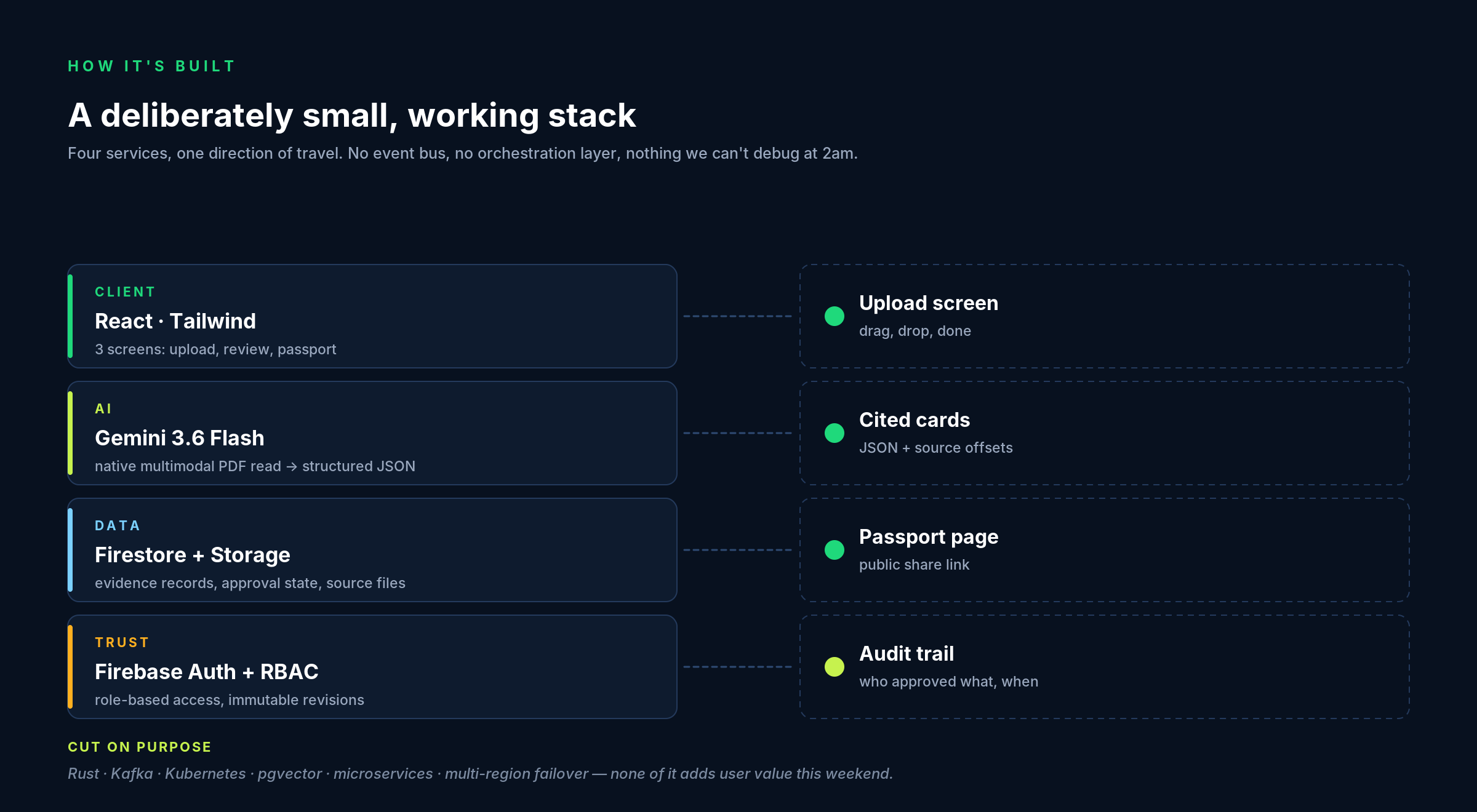
React front end, three screens: upload, mentor review, passport. Deliberately three.
Firebase Auth for sign-in, Firestore for evidence records and approval state, Firebase Storage for source files.
Gemini 3.6 Flash via the Gemini API for document understanding. We chose it because the job is reading a messy real-world document and returning structured, grounded output — exactly what a multimodal Flash model is good at, at a cost that lets us run extraction on every upload rather than rationing it.
The core design decision was the schema. Every evidence card must include a source span. No span, no card. The model is never trusted to invent a claim; it is only trusted to relocate one.
Challenges we ran into
Getting the model to cite reliably was the hard part. Early prompts returned confident paraphrase with no offset — convincing, and useless. We fixed it by making the citation a required field in the response schema rather than something we merely asked for in the prompt, then surfacing confidence to the mentor instead of hiding it.
The human gate was the second challenge. It is tempting to let plausibly-correct cards auto-verify, because it makes the demo flow faster. That would destroy the entire premise. We made mentor approval write an immutable revision, so the AI cannot promote its own output to verified.
Scope was the third, and the one we're most proud of. Our first design was an eight-layer platform: mentor matching, funding discovery, IP workflows, institution analytics, a multi-region event bus. We cut almost all of it. A two-day build that claims a distributed architecture is a build whose demo doesn't work.
Accomplishments that we're proud of
The citation survives. On a real, messy deck, every card we generate points at a paragraph you can open and check — and when it can't, it says so instead of guessing.
We shipped the honest version rather than the impressive one. The product makes a promise it can keep: proof a founder controls, that a mentor has verified, and that anyone can check in a single click.
And we found a position that isn't a losing fight. National platforms already match founders to mentors at scale, for free. We are not competing with that. We are building the evidence layer that makes those matches worth having.
What we learned
Citations are a schema problem, not a prompting problem. Asking a model to be honest is not a control. Making the source span a required field is.
Human-in-the-loop has to be structural. If the reviewer can be skipped, the reviewer will be skipped — by the team first, and by users second.
The best scope decision is a deletion. Every feature we cut made the remaining demo more believable, and believable is the only thing a judge can score.
What's next for Evidence Passport
Next 30 days: capture mentor sessions with Speech-to-Text so a conversation becomes evidence too; a MAARG-compatible export so we feed the national platform rather than compete with it; an incubator impact dashboard; Cloud Translation so a founder can submit regional-language documents.
The bigger bet: the mechanism isn't specific to India. The distance from capital — not the country — is what strands founders. The same record that helps a builder in a Tier-3 city helps one in California's Central Valley or the Inland Empire.
Every founder outside the ecosystem is one verified record away from being seen.
