-
-
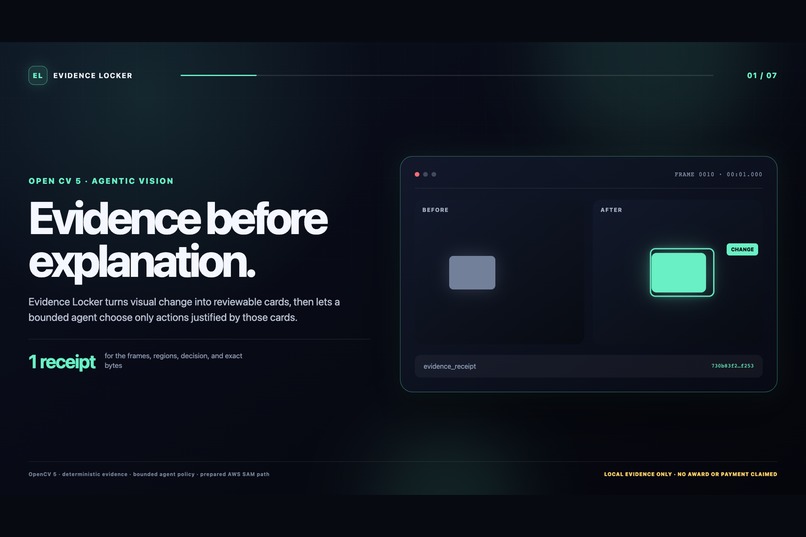
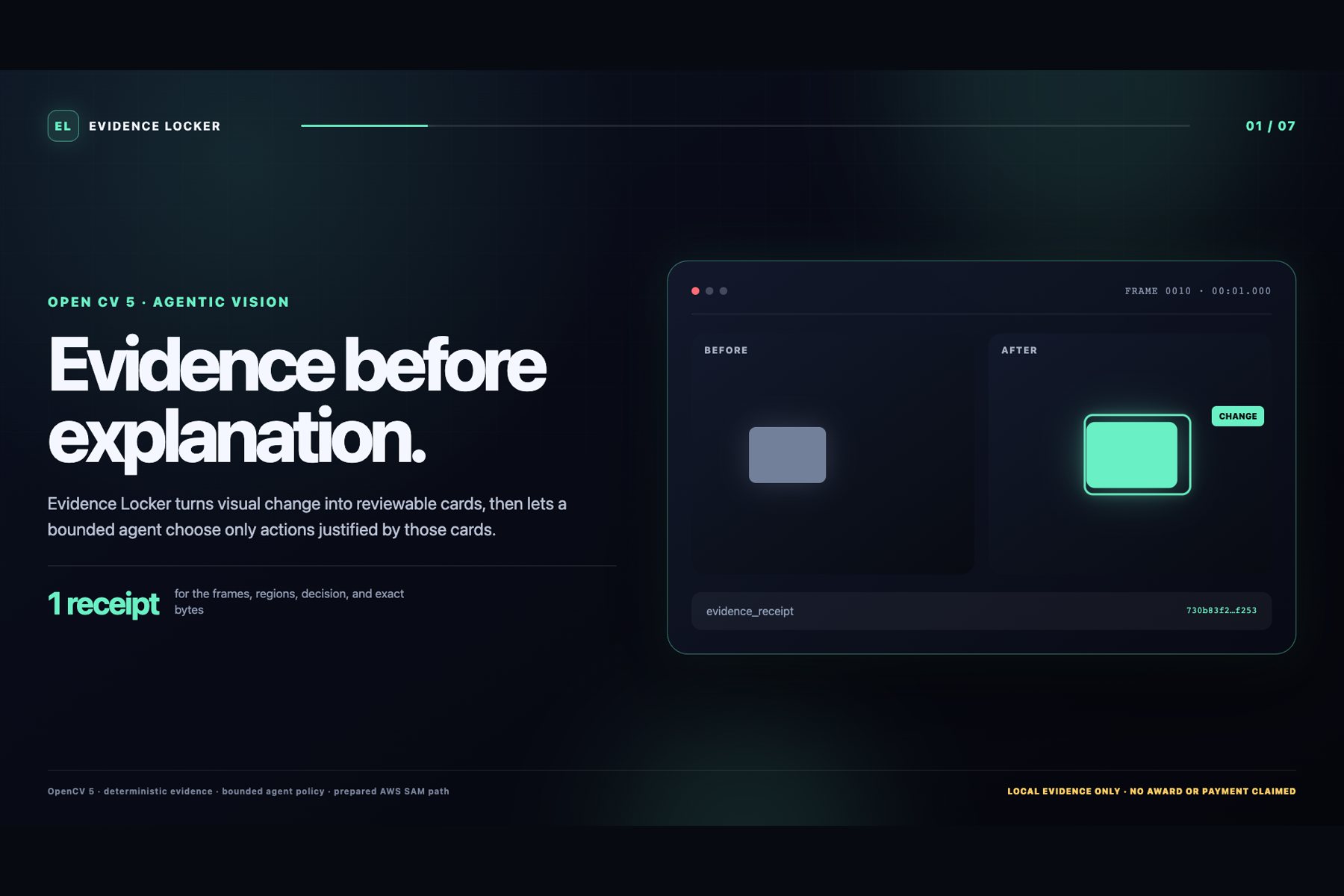
Evidence Locker overview: deterministic OpenCV evidence and bounded agent action.
-
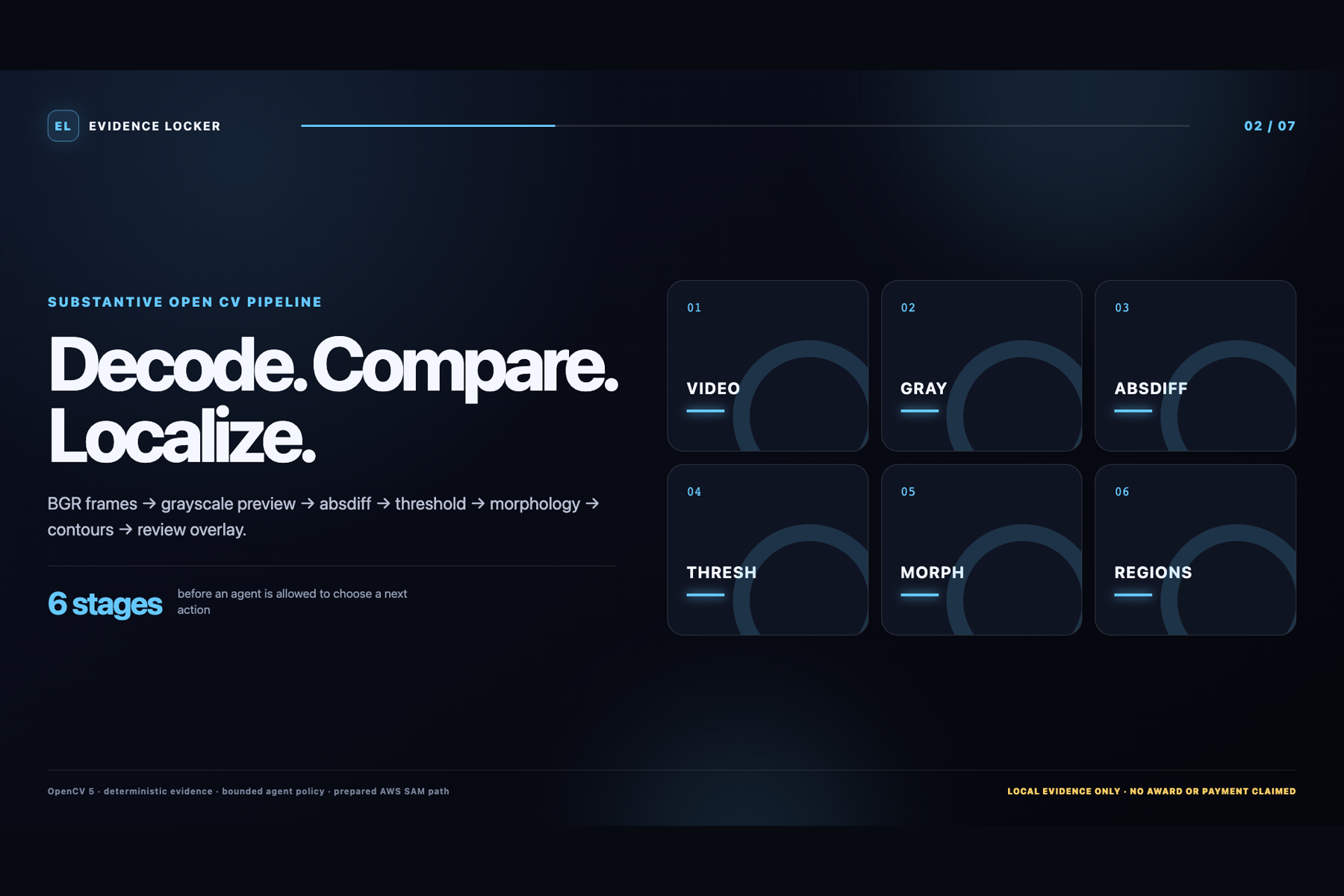
Review UI showing the policy-selected action, evidence cards, and report receipt.
-
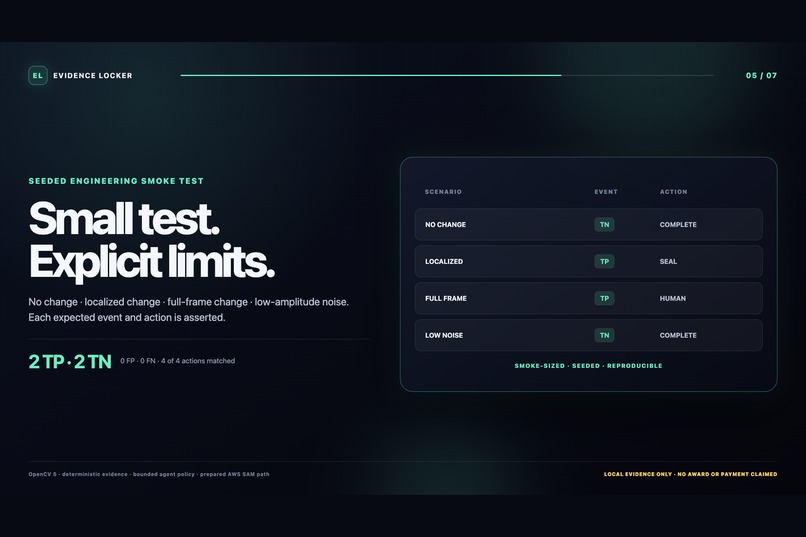
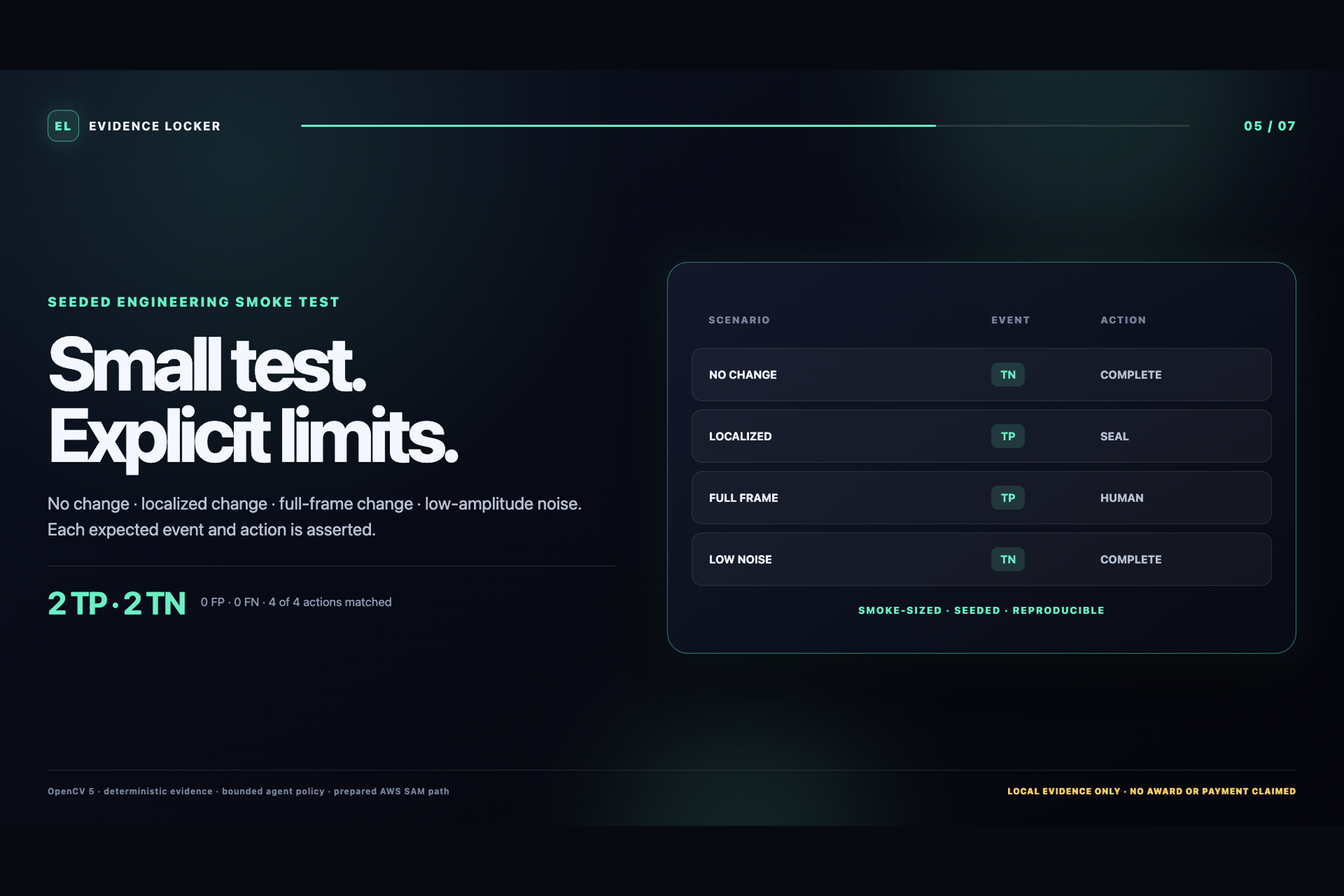
Synthetic evaluation: 2 TP, 2 TN, 0 FP, 0 FN, and 4/4 correct actions.
-
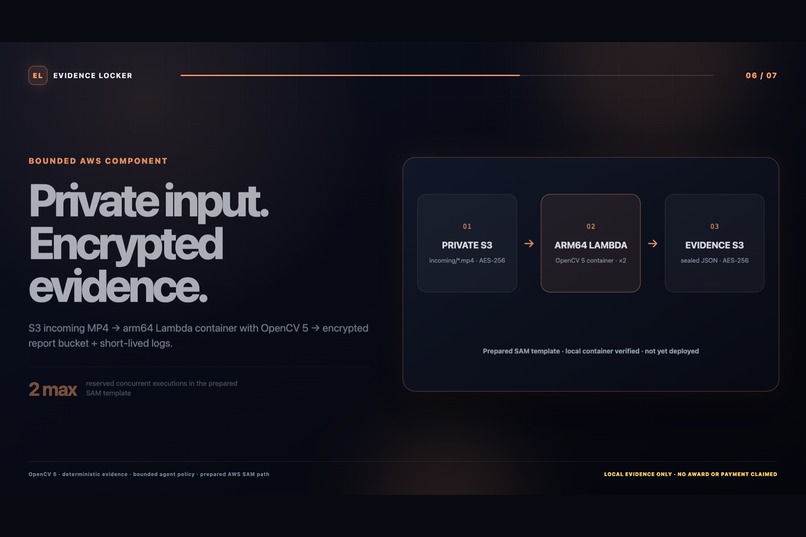
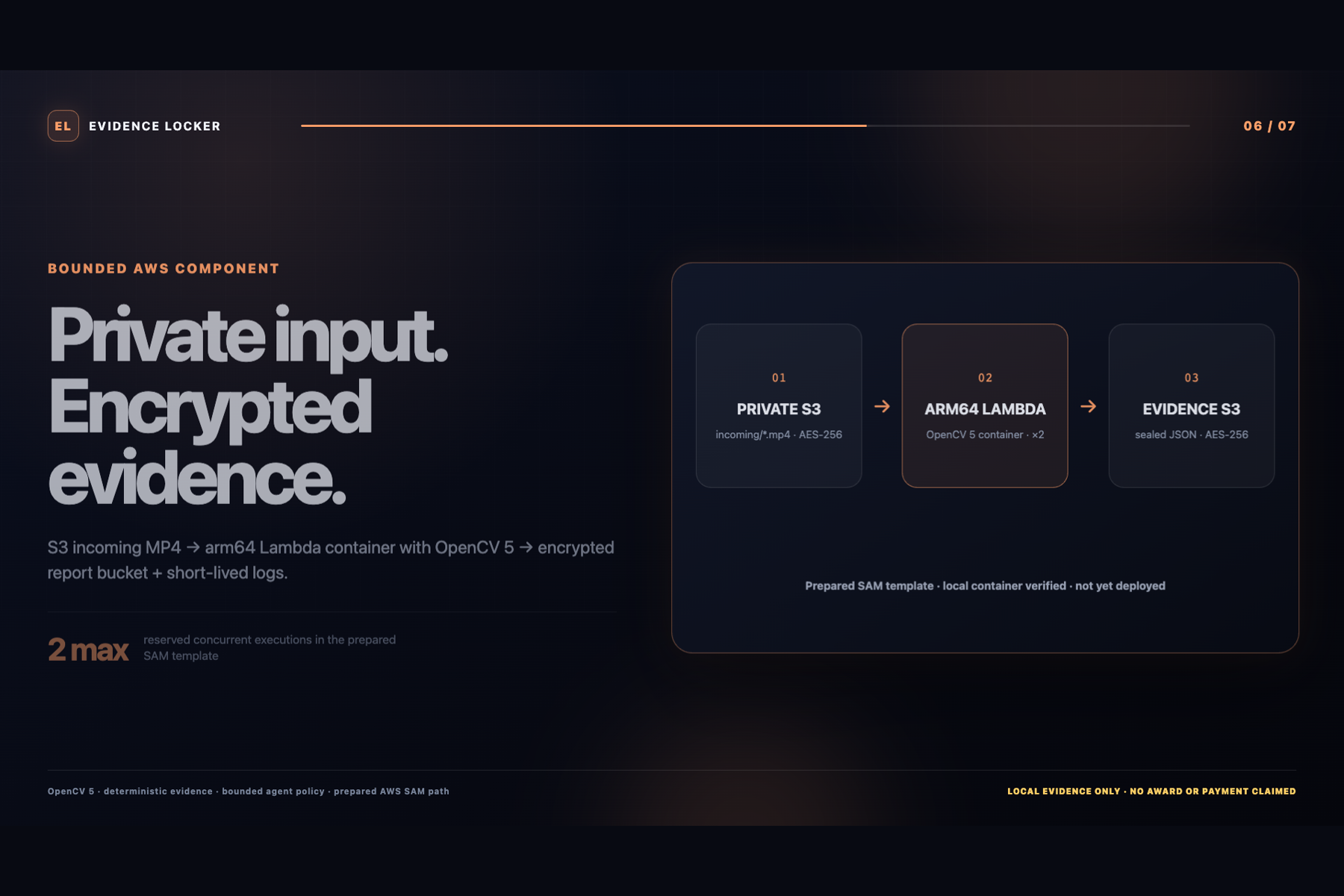
AWS architecture: private S3 input, arm64 Lambda container, and encrypted report storage.
Inspiration
Visual change detection is easy to demo and hard to trust. In inspection, incident review, and media triage, an agent should not be allowed to turn a plausible summary into evidence. We built Evidence Locker around the opposite idea: OpenCV extracts the facts first, seals them, and strictly bounds what the agent may do next.
What it does
Evidence Locker converts a short video into deterministic evidence cards. Each card records the changed frame and timestamp, sorted bounding regions, a normalized change score, and SHA-256 hashes of the exact before and after frame data. A bounded policy then chooses one of four actions:
- complete when no material change was extracted;
- rerun localization when a frame-level event has no reviewable region;
- seal localized evidence for an explanation; or
- request human approval for a material transition.
The review page shows the selected action, its reason, the evidence cards, hash-addressed overlays, and the canonical report receipt. The explanation layer rejects unknown frame citations and any recommendation that differs from the policy-selected action.
How we built it
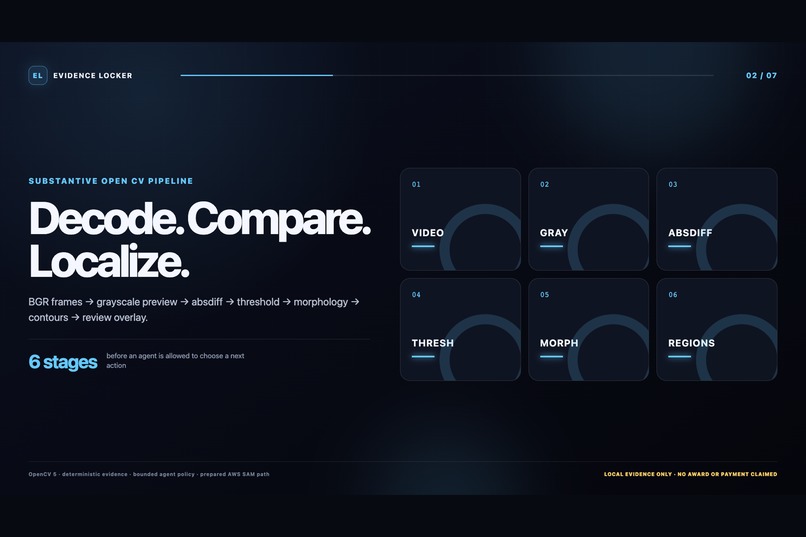
OpenCV 5.0.0 is used across the core path, not as a wrapper around a chatbot. It decodes video, reads timing metadata, converts adjacent frames to grayscale, downsamples with INTER_AREA, computes absdiff, thresholds full-resolution deltas, closes masks morphologically, extracts contours and bounding boxes, and renders separate review overlays without modifying the source frames.
Hysteresis prevents continuous motion from creating an event on every frame. An adaptive region-area floor suppresses tiny contour noise. Frame shape, dtype, and bytes are included in the hashes, evidence regions are sorted for stable serialization, and the complete report receives its own SHA-256 receipt.
The repository also includes a Lambda adapter and bounded AWS SAM template. The template defines private encrypted input and report buckets, an arm64 OpenCV 5 container Lambda, a single incoming/*.mp4 event boundary, optional reserved concurrency of one or two, short retention, and least-privilege bucket policies. On September 4 we deployed it in us-east-2 for one bounded smoke run. A private S3 upload triggered Lambda, OpenCV 5.0.0 produced one evidence card and encrypted JSON report, and the analysis completed in 3004 ms (3791 ms billed, 160 MB peak memory). We verified both SHA-256 receipts and structured CloudWatch logs, then deleted the stack, buckets, ECR repository, function, logs, and role. No public write endpoint or persistent AWS resource remains.
Agent workflow and human control
The workflow is perception -> decision -> bounded action -> human review. OpenCV evidence changes the downstream tool decision. A full-frame transition routes to human approval, a localized transition may be sealed for summary, and missing localization fails closed into a rerun. The agent cannot expand its own action set or cite a frame that OpenCV did not extract.
Evaluation
A clean OpenCV 5 environment passes all 38 tests. The seeded four-scenario suite covers no change, localized change, full-frame change, and low-amplitude noise: 2 true positives, 2 true negatives, 0 false positives, 0 false negatives, and 4/4 correct downstream actions. This is an engineering smoke test, not a claim of production accuracy.
We also ran three public opencv_extra/5.x videos with different sizes and metadata. All completed without upload or crash. Repeating the 15-frame sample produced identical evidence and the same report receipt. A first run on the Big Buck Bunny sample exposed an event flood of 56 cards across 125 frames; hysteresis and regression tests reduced it to one card while preserving re-arm after a quiet frame.
On September 7 we added a frozen held-out foreground-change evaluation: 36 frame pairs from 12 DAVIS 2017 validation sequences, selected before predictions, with reference labels derived from human foreground masks. The unchanged detector found 34 positive pairs and missed two (94.4% recall). All 36 references were positive, so real-video false-positive rate remains unknown. Separate constructed controls produced no triggers for exact repeats or ±2 noise (12 each), but all 12 brightness-shift controls triggered. Every result, failure, annotation diagram, source hash and the frozen protocol is inspectable at the live evaluation page: https://tzh476.github.io/opencv-evidence-locker/evaluation/ . This is a small foreground-change proxy, not semantic incident accuracy or an official DAVIS score.
Challenges and limitations
The hardest failure was distinguishing a meaningful transition from continuous motion without hiding later events. A second challenge was keeping the explanation useful while preventing it from inventing visual facts. The current detector is deliberately narrow: it does not identify objects, people, intent, or safety-critical anomalies. Camera motion and illumination can trigger events, and subtle changes can be missed. Production use needs a right-cleared held-out dataset, calibrated thresholds, and measured precision/recall tradeoffs.
What's next
The next milestone is natural negative-video evaluation and cold-start measurement. The first live Lambda cold initialization reached the initialization timeout before AWS retried and completed the event, so reducing image/init cost is more valuable than keeping an idle demo stack online. We will preserve the same evidence-first, human-controlled policy boundary.
Built With
- amazon-web-services
- aws-sam
- cloudformation
- docker
- lambda
- numpy
- opencv
- python
- serverless

Log in or sign up for Devpost to join the conversation.