Inspiration
Digital forensic investigations are time-consuming and require expert knowledge. Analysts manually sift through gigabytes of disk images, memory dumps, and logs to find malicious activity. We wanted to automate this process while maintaining forensic rigor — every finding must be traceable to specific evidence.
What it does
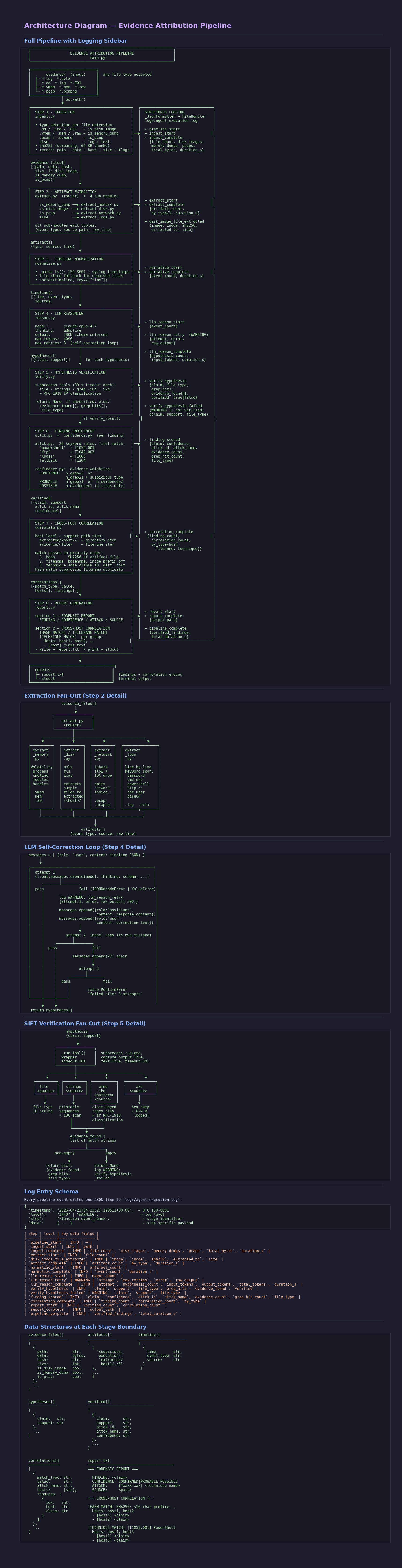
Evidence Attribution Pipeline is an autonomous forensic AI agent that:
- Ingests disk images (E01), memory dumps, network captures, and log files
- Extracts artifacts using real SIFT forensic tools (fls, icat, strings, tshark, Volatility3)
- Builds a chronological timeline of suspicious events
- Uses Claude AI with adaptive thinking to reason over the evidence
- Verifies every hypothesis against the raw evidence before reporting
- Maps findings to MITRE ATT&CK techniques with confidence scoring
- Correlates findings across multiple hosts to identify lateral movement
- Produces a professional incident report with executive summary, attack timeline, and recommended actions
How we built it
Built on the SANS SIFT Workstation using Claude Code as the agentic framework. The pipeline is modular — 12 Python modules each handling one stage. Claude API with adaptive thinking reasons over structured forensic timelines and generates hypotheses. Each hypothesis is then verified using subprocess calls to SIFT tools before appearing in the final report.
Challenges
- Parsing NTFS filesystems from E01 images without partition tables
- Preventing the LLM from hallucinating file paths that don't exist
- Keeping API token usage under rate limits with large disk images
- Distinguishing legitimate Chocolatey from trojanized versions
What we learned
Real forensic evidence is messy. The SANS SRL-2018 dataset showed that attackers abuse legitimate tools (Chocolatey) making detection harder than synthetic test cases.
What's next
- YARA rule integration with community rulesets
- Sigma rule engine for standardized log detection
- Entity graph visualization of attack paths
- Local model support for offline/air-gapped environments


Log in or sign up for Devpost to join the conversation.