-
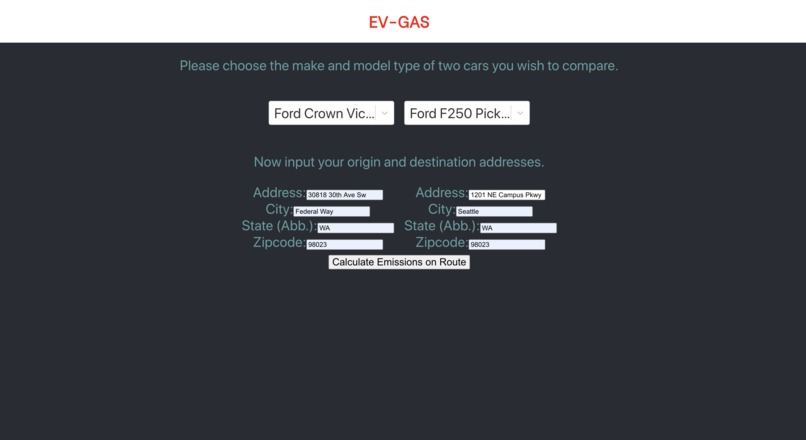
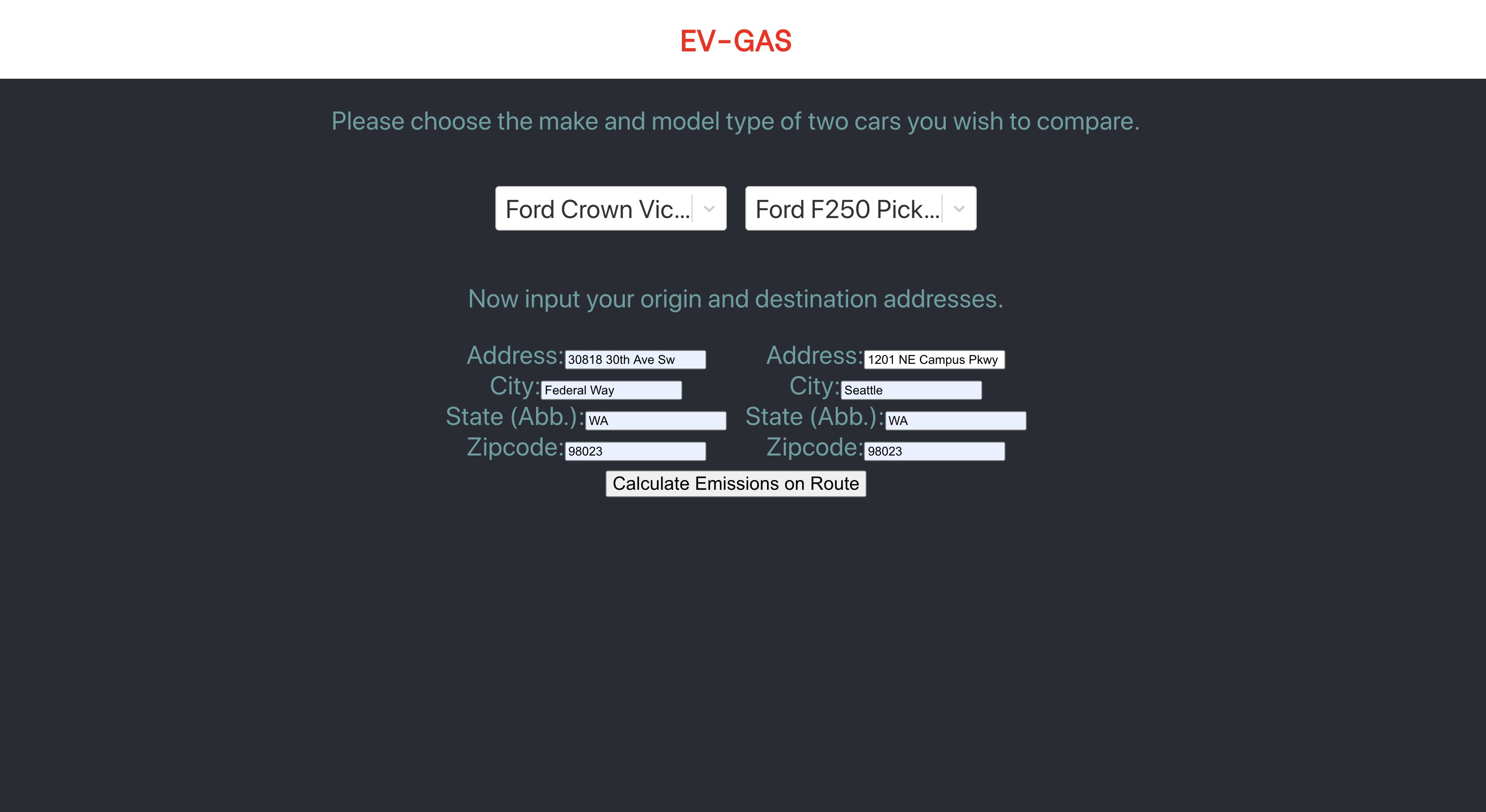
Front-end of the EV-Gas Website
Inspiration
Our project started off as an idea of whether an electric car has a lower carbon footprint compared to that of a gasoline-powered car. We had heard previously that in states where the main source of energy is non-renewable resources, like coal and oil, that electric cars had larger carbon footprints than their gasoline-powered car counterparts. Thus, the main goal of this project was to create a web app that allowed users to determine if it is more beneficial to drive a gas-powered or electric car on a given route in the United States.
For this web app, we built it from scratch utilizing the Google maps and various government agencies API. We first calculated the distance between two points, and then we calculated points along the route where the car would need to stop and refuel or charge up. For gas cars, we calculated the total miles traveled and multiplied it by the grams of carbon emitted per each mile to find the Carbon footprint. For electric cars, at each stop, we found the carbon footprint of the energy source in that given region. In other words, if an electric car stopped to refuel in a region that relies on non-renewable energy sources, like coal and oil, the electric car would have a larger footprint than in a region with a heavy emphasis on more renewable sources, like hydroelectric and wind power. Our idea was to therefore perform various calculations to determine whether a particular car is more environmentally efficient on a given route (depends on stops for refilling oil/recharging). This result is displayed on the bottom of our WebApp.
What it does
Users can pick two different cars with unique makes & models and compare their carbon footprint to each other on a given route.
How I built it
We built the web app using the React framework with HTML and CSS frontend added. We performed multiple API calls and integrated Node.JS and SQL on the backend to deal with those additional servers and integrate relevant online data that was also added.
Challenges I ran into
Originally coming into the project, we thought that navigating backend calculations would become the most difficult part (ie. using various maps API calls to determine exact coordinates in which refills are needed along a route) . However, this was not the case; set-up and infrastructure took the longest portion of our time. We were having trouble connecting our Node.js app engine to the Cloud SQL database and navigating Google Cloud in general.
Accomplishments that I'm proud of
We are proud that we were able to navigate the google cloud interface. It was very difficult for us to connect the SQL database on google cloud. We found the google cloud interface unintuitive at times, but we are proud that we were able to properly use the web service.
What I learned
We learned that set-up can be the hardest and most annoying part of the project. Also, we probably should ask for help from professionals who have experience in deploying web apps in the cloud. We also learned a lot about SQL and React.


Log in or sign up for Devpost to join the conversation.