Inspiration
Healthcare appointments often require patients to organize information before they meet a provider—appointment details, previous records, medication and supplement lists, insurance information, and questions they want to ask.
The challenge is not necessarily a lack of information. It is making the right information easy to understand and act on without crossing the boundary into medical diagnosis or treatment.
I wanted to build an AI agent that could help with this routine preparation while keeping grounding, safety, transparency, and human oversight at the center.
This led to the idea for the Everyday Health Agent, with an initial focus on an Appointment Readiness Agent.
What the Agent Does
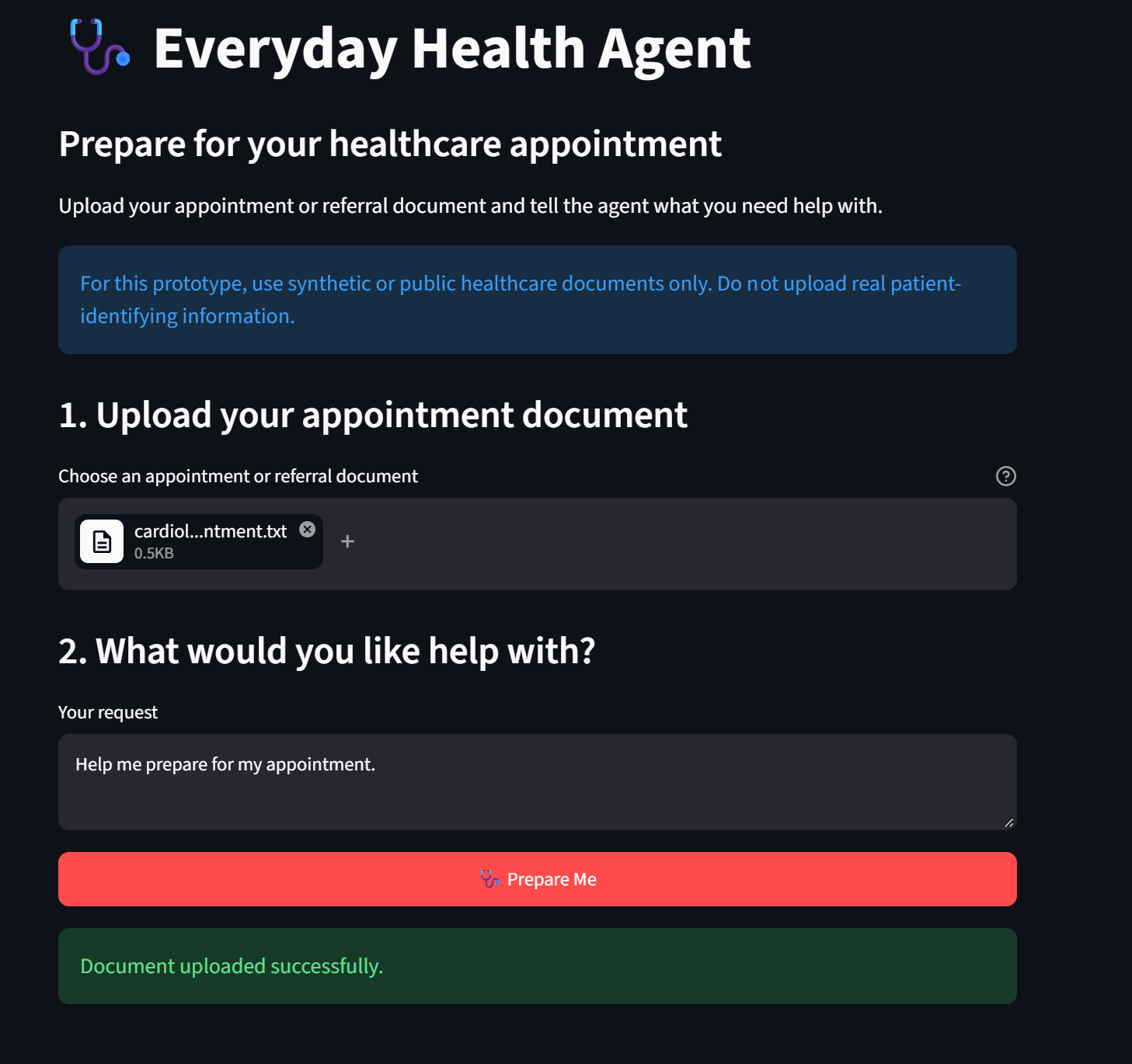
The user uploads an appointment document and provides a natural-language request such as:
"Help me prepare for this appointment."
The agent then:
- Extracts relevant appointment information from the document.
- Retrieves applicable general healthcare preparation guidance from a local knowledge source.
- Generates an appointment-specific preparation checklist.
- Runs a safety review to identify sensitive topics and avoid clinical overreach.
- Produces a grounded response with sources and items that should be confirmed with a healthcare professional.
The goal is not to replace a healthcare professional. The goal is to make routine information organization easier so patients can arrive better prepared.
How I Built It
The architecture centers on Strands Agents, with specialized tools responsible for different parts of the workflow:
- Document Tool — extracts appointment type, provider, date, time, reason, and instructions.
- Healthcare Knowledge Tool — retrieves relevant general appointment-preparation guidance from a local knowledge source.
- Appointment Preparation Tool — combines the available information into a practical preparation checklist.
- Safety Tool — checks for sensitive topics and reinforces boundaries around diagnosis, treatment, and clinical decisions.
The user interface is built with Streamlit, while the agent is implemented in Python using Strands Agents.
The working model provider is Gemini through Strands. AWS and Amazon Bedrock were also explored during development. However, attempts to invoke Bedrock models resulted in an account-level "Error 002: Access to Bedrock models is not allowed" restriction. Rather than stop development while resolving the account-access issue, I used Gemini through Strands so I could continue building and testing the agent. Because Strands provides a provider-agnostic agent architecture, this change did not require redesigning the core workflow.
Challenges
One of the biggest challenges was designing the agent so that it could be useful without becoming a source of medical advice.
Healthcare is a high-stakes domain, so the agent was intentionally designed around clear boundaries. It focuses on organizing information, retrieving general preparation guidance, creating checklists, and identifying questions that should be confirmed with a healthcare professional.
Another challenge was model access during development. Bedrock access returned an account-level Error 002, which led me to temporarily use Gemini while keeping the agent architecture centered on Strands.
I also learned that an effective agent is not simply an LLM with a prompt. The specialized tools, workflow, grounding sources, and safety checks are what make the system more structured and reliable.
What I Learned
Building this project gave me practical experience with:
- Agentic AI using Strands Agents
- Tool selection and orchestration
- Healthcare-focused grounding
- Document-driven AI workflows
- Responsible AI and safety boundaries
- Provider-agnostic model integration
- Building and testing an end-to-end AI application
- Designing a simple user experience around a complex agent workflow
Most importantly, I learned that in healthcare AI, knowing when not to answer is just as important as knowing how to answer.
Impact
The Everyday Health Agent is designed to reduce the effort required to organize routine appointment information and help patients approach appointments with a clearer preparation plan.
The current implementation focuses on appointment readiness, but the architecture is intentionally modular so additional healthcare tools and workflows can be added over time.
What's Next
Future development could include support for additional document formats, broader trusted healthcare knowledge sources, more specialized healthcare tools, stronger evaluation of tool-selection accuracy and groundedness, and additional appointment and patient-information workflows.
As the system expands, the focus will remain on grounded responses, transparent limitations, safety, and human oversight.
The long-term vision is not to automate healthcare decisions, but to build responsible everyday AI assistance that helps people organize information and prepare for interactions with healthcare professionals.
Built With
- agenticai
- bedrock
- gemini
- genai
- healthcareai
- natural-language-processing
- python
- strandsagents
- streamlit

Log in or sign up for Devpost to join the conversation.