-
-
Logo design
-
Dementia Statistics
-
Persona Jane
-
Additional Features
-
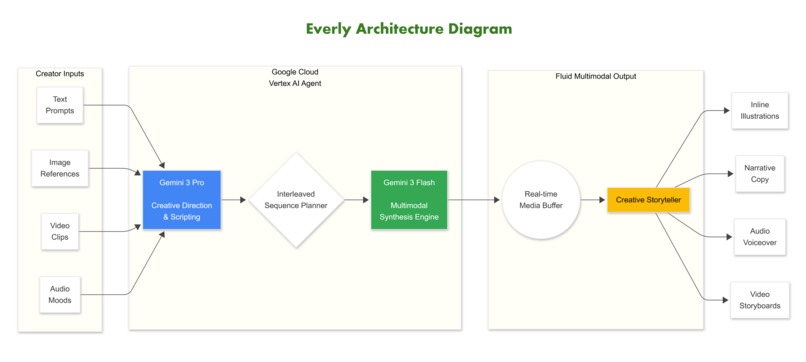
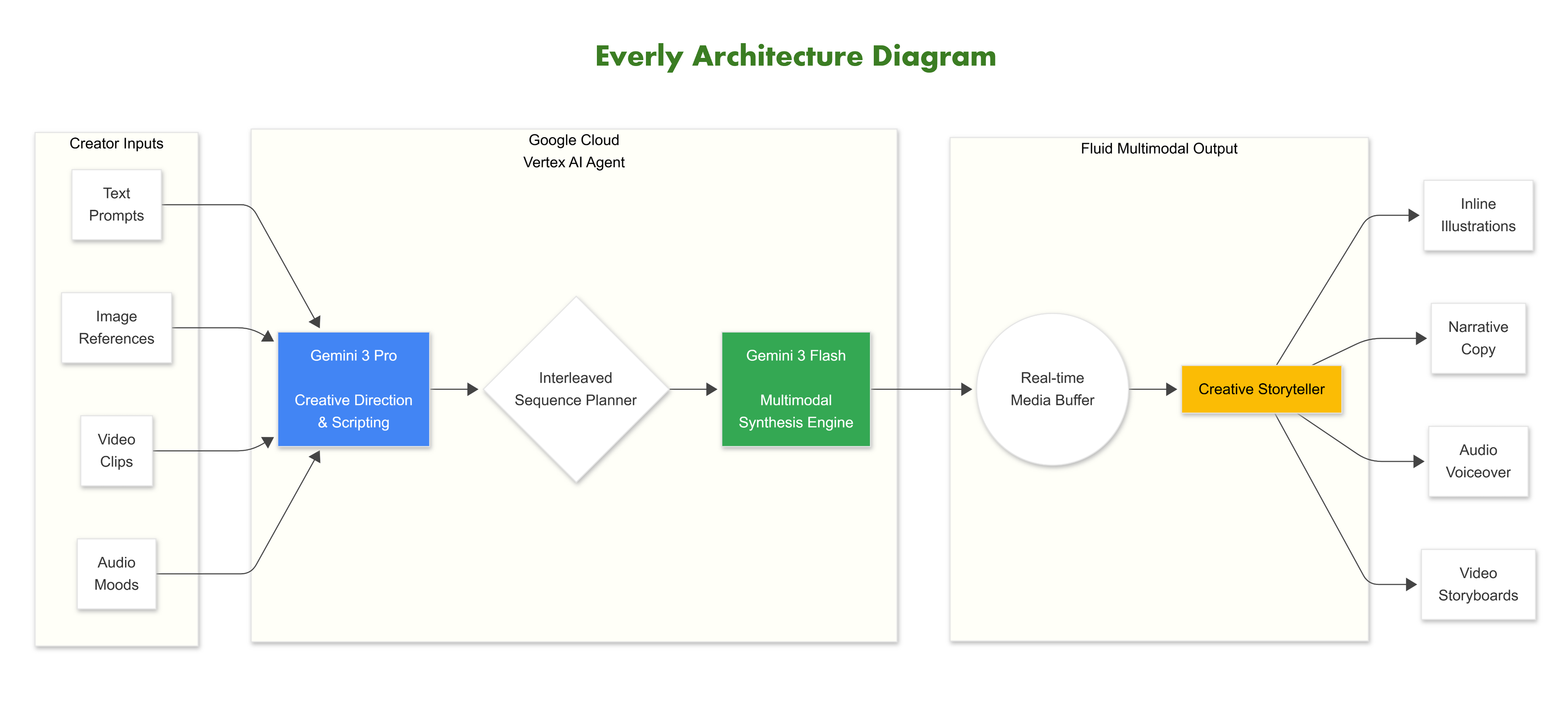
Architecture Diagram
Inspiration
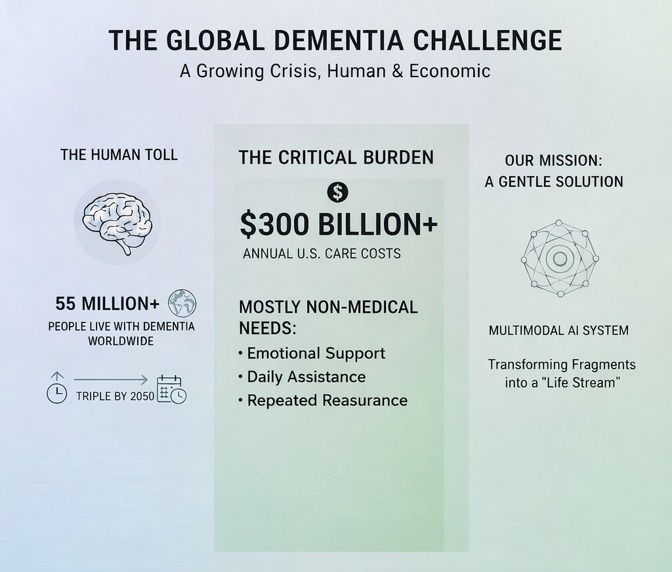
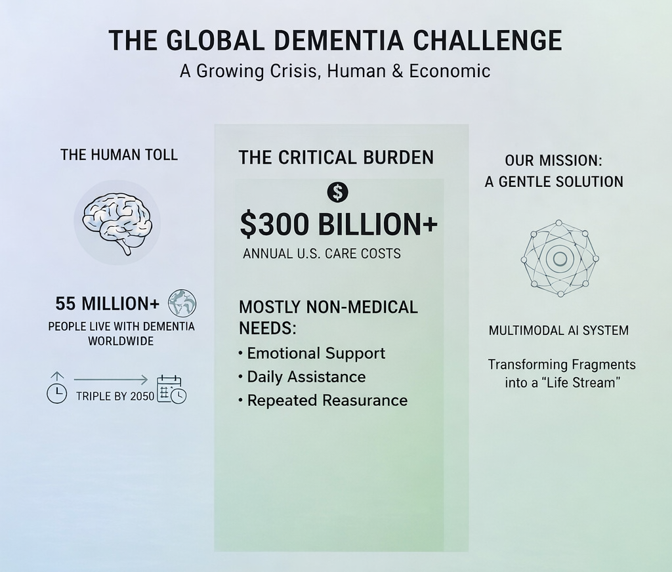
Alzheimer’s and dementia represent one of the fastest-growing global health challenges — not only clinically, but emotionally and economically. Today, more than 55 million people worldwide live with dementia, and that number is projected to triple by 2050. In the U.S. alone, dementia-related care exceeds $300 billion annually, much of it driven by non-medical needs such as repeated reassurance, emotional distress, and caregiver burnout.

Despite this, most digital solutions focus on medical monitoring or compliance. Very few address what families consistently identify as the most painful loss: identity, familiarity, and connection to a life once lived.
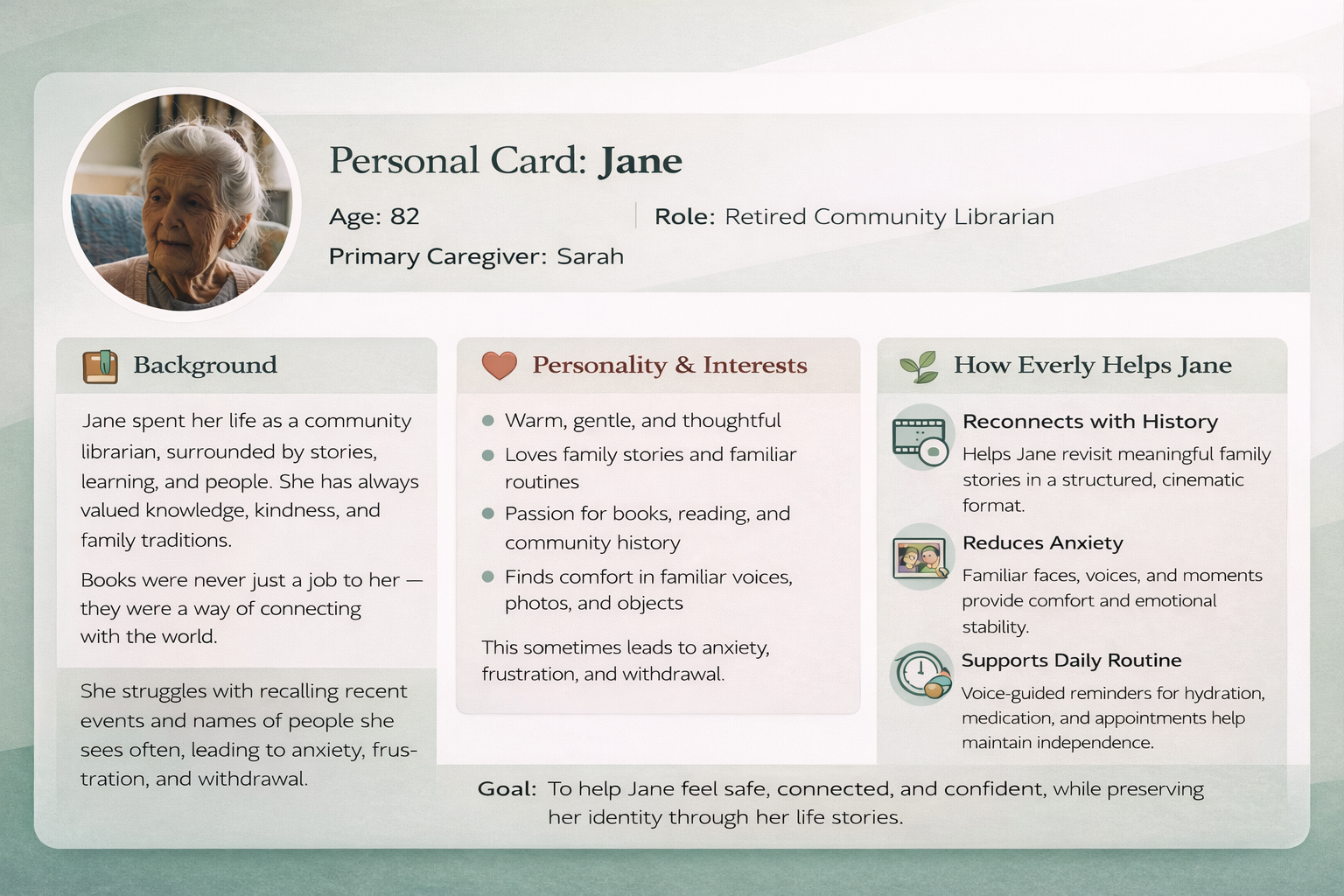
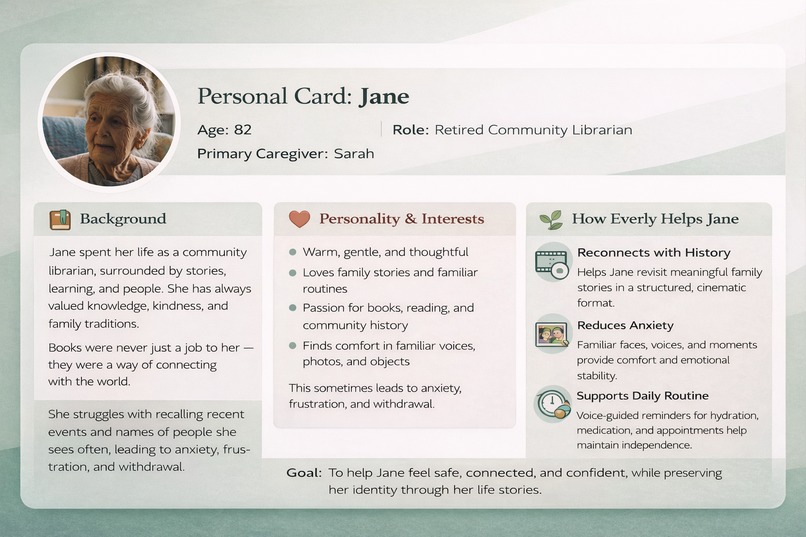
That gap becomes personal with Jane, a 82-year-old living with Alzheimer’s. Jane has a husband, Michael, two children, Emily and Daniel, and two grandchildren, Lily and Noah. While her family remembers a lifetime of shared moments, Jane doesn’t always have access to those memories. What her family wanted wasn’t another reminder app, but a humane way to carry their voices, faces, and stories with her.
Everly was inspired by this need: to preserve connection when memory fades.
What It Does
Everly is a multimodal memory companion, powered by Gemini 3, that helps people with Alzheimer’s reconnect with their life story.
Families collaboratively upload:
Photos
Audio messages
Good old songs
Short videos
Simple written memories
Everly organizes these into a living storybook that:
Plays automatically with voice narration
Flips pages on its own, like a video
Can be interrupted naturally for conversation
Answers questions using only family-approved memories
Everly is voice-first, calm, and requires no learning or navigation.
The meaning behind the name Everly:
Everly was chosen as the name because it feels like “ever” — something lasting, continuous, and always there — which reflects the purpose of the app: preserving identity even when memory fades. It also sounds gentle and human, like a person’s name, which matters because Everly isn’t meant to feel like a tool or a medical device. It’s meant to feel like a companion.
In the context of Alzheimer’s, where memories can become fragmented or disappear, Everly represents the idea that love, family, and personal story can still remain—even if they show up in small moments.
That meaning connects directly to the logo too: the soft spinning shape with no concrete form, sometimes fading, reflects how memory can be fluid, incomplete, and drifting, yet still beautiful and present.
How We Built It
System Architecture: Two Modes
- Caregiver Mode (The Creation Studio) A wizard-based environment for building the story. Memory Studio: The primary workflow where Gemini 3 analyzes media, asks clarifying questions, and converts raw files into "story-ready" memories. Management: Handles profile setup (safety context), team invitations for family, and scheduling for medication/hydration reminders. Publishing: Triggers the final narrative compilation into the patient-facing format.
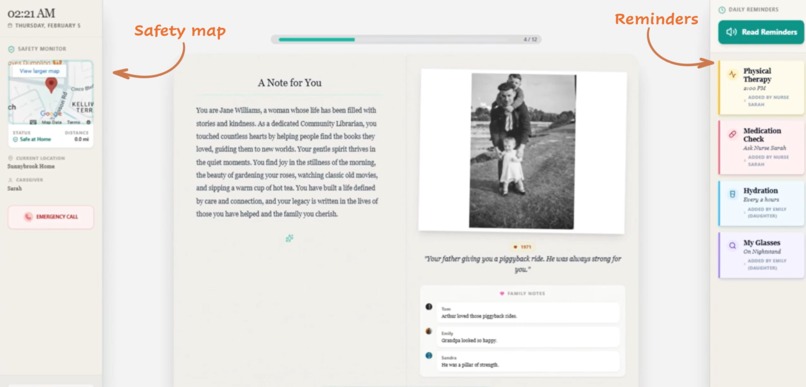
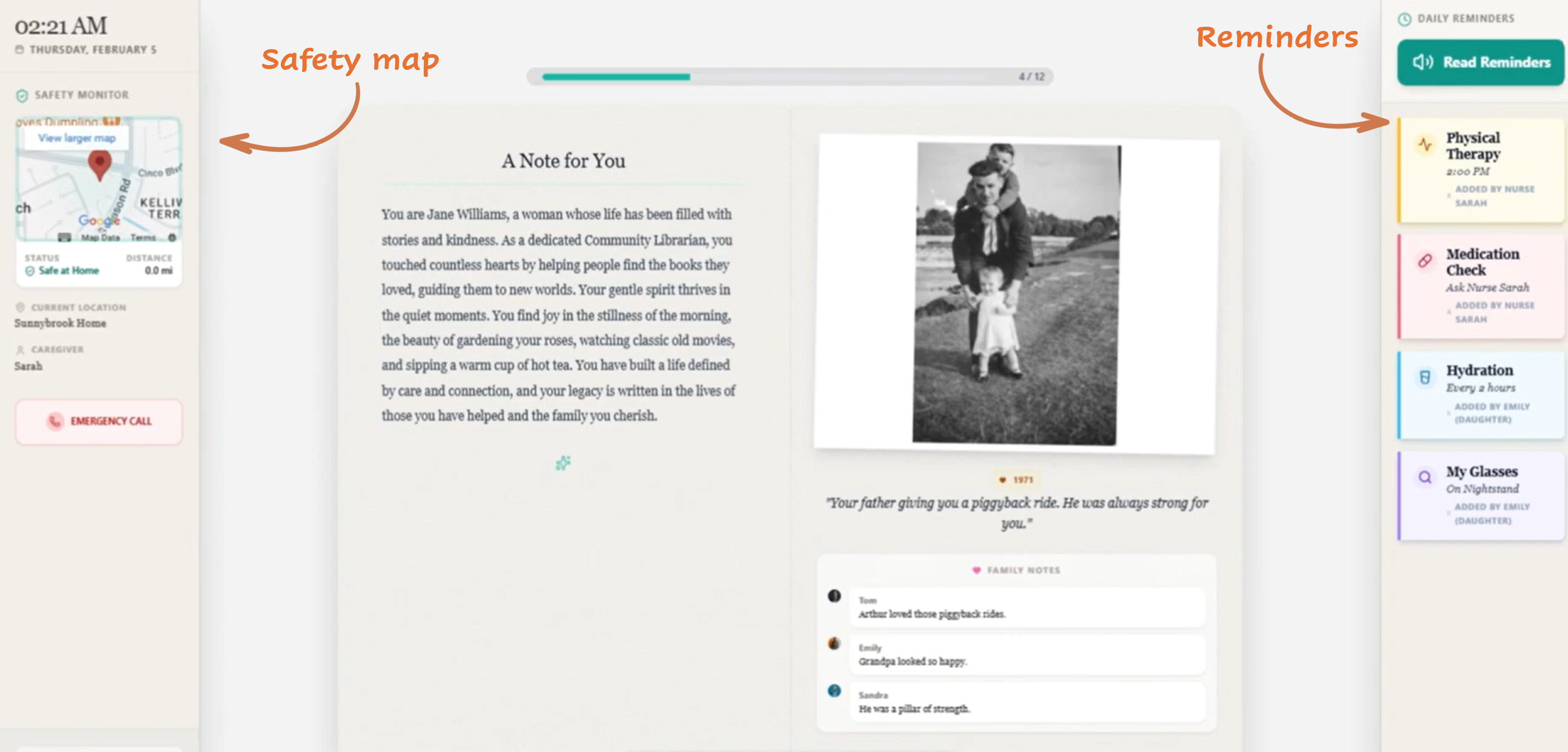
- Patient Mode (The Delivery Experience) A high-accessibility, low-friction interface designed for cognitive ease. Interactive Storybook: A 3D book viewer with auto-turning pages and cinematic intros to reinforce the patient's current location and safety. Multimodal Delivery: Uses Gemini 2.5 Flash for low-latency, native audio narration and real-time "Live Companion" voice interactions if the patient becomes confused. Safety Sidebar: Constant visibility of time, date, location, and an emergency button to minimize disorientation.
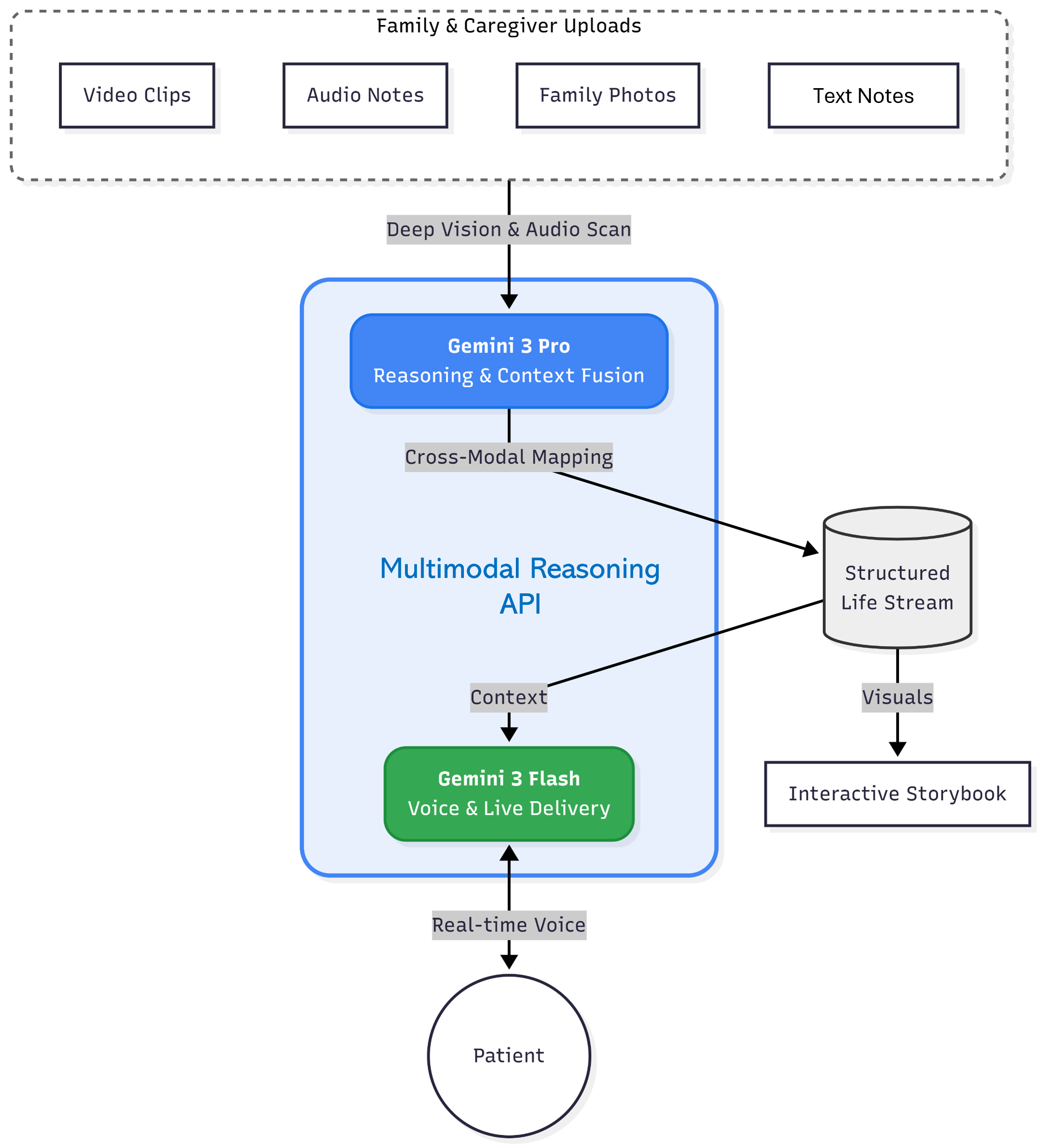
The Core Engine: Gemini 3 Multimodal Reasoning This system transforms fragmented media into a "life stream" for dementia patients, utilizing Gemini 3 as a multimodal reasoning engine rather than a simple chatbot. It bridges the gap between raw uploads (photos, vague videos, notes) and structured, emotionally safe narratives. The system uses the gemini-3-pro-preview model in the service layer to perform three high-order reasoning tasks: The AI Interviewer (processCaptionTurn): Instead of generic labeling, the model identifies missing context (e.g., "Who is the baby?") and interviews caregivers to fill narrative gaps. The Biographer (compileBookNarrative): It synthesizes the entire "Memory Circle" into a structured JSON narrative, ensuring emotional consistency and safety-first messaging. The Expert Companion (createCaregiverChat): A consultant-style interface providing dementia-care advice grounded specifically in the patient's personal life data.
Why Gemini 3? The product shifts from a "media gallery" to a "memory reconstruction system" because Gemini 3 can: Fuse Cross-Modal Context: Aligning a text note from 1995 with a blurry photo from the same era. Handle Long Context: Maintaining narrative consistency across dozens of fragmented memories. Ensure Safety: Structuring outputs to be gentle, repetitive, and grounding for those with cognitive decline. While Gemini 3 Pro serves as the "Biographer" (handling complex, slow-burn reasoning), Gemini 3 Flash is the "Voice" and "Conversationalist." We specifically migrated the patient-facing interactions to Gemini 3 Flash to ensure the experience feels human and safe.
Why We Use Gemini 3 Flash for Voice For a dementia patient, even a two-second delay in conversation can cause confusion or anxiety. Gemini 3 Flash is built for low-latency, high-frequency interactions.
| Feature | Gemini 3 Pro (The Brain) | Gemini 3 Flash (The Voice) |
|---|---|---|
| Primary Goal | Deep Multimodal Reasoning | Speed & Fluid Interaction |
| Response Time | Slower (2–5+ seconds) | Ultra-Fast (Sub-second TTFT) |
| Voice Persona | Detailed & Analytical | Natural & Low-Latency |
| Context Window | 2M+ Tokens | 1M Tokens (Optimized for scale) |
| Token Efficiency | Standard | 30% more efficient (less "wasted" thought) |
Because Everly is a supportive, non-medical companion, it requires no FDA approval and can be deployed through existing consumer platforms such as Google Home devices.
Challenges We Ran Into
The hardest challenge was designing for emotional safety.
We had to ensure:
Everly never invents memories
Repetition never feels frustrating
Instructions don’t overwhelm
Voice interaction feels natural, not robotic
Technically, managing uninterrupted narration alongside natural voice interruption required careful prompt design and state control. We originally tried to run everything through the most powerful model (Gemini 3 Pro). However, the "thinking time" created a 3-5 second silence. For a person with memory loss, those three seconds are a "cognitive cliff"—by the time the AI spoke, the patient had forgotten they asked a question. This is why we pivoted to Gemini 3 Flash; we sacrificed a tiny bit of "deep reasoning" for sub-second speed, which is much more important for maintaining a patient's flow.
Accomplishments That We’re Proud Of
Creating a multimodal storytelling experience that feels human
Using Gemini 3 for emotional consistency, not raw intelligence
Designing an interface that works without menus or tutorials
Making memory-building a family collaboration, not a medical task
Delivering a functional, demo-ready product in a short timeframe
What We Learned
We learned that Alzheimer’s care isn’t about fixing memory — it’s about preserving identity and emotional safety.
We learned:
Voice-first design outperforms visual complexity
Multimodal memories are more powerful than text alone
AI is most impactful when it knows its limits
Gemini 3 enabled us to build something gentle, reliable, and grounded.
We also consulted with nurse Alec Arro, who works in elder-care hospital physical therapy and regularly supports patients with dementia. He also shared that elderly care centers, hospitals, and family members would be highly interested in an app like this, since it supports both patient safety and everyday caregiving needs. Based on his real-world experience, he strongly recommended expanding beyond memory books by adding practical safety-focused features like a Safety Map, Emergency Call, and Daily Reminders. His insight was clear: while memory tools help preserve identity, safety and routine tools help patients stay independent and protected—especially in moments of confusion or disorientation. From that consulting session, we quickly implemented the two new features to the storybook to make it even more beneficial for the intended user.

What’s Next for Everly
Next, we plan to:
Support multiple languages
Enable caregiver-controlled pacing and personalization
Expand family collaboration features
Integrate more deeply with home voice assistants
Our long-term vision is simple: to help people like Jane feel remembered, connected, and valued — every day. Everly uses Gemini 3 to turn family memories into a living, multimodal storybook — so even when memory fades, a life well lived is never lost.
Built With
- gemini
- html
- react
- tailwind
- typescript


Log in or sign up for Devpost to join the conversation.