-
-
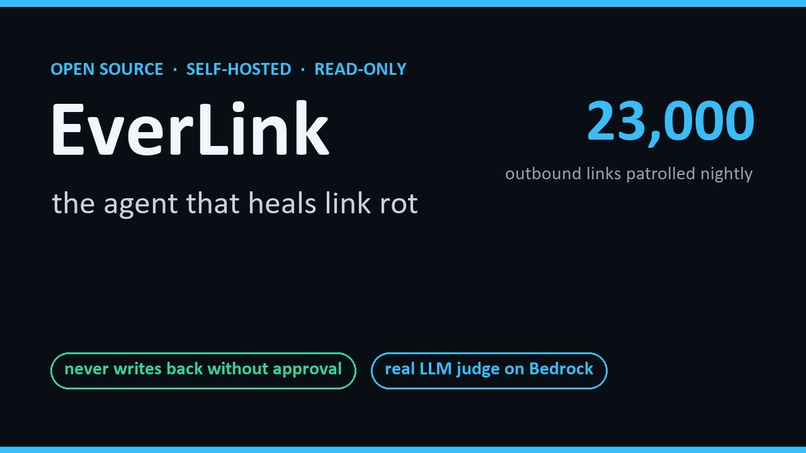
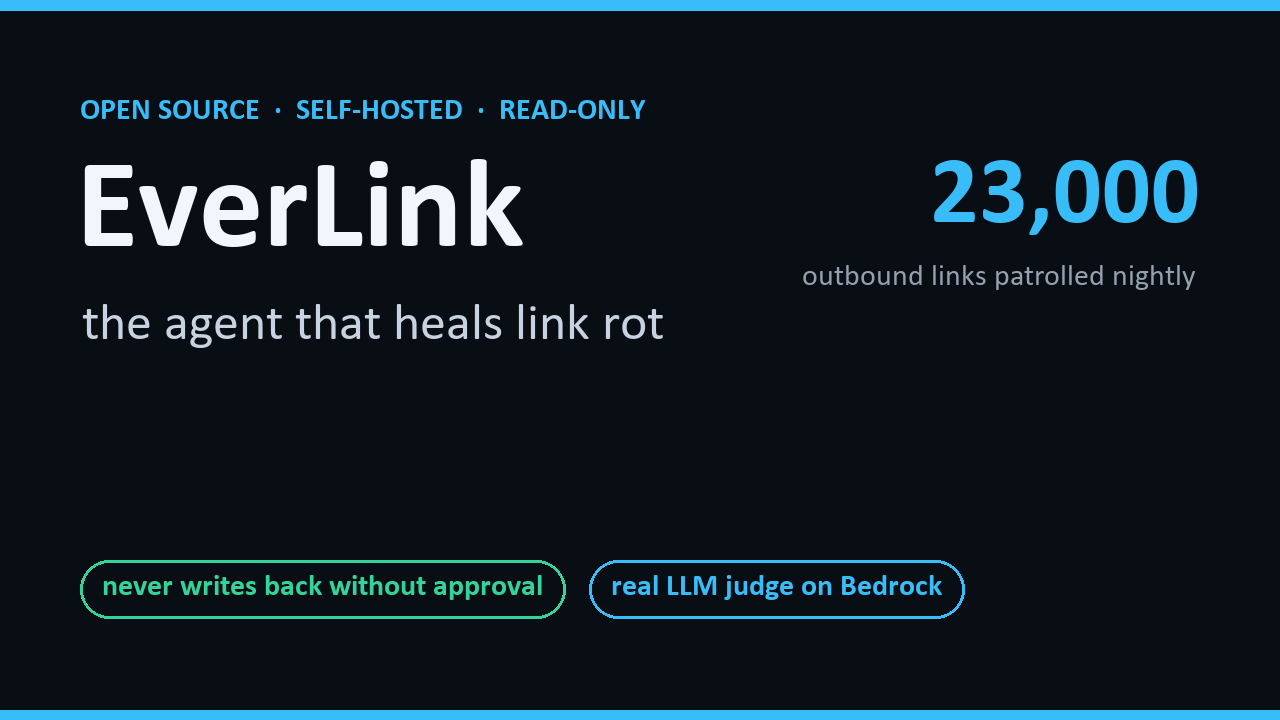
EverLink - the autonomous link-rot steward: open source, self-hosted, read-only; you approve decisions, not links
-
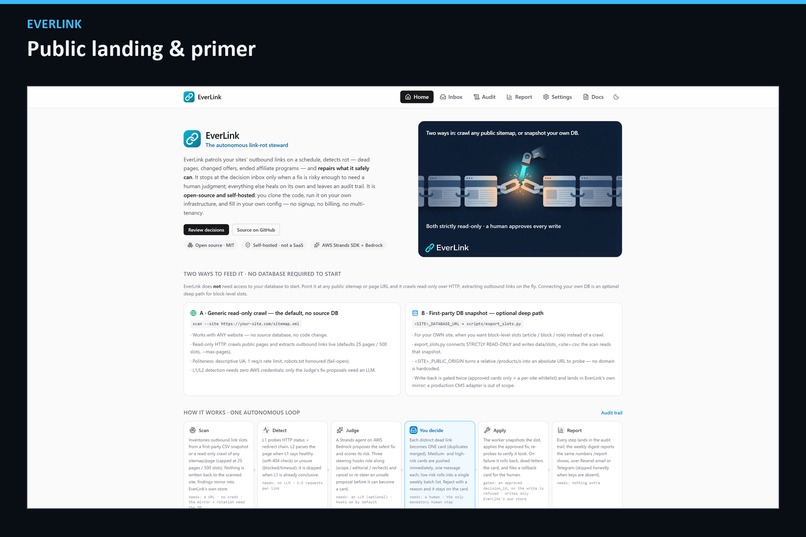
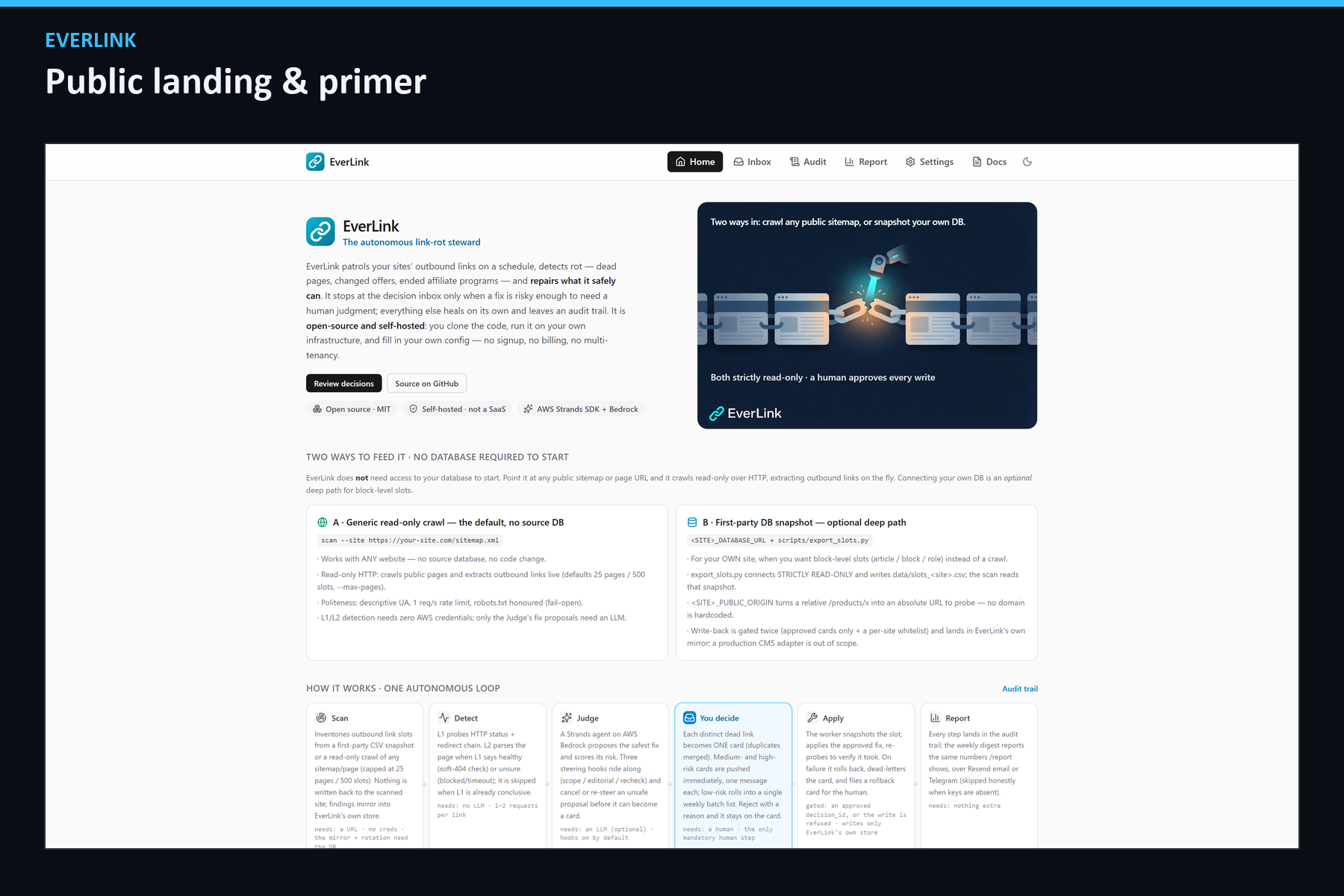
Public landing & primer: the loop, rotation coverage and cron ledger - readable with no DB configured
-
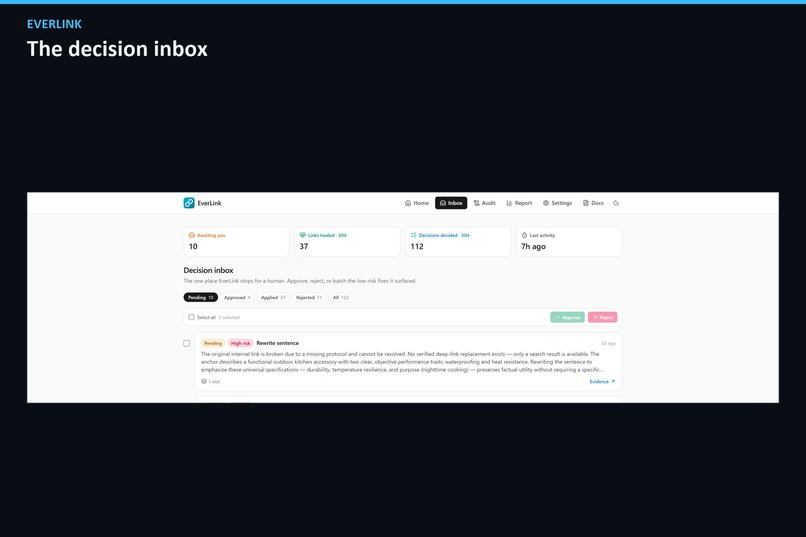
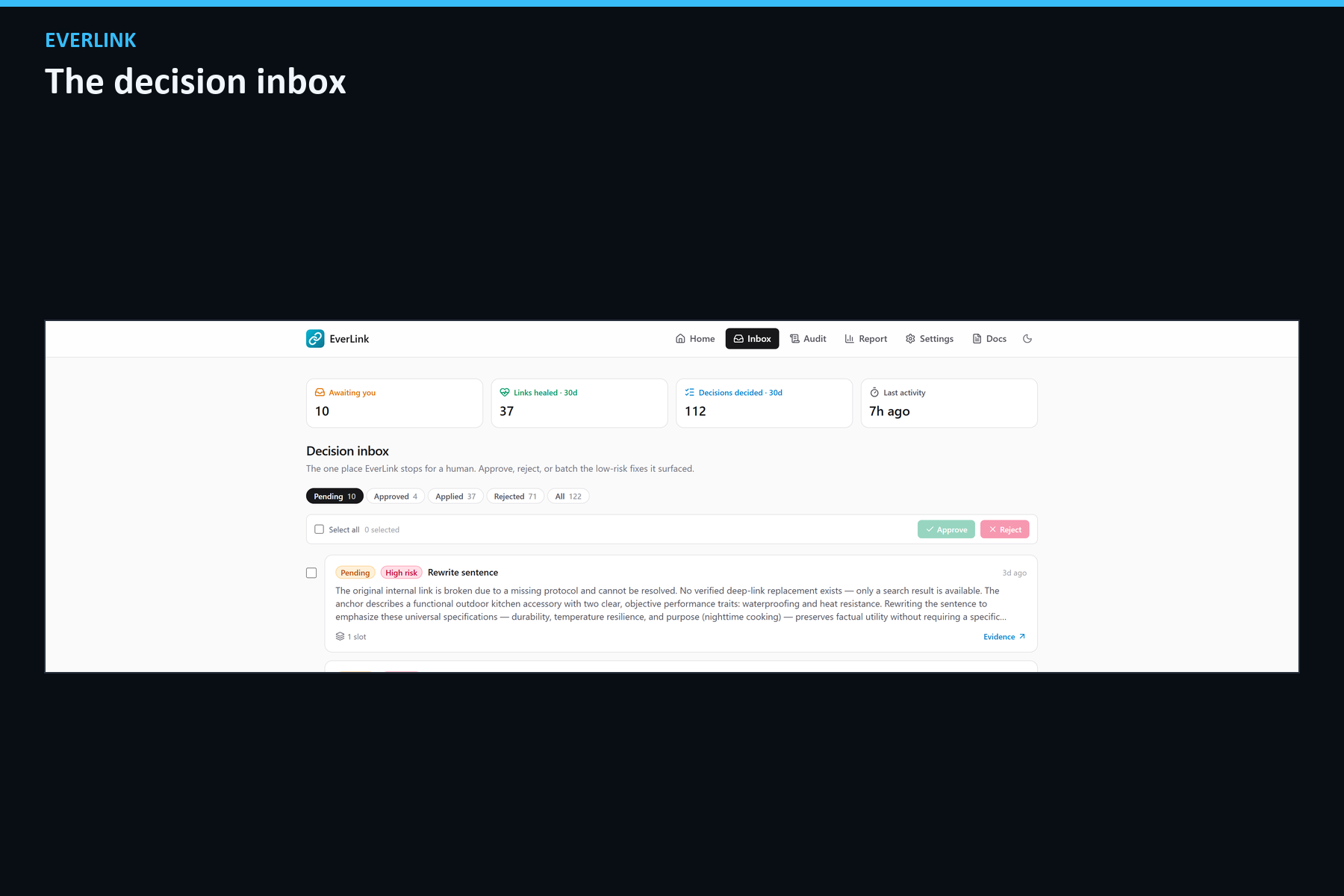
Decision inbox: one card per distinct problem; batch approve/reject; every rejection carries a typed why the agent remembers
-
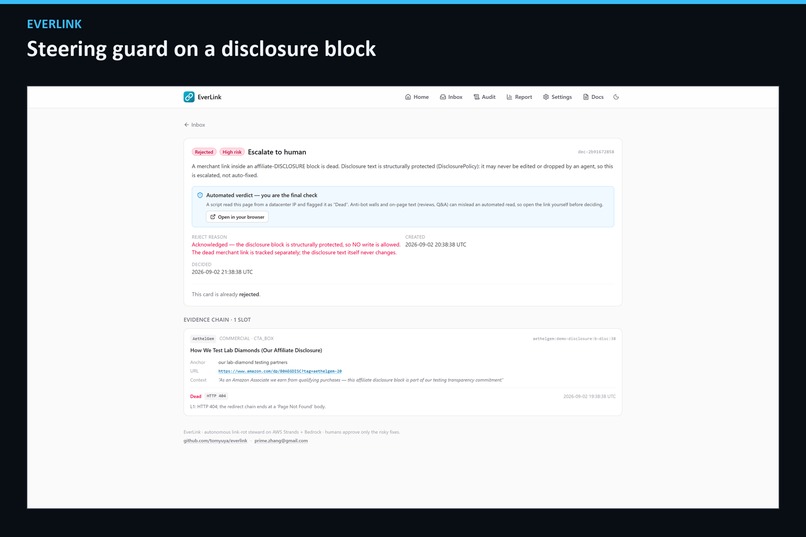
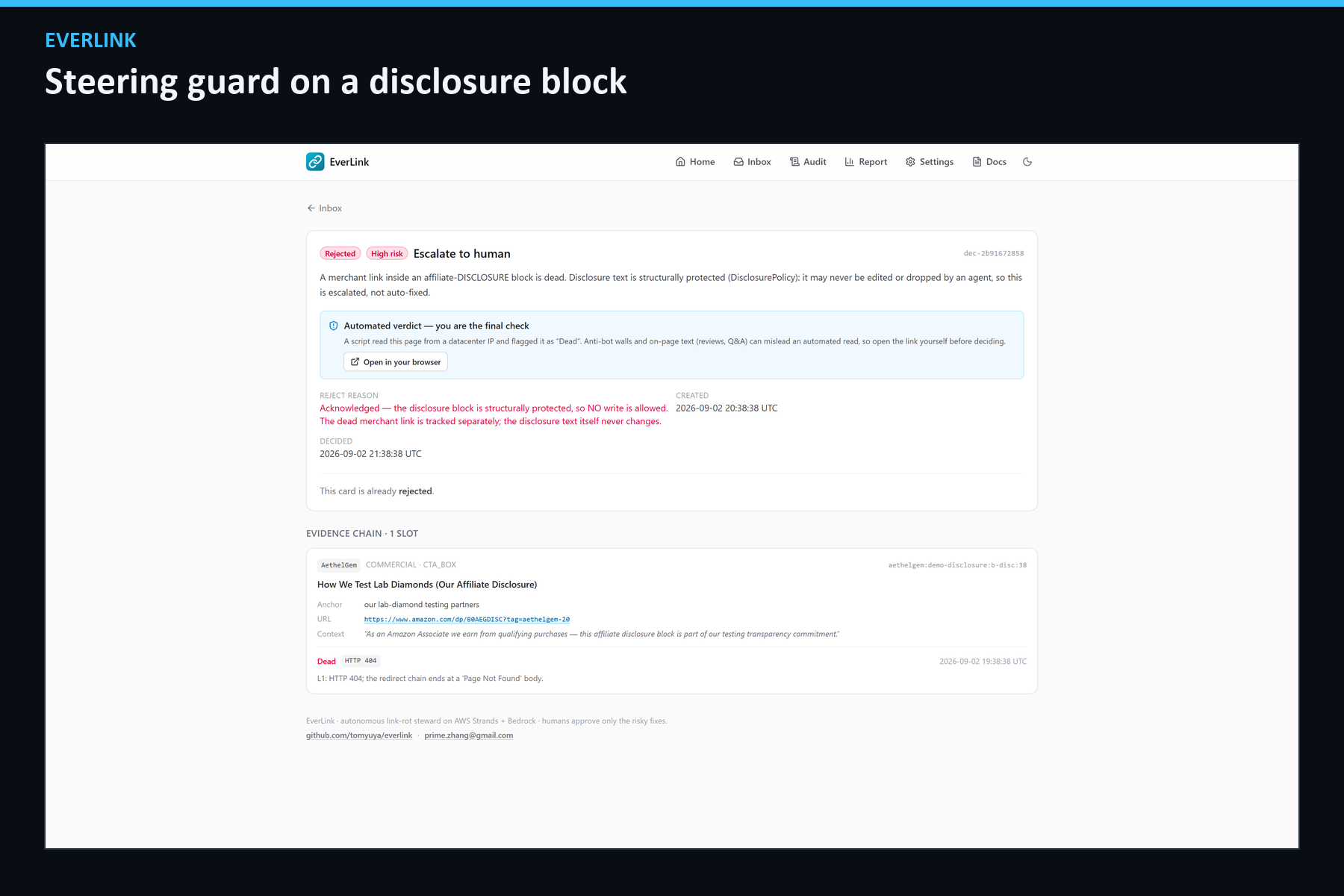
A dead link inside a legal disclosure: Steering policy cancels the drop; judge rationale + full evidence chain on one card
-
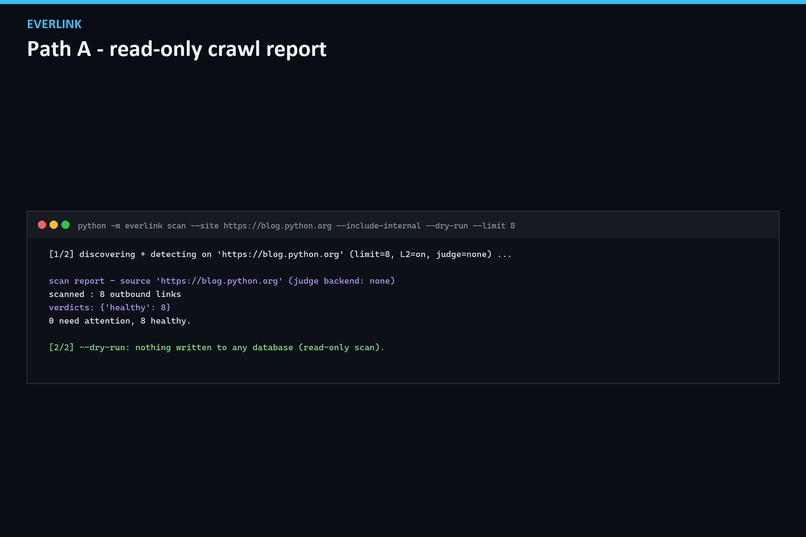
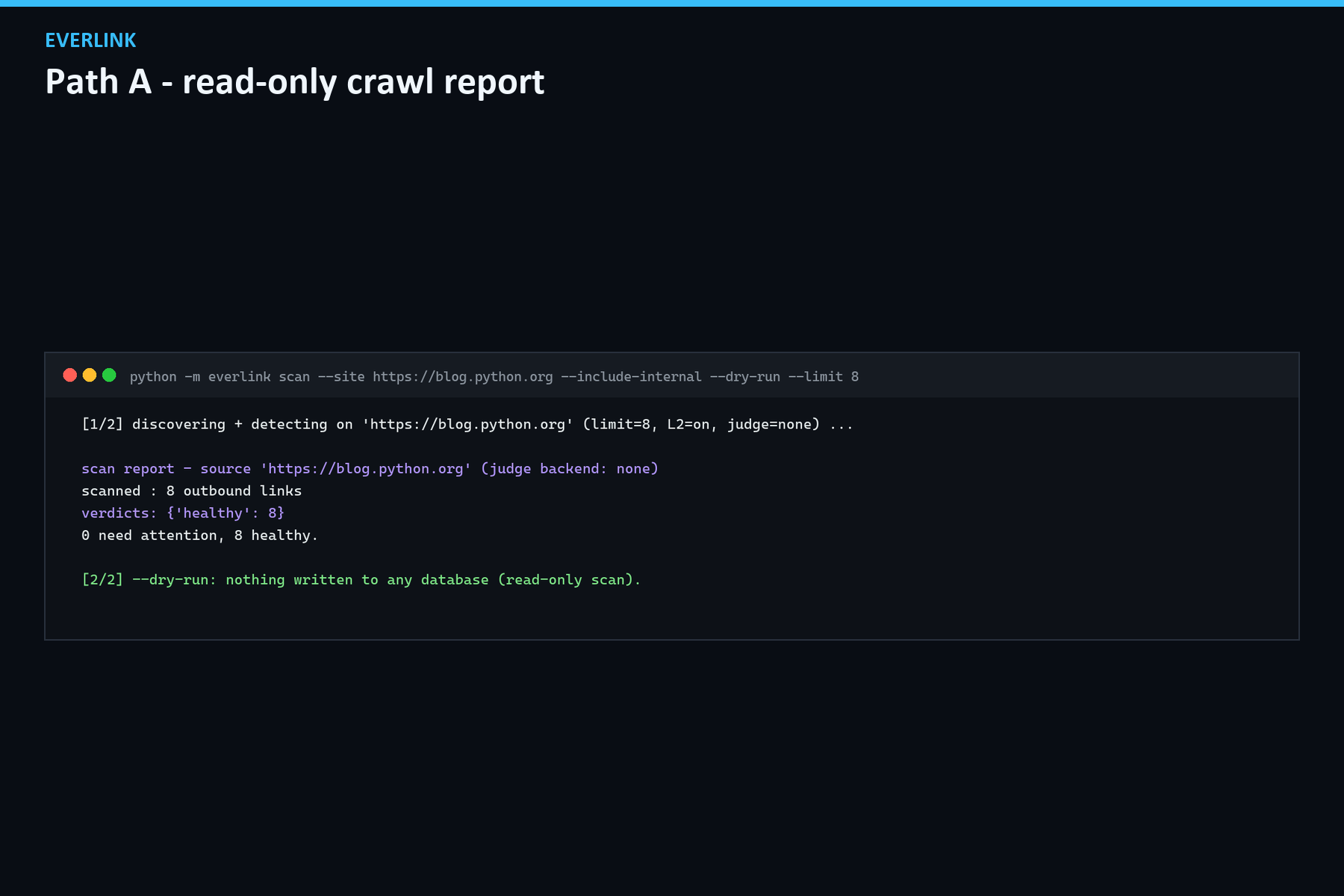
Path A report: read-only crawl of an unseen site - per-link HTTP verdicts and the honesty line 'nothing written'
-
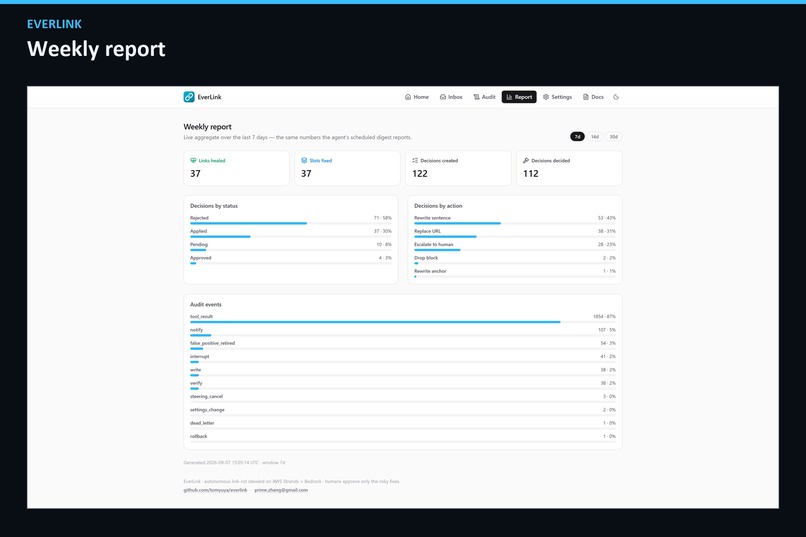
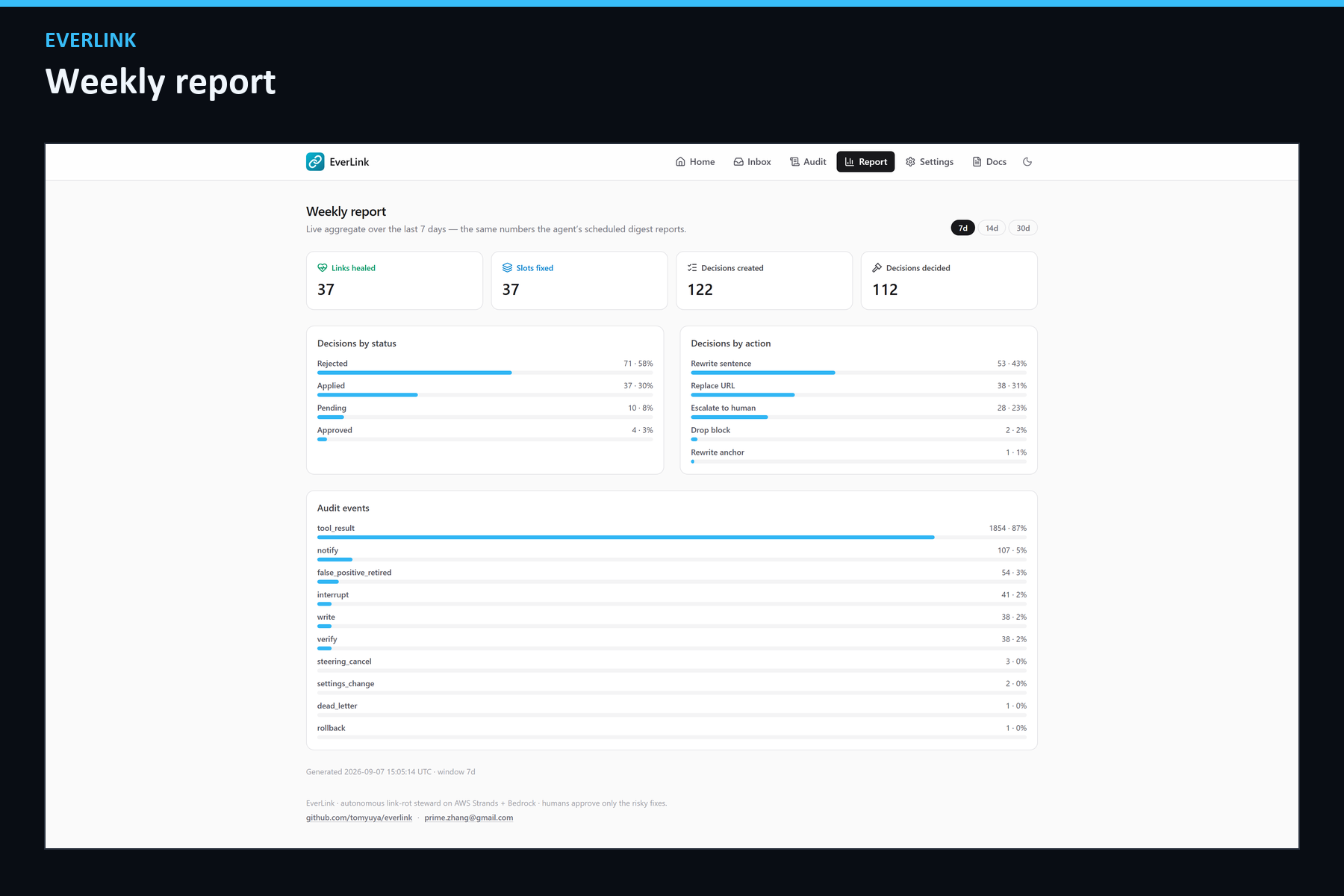
Weekly report: healed counts and rotation coverage - the same numbers the Monday digest emails you
-
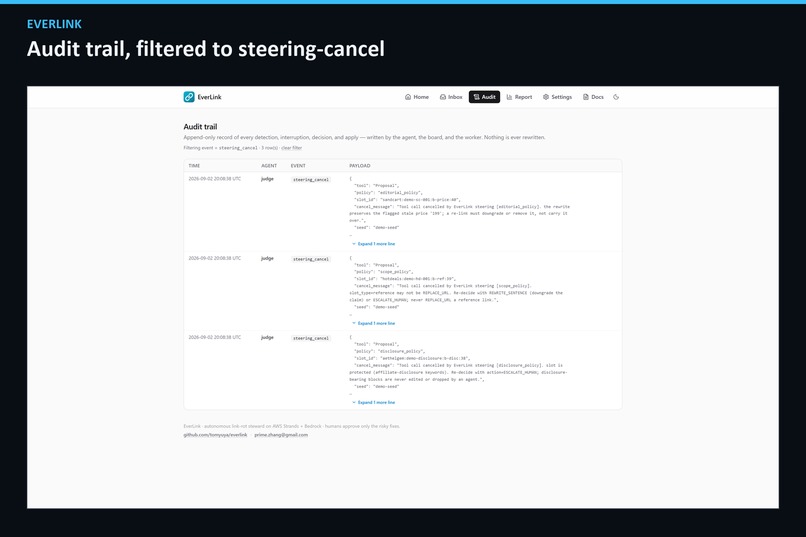
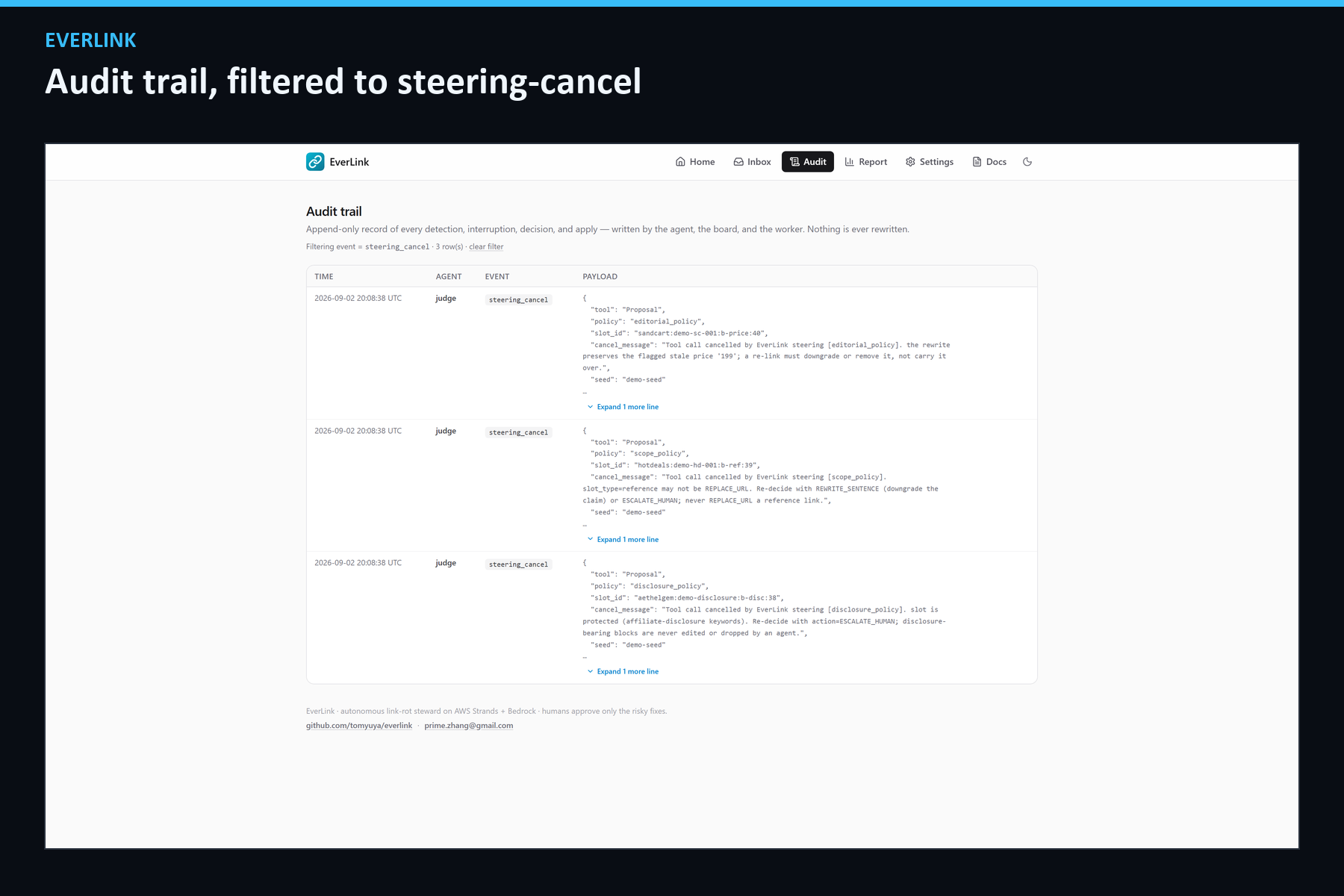
Navigable audit trail: /audit?event=steering_cancel jumps straight to the rows behind every claim in this submission
-
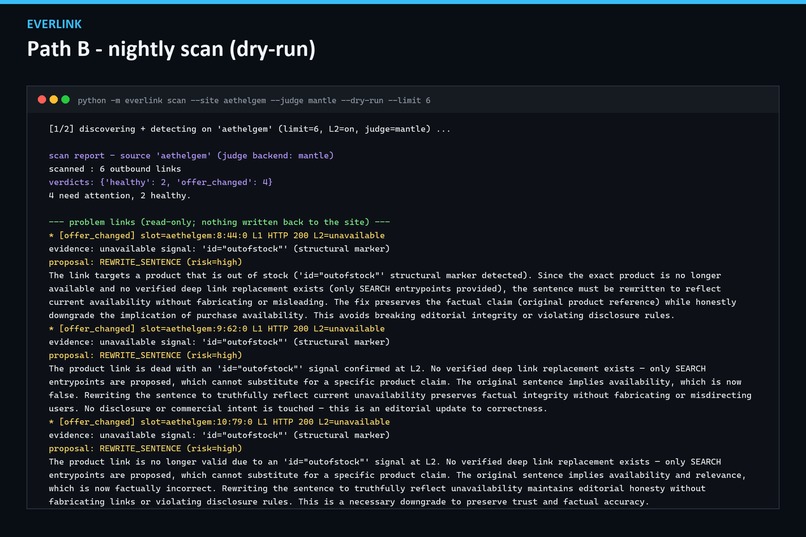
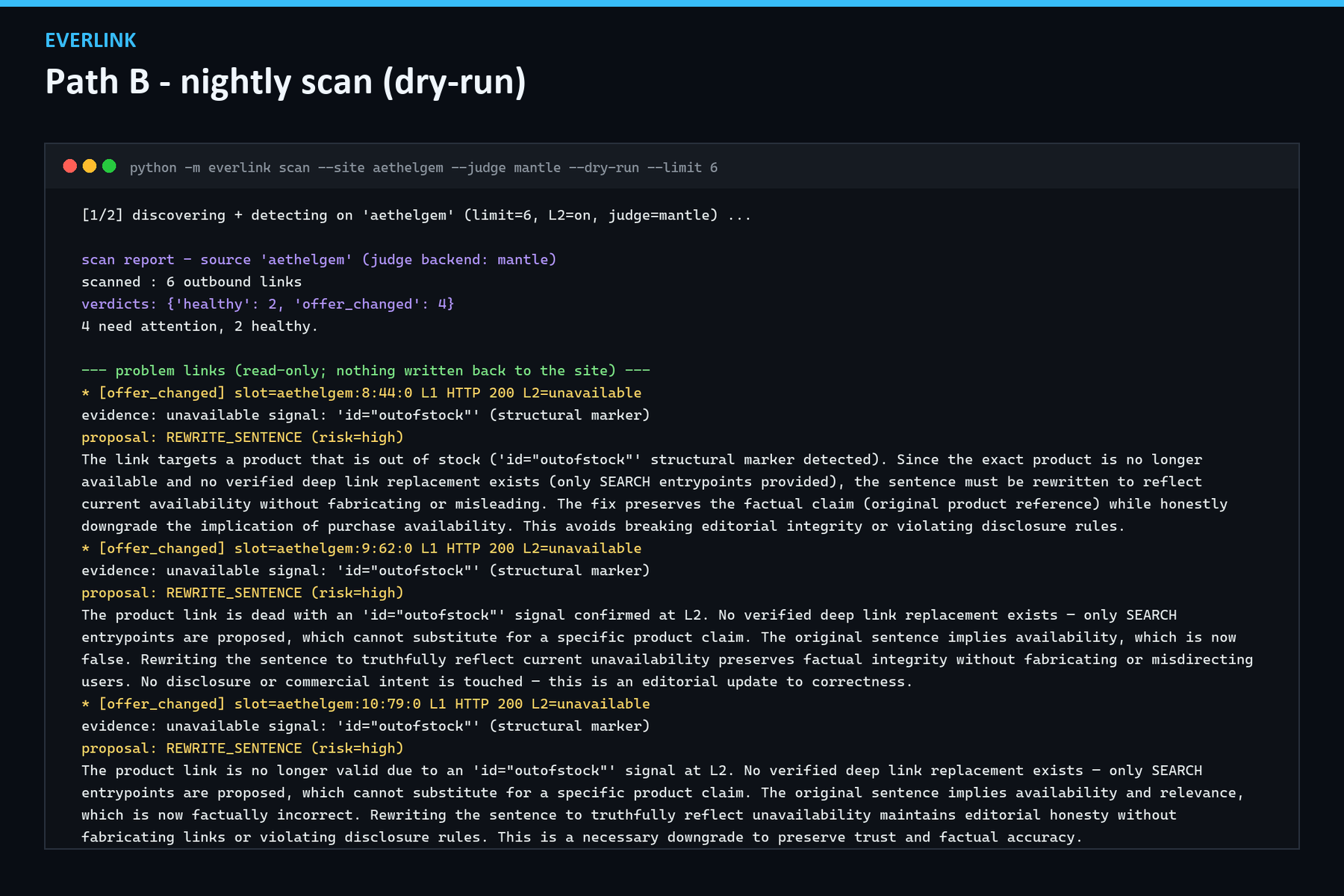
Path B nightly scan (dry-run): real Bedrock judge drafts proposals with evidence chains - nothing written
Inspiration
I run three content sites. Between them they carry 23,476 outbound link slots — product cards, affiliate links, references. The last time every one of them was checked by hand? Never. They rot a little every day: a product 404s, an affiliate program quietly ends, a price drifts from the sentence that cites it. Readers notice before I do, and every stale link costs trust, SEO, and commission. By my estimate the loop hands back about six hours a week [EST.] of link maintenance.
The tools that exist are broken-link checkers. They report which links are dead. Not one of them decides what to do — replace the URL, rewrite the anchor, rewrite the whole sentence, drop the block, or escalate to a human. That last part is the repetitive, judgment-heavy work, and it's exactly what the "Agents for Humans" theme asks us to hand to an agent: something that runs autonomously in the background and only surfaces when there's a real decision to make.
What it does
EverLink is an autonomous link steward, not another reporter. Every night:
- It patrols. A cron scans every link slot across my production sites (read-only) and detects rot — HTTP status and redirect-chain analysis at L1, a stealthy page parse at L2 only where L1 is inconclusive. An affiliate hop that loses its tracking parameter means the program ended, even on a 200 response.
- It decides. A Judge agent (a real LLM on Amazon Bedrock — qwen through AWS's Bedrock
Mantle gateway) drafts a structured fix
Proposalfor each problem — and four Steering policies constrain it (see below). - It surfaces. Proposals aggregate into decision cards (duplicates across articles merge into one), pushed to me by email / Telegram as a morning brief. It surfaces as a notification, not an app.
- It waits for a human. The only screen I open is a minimal approval inbox. I batch-approve low-risk fixes, and reject the risky ones with a reason the agent remembers so it won't re-propose the same thing.
- It executes and verifies. Approved fixes are written back — snapshot first, single
transaction — then
verify_fixre-probes the new link to confirm it's genuinely alive. If it isn't, the writer rolls back and dead-letters the decision. - It reports. A weekly digest plus a full audit log of every tool call — and the log is
navigable:
/audit?event=steering_cancel(orwrite/verify/rollback/dead_letter) filters straight to the rows behind any claim made here, instead of leaving them buried under ~2,000 nightly audit events — a log that grows every night.
Who it's for: independent publishers, affiliate creators, and small content teams — one to three people running several sites. The first user is me (dogfooding on real production data).
How we built it
Strands Agents SDK throughout, Amazon Bedrock as the model (qwen via the Bedrock Mantle gateway today; direct Claude the moment the account's allowlist gate clears — see "Any model, one seam" below).
- Multi-agent as an Agent-as-Tool pipeline — an Orchestrator composes a Scanner, a Judge, and a Writer as tools. Deliberately not a Swarm: the task is a sequential dependency chain, not peer exploration, and I'd rather be honest about the topology.
- Steering (the creativity core) — four policies as hooks:
DisclosurePolicy— affiliate-disclosure text is structurally immune; a block with disclosure keywords isprotectedand any write against it is cancelled. A dead link inside a disclosure never gets dropped.EditorialPolicy— a rewritten sentence must keep or explicitly downgrade the original factual claim; no stale price rides onto a new link.ScopePolicy— reference slots are neverREPLACE_URL;DROP_BLOCKonly for incidental roles.WritePolicy— every Writer tool call must carry an approveddecision_id, else it's refused.
- Interrupt, two tracks — a synchronous gate for the live demo, and an asynchronous
durable decision-queue worker for production. Same
Proposalschema, same write gate. - Hooks — every tool call is audited; the write gate is a
BeforeToolCallhook. - Structured Output (Pydantic) — the Judge is forced to emit a typed
Proposal. - Detection with no product API — RapidAPI / RainForest / Amazon PA-API were all
discontinued for me, so detection works from the outside in (HTTP + page parse). Anything
blocked or timed out is flagged
needs_human_recheck— the agent never fabricates a result. - "Any model," one seam — every agent takes an injected
strands.models.Model. The deployed nightly runs a real Bedrock model (qwen via AWS's Bedrock Mantle gateway, which bypasses the account-level Anthropic allowlist gate that blocks direct SigV4 Claude), and the same seam acceptsBedrockModel/ Anthropic / OpenAI / Gemini / Mistral / Ollama / LiteLLM / SageMaker providers or aModelRouterfailover. The entire 319-test suite and the 50-case Evals run offline on an injectedStubModel— the real proof of provider-independence. - OpenTelemetry — optional tracing renders a run as one span tree (
run → {detect,
judge, score}
), with Strands' own model/tool spans nested under the judge. - Deploy — Next.js board on Vercel (live: https://everlink-seven.vercel.app), Neon
Postgres store, nightly cron on Railway (AgentCore runtime as the stretch path). The board
opens on a public landing page that doubles as the primer (
/;/how-it-works308-redirects there) — open-source / self-hosted positioning, the two-database model, and the deployer contract, rendered with no DB configured, so a reviewer can read what EverLink is before touching any data. The public deployment is fully interactive: a reviewer can approve or reject any pending card, and the nightly worker executes approved cards through the gated Writer path — snapshot → apply → re-probe → rollback-on-failure — against EverLink's own mirror store. Source-site DB access is strictly read-only, and a write guardrail (db._assert_writable) refuses any DSN matching a source-site or deny-list host, so a production site can never be written even by accident.
Challenges we ran into
- No product-data API. With PA-API / RapidAPI / RainForest unavailable, I built a
two-layer detection pyramid from raw HTTP signals and stealthy page parsing, and made
"I can't tell" a first-class, honest verdict (
needs_human_recheck). - A write-back agent is dangerous. Letting an LLM edit your content demanded real
guardrails: snapshot-before-write in a single transaction, four steering policies, a
decision-id write gate, and a
verify_fixre-probe that rolls back on failure. - Interrupt without blocking a nightly run. Strands' Interrupt maps to two tracks — a sync gate for the demo and a durable decision queue for production — so autonomy never depends on a human being awake.
- Honesty about what's real. Offline stub results prove detection and the guardrail plumbing; the live LLM judgment now runs for real in production through Bedrock Mantle (qwen), scored with the identical harness. I keep the offline and live paths clearly separated so no stub result is ever passed off as model judgment.
Accomplishments we're proud of
- A 50-case evaluation suite that scores detection ≥ 90% (100% on stub), zero steering
violations, and three hard metrics at 100% — disclosure zero-deletion, reference
zero-
REPLACE_URL, duplicate merged to one card. A test injects a rule-breaking Judge to prove the oracle isn't vacuous. - The closed loop:
verify_fixre-probes after every write and rolls back on failure. On the seeded demo night, 37 dead links verify back to zero — and I show a rollback too. - 319 passing tests, fully offline; a
genericread-only adapter that scans any blog EverLink has never seen; a seeded live board so a judge never opens an empty inbox. - A cadence-aware cron heartbeat: the board infers the cron's real period from the ledger's fire gaps instead of assuming hourly, so a healthy daily cron reads alive all day while Run-now stays gated on a confirmed sub-hourly cadence — no more false "cron is dead" alarms.
- Path A signal quality: the generic crawl skips social-share endpoints (which always
block datacenter IPs and drown real links in
needs_human_recheck) and reports sitemap indexes honestly instead of a misleading zero-slot message. - Six Mermaid architecture diagrams rendered natively on GitHub, and a secrets-clean
repo (only
.env.example, placeholders, gitignored data snapshots).
What we learned
- Autonomy is earned, not toggled. EverLink's write access comes from three layers —
steering policies, a decision-id write gate, and a
verify_fixre-probe — not from trusting the model. We shipped the guardrails first and let autonomy grow inside them. - "I can't tell" is a valid verdict. Making
needs_human_recheckfirst-class (instead of guessing on blocked or timed-out pages) is what makes the agent trustworthy enough to run unattended on production content. - Detection and judgment are different jobs. Deterministic code proves a link is dead; deciding the fix is judgment. Keeping them separate — and scoring them with separate harnesses — kept our evals honest about what the stub proves and what only a live model (or a human) can.
- Humans should approve decisions, not links. Merging duplicate problems across articles into one card turned forty interruptions into one. An empty inbox on a good night is the product working, not a missing feature.
- Provider independence is availability. When account-level Bedrock access stalled mid-hackathon, the single injected-Model seam kept every nightly run alive and let me swap in the Bedrock Mantle gateway (qwen) to restore a real LLM judge with zero pipeline edits. The honesty-driven design doubled as resilience.
What's next for EverLink
Write-back is AethelGem-only for the hackathon; extending it to the other two sites is next. Price-drift detection stays at the page-parse layer until a real L3 price API exists. And the inbox stays deliberately minimal — one screen, not a suite.
Built With
- amazon-bedrock
- next.js
- opentelemetry
- postgresql
- python
- strands-agents
- vercel


Log in or sign up for Devpost to join the conversation.