-
-
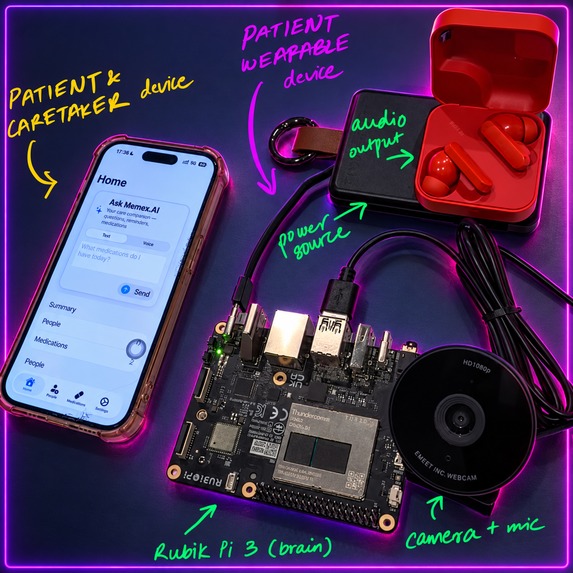
product prototype
-
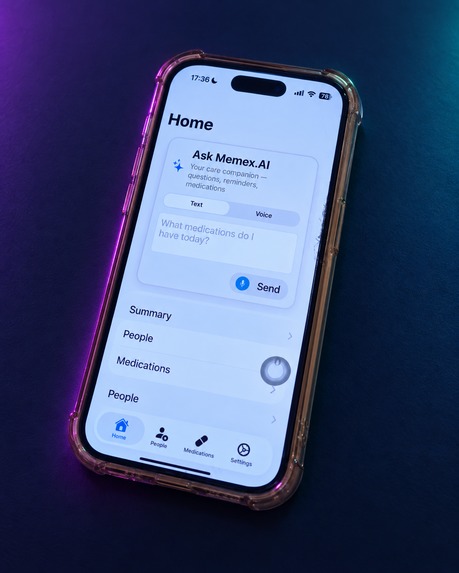
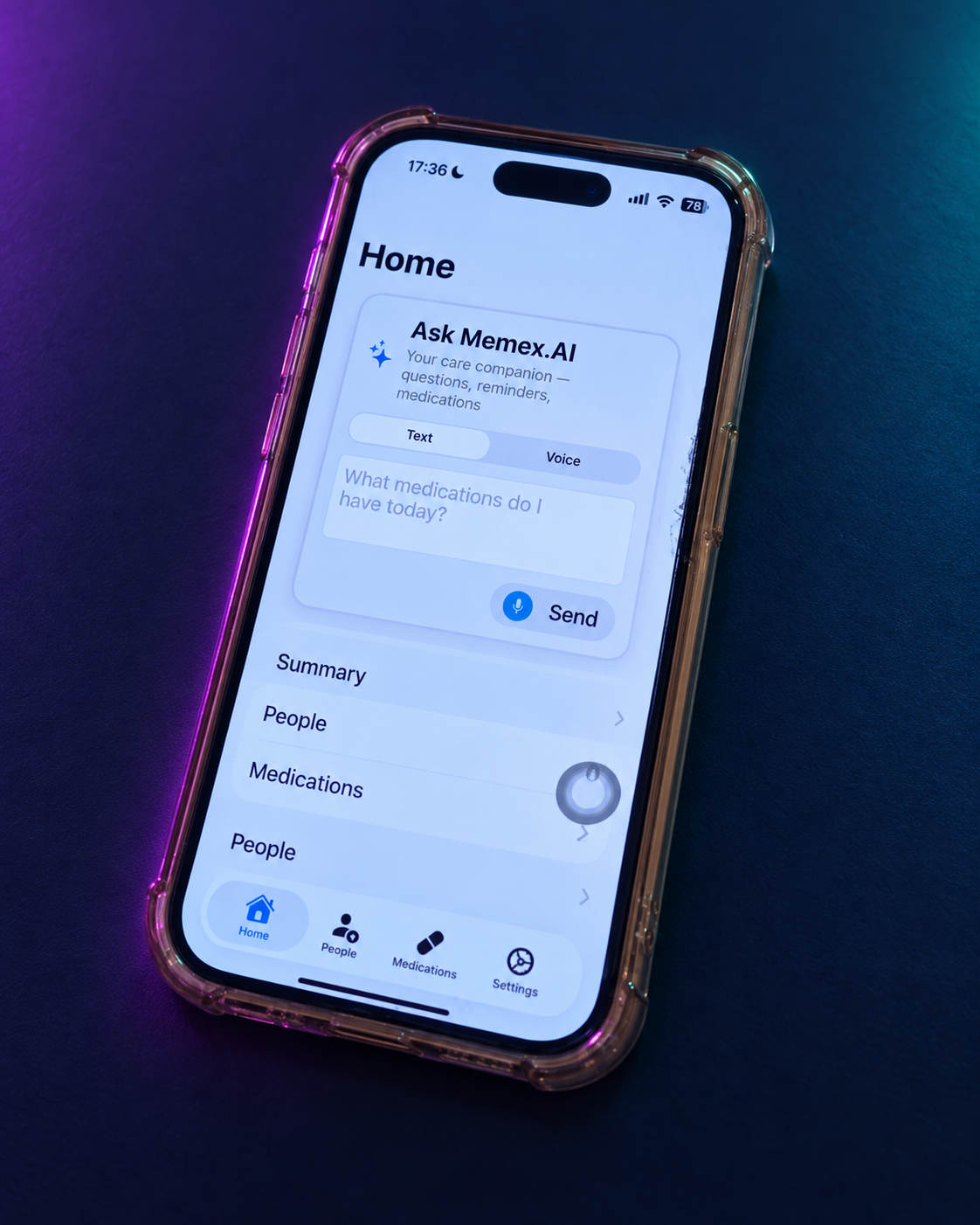
ios App
-
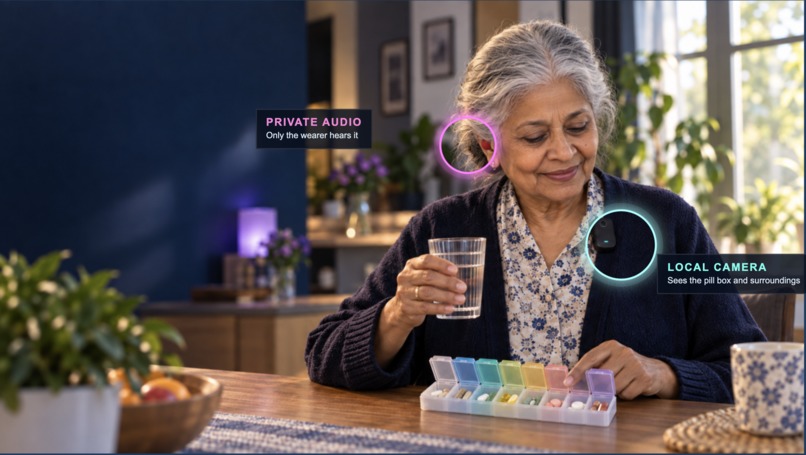
User Case
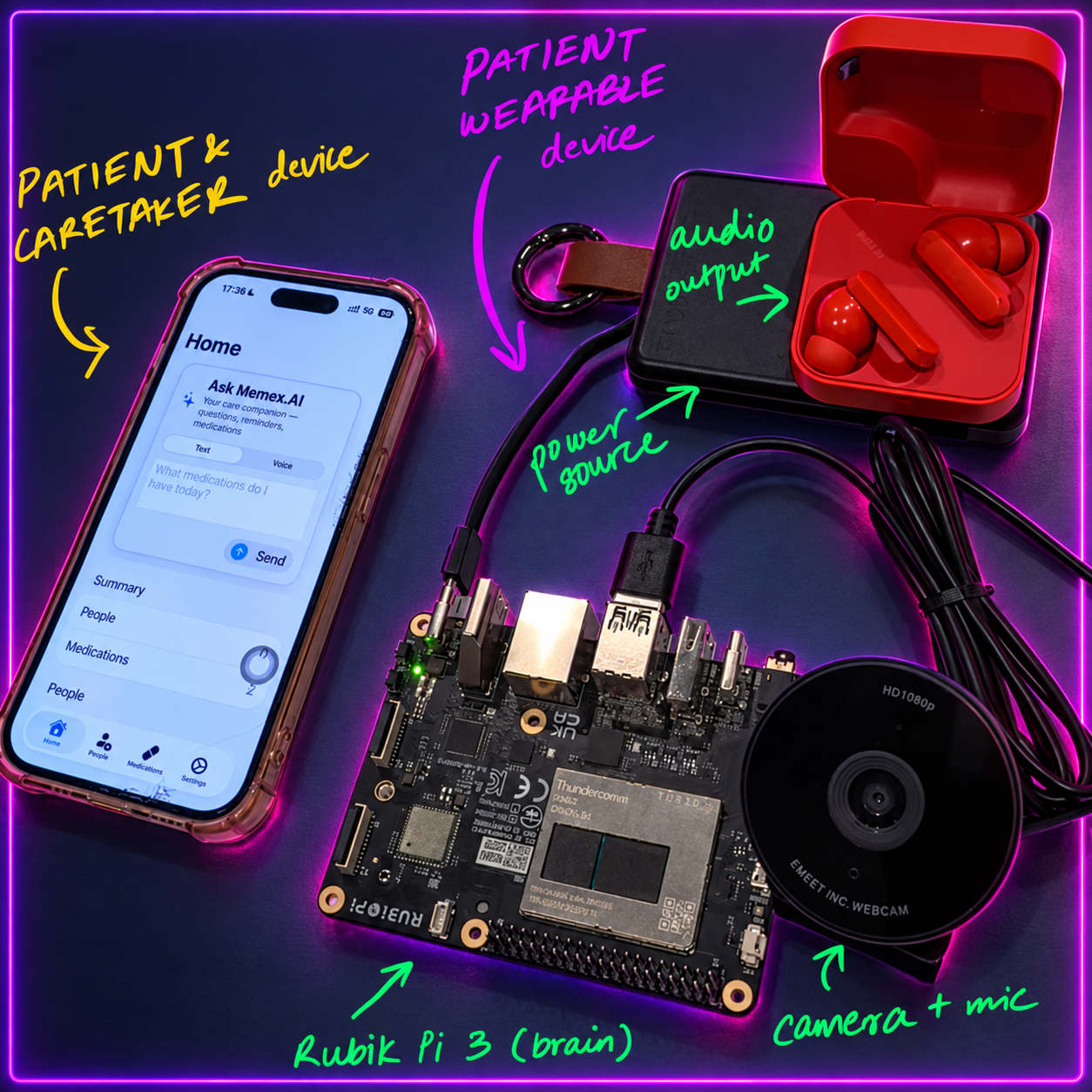
Memex.AI by EverCare
Track: Aging and Longevity
Prompt G: AI for the Aging Population
A private, offline AI companion that helps older adults manage medication, remember familiar people, and stay independent
Inspiration
Longer lives should come with greater independence, not greater dependence on screens, cloud services, or constant caregiver supervision.
Many older adults manage several medications and daily routines. Missing one reminder can create anxiety for the person and their family. This challenge affects the broader aging population, not only people diagnosed with dementia.
In a community cohort of 6,279 adults between ages 66 and 90:
- One-third reported forgetting to take medication.
- Among participants with less than complete adherence, 73% cited poor memory as the reason.
Source: ARIC older-adult medication adherence study
Dementia represents another important use case. Approximately 57 million people worldwide were living with dementia in 2021, according to the World Health Organization.
Source: WHO dementia fact sheet
We built Memex.AI to make daily assistance private, immediate, and available without requiring the wearer to operate a phone.
What it does
Memex.AI is a wearable AI companion for the aging population.
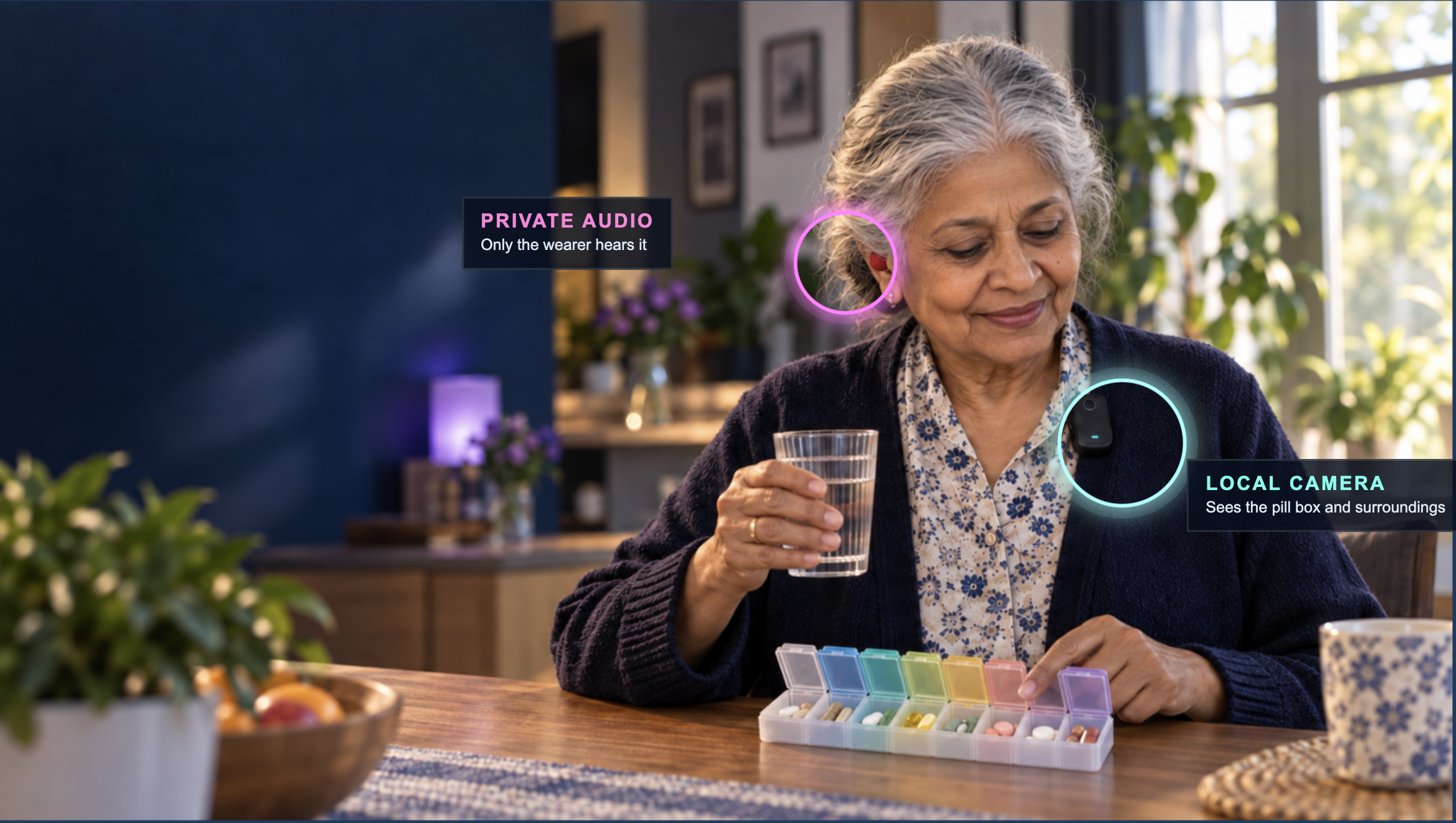
The current prototype combines a RUBIK Pi 3, camera, Bluetooth earpiece, microphone, local AI models, and a family companion app.
1. Private medication reminders
A family member enters the medication name, quantity, and schedule through the app.
At the scheduled time, Memex.AI speaks directly into the wearer’s earpiece:
“It is 8:00 AM. Time for your prebiotic.”
The reminder is private and hands-free. The wearer does not need to find a phone, unlock a screen, or navigate an application.
Memex.AI only reads the stored medication schedule. It never changes the medication, dosage, or scheduled time.
2. Familiar-face recognition
For older adults experiencing memory decline or dementia, Memex.AI can recognize enrolled family members.
When the camera identifies someone, the wearer privately hears their name and relationship:
“Ron, your son, is in front of you.”
During prototype testing, the system recognized an enrolled face with confidence scores between 0.82 and 0.86 and triggered local speech output.
3. Local agentic assistance
The wearer can activate the assistant by saying:
“Hey Buddy”
The assistant can respond to focused questions such as:
- “What medication is next?”
- “When is my next appointment?”
- “Remind me to call Ron at 6 PM.”
The local agent uses approved information about the wearer and a limited set of safe actions.
It cannot diagnose a condition, prescribe treatment, or modify medication.
4. Family onboarding
The companion app allows a family member to:
- Add medications and schedules
- Enroll trusted people
- Store names and relationships
- Pair the wearable
- Configure the information available to the assistant
The app handles setup while the wearable provides a simple hands-free experience for the older adult.
Who it serves
- Primary user: Older adults managing medication, appointments, and everyday routines while living independently.
- Additional users: People experiencing mild cognitive impairment, memory decline, or dementia.
- Buyer: Adult children and family caregivers who want to support independence without constant monitoring.
- Potential partners: Senior-living communities, home-care organizations, pharmacies, healthcare systems, and aging-support programs.
Why existing solutions fall short
- Phone alarms can be dismissed without understanding what the reminder was for.
- Medication apps require active navigation and depend on the person carrying and operating a phone.
- Smart speakers can announce private information publicly and often depend on a cloud connection.
- Emergency buttons usually respond after something has gone wrong.
- Memex.AI stays with the wearer and provides context before a routine becomes a crisis.
How we built it
The working prototype runs on a RUBIK Pi 3 with a connected camera and Bluetooth headset.
1. Face-recognition pipeline
- The camera captures frames locally using OpenCV.
- InsightFace detects faces and generates embeddings.
- The system compares the embedding with enrolled records.
- MongoDB returns the matched name and relationship.
- Piper converts the message into speech.
- The wearer hears the result privately through the earpiece.
2. Medication pipeline
- A family member enters the medication schedule through the app.
- MongoDB stores the approved schedule.
- A background scheduler checks for due medications.
- The speech worker generates the reminder locally.
- The reminder plays through the wearer’s earpiece.
3. Voice-agent pipeline
- The Bluetooth microphone captures the wearer’s question.
- Whisper transcribes the speech locally.
- A quantized IBM Granite language model processes the request.
- The model runs through a persistent llama.cpp server.
- The agent retrieves approved personal context or calls a defined tool.
- Piper generates the spoken response.
- The answer plays through the earpiece.
4. Application architecture
- Python powers the device services.
- FastAPI connects the app, database, recognition system, and local agent.
- MongoDB stores enrolled people and medication schedules.
- A startup script resets stale processes, reconnects Bluetooth, selects the microphone and speaker, and launches the complete system.
Why local AI matters
Older adults should not lose access to essential assistance when Wi-Fi disappears.
The core Memex.AI experience runs locally:
- Face recognition
- Medication scheduling
- Speech transcription
- Language-model reasoning
- Text-to-speech generation
- Personal-context retrieval
Local processing also reduces the amount of sensitive personal information sent outside the device.
The system can recognize someone, announce a medication reminder, and answer an approved question without depending on a cloud AI service.
Privacy and healthcare safety
Memex.AI provides assistance, not medical judgment.
The system follows several boundaries:
- It reads caregiver-entered, clinician-confirmed medication schedules.
- It does not recommend a medication.
- It does not change a dosage.
- It does not reschedule treatment.
- It does not diagnose conditions.
- It answers healthcare-related questions only from approved personal context.
- Face matching happens locally against enrolled people.
These constraints make the assistant more predictable and appropriate for an aging population.
Challenges we overcame
1. Reliable camera processing
The camera initially produced stream-buffer timeouts and inconsistent recognition. We stabilized the capture pipeline, corrected the camera orientation, and added confidence logging.
2. Clear Bluetooth audio
Our initial Bluetooth configuration produced broken speech and inconsistent microphone access. We configured the mSBC headset profile, selected the Bluetooth device as the default microphone and speaker, and separated speech playback into a dedicated worker.
3. Local-model performance
The first local-model response had noticeable startup latency. We used a quantized small language model, kept the model server loaded in memory, reduced unnecessary prompt context, and limited the agent to focused tasks.
4. Coordinating multiple services
Face recognition, medication scheduling, speech transcription, the language model, audio playback, and the API must operate at the same time.
We separated these responsibilities into dedicated services and created one startup script that reliably launches the complete system.
Accomplishments
We have built a working end-to-end prototype that can:
- Capture live photo from the connected camera
- Recognize an enrolled family member
- Retrieve the person’s name and relationship
- Speak the result through an earpiece
- Store medication schedules
- Trigger medication reminders
- Capture speech through a Bluetooth microphone
- Transcribe speech locally
- Run a small language model on the device
- Answer focused questions using personal context
- Generate local speech responses
- Start all required services through one command
The project progressed beyond a mockup. We demonstrated the complete flow using real hardware.
What we learned
The most important part of AI for the aging population is not the size of the model. It is whether the system is clear, private, reliable, and easy to use.
We learned that audio quality can matter more than a visual interface for a wearable assistant.
We also learned that a small local model becomes powerful when it receives focused context and a limited set of useful actions.
The best experience does not ask the older adult to learn a new interface. It fits quietly into an existing routine.
Business model hypothesis
We would begin with a direct family offering:
- $59 to $69 for the wearable device.
- Core medication reminders and familiar-face recognition included.
- $9 per month for the optional EverCare Companion plan for agentic conversations.
The subscription would include local agentic support, additional reminder actions, model updates, and caregiver synchronization.
For senior-living and home-care organizations, we would test pricing between $20 and $30 per member each month.
These prices remain hypotheses that require customer validation.
What is next
Our next milestone is a supervised pilot with five families.
We plan to measure:
- Medication reminder completion
- Face-recognition precision
- False recognition rates
- Agent response time
- Battery life
- Thermal comfort
- Bluetooth reliability
- Caregiver setup time
- The wearer’s sense of independence
We also plan to interview at least 20 older adults and family caregivers before finalizing the product design and pricing.
The current development board would eventually become a compact collar-worn device with a smaller camera, battery, and dedicated audio connection.
Built with
- RUBIK Pi 3
- Python
- FastAPI
- MongoDB
- OpenCV
- InsightFace
- Whisper
- IBM Granite
- llama.cpp
- Piper TTS
- PipeWire
- PulseAudio
- Bluetooth mSBC audio

Log in or sign up for Devpost to join the conversation.