-
-
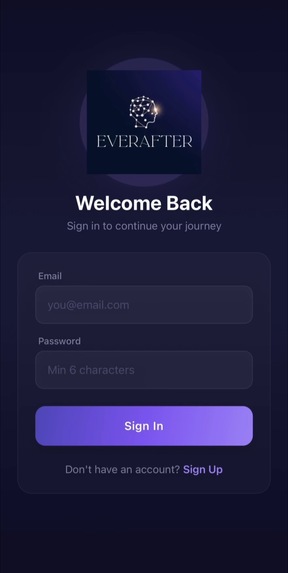
Login Page
-
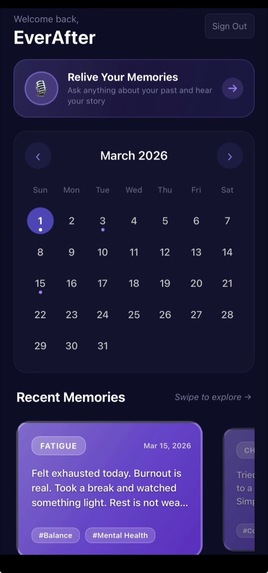
Home Page
-
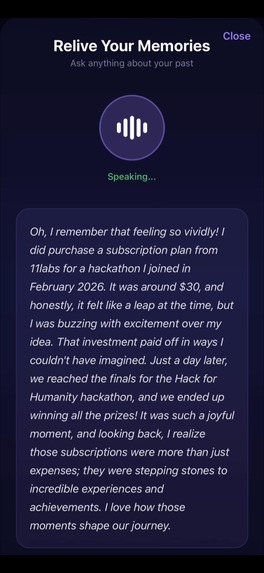
Relive your Memory
-
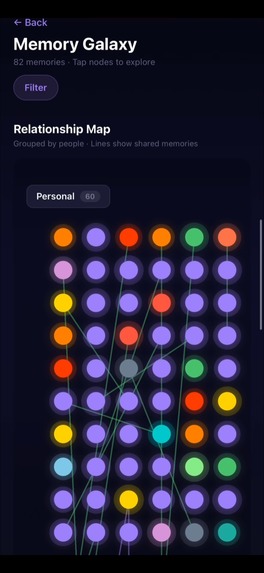
Memory Galaxy
-
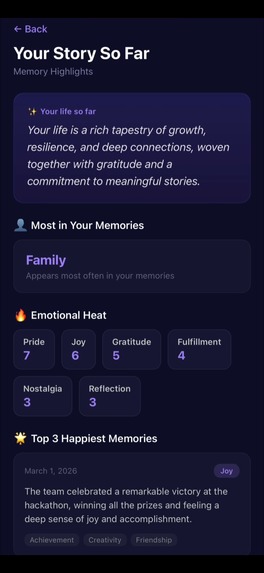
Highlights


Project Story – About EverAfter
Inspiration
Memory is fragile.
By 2050, over 150 million people are expected to live with dementia. When memory fades, families don’t just lose stories, they lose identity.
A father forgets his daughter’s wedding. A mother forgets her child’s voice. A son wishes he had recorded one more ordinary conversation.
We preserve photos. We preserve videos. But we do not preserve structured memory.
EverAfter was built to change that.
We asked a simple question:
What if we could model a human life as a semantic knowledge graph and preserve it before it fades?
What It Does
EverAfter is an AI-powered cognitive preservation platform that transforms personal memories into an interactive, explorable life archive.
Users can:
- Record memories through text, voice, and images
- Enhance them using AI
- Explore their life as a connected memory graph
Ask questions like:
- “When was I happiest?”
- “How did I feel when I moved abroad?”
Hear responses narrated through neural voice synthesis
This is not a diary. It is a structured life model.
How We Built It
EverAfter is built as a cross-platform mobile application using:
- React Native (Expo SDK 54)
- Firebase (Auth, Firestore, Storage)
- OpenAI GPT-4o-mini
- text-embedding-3-small (1536-dimension embeddings)
- Whisper (speech-to-text)
- ElevenLabs (neural voice synthesis)
Intelligent Memory Enhancement
When a user enters a memory, we:
- Use structured prompt engineering with GPT-4o-mini
- Extract:
- People
- Locations
- Emotions (16-class taxonomy)
- Themes
- Life stage classification
- Generate a concise narrative summary
If AI extraction fails, we use rule-based fallback heuristics to ensure 100% metadata completion.
Semantic Life Graph Construction
Each memory is converted into a 1536-dimensional embedding vector.
We batch embeddings in chunks of 50 to prevent API rate limits and reduce overhead.
To create meaningful connections:
- We compute cosine similarity:
[ cos(theta) = {A x B}/{|A| |B|} ]
- Apply a similarity threshold (≥ 0.82)
- Select top-k connections to prevent O(n²) visual explosion
- Limit edges per type to preserve clarity
We also cluster memories using a frequency-based person clustering algorithm with near O(n) complexity.
The result is a clean, explorable semantic memory galaxy.
Voice-Driven Memory Retrieval
When a user asks a question:
- We generate a query embedding
- Rank all memory embeddings using cosine similarity
- Retrieve top-3 most relevant memories
- Generate a first-person narrative response
- Convert it to natural speech using ElevenLabs
We implemented a finite-state audio machine:
IDLE → LOADING → PLAYING ↔ PAUSED → STOPPED
This ensures smooth playback and prevents UI blocking.
Challenges We Faced
- Preventing visual clutter from O(n²) similarity connections
- Managing embedding batch sizes to avoid API limits
- Ensuring Firestore compatibility (removing undefined recursively)
- Maintaining audio state synchronization
- Designing emotionally powerful features without feeling manipulative
Balancing technical scalability with human sensitivity was our biggest challenge.
Why This Matters
EverAfter is powerful in real-world scenarios:
- A father records advice for his child’s wedding and years later, his voice is still present.
- An early-stage Alzheimer’s patient preserves their memories before cognitive decline progresses.
- A family keeps ordinary voice notes that become priceless after unexpected loss.
- A child in 2045 asks, “What were you like at 25?” and hears the answer directly.
We are not replacing people.
We are preserving what they chose to leave behind.
What We Learned
We learned that:
- Technology should amplify humanity, not replace it.
- Embeddings and clustering aren’t just technical tools, they can model identity.
- Ordinary moments become extraordinary over time.
- Presence through voice is more powerful than text alone.
What’s Next
- Personalized voice cloning for premium users
- Long-term memory trend analytics
- Collaborative family memory spaces
- Secure legacy release modes
The aging population crisis is growing.
The need to preserve identity is growing with it.
Technology already stores data.
EverAfter preserves a mind before it fades.
Built With
- elevenlabs
- firebase
- javascript
- openai-gpt-4o-mini
- react-native-(expo)
- text-embedding-3-small
- typescript
- whisper


Log in or sign up for Devpost to join the conversation.