-
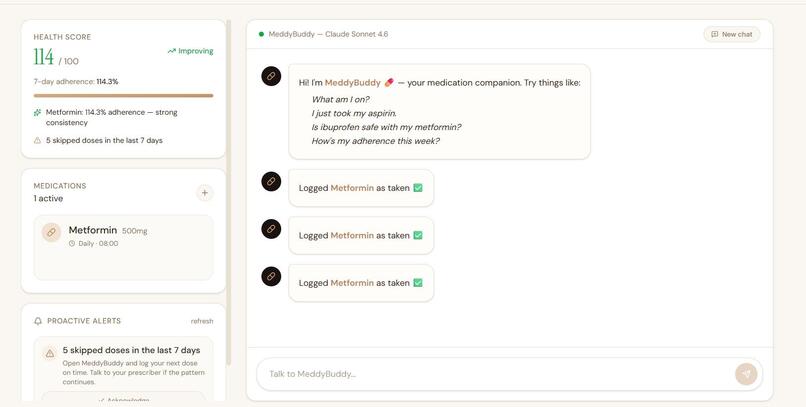
Dashboard page
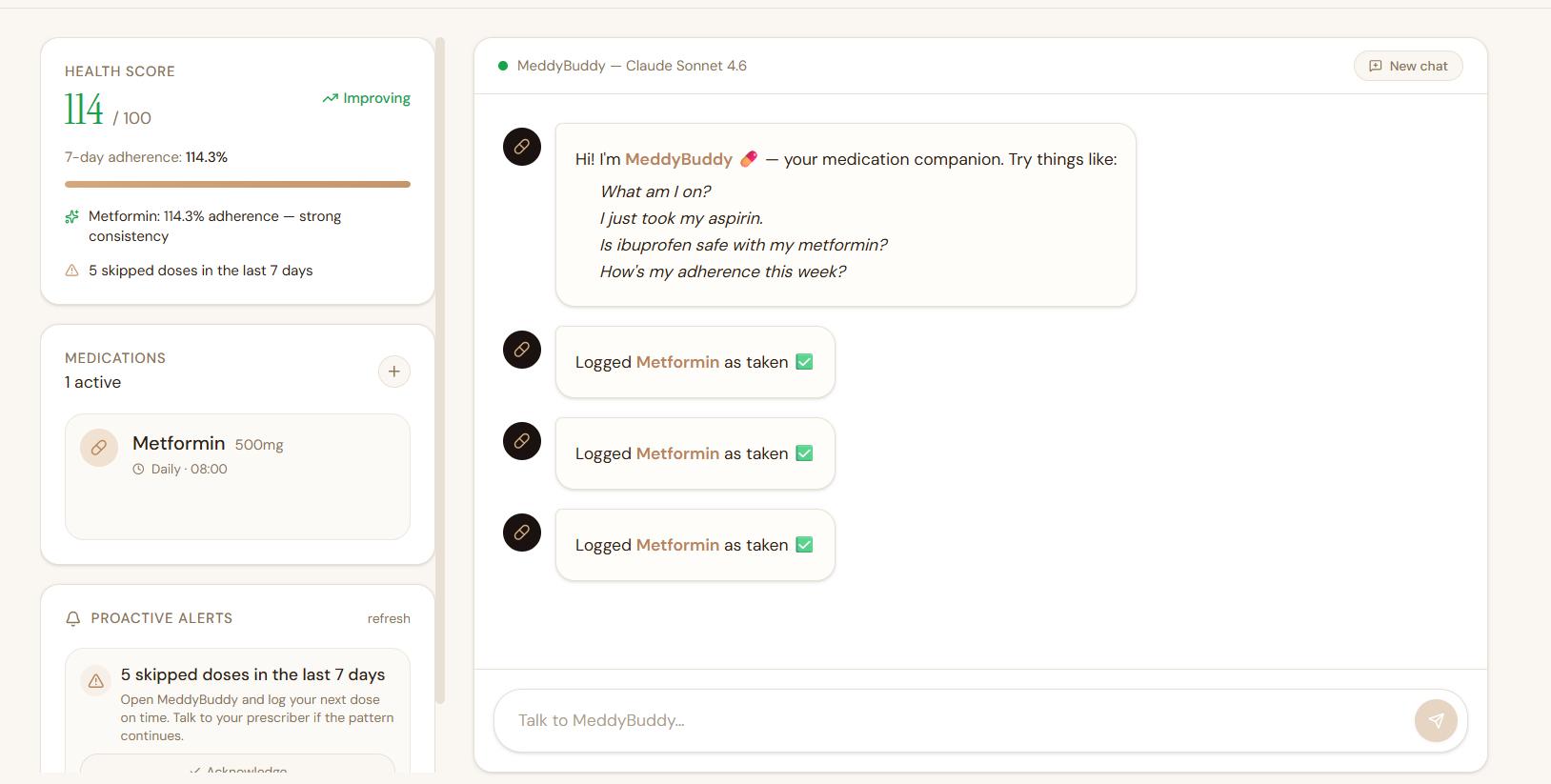
MediGuard AI — Intelligent Medication Safety Platform
Inspiration
Taking medication on time may seem simple, but managing multiple medicines with different schedules can become difficult, especially for older adults and people who rely on caregivers. A missed reminder, an incorrect entry, or a misunderstanding about whether a dose has been taken can create unnecessary stress and potential safety concerns.
We were inspired by the idea that technology should do more than remind people about their responsibilities. It should help them recognise patterns, understand potential problems, and make better-informed decisions with appropriate support.
This led us to create MediGuard AI, a software-based medication safety platform designed to combine intelligent adherence analysis, medication schedule management, and caregiver support in one application.
Our vision is to move beyond conventional reminder applications and explore how AI can help identify recurring medication adherence problems before they become persistent habits.
What It Does
MediGuard AI is designed to help patients manage their prescribed medication schedules while giving authorised caregivers better visibility into adherence patterns.
The platform focuses on three core capabilities:
- Intelligent medication management: Organises prescribed medication schedules and tracks due, confirmed, missed, skipped, and unresolved events.
- AI-powered adherence analysis: Analyses historical confirmation records to identify recurring patterns and, when sufficient data is available, estimate the likelihood of future missed confirmations.
- Medication safety and caregiver support: Flags potential schedule inconsistencies and provides explanations of observed patterns so caregivers can review them appropriately.
The platform distinguishes between a patient-reported dose confirmation and verified ingestion. It does not independently change prescriptions or recommend taking additional medication.
How We Built It
We designed MediGuard AI as a full-stack software application with separate responsibilities for the user interface, backend services, data storage, and AI analysis.
Frontend
We use React and TypeScript to build an accessible interface for patients and caregivers. The interface is intended to provide medication schedules, adherence summaries, event histories, and actionable notifications in a clear and understandable format.
Backend
Node.js and Express handle application logic, authentication, medication scheduling, dose-event management, and access control. The backend is responsible for validating inputs and ensuring that patients and caregivers can access only the information they are authorised to view.
Database
PostgreSQL and Prisma provide structured storage for medication records, schedules, dose events, user relationships, and audit history.
AI and analytics
Python and scikit-learn are planned for adherence-pattern analysis and predictive modelling. We intend to compare the model with a simple rule-based baseline and evaluate its performance using appropriate metrics, including precision, recall, false-positive rate, and calibration where applicable.
Medication-safety checks are treated separately from adherence prediction. Potential interactions and other medication-related warnings must rely on verified information sources and appropriate clinical review rather than unsupported AI-generated claims.
Challenges We Faced
One of the main challenges in designing MediGuard AI is distinguishing a useful reminder system from a genuinely intelligent application.
A reminder can notify someone that a dose is due, but analysing adherence patterns requires reliable event histories, appropriate data processing, and a clear understanding of what the records actually represent.
Another challenge is responsible AI use in healthcare. A model trained on simulated data may perform well in a demonstration without being reliable in real-world situations. We therefore need to distinguish prototype results from clinically validated performance and avoid presenting predictions as medical diagnoses.
We also need to handle incomplete records, missed confirmations, incorrect schedules, duplicate entries, privacy, and connectivity failures. These considerations influence both our software architecture and our approach to testing.
Our approach is to develop the platform incrementally, validate its core scheduling and event-tracking behaviour first, and introduce predictive capabilities only when we can evaluate them meaningfully.
What We Learned
This project has helped us understand that building AI for healthcare involves much more than integrating a machine-learning model into an application.
Reliable data, transparent explanations, careful handling of uncertainty, security, and human oversight are equally important. A prediction is useful only when its limitations are understood and its output helps someone take an appropriate next step.
We also learned the importance of separating deterministic safety rules from probabilistic predictions. The system should enforce well-defined application rules consistently, while AI should identify patterns and communicate uncertainty rather than make unsupported medical decisions.
From an engineering perspective, MediGuard AI brings together full-stack development, database design, machine learning, and healthcare-oriented product thinking in a single project.
What's Next
Our next steps are to complete the core medication-management workflow, implement the caregiver dashboard, develop and evaluate the adherence-analysis model, and test the platform using clearly labelled simulated data.
We also aim to improve accessibility, strengthen privacy and auditability, and investigate integration with verified medication-information sources.
Before any real-world clinical use, the platform would require appropriate validation, safety assessment, and review by qualified healthcare professionals.
Our Vision
MediGuard AI represents our effort to use AI for a practical healthcare problem: helping people manage medication routines more confidently while giving caregivers better information to support them.
We believe that responsible healthcare AI should not replace patients, caregivers, or medical professionals. It should help them understand information more clearly, identify patterns they might otherwise miss, and make better-informed decisions together.
Built With
- ai
- artificial
- data
- development
- explainable
- express.js
- full-stack
- healthcare
- healthtech
- intelligence
- learning
- machine
- natural-language-processing
- node.js
- patient
- postgresql
- prisma
- python
- react
- scikit-learn
- typescript
- web

Log in or sign up for Devpost to join the conversation.