Inspiration
Big decisions rarely have one obvious path, and most tools only return a single “best answer.” We built EventSim to help people explore multiple possible futures before committing, especially in high-uncertainty situations like career moves, team decisions, and disaster-response planning. We were also motivated by how often people make choices without seeing second-order effects.
What it does
EventSim is an interactive, counterfactual decision-making platform. Instead of giving you a single block of generated text, it maps out parallel strategies.
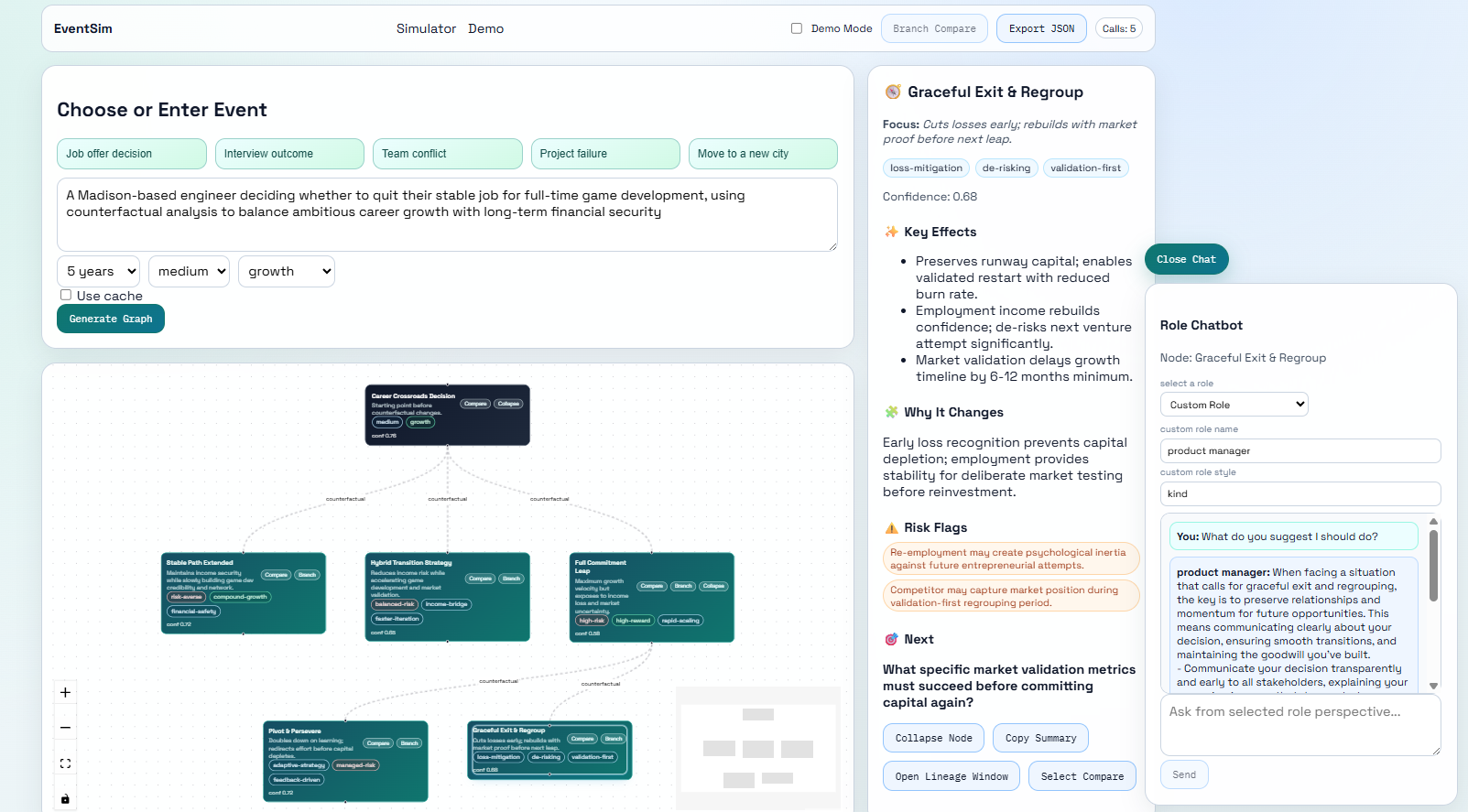
Tree Graph & Branching: Users start with a baseline scenario and can "branch" out new child nodes to explore different resource allocations (e.g., investing in immediate shelter vs. communication infrastructure).
Grounded RAG Hit: To eliminate LLM hallucinations, decisions are anchored in real-world data (like FEMA historical flood records). The system explicitly displays a "RAG HIT" tag, ensuring decision-makers know the parameters are fact-based.
Multi-Stakeholder Role Chatbot: Disasters affect everyone differently. Our custom roles feature allows users to simulate the specific perspectives of various stakeholders (e.g., an emergency coordinator, a local volunteer, or a displaced family) within the same event timeline to uncover blind spots.
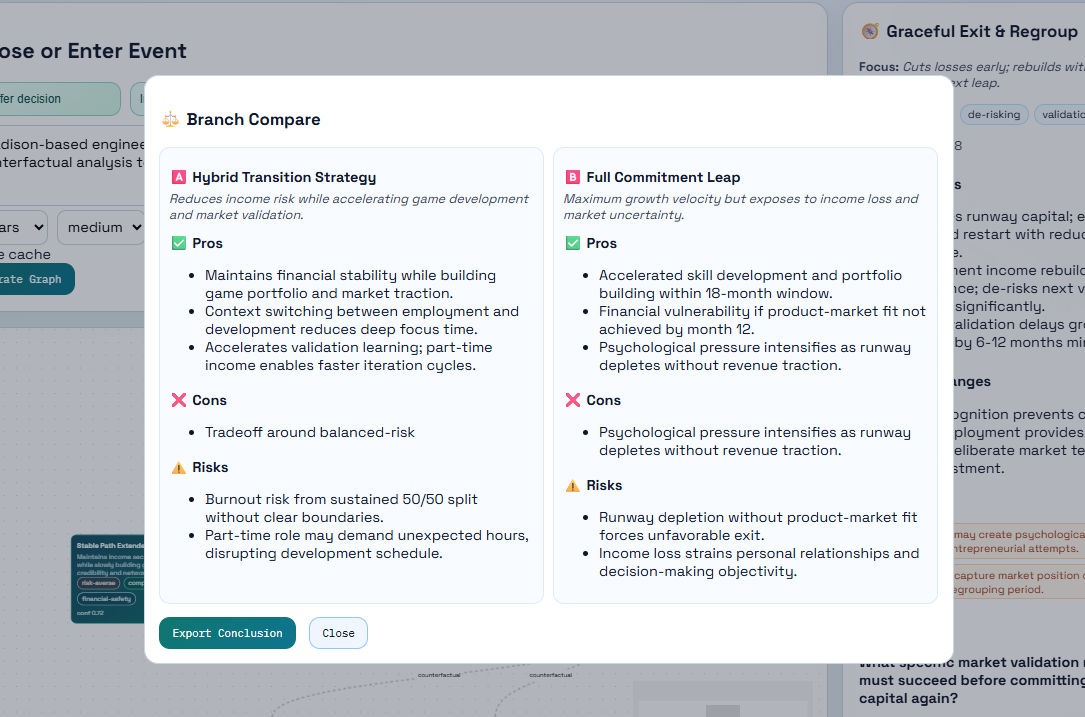
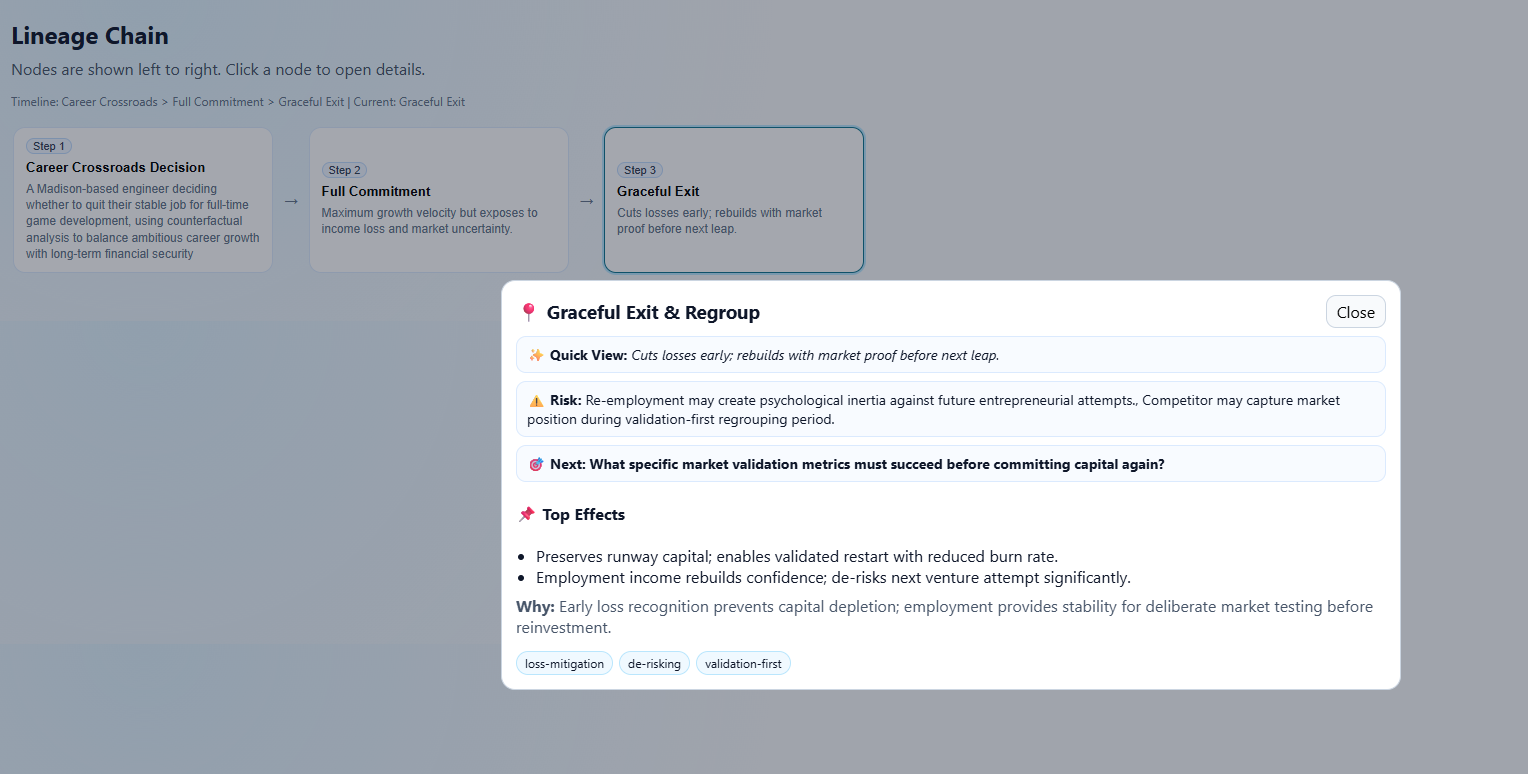
Lineage Chain & Comparison: Users can track the exact historical chain of decisions, compare branches side-by-side to weigh trade-offs (budget, time, impact), and ultimately Export to JSON for immediate downstream execution.
How we built it
We designed a pipeline that forces the LLM to act as a structured reasoning engine rather than a creative writer.
Backend & LLM Integration: We implemented a Retrieval-Augmented Generation (RAG) architecture, indexing historical crisis reports into a vector database to provide factual grounding.
Prompt Engineering & Structured Output: We rigorously prompted the model to generate JSON-formatted decision nodes, complete with confidence scores and specific counterfactual parameters.
Frontend Visualizer: We built a custom interactive UI using a node-based graph library to render the Tree Graph. The side-bar handles state management smoothly, allowing real-time role-playing and branch comparisons without losing the context of the main lineage chain.
Challenges we ran into
The hardest parts were getting consistent structured outputs from different model providers, balancing speed/cost with depth of reasoning, and keeping graph interactions smooth as branches expand. We also had to tune retrieval quality for noisy user prompts (state aliases, incident synonyms) and add safety constraints without making the system feel overly restrictive.
Accomplishments that we're proud of
What we learned
We learned that prompt design is only half the problem; robust contracts, fallback logic, and cache/version strategy matter just as much. We also learned that lightweight retrieval can significantly improve relevance when paired with domain-specific preprocessing, and that UX clarity (lineage, compare views, concise one-liners) is critical for trust in AI-assisted decisions.
What's next for EventSim
Next, we want to add stronger evaluation metrics for branch quality, persistent project workspaces and shareable links, richer domain datasets beyond FEMA, and deeper collaboration features (multi-user scenario reviews). We also plan to improve explainability with confidence/uncertainty indicators and recommended next actions per branch.


Log in or sign up for Devpost to join the conversation.