-
-
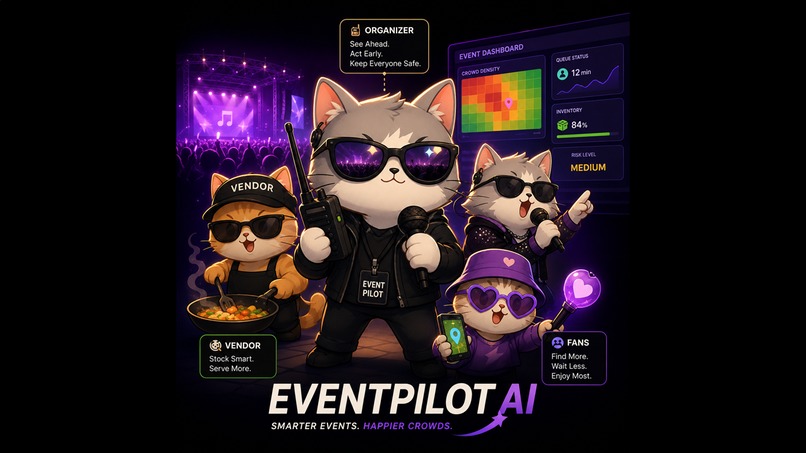
Pitch Deck Slide 1 - Thumbnail
-
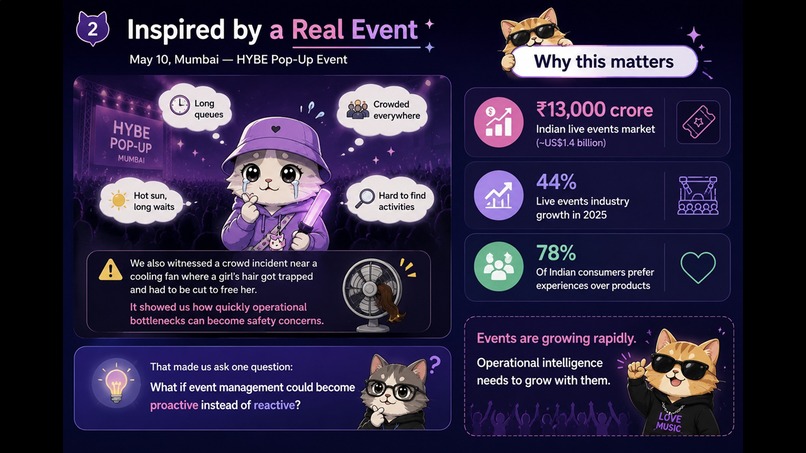
Pitch Deck Slide 2 - Inspiration and Market Study
-
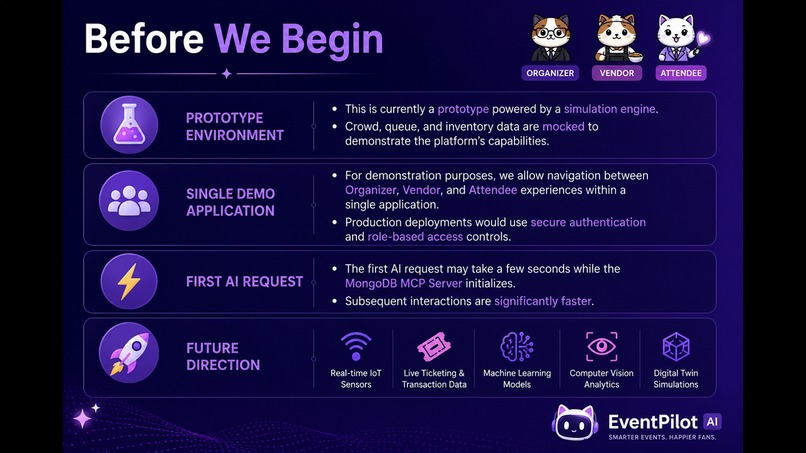
Pitch Deck Slide 3 - Prototype Limitations
-
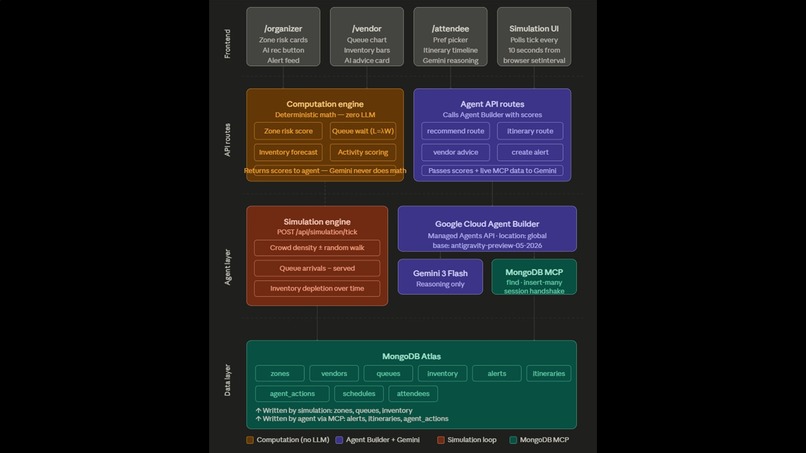
Pitch Deck Slide 4 - Project Architecture
-
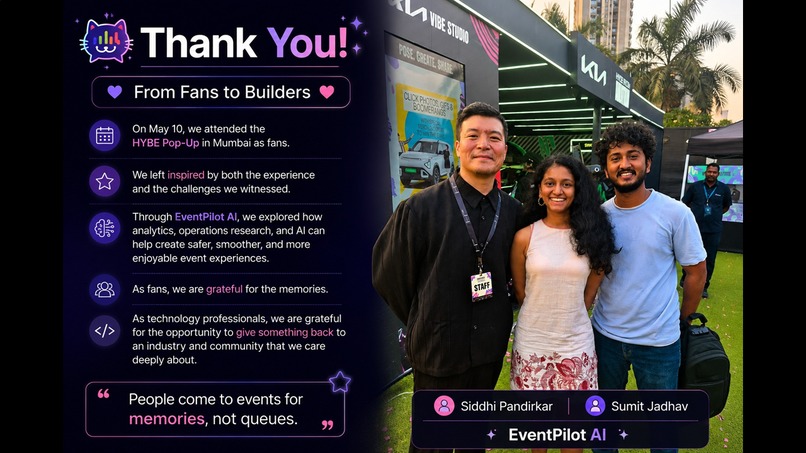
Pitch Deck Slide 5 - Thank You
-
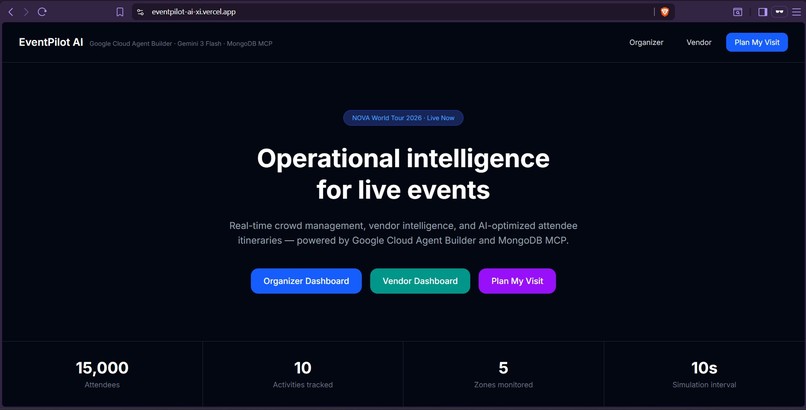
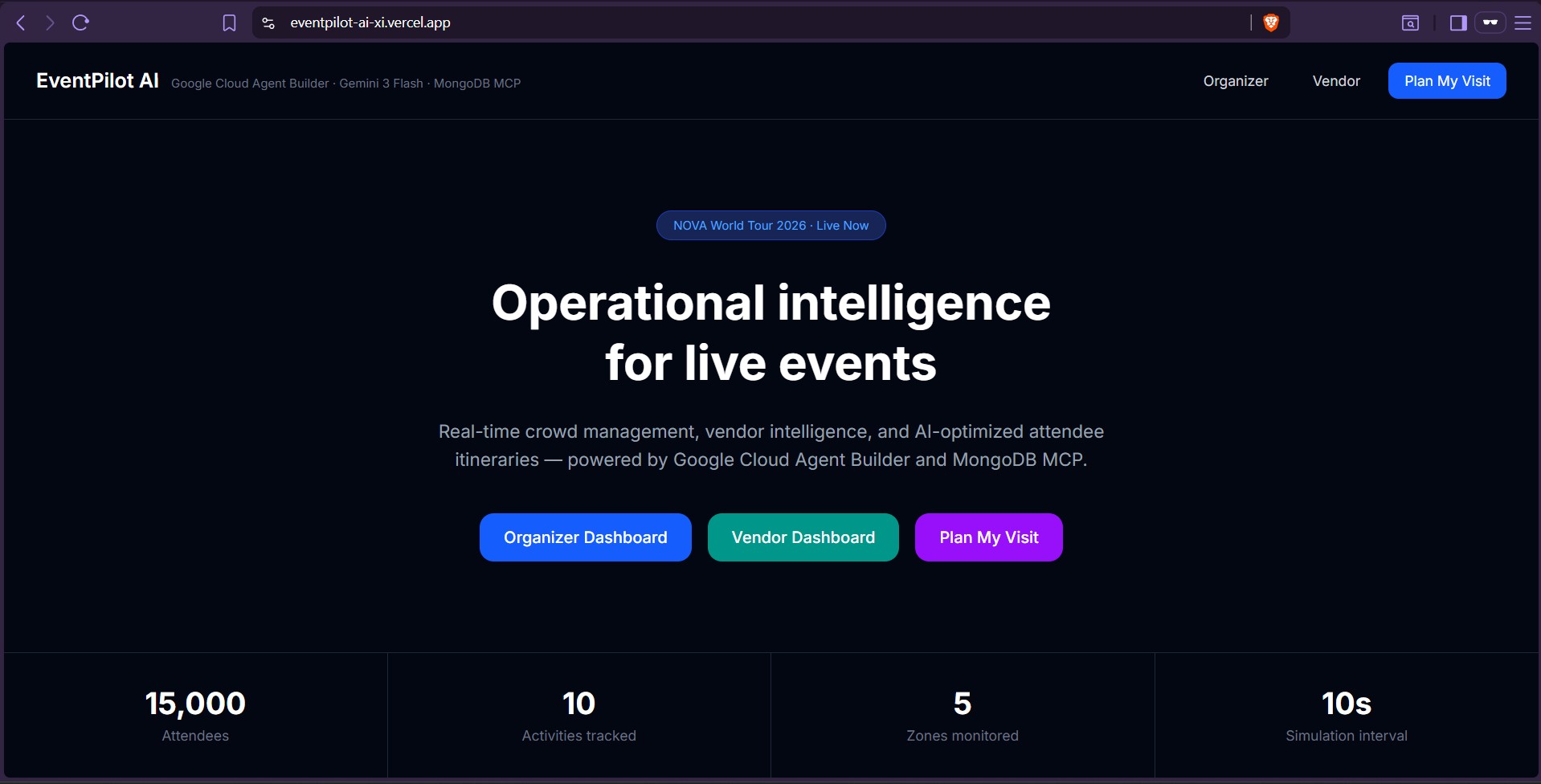
Landing Page
-
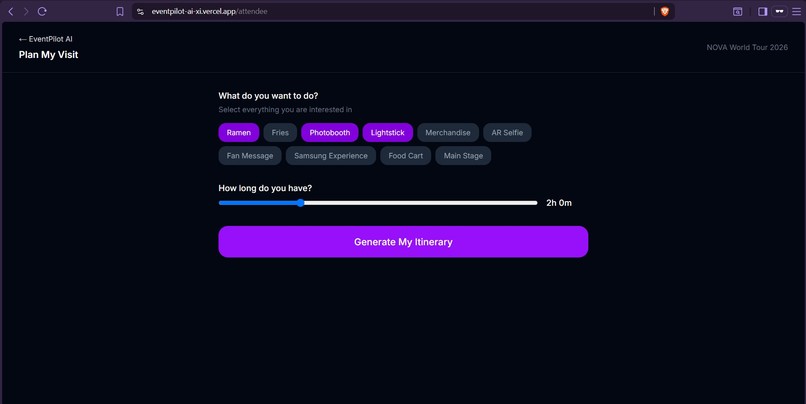
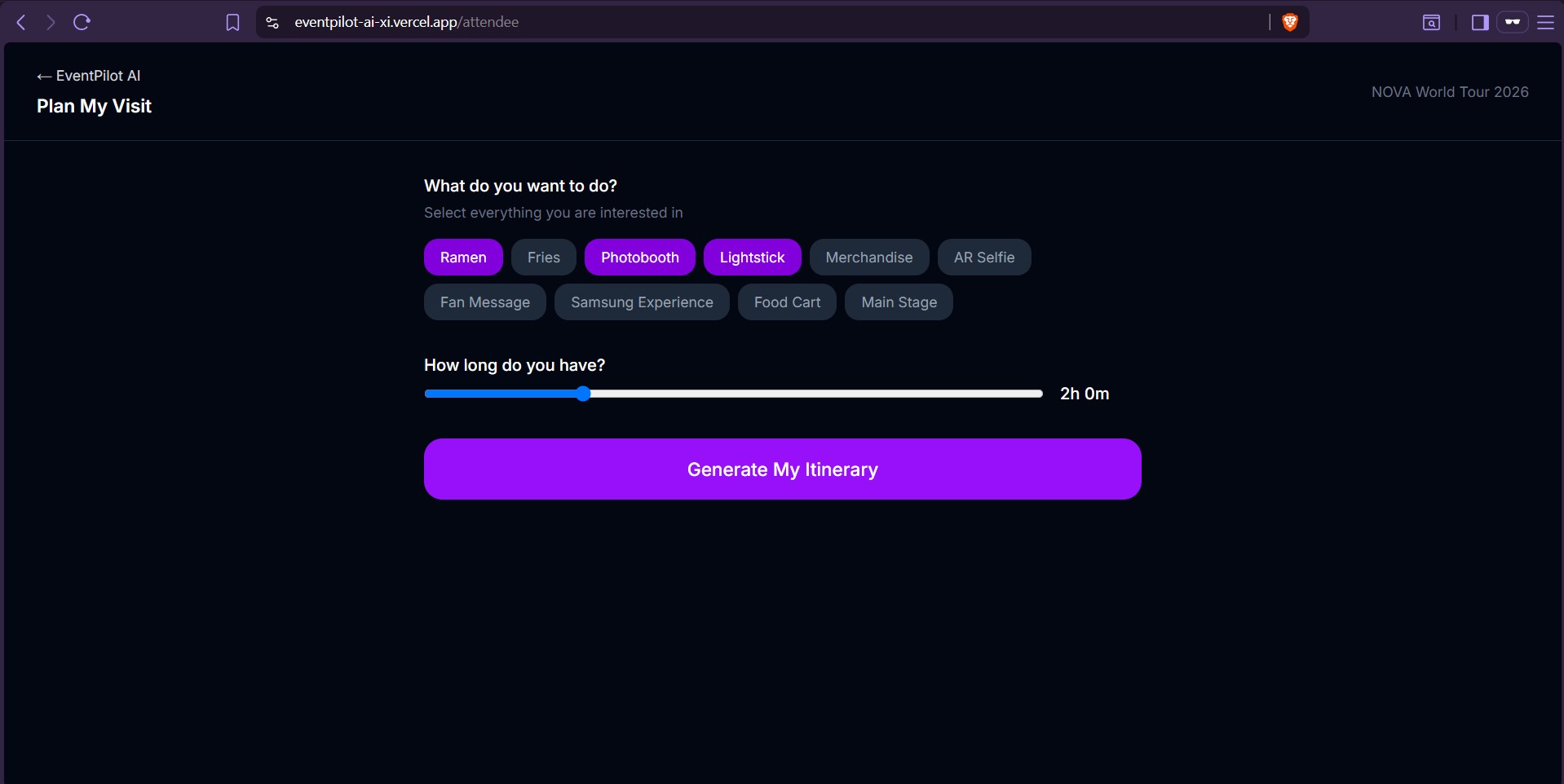
Generate Itinerary Page
-
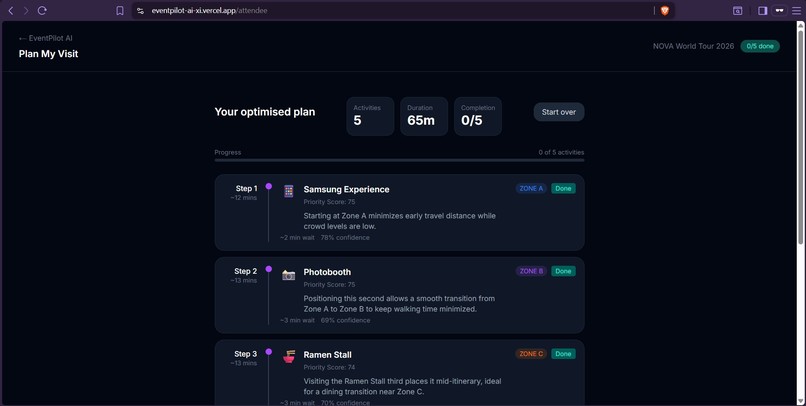
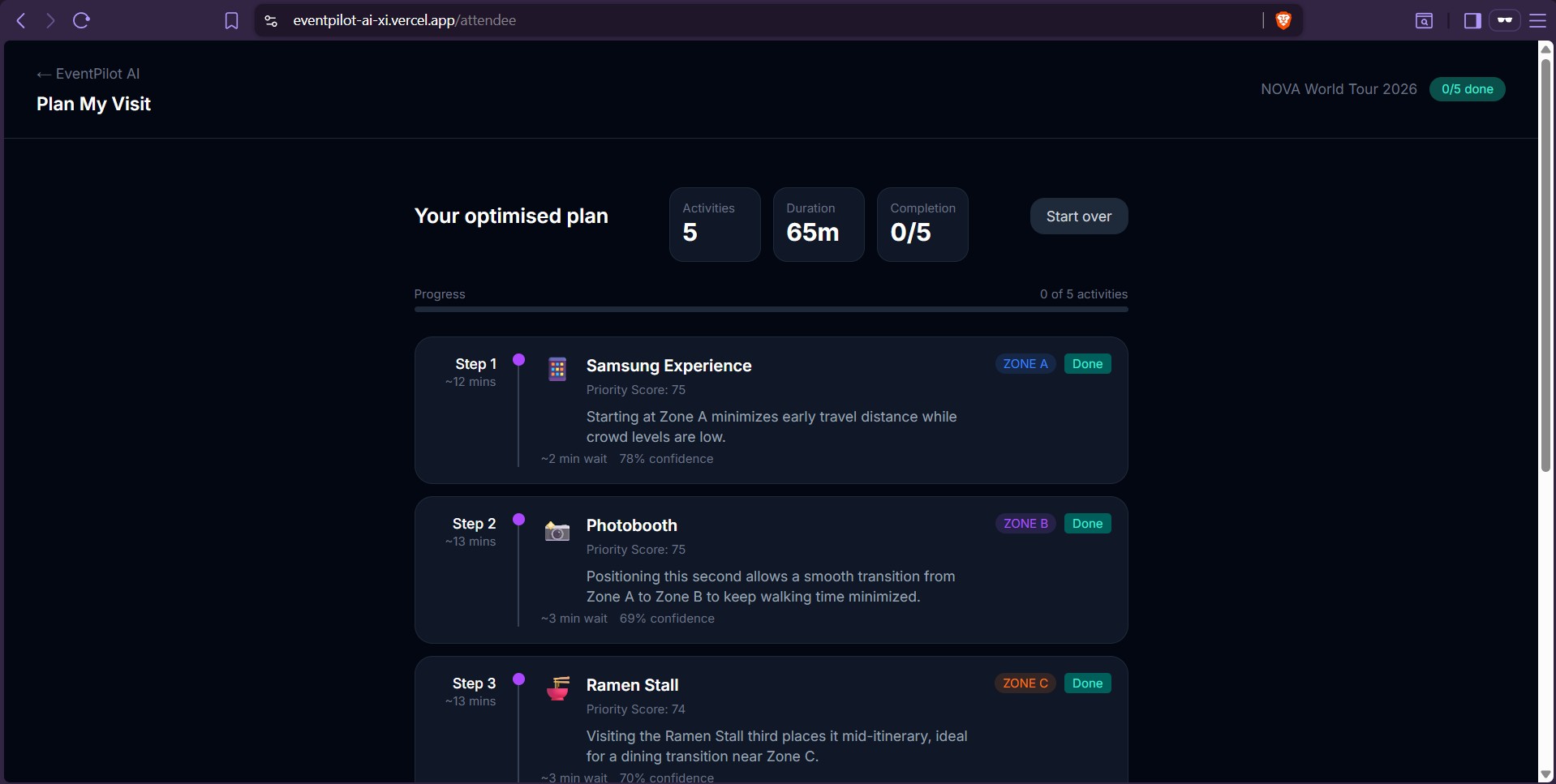
Generated Itinerary
-
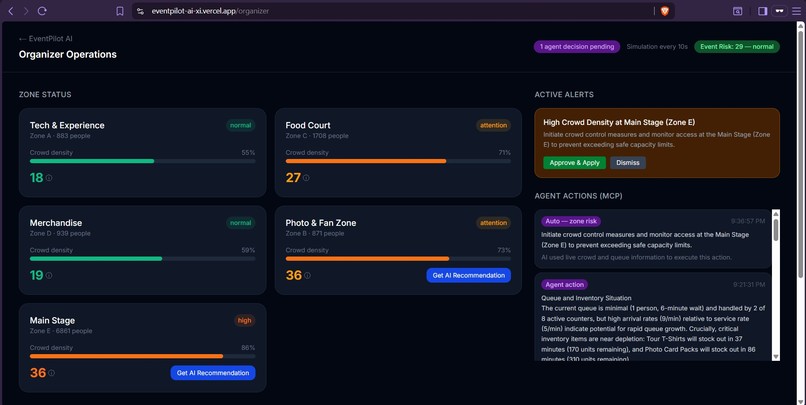
Organizer Dashboard
-
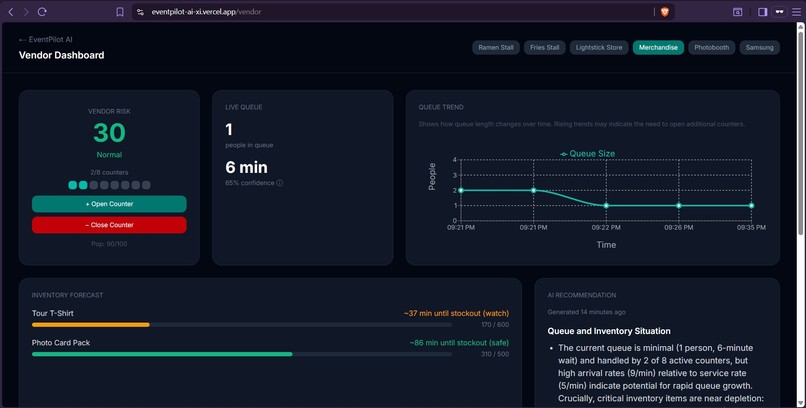
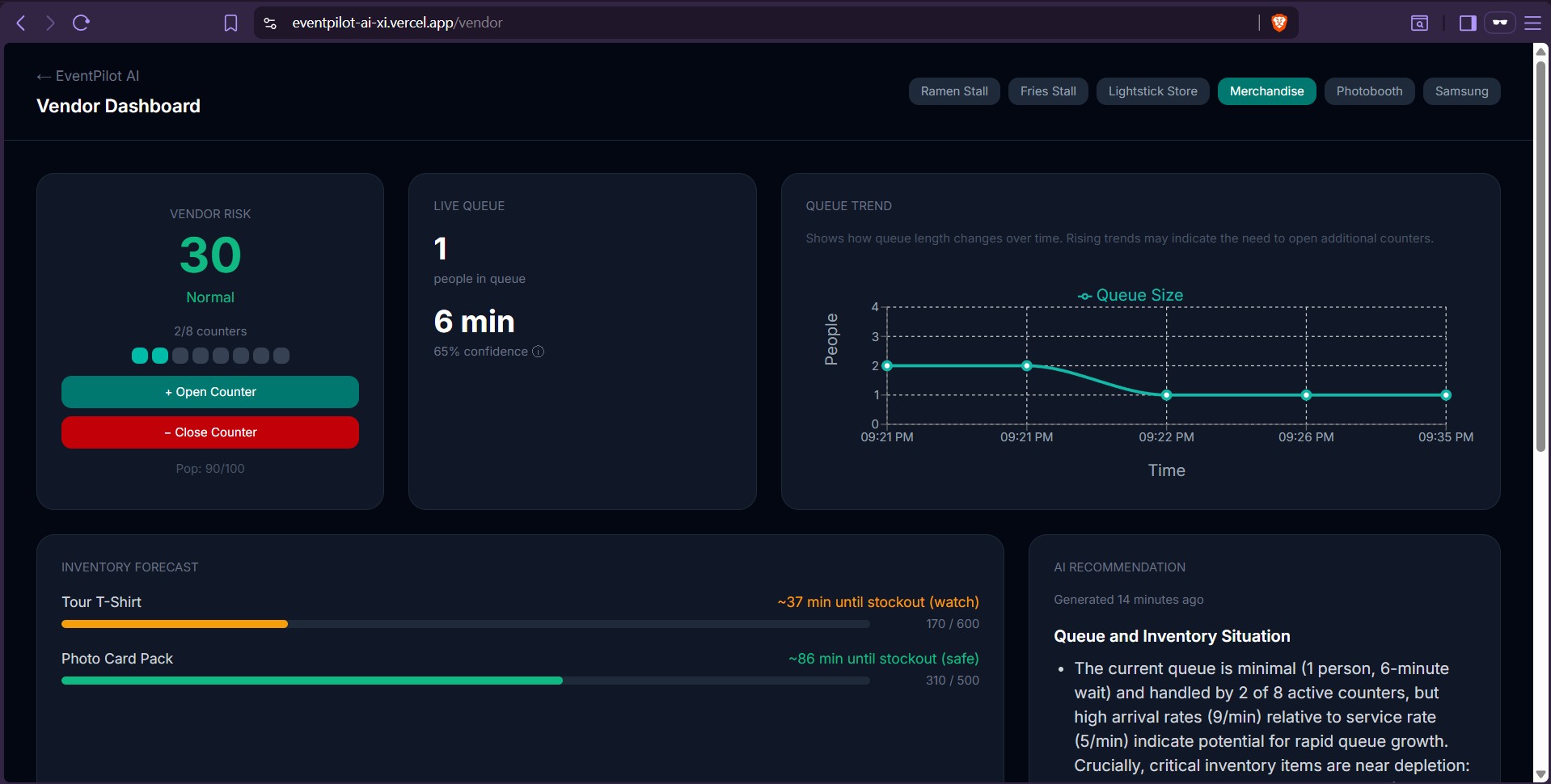
Vendor Dashboard
-
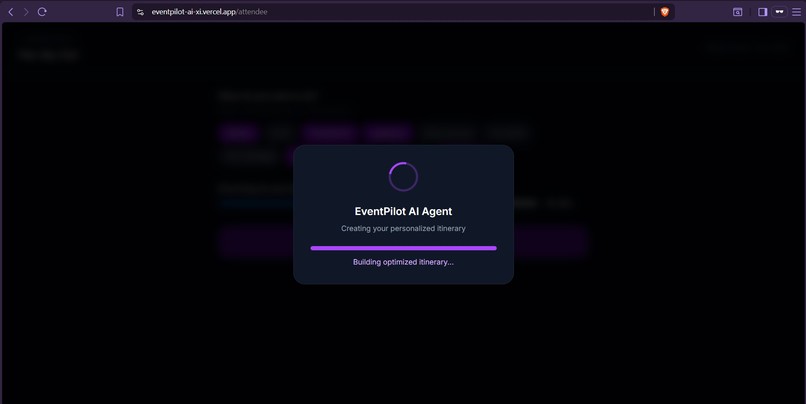
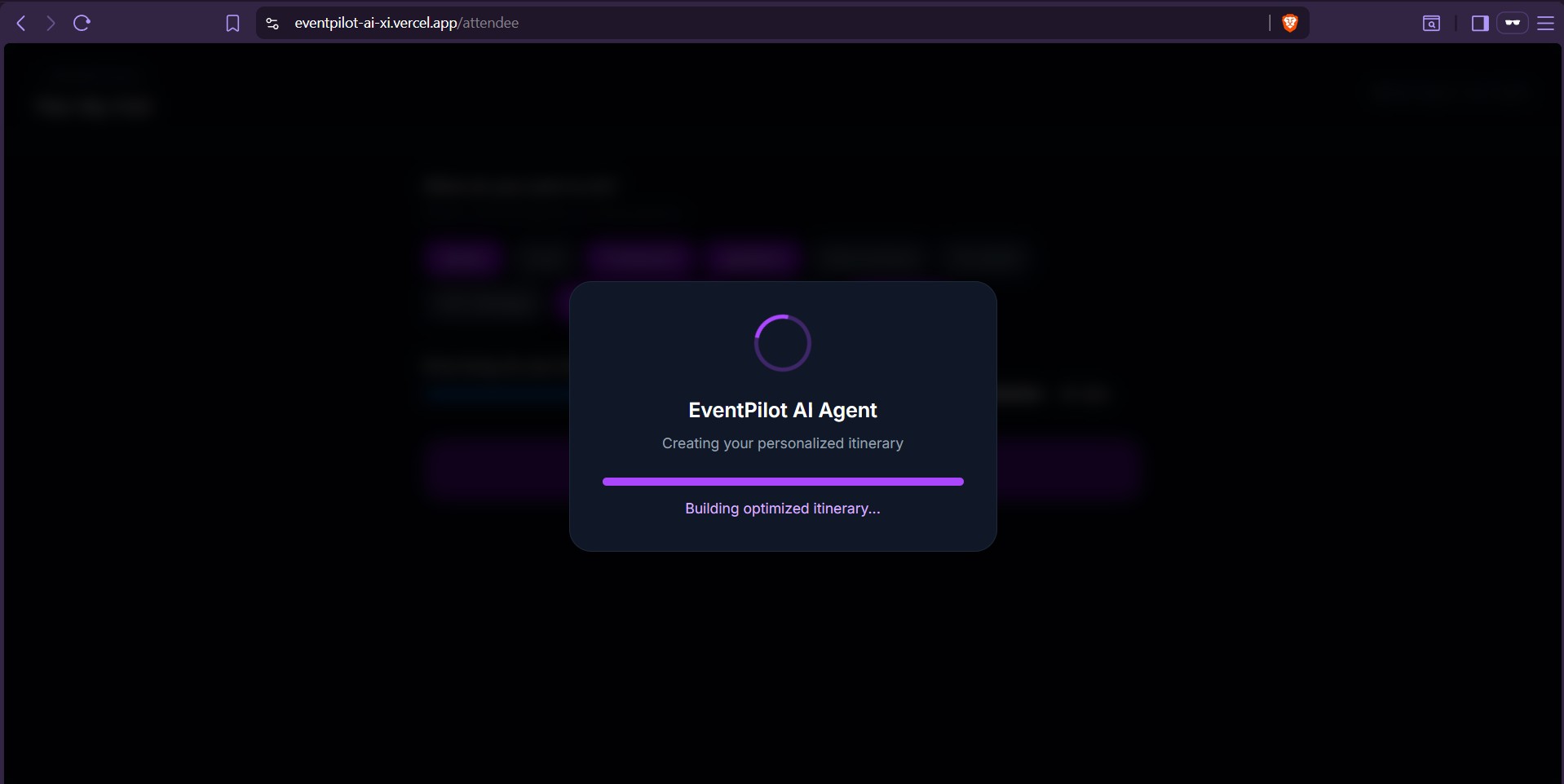
Wait Time Loading

Inspiration
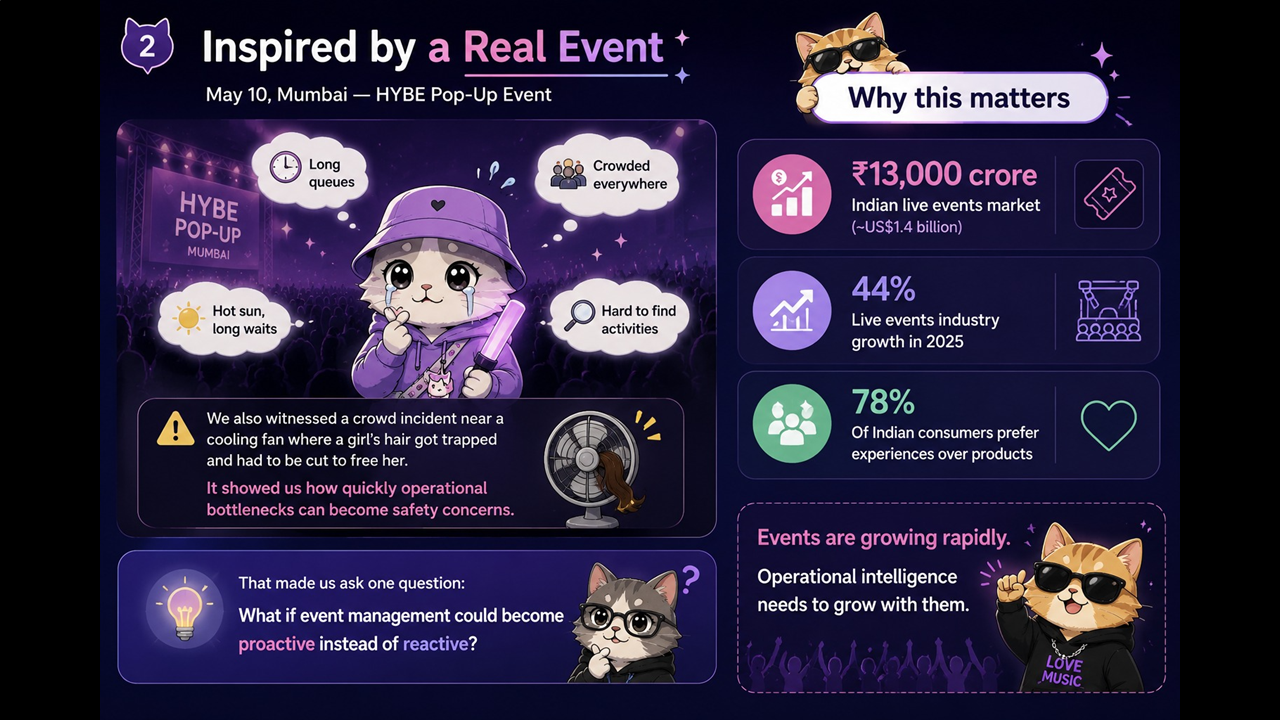
We are BTS fans, so when HYBE brought its pop-up event to Mumbai in May 2026, we were thrilled. Like thousands of other fans, we showed up early and looked forward to a day filled with performances, food, merchandise, activities, and fan experiences.
The event had everything we could have asked for. There were brand pop-ups by Samsung, Kia, Snapchat, H&M, and Shoppers Stop, amazing food stalls, and performances from independent artists throughout the day. The atmosphere was incredible.
Yet when we think back to that day, the first thing that comes to mind is not the music, the activities, or the merchandise.
It is the queues.
We spent a large part of the day standing in lines under the summer sun. Every popular stall had a crowd. Every activity had a wait. Moving from one area to another often meant navigating through dense groups of people.
One incident in particular stayed with us. While people were queued near a photobooth stall, movement in the crowd caused a young woman to be pushed toward a cooling fan. Her long hair became caught in the fan, and event staff eventually had to cut part of it to free her. Thankfully she was not seriously injured, but it was a moment that made us realize how quickly operational issues can become safety issues.
On the train ride home, we kept discussing the same question.
The artists wanted people watching performances.
The brands wanted people engaging with activations.
The vendors wanted to serve customers.
The attendees wanted to enjoy the experience they had paid for.
Yet everyone seemed to lose time to the same bottlenecks.
As attendees, we were grateful that an event we cared about had finally come to our city. As technology professionals, we started wondering whether some of these challenges could be improved through better operational intelligence.
As we started researching the problem, we realized that this was not an isolated issue. India's live events industry is now worth approximately ₹13,000 crore (~US$1.4 billion), according to the EY-Parthenon × BookMyShow report. Live events were also among the fastest-growing segments of India's media and entertainment industry, growing by 44% in 2025 according to the FICCI-EY Media & Entertainment Report. The same research found that 78% of Indian consumers prefer spending on experiences over products.
India is one of the largest fan communities in the world. More concerts, fan events, conventions, festivals, and sporting events are arriving every year. Attendance is growing rapidly, but operational intelligence has not always kept pace.
That led us to a simple question:
What if event management could become proactive instead of reactive?
That question became EventPilot AI.
What it does
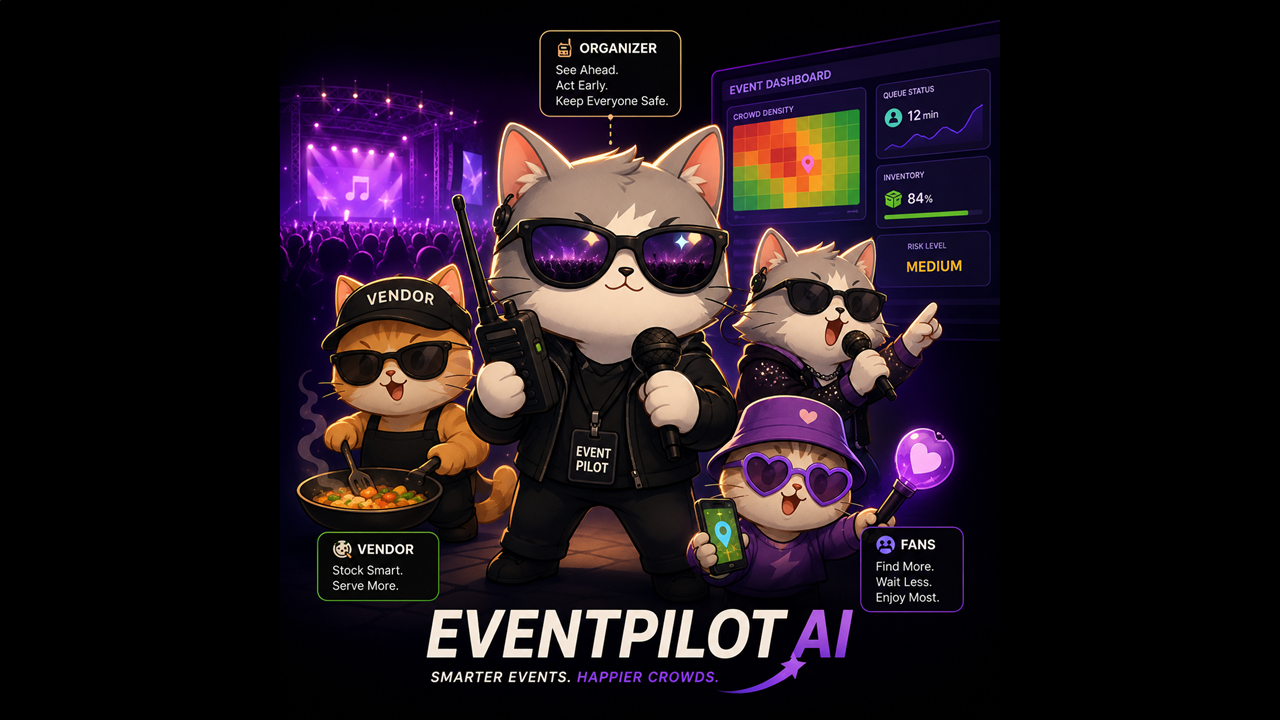
EventPilot AI is an event operations copilot designed for organizers, vendors, and attendees.
For organizers, it identifies congestion hotspots, operational risks, and emerging bottlenecks before they become larger problems.
For vendors, it forecasts inventory demand and highlights potential stockout risks.
For attendees, it generates personalized recommendations and itineraries that help them spend less time waiting and more time enjoying the event.
The goal is simple: help people spend less time standing in queues and more time creating memories.
EventPilot is not only about reducing queues. It is about helping every stakeholder achieve their goals.
For organizers, that means safer operations and better crowd flow.
For vendors, that means improved staffing and inventory planning.
For sponsors and brands, that means higher engagement with activations instead of attendees being trapped in overcrowded areas elsewhere in the venue.
For attendees, it means spending more time enjoying experiences and less time waiting for them.
How we built it
We approached the problem from both an operations research and an AI perspective.
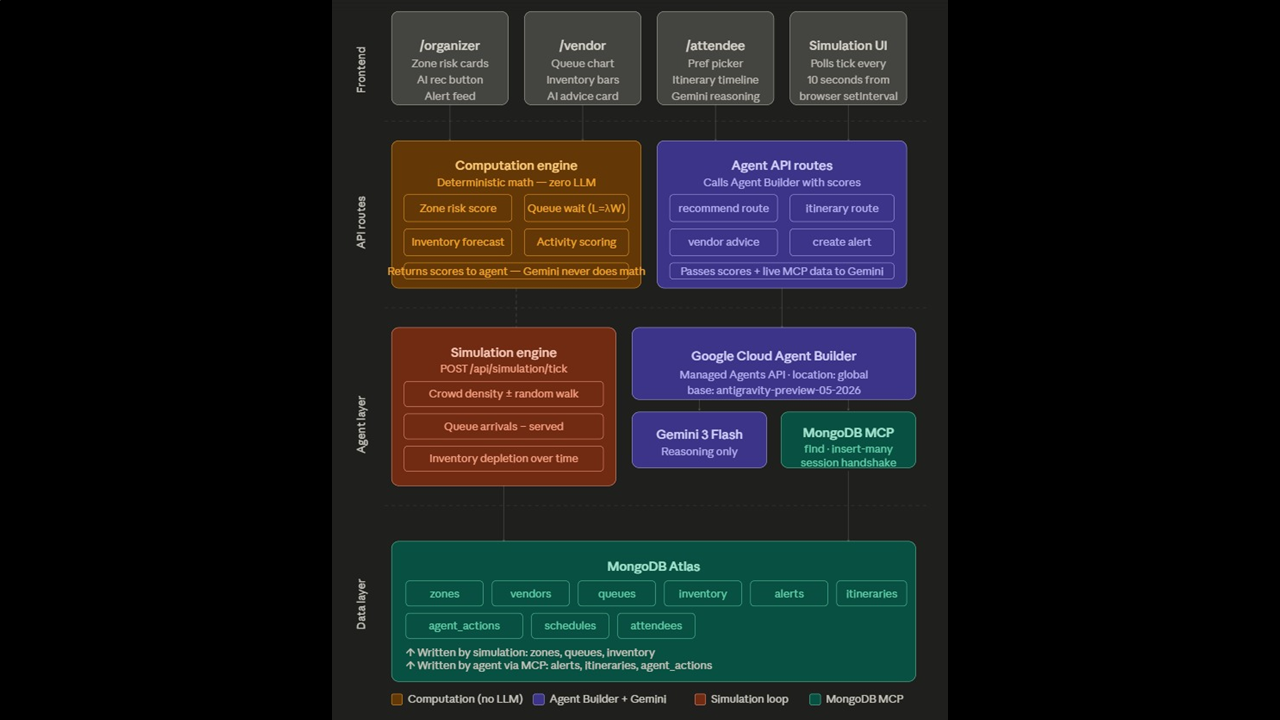
First, we built a simulation layer that models crowd movement, queue formation, vendor demand, and attendee activity across an event environment.
Next, we developed a deterministic analytics layer that computes operational metrics such as risk scores, queue estimates, inventory forecasts, and recommendation rankings.
For example, zone risk is calculated using a weighted scoring model:
$$ RiskScore = w_1 \cdot CrowdDensity + w_2 \cdot QueuePressure + w_3 \cdot IncidentCount $$
Rather than asking a language model to perform these calculations, we use structured analytics to generate operational signals.
These signals are then interpreted by Gemini through Google Agent Builder, which generates contextual recommendations and actions for different stakeholders.
The recommendation layer is designed to go beyond operational alerts.
For example, if a particular area becomes congested, organizers could use targeted notifications, limited-time experiences, flash discounts, giveaways, or sponsor activations to encourage attendees to explore lower-density areas of the venue.
This creates a win-win outcome: attendees discover more experiences, vendors and sponsors receive better engagement, and organizers achieve healthier crowd distribution.
MongoDB Atlas serves as the memory layer for the system. Using the MongoDB MCP Server, EventPilot can store and retrieve operational history, alerts, recommendations, attendee itineraries, and vendor information, allowing decisions to be made with historical context rather than isolated prompts.
The application was built using Next.js, React, TypeScript, Tailwind CSS, MongoDB Atlas, Google Agent Builder, Gemini, and Vercel.
Challenges we ran into
One of the biggest challenges was deciding where analytics should stop and where AI should begin.
It was tempting to let the language model calculate everything. However, we wanted recommendations to remain explainable and grounded in transparent logic.
Another challenge was realism. We did not have access to large-scale event operations datasets, so we designed a simulation framework that could demonstrate realistic event conditions while remaining extensible for future real-world integrations.
We also had to balance the needs of multiple stakeholders. Organizers, vendors, attendees, sponsors, and brands often have different goals, and building a system that creates value for all of them required careful design.
Also, while we are both tech people, this was both of our first time creating with MongoDB and MCP, so it was a challenge and a great learning experience in one.
Accomplishments that we are proud of
We are proud that EventPilot AI is more than a chatbot.
We built a system that combines simulation, analytics, memory, and agentic reasoning into a unified workflow while keeping recommendations grounded in explainable logic.
We are also proud that the project considers the entire event ecosystem rather than a single stakeholder. Organizers, vendors, sponsors, artists, and attendees all benefit when crowd movement and operational decisions improve.
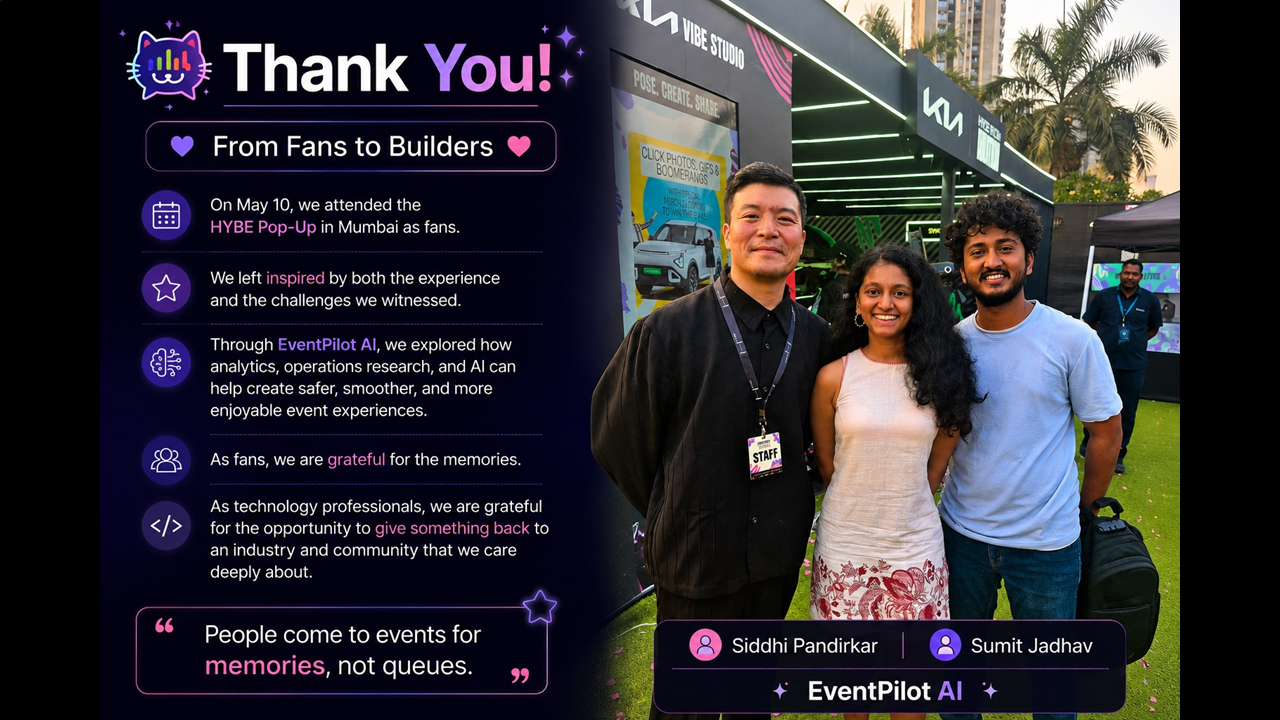
Most importantly, we are proud that a memorable day as fans became an opportunity to contribute something back.
We attended the HYBE event as attendees. Through this hackathon, we were able to approach the same problem as builders and explore how technology could help create better experiences for future events.
What we learned
This project taught us that many event-management problems are fundamentally operations problems.
We learned how concepts from operations research, forecasting, and decision support can complement modern AI systems.
We also learned the importance of memory. Recommendations become far more useful when an agent can access previous decisions, alerts, and operational history rather than treating every interaction independently.
Most of all, we learned that some of the strongest ideas come from problems people genuinely experience.
What is next for EventPilot AI
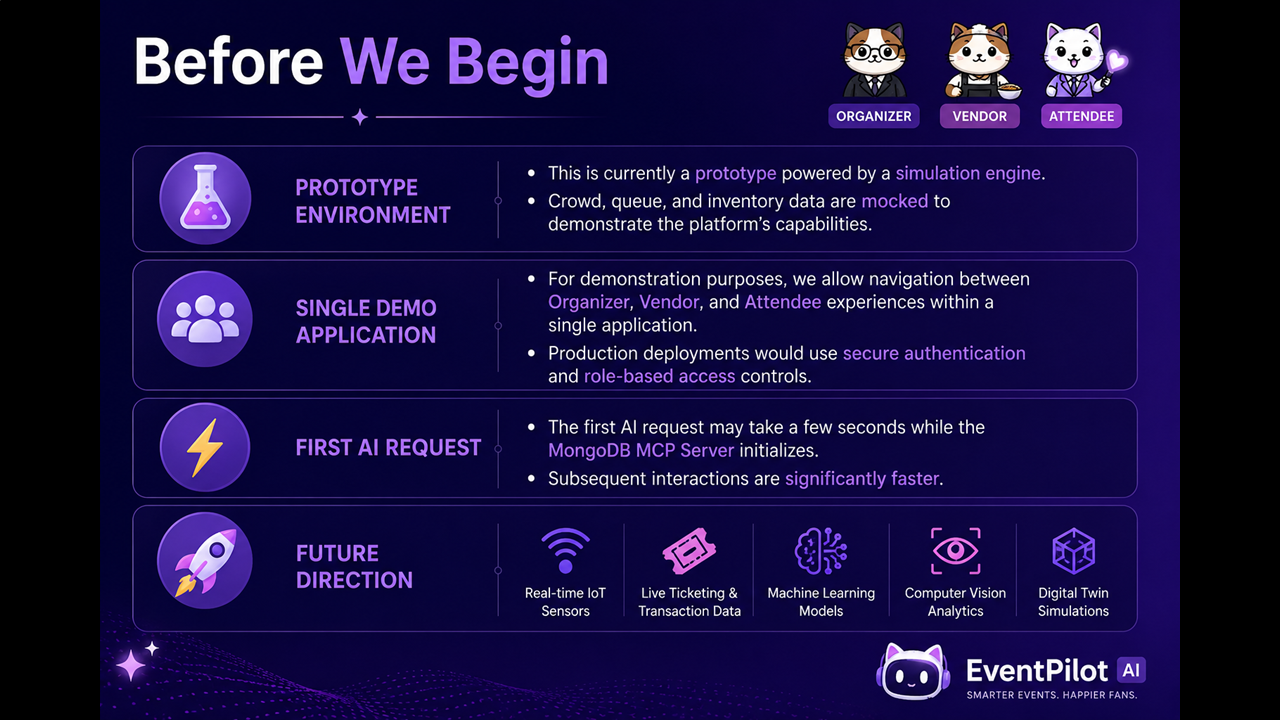
Our current implementation demonstrates the concept using explainable analytics and simulated event environments.
The next step is integrating real-world data sources such as ticketing platforms, vendor transactions, crowd sensors, and computer-vision-based crowd monitoring.
We also plan to enhance the analytical layer with advanced queueing theory, probabilistic risk models, demand forecasting, optimization algorithms, and digital twin simulations.
Additionally, the current system uses deterministic and heuristic-based scoring models. Future versions will incorporate machine learning models trained on real event data to improve forecasting accuracy, recommendation quality, and operational decision-making.
Our long-term vision is to build an operational intelligence platform that helps organizers, vendors, sponsors, artists, and attendees create safer, smoother, and more enjoyable event experiences at scale.
As fans ourselves, we hope future attendees spend less time in queues and more time enjoying the artists, experiences, and communities that brought them there in the first place.


Log in or sign up for Devpost to join the conversation.