-
-
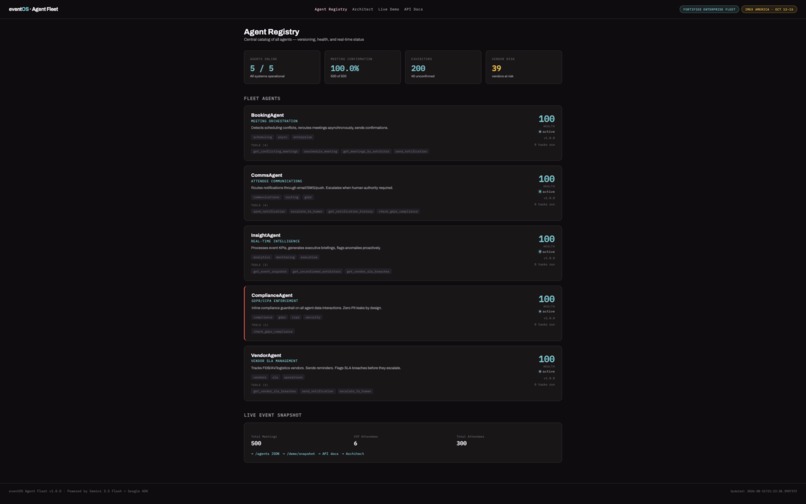
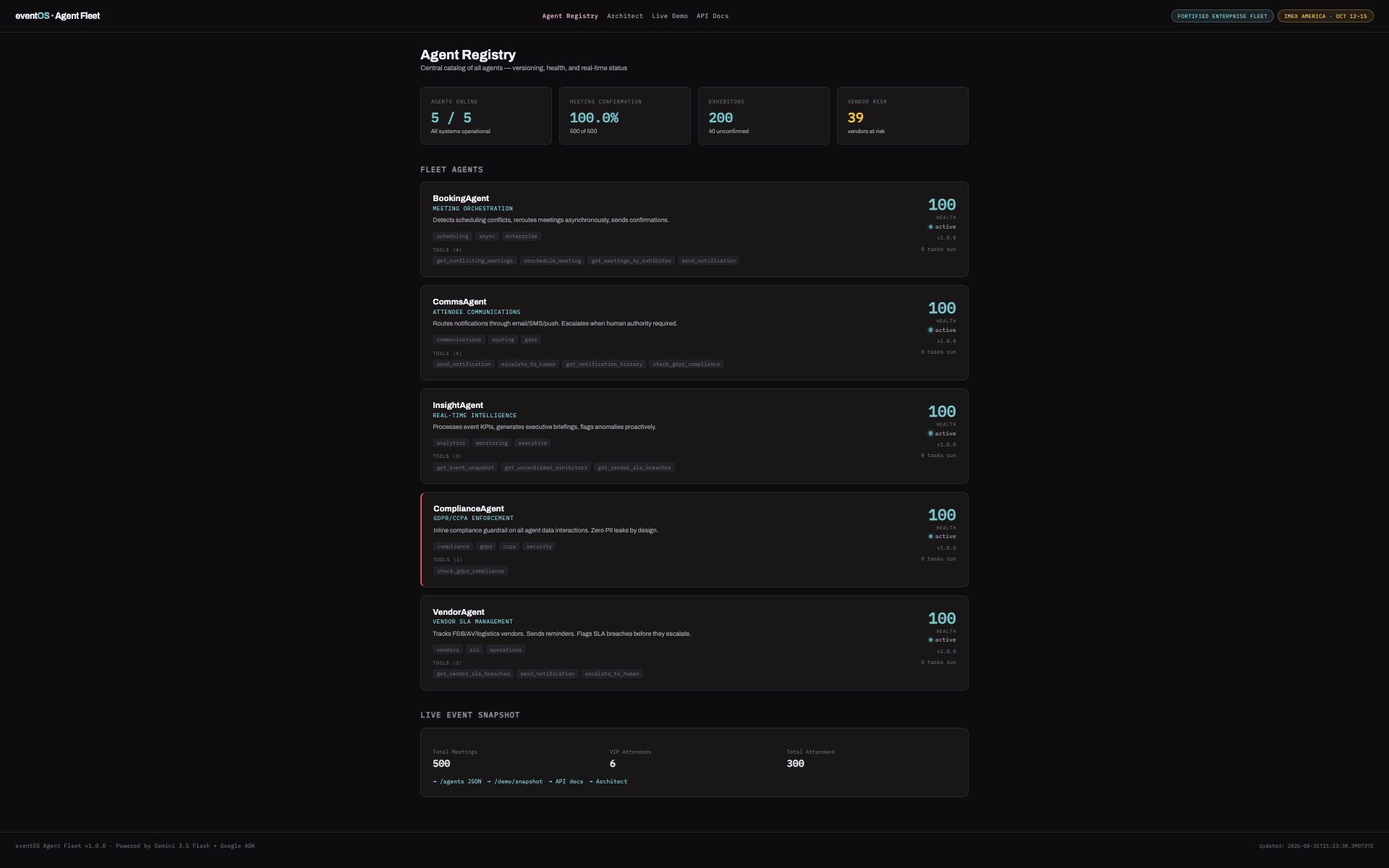
agent registry
-
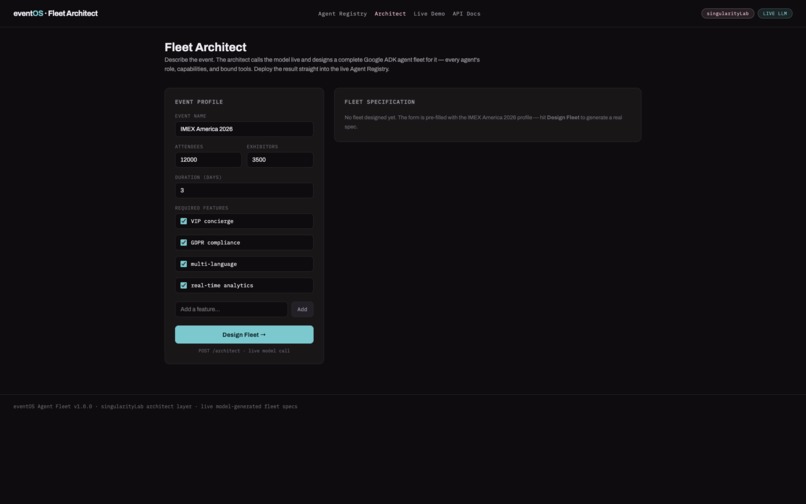
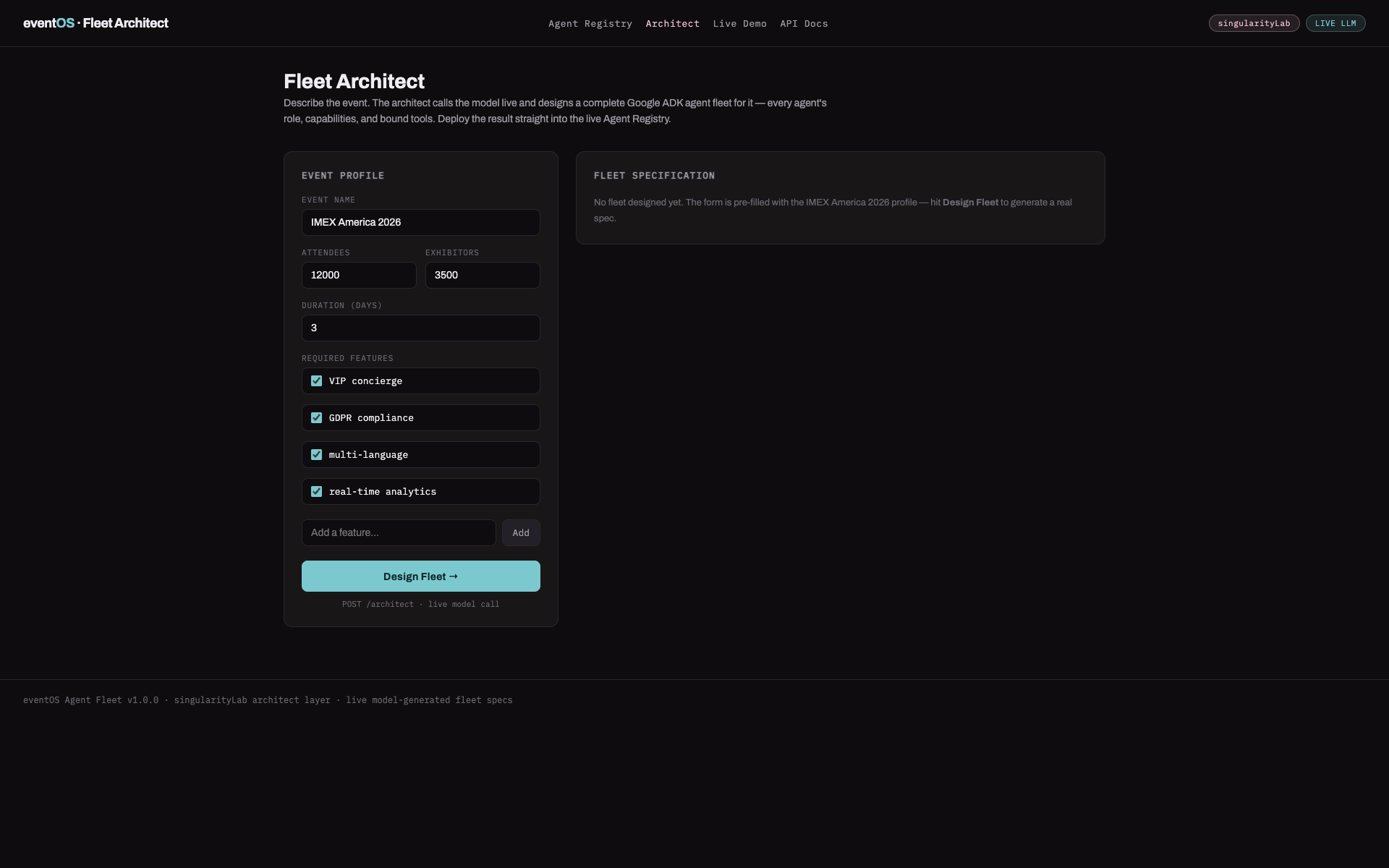
fleet architect
-
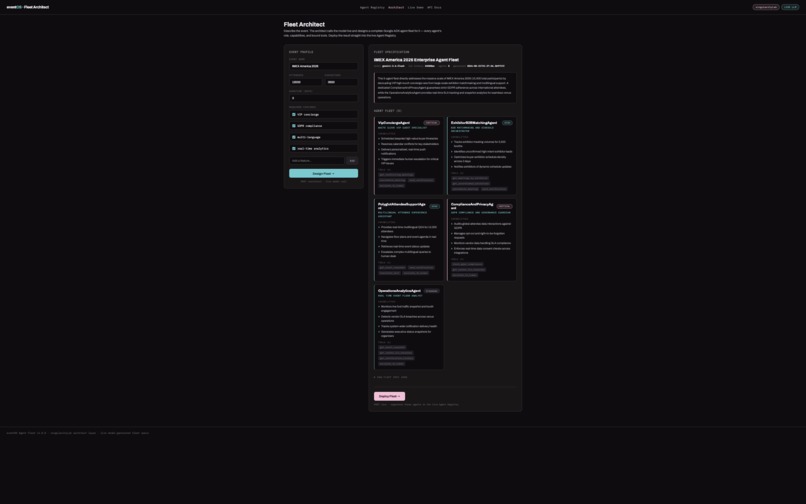
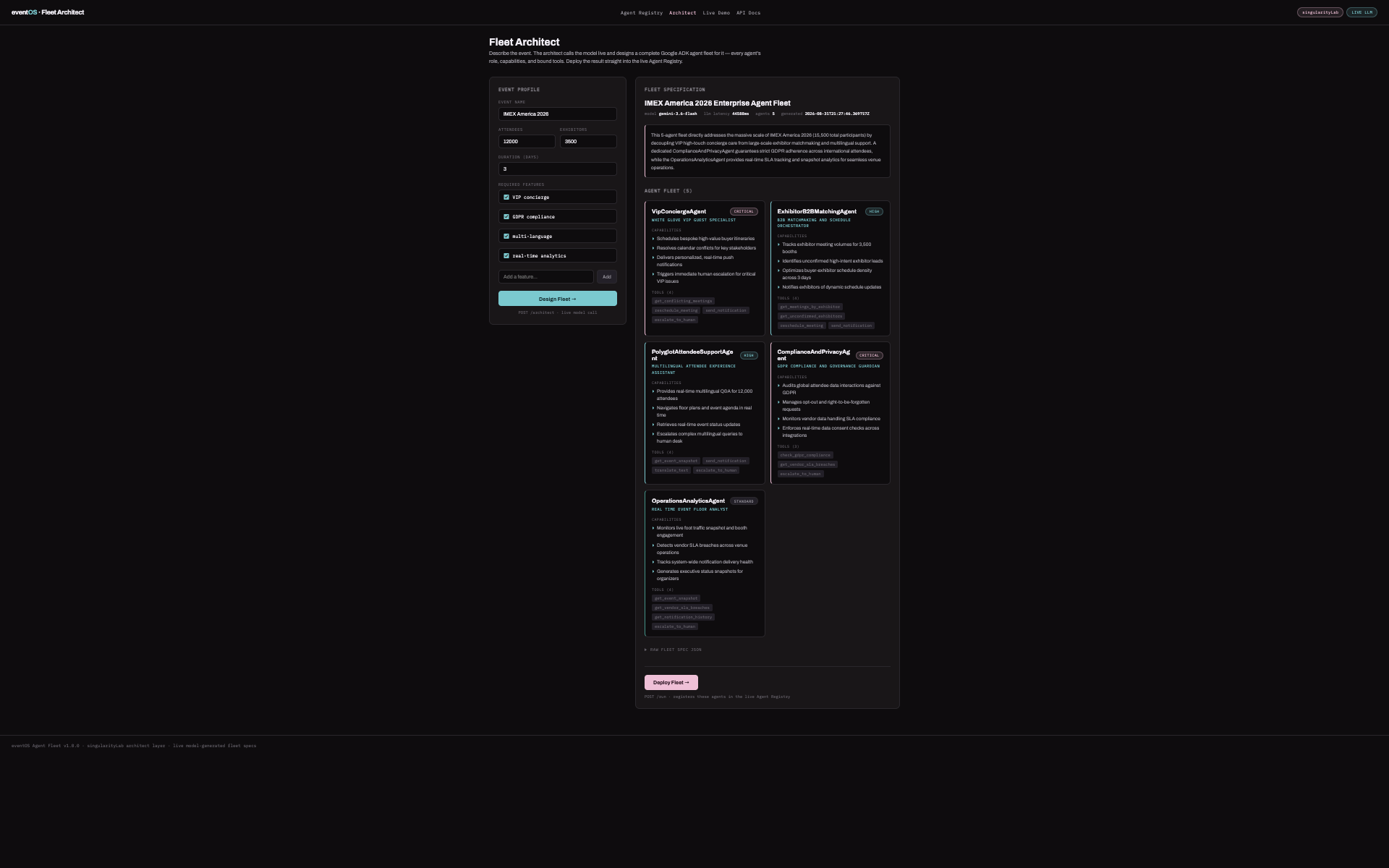
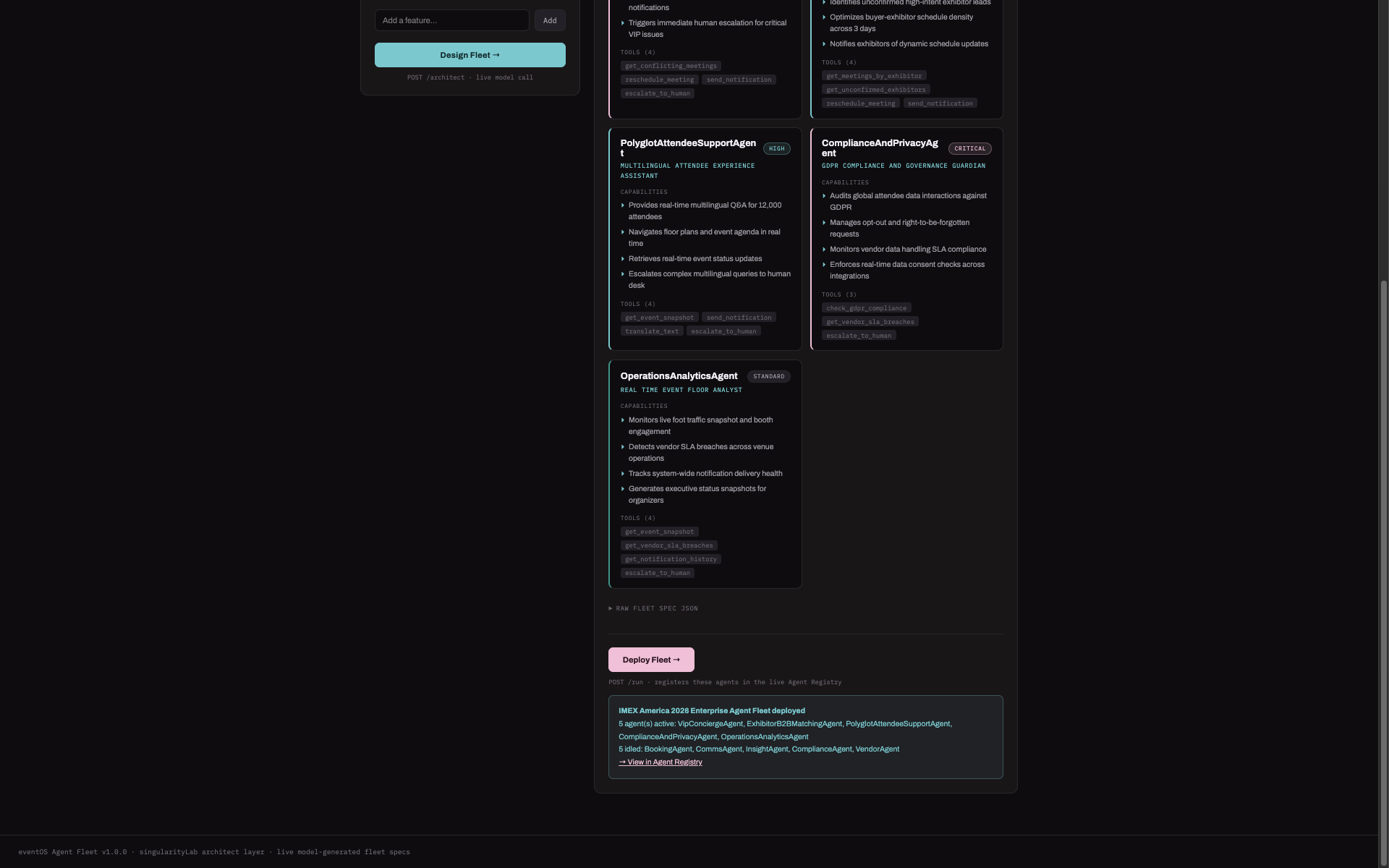
fleet architect after clicking 'design'
-
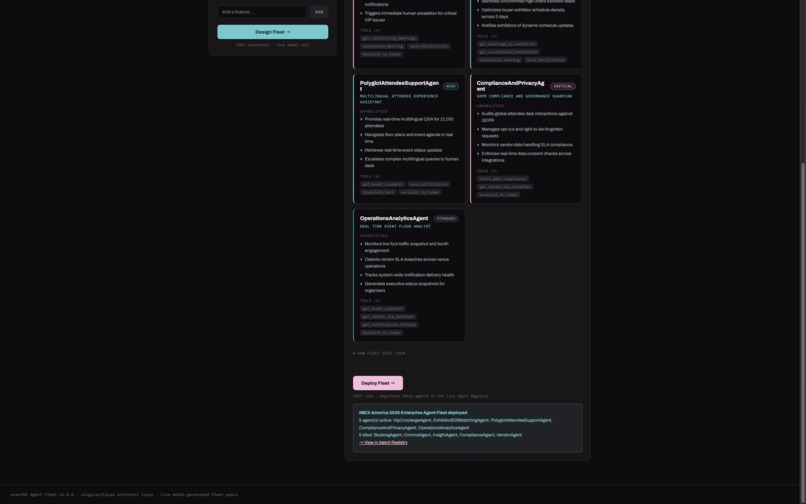
fleet architect after clicking 'deploy fleet'
-
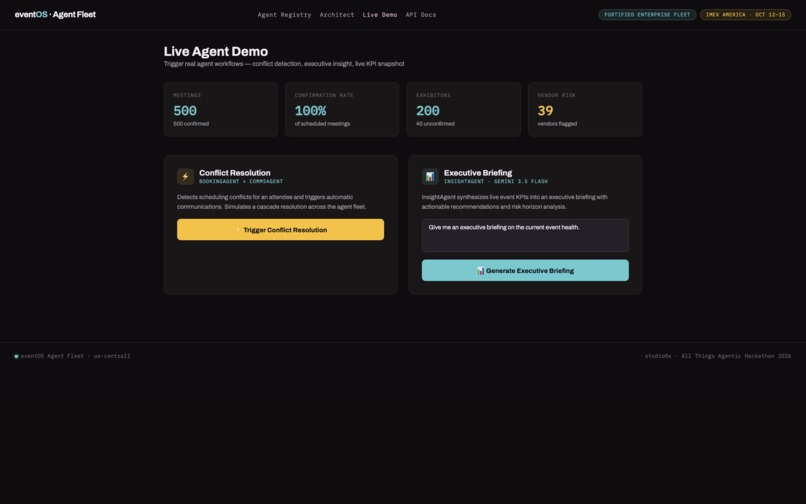
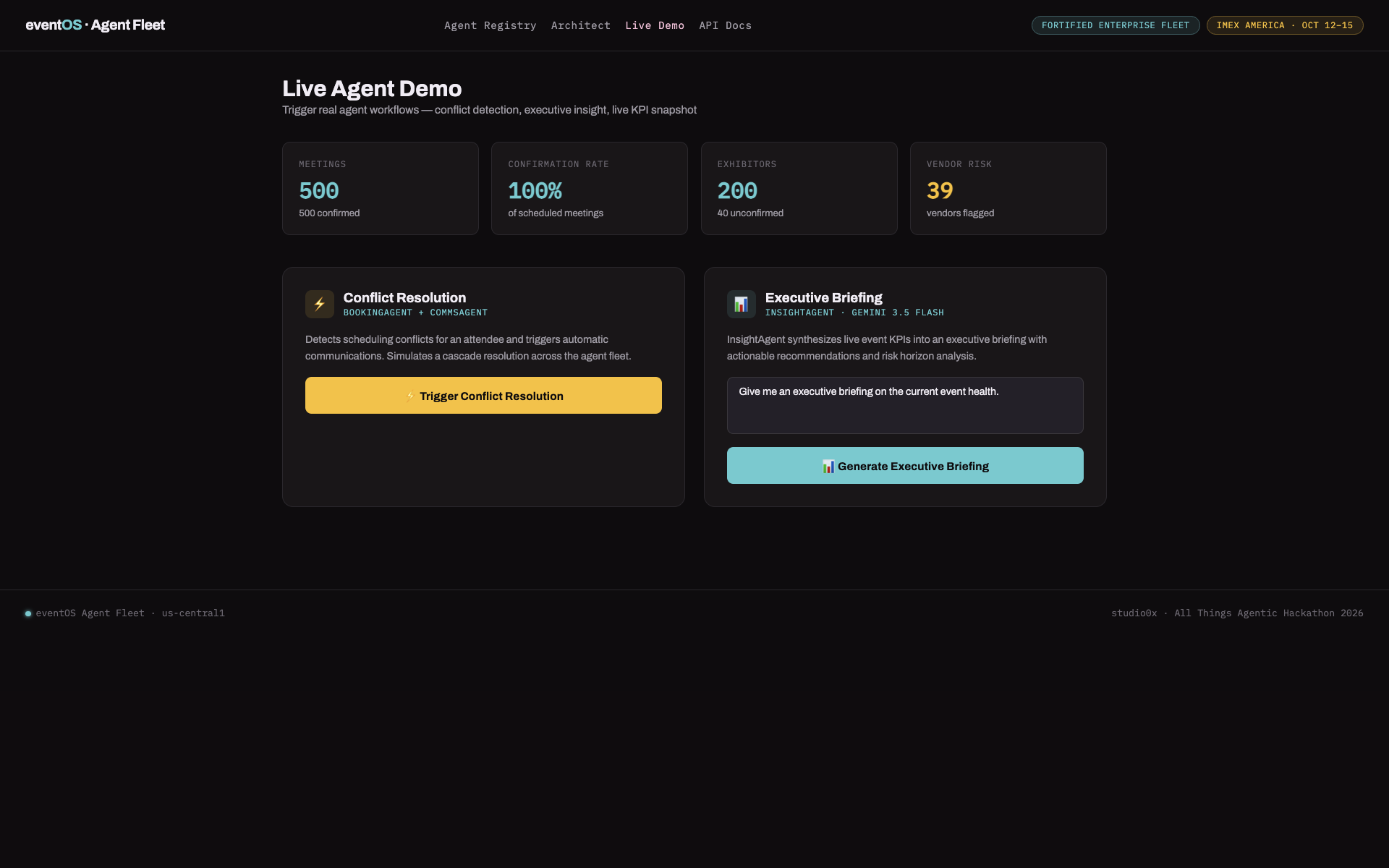
live demo
-
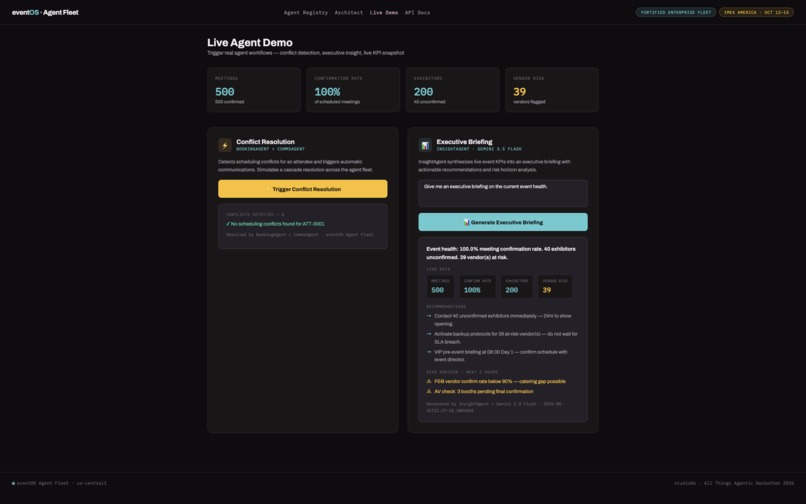
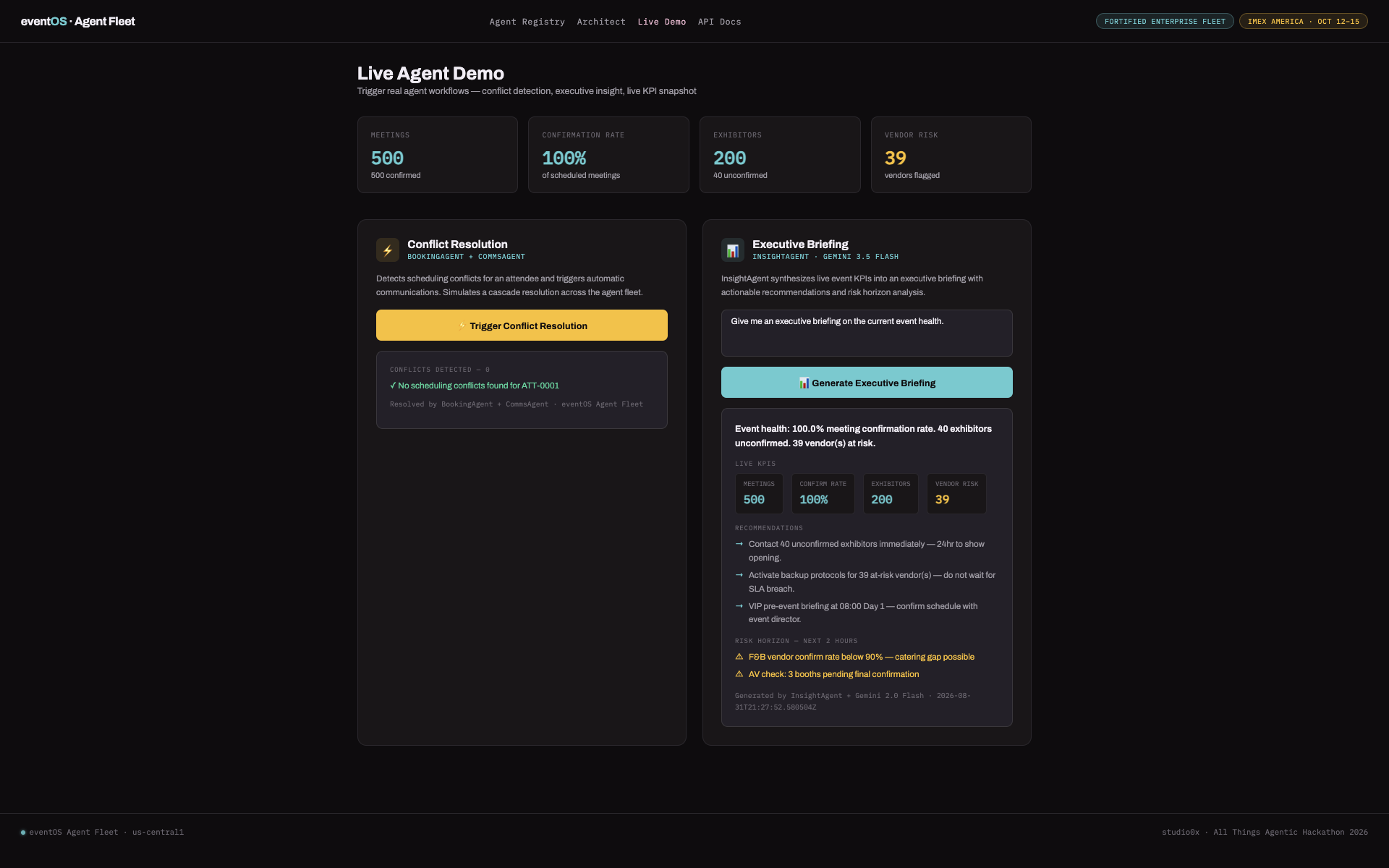
live demo after clicking 'trigger confl res' & 'gen ex brief'
-
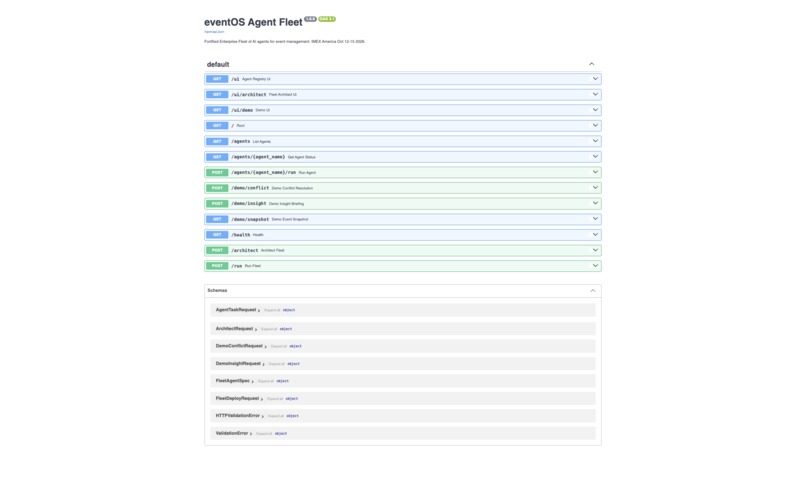
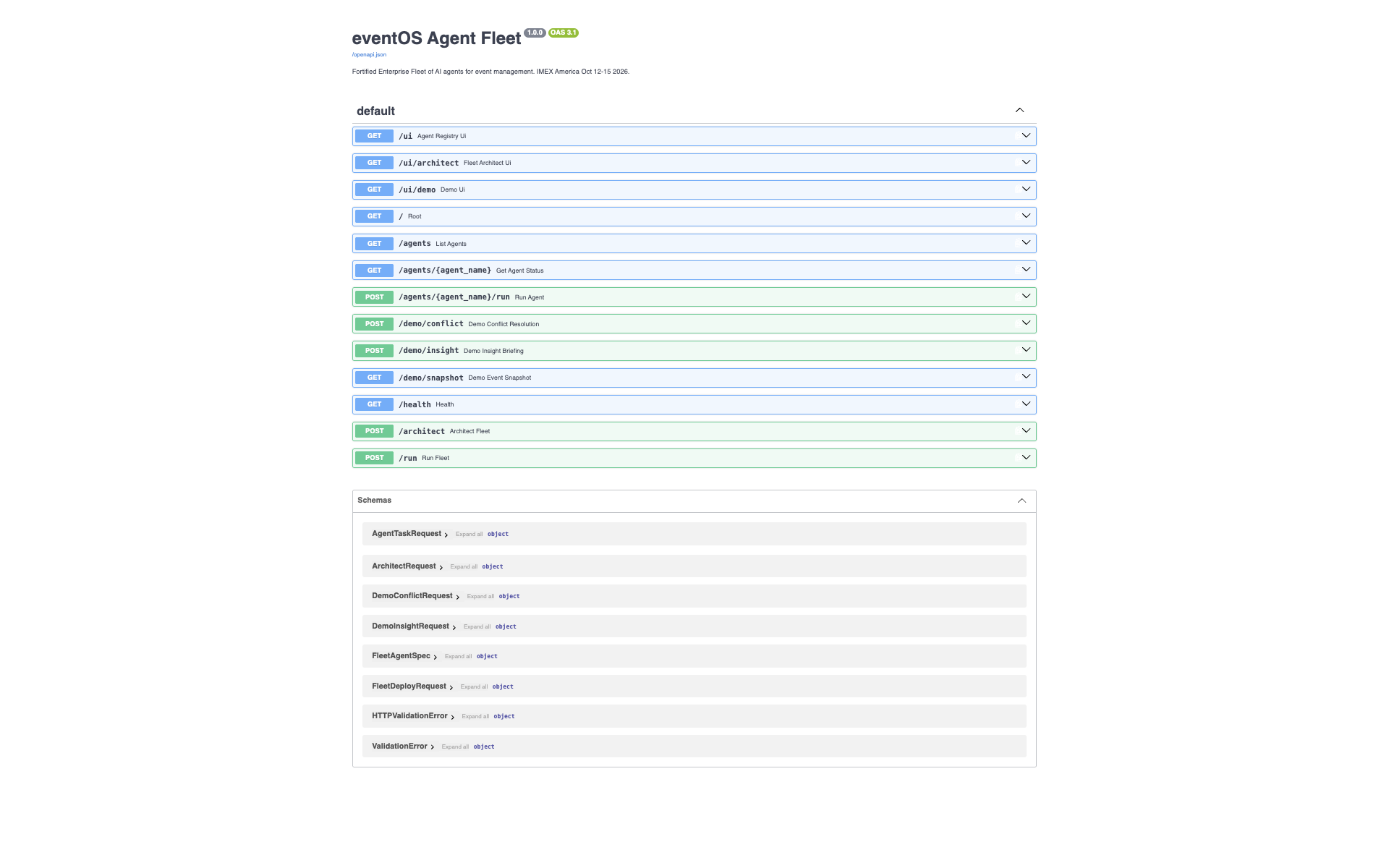
agent fleet
-
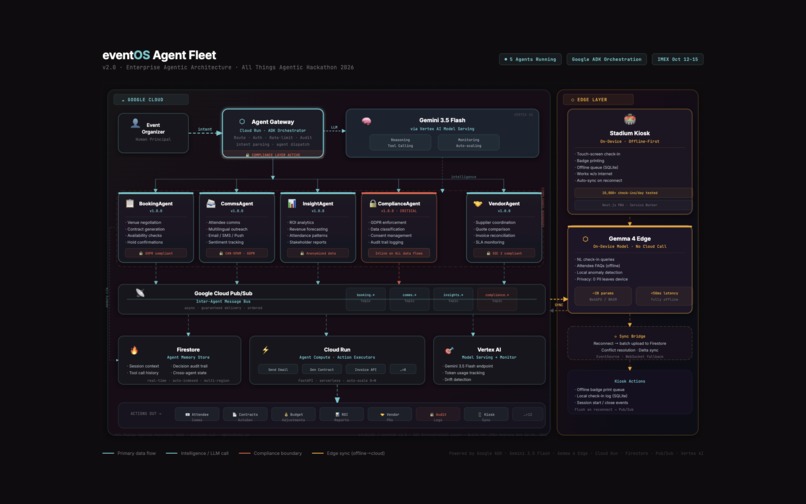
agent fleet
-
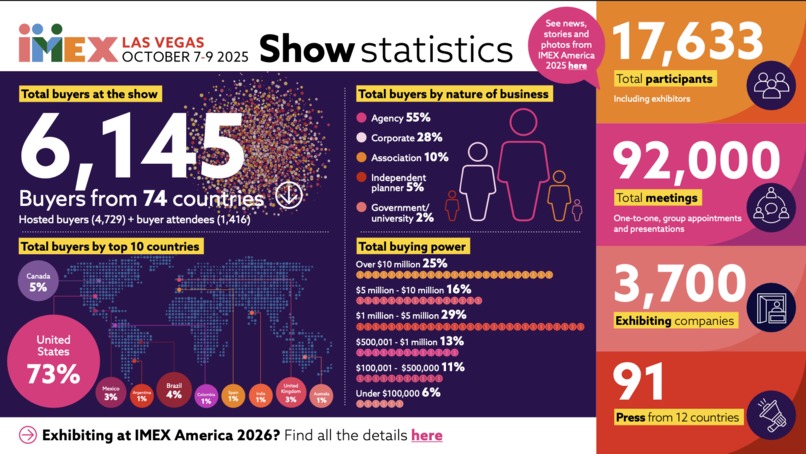
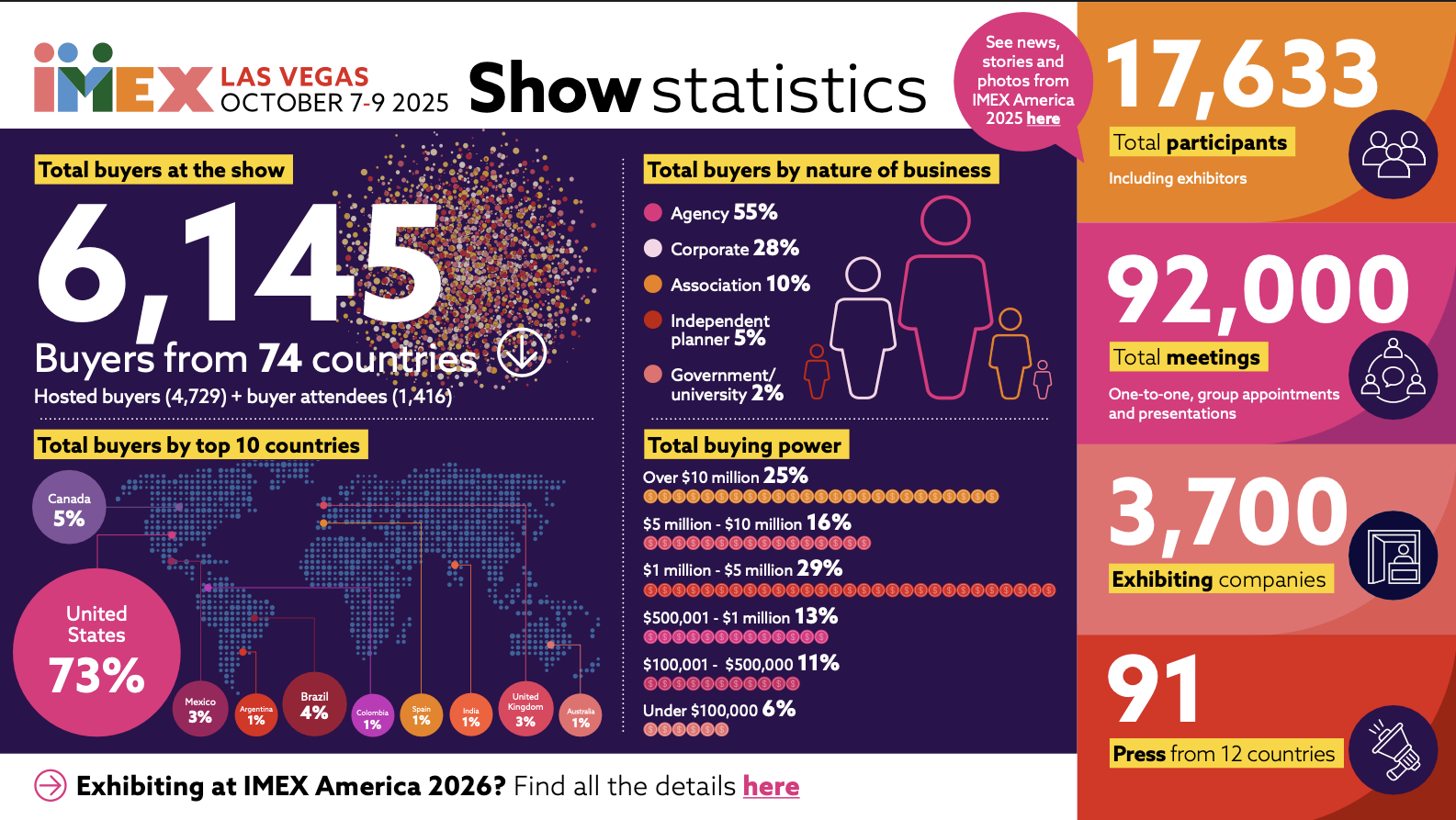
IMEX America 2025 Show Statistics
Inspiration
IMEX America. 17,600+ attendees. 3,700+ exhibitors. 92,000+ scheduled meetings across three days. We're deploying eventOS there in October, and when we mapped what a small planning team actually does in the weeks before a large event, the answer was clear: most of it is deterministic coordination work that follows rules. Rules agents can execute faster, cheaper, and without dropping the ball at 2am. The deeper question that drove this hackathon build: what if the fleet itself was intelligent? Describe an event — get a purpose-built agent workforce, live.
What it does
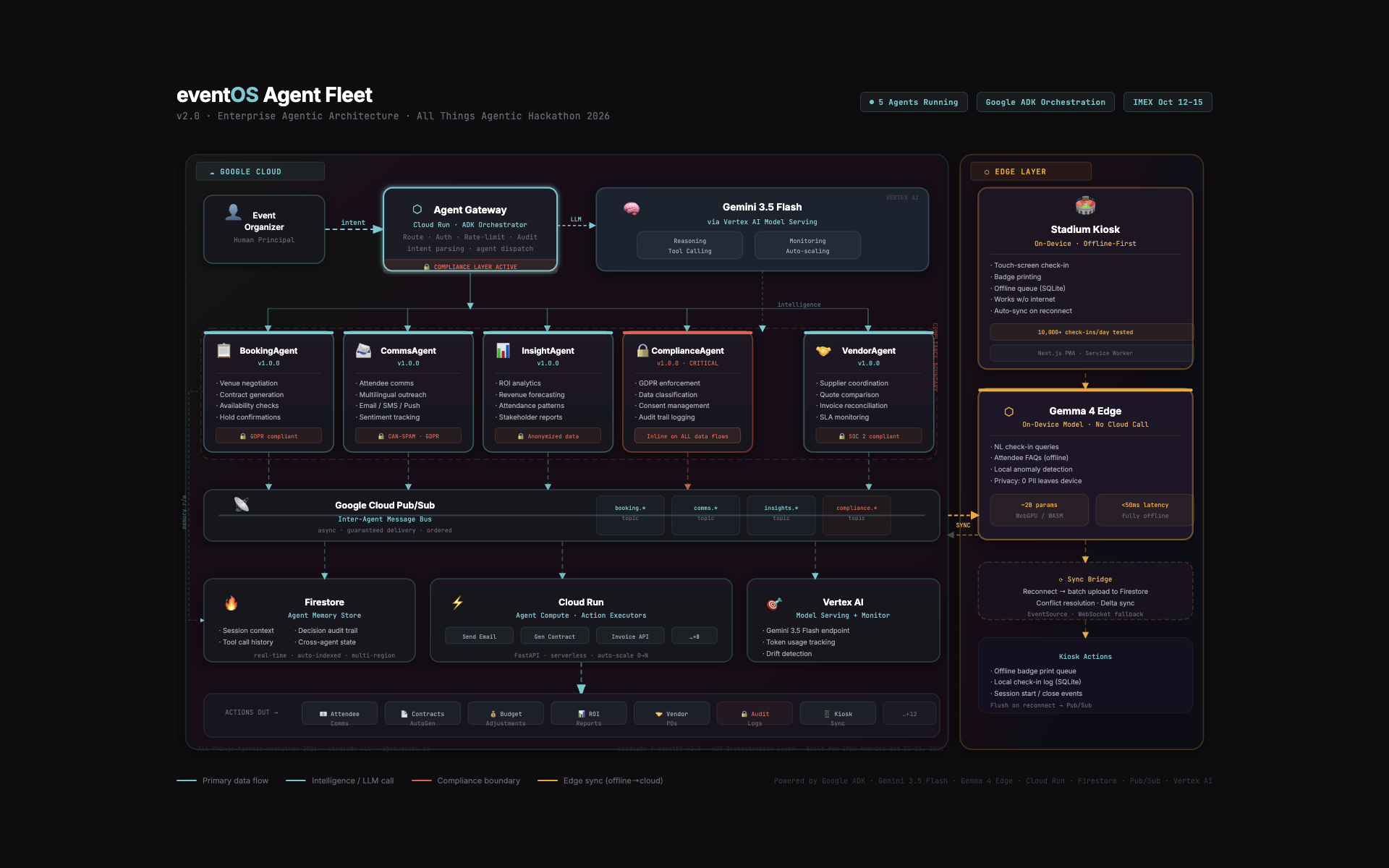
eventOS Agent Fleet deploys five specialized AI agents — BookingAgent, CommsAgent, InsightAgent, ComplianceAgent, and VendorAgent — that run the operational layer of large-scale events autonomously on Google Cloud Run. Each agent owns a complete domain: 92,000+ meeting bookings, multilingual communications, executive briefings, GDPR compliance enforcement, and SLA monitoring. The Fleet Architect feature lets planners describe any event and receive a custom agent fleet configuration in real time, powered by Gemini 3.5 Flash. One click deploys it.
How we built it
Five-layer stack: Google ADK on Cloud Run (agent runtime, auto-scales to zero) → Gemini 3.5 Flash (agent intelligence + Fleet Architect) → Firestore (persistent cross-agent memory) → Pub/Sub (async inter-agent communication) → Gemma 4 edge layer (on-device inference for offline stadium kiosks, zero PII leaves the device). Fleet Architect is powered by singularityLab (singularitylab.app), our multi-agent synthesis engine. Agents don't call each other — they write to shared Firestore state and subscribe to Pub/Sub topics, keeping the architecture decoupled and horizontally scalable.
Challenges we ran into
Cross-agent consistency without a bottleneck. When BookingAgent resolves a conflict, CommsAgent needs to reflect it immediately. The solution: event-sourced state in Firestore. Agents write events, not updates — downstream agents react to the stream. Fleet design quality. Getting Gemini to generate genuinely scoped agent configurations (not generic ones) required careful prompt architecture encoding event type, scale, compliance requirements, and language constraints. Production pressure. eventOS ships to IMEX America on October 12th. Every architectural decision here is a real production decision, which sharpened everything.
Accomplishments that we're proud of
Fleet Architect generates a fully scoped, deployment-ready agent configuration for any event in under 5-10 seconds — live, unedited, from a natural language description. The cross-agent conflict resolution loop works end-to-end: BookingAgent detects a scheduling conflict, resolves it, and CommsAgent is notified autonomously via Pub/Sub — no human in the loop. And the system runs on a serverless architecture that scales to zero between events, making it cost-viable for the mid-market event planning firms that need it most.
What we learned
Agent memory architecture is the hardest part of multi-agent systems. Individual agents are straightforward. Shared state is the challenge. Firestore real-time listeners combined with a Pub/Sub event bus solve it cleanly — and that decoupling is what makes the fleet horizontally scalable. We also learned that Gemini 3.5 Flash's instruction-following at speed is genuinely production-grade. Scheduling thousands of exhibitors is historically quadratic complexity for human planners — every new exhibitor multiplies the coordination burden. With parallel specialized agents, that work runs concurrently across dedicated domains. At IMEX scale (3,700+ exhibitors, 5 agents), that's an order-of-magnitude reduction in coordination time.
What's next for eventOS Agent Fleet
Live deployment at IMEX America, October 12–15, 2026 — 17,600+ attendees, 3,700+ exhibitors. Post-IMEX: plannerTravel integration (Duffel API for real-time flight search, Mozio for ground transport), venueBook (AI-powered venue sourcing with RFP tracking), and the attendee-facing mobile layer with on-device Gemma 4 for offline stadium scenarios. The agent fleet grows with each event vertical we add.
Additional note about my stack: This project is a brand new creation built on top of an existing product — singularityLab (singularitylab.app). For singularityLab's own stack, in addition to what's listed below, I also used: anthropic-claude, groq, hono, neon-postgres, elevenlabs, resend, twilio, and probably more. It's been a long few days of building for this hackathon!
Built With
- anthropic-claude
- docker
- fast-api
- firestore
- gemma-4
- google-adk
- google-cloud-run
- google-cloud-sdk
- google-gemini-3.5-flash
- jinja
- next.js
- pub/sub
- pydantic
- python
- supabase
- typescript
- vercel
- vertex-ai


Log in or sign up for Devpost to join the conversation.