-
-
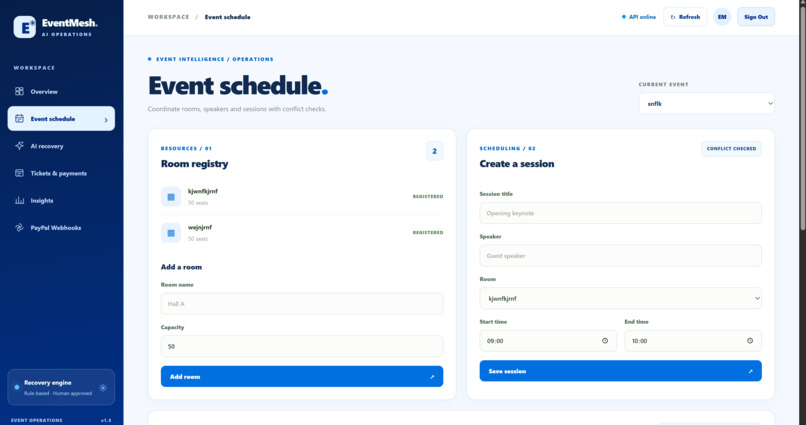
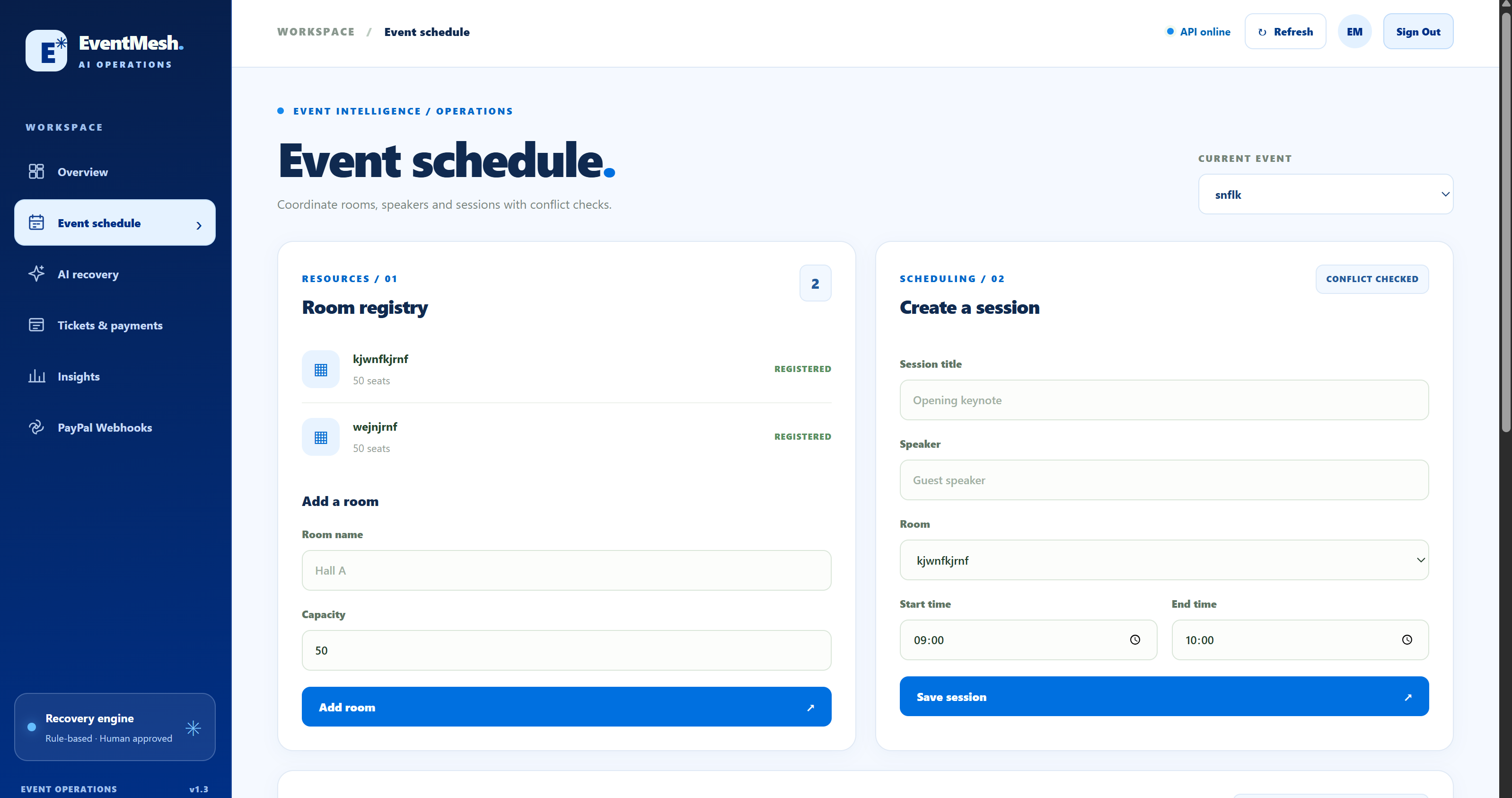
Event scheduler
-
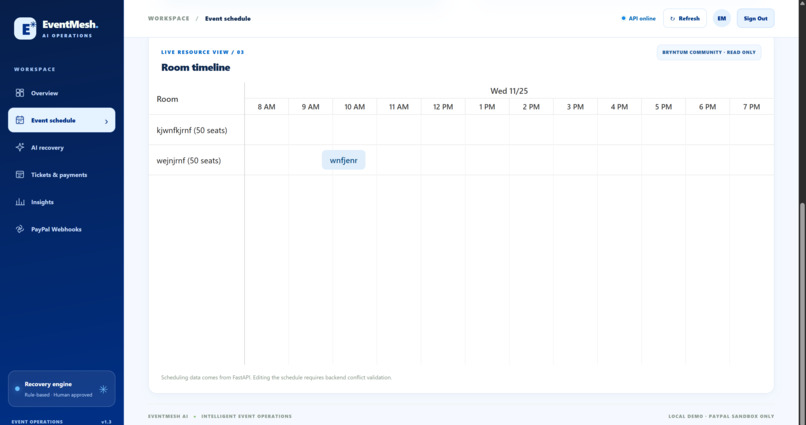
Bryntnum Scheduler
-
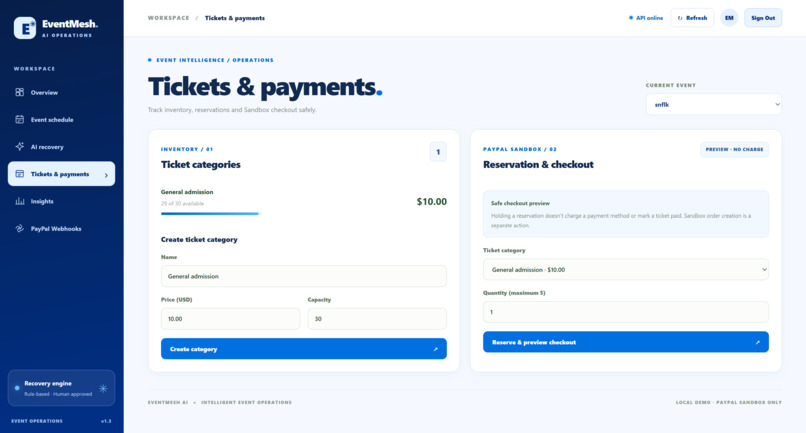
Ticket
-
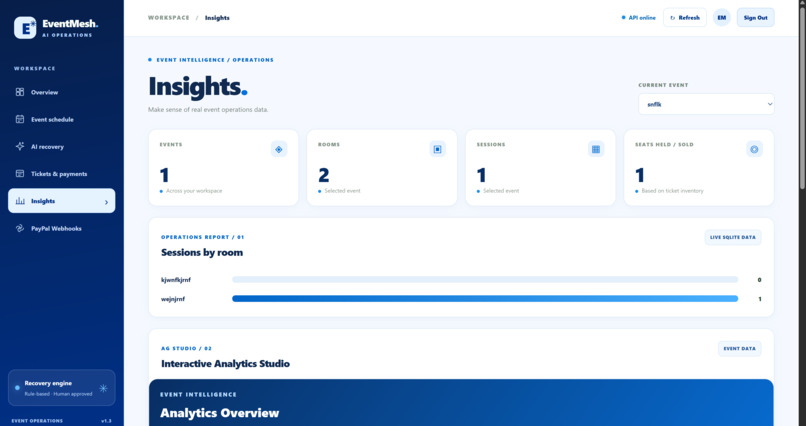
Insights
-
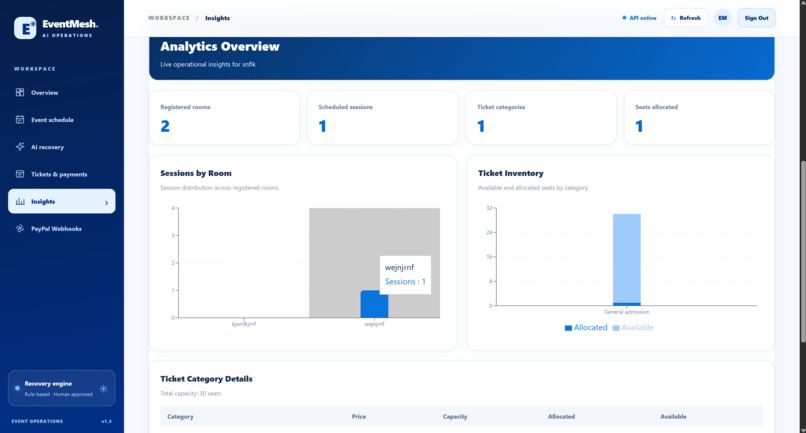
Insights
-
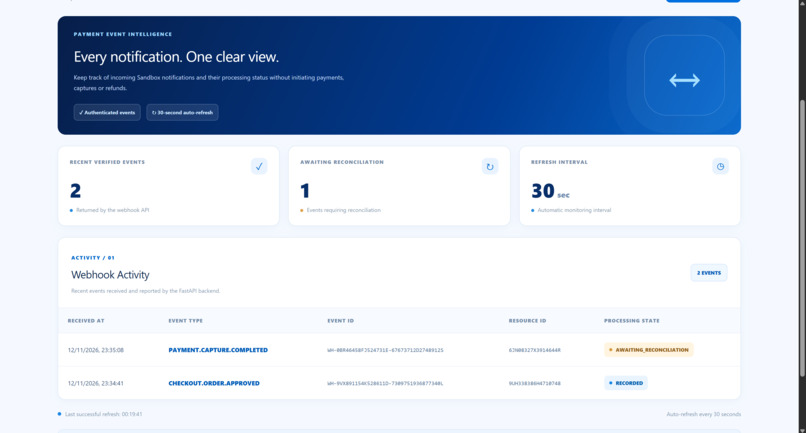
Webhooks
-
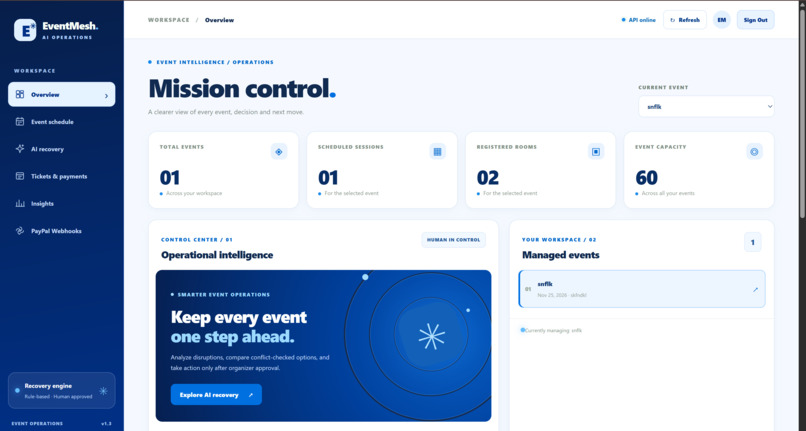
Dashboard
Inspiration Imagine spending weeks planning an event. Every speaker is confirmed, every room is assigned, the schedule is finalized, and attendees are excited.
Then, just before the event begins, a speaker cancels. A room becomes unavailable. Two important sessions overlap. Suddenly, the carefully planned schedule starts falling apart.
The problem isn't that events are poorly planned. The problem is that even the best plans cannot predict everything.
This realization inspired us to build EVENTMESH-AI.
We noticed that most event management platforms focus on creating schedules, managing registrations, and processing payments. But when something unexpected happens, organizers are often left to resolve the situation manually, under pressure, with limited time and incomplete information.
We asked ourselves a simple question:
What if an event management platform could do more than organize events? What if it could help organizers anticipate disruptions, evaluate alternatives, and recover intelligently?
That's where EVENTMESH-AI began.
Our vision was to bring intelligent scheduling, disruption recovery, ticket management, and secure payments into one connected ecosystem.
We didn't want AI to replace human judgment. We wanted it to strengthen it.
Because successful events aren't defined only by how well they're planned, but also by how effectively they adapt when things don't go according to plan.
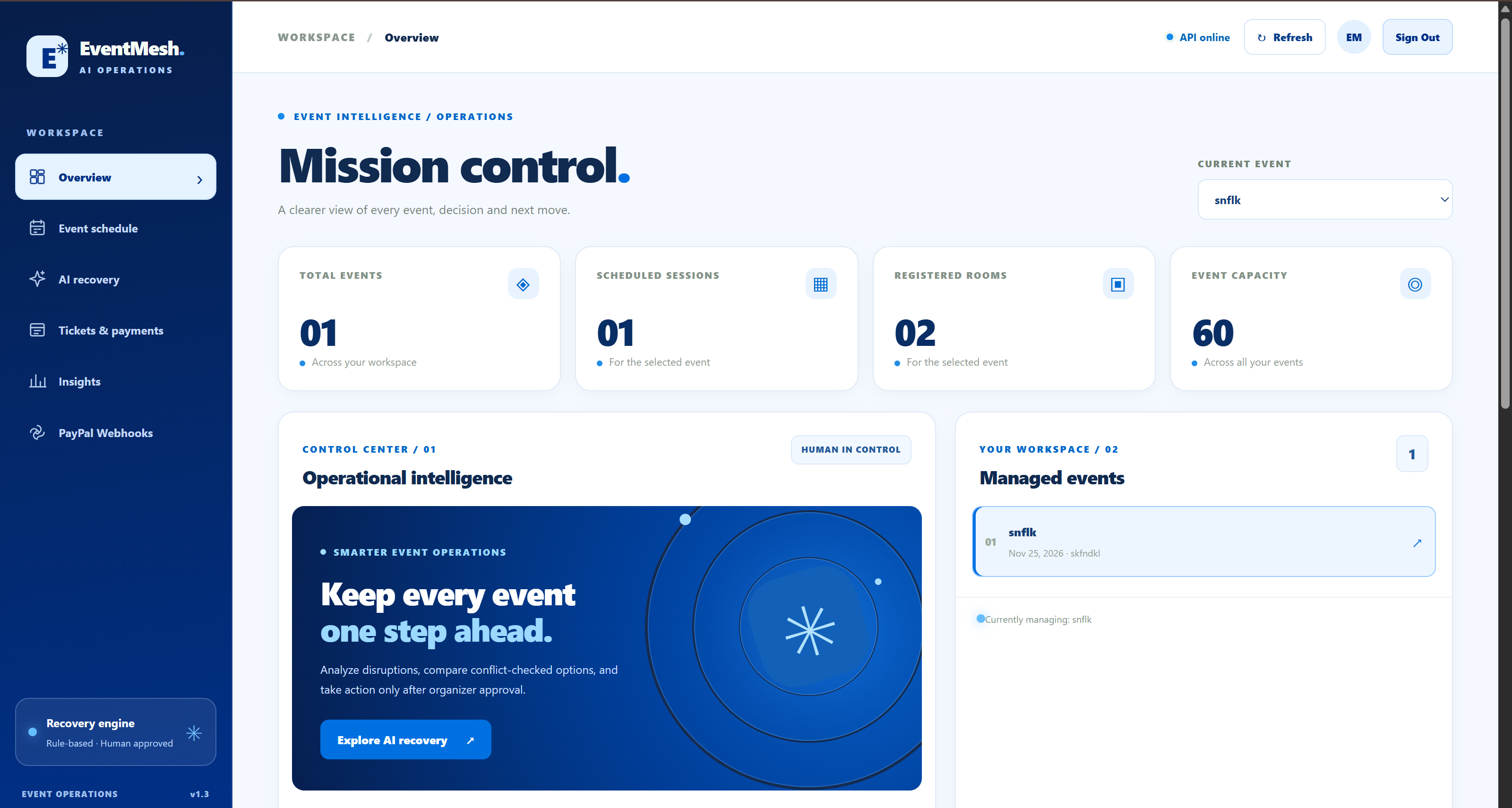
What it does EVENTMESH-AI is an intelligent event operations and recovery platform designed to help organizers plan smarter, respond faster, and manage events with confidence.
Instead of treating scheduling, ticketing, and payments as separate activities, our platform connects them into a unified workflow.
Intelligent Event Scheduling
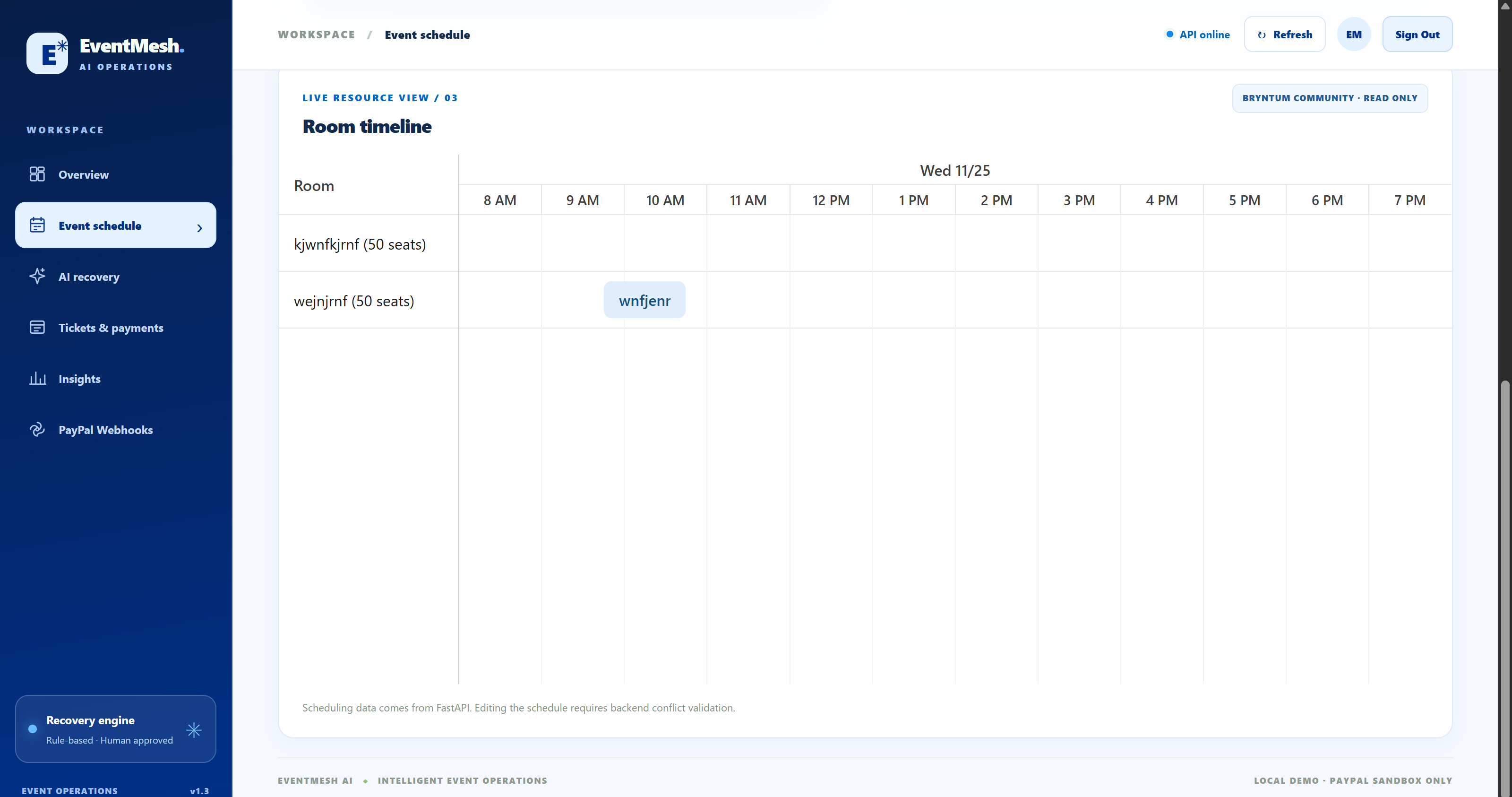
Organizers can create events, manage rooms, assign sessions, and visualize schedules through an interactive timeline. This makes it easier to understand how different activities fit together and identify scheduling conflicts.
AI-Assisted Disruption Recovery
When unexpected disruptions occur, such as room unavailability or scheduling conflicts, EVENTMESH-AI helps evaluate alternative arrangements.
The system considers scheduling constraints and generates explainable recovery recommendations, allowing organizers to understand the possible solutions before approving changes.
Our guiding principle is human-in-the-loop decision-making. The system recommends; the organizer decides.
Ticket Reservations and PayPal Integration
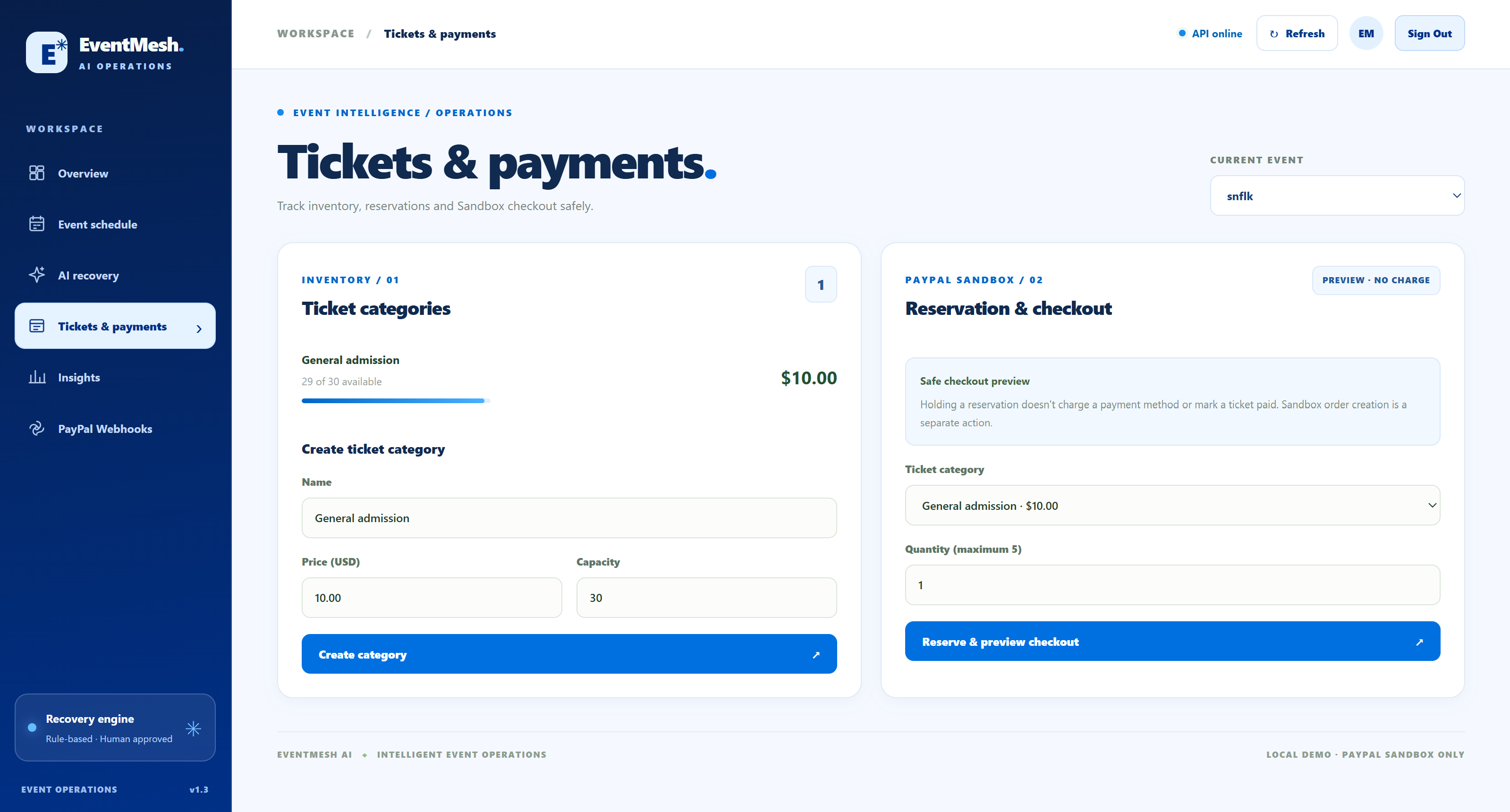
EVENTMESH-AI integrates PayPal Sandbox to demonstrate a complete digital payment workflow.
Organizers can manage ticket reservations, initiate PayPal checkout, process payment approvals, verify captured transactions, and issue tickets after successful verification.
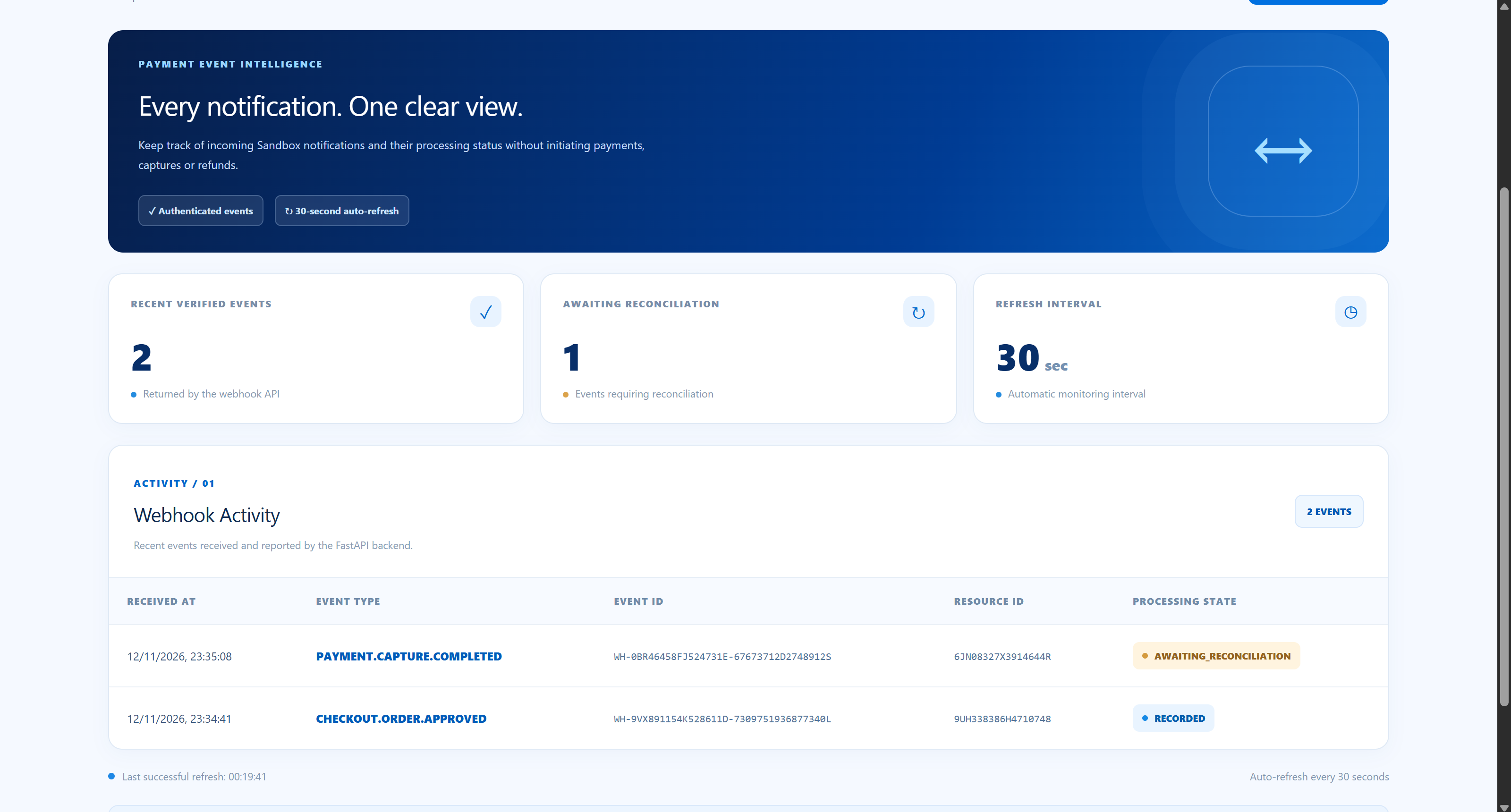
We also implemented webhook handling and reconciliation workflows to support reliable payment tracking.
Operational Analytics and Monitoring
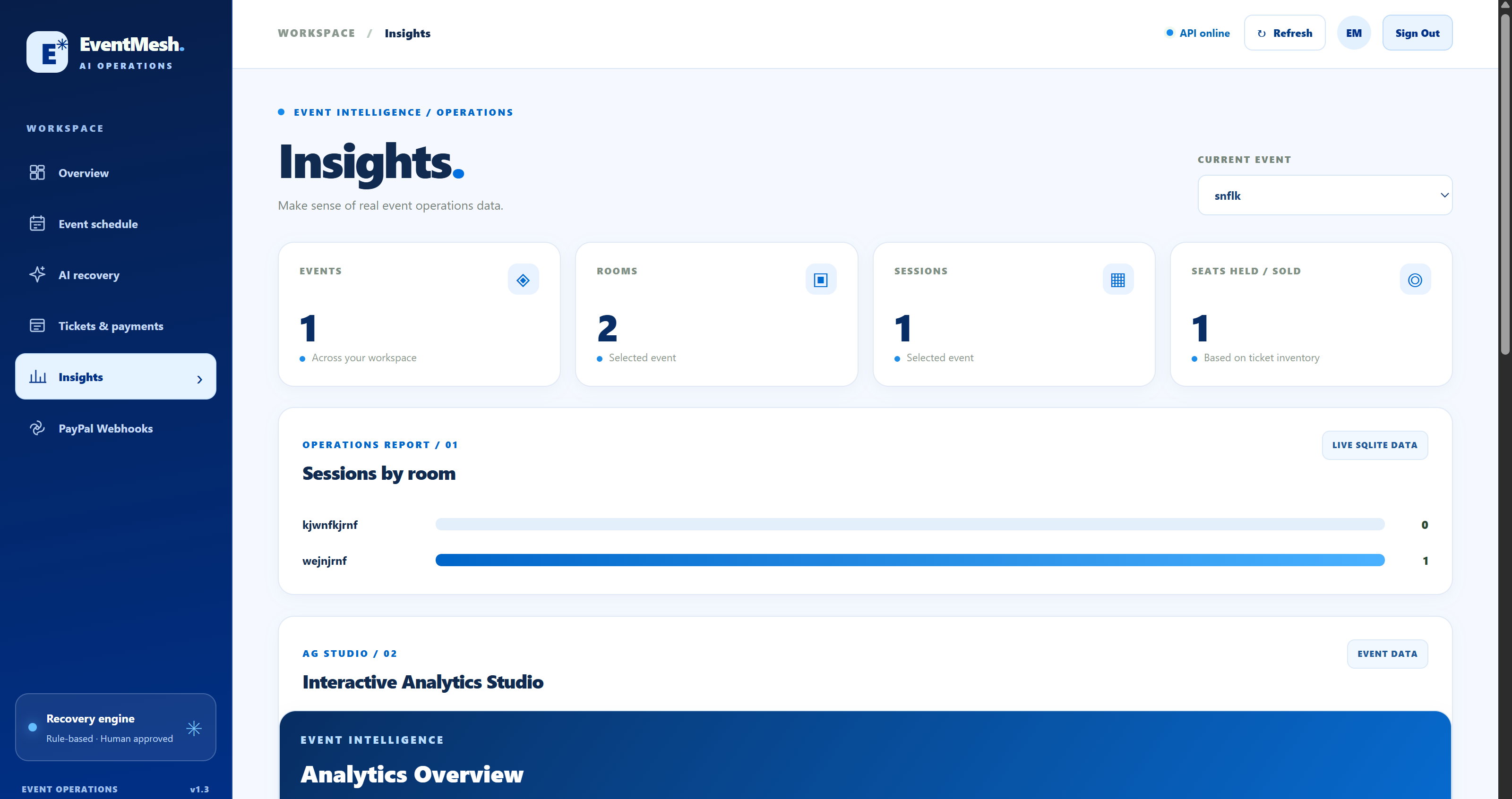
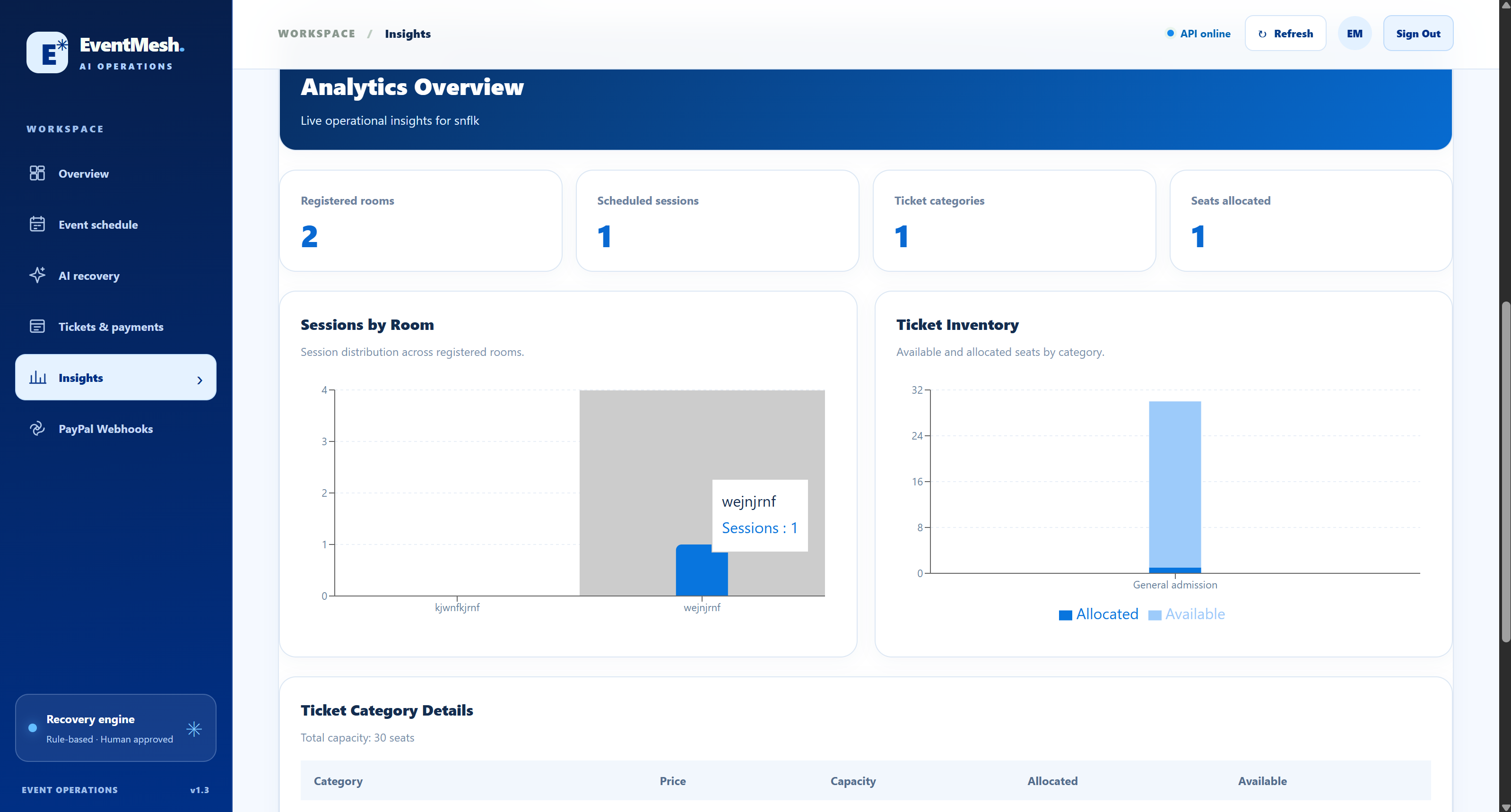
The platform provides insights into event operations, helping organizers monitor scheduling activity, reservations, and operational changes.
A Unified Organizer Dashboard
All these capabilities are brought together in a single interface, reducing the need to switch between multiple disconnected tools.
Ultimately, EVENTMESH-AI aims to transform event management from a reactive process into a more intelligent, adaptive, and coordinated experience.
How we built it Building EVENTMESH-AI required us to connect several technologies into a working end-to-end application.
We began by designing the event operations workflow and identifying the core challenges organizers face: scheduling conflicts, unexpected disruptions, ticket reservations, and payment verification.
From there, we divided the system into a modern frontend, a Python-powered backend, a scheduling and recovery engine, and an integrated payment infrastructure.
Frontend Development
We developed the frontend using Next.js, React, and TypeScript, creating a responsive organizer dashboard that brings the platform's functionality into one place.
For interactive scheduling, we integrated Bryntum Scheduler Community, enabling organizers to visualize rooms and sessions on a timeline.
We also incorporated Recharts for presenting operational information through visual analytics.
Backend and Business Logic
Our backend is built with Python and FastAPI, which handles authentication, event operations, scheduling workflows, ticket reservations, and payment-related API requests.
We designed the backend to keep operational logic separate from the user interface, making the system more modular and easier to maintain.
Intelligent Scheduling and Recovery
We implemented constraint-aware scheduling and recovery logic to analyze disruptions and evaluate feasible alternatives.
Instead of simply returning a suggested change, the system provides reasoning that helps organizers understand the recommendation.
This was an important design decision because we wanted the platform's intelligence to remain transparent and actionable.
Database Management
We used SQLite to manage application data during development and demonstration.
SQLite helped us iterate quickly without requiring a complex database infrastructure during the hackathon.
The lightweight database setup allowed us to focus on developing and integrating the platform's core features efficiently.
PayPal Sandbox Integration
One of the most significant parts of our implementation was integrating PayPal Sandbox.
We developed workflows for creating payment orders, redirecting users for approval, verifying completed captures, processing webhooks, and reconciling payment information with ticket reservations.
We deliberately separated payment approval from payment verification, ensuring that tickets are issued only after the transaction is successfully confirmed.
Cloud Deployment
Finally, we deployed the application using Render, hosting our Next.js frontend and FastAPI backend as separate services.
This required configuring environment variables, cross-service communication, authentication security, and production-specific settings.
Our technology stack includes:
Next.js, React, TypeScript, Python, FastAPI, SQLite, Bryntum Scheduler Community, Recharts, PayPal Sandbox, and Render.
What started as an idea gradually became a connected system where scheduling, recovery, ticketing, and payments work together.
Challenges we ran into Building EVENTMESH-AI was an exciting experience, but it came with challenges that pushed us beyond simply writing code.
Making intelligent scheduling practical One of our first challenges was developing a scheduling recovery system that could handle real-world constraints.
Finding an alternative time slot is relatively simple. Finding an alternative that respects room availability, scheduling conflicts, and other operational requirements is much harder.
We had to think carefully about how recommendations should be evaluated and presented so organizers could make informed decisions.
This taught us that intelligent systems are not only about generating answers, but about generating solutions that can actually be used.
Integrating multiple systems into one platform One of our biggest engineering challenges was making scheduling, event management, ticket reservations, payments, and analytics work together seamlessly.
Each feature had its own logic and dependencies. A small change in one component could unexpectedly affect another part of the application.
We had to carefully design API communication, manage application states, and ensure that the frontend and backend remained synchronized.
This taught us that building a complete product requires much more than developing individual features.
Managing SQLite database persistence Another significant challenge involved our database.
We noticed that application data could disappear after certain cloud service restarts or redeployments.
After investigating, we understood that our SQLite database was stored on an ephemeral filesystem, meaning local database changes were not guaranteed to survive service replacement.
For the hackathon demonstration, we implemented a designated organizer account that could be initialized through backend configuration.
This helped us maintain predictable demo access even when temporary application data was cleared.
More importantly, it taught us the distinction between a functional prototype and production-grade data persistence.
PayPal payment approval versus successful capture Integrating PayPal turned out to be more involved than simply connecting a payment button.
During testing, we discovered that a PayPal order could be approved without the corresponding reservation being marked as paid.
We also encountered a redirect issue where a temporary frontend preview sent users back to our original deployed website. Because the two domains had different authentication sessions, the checkout could not be matched correctly.
We investigated the return URLs, session handling, payment status endpoints, and checkout verification logic.
Eventually, we successfully completed and verified PayPal Sandbox payments through the original deployment, including confirmed ticket issuance.
This was one of the most satisfying technical milestones of the project.
Keeping authentication and deployment secure We also faced challenges involving organizer authentication, reverse-proxy configuration, environment variables, and differences between development and production environments.
At times, a change that fixed one issue introduced another.
To protect our working application, we learned to use Git branches, backups, and pull requests before modifying deployment-related code.
These challenges made us appreciate the importance of careful testing, version control, and reliable deployment practices.
Accomplishments that we're proud of Looking back at our journey, what makes us proudest is that EVENTMESH-AI grew from a concept into a functional, deployed application.
Building a connected event management ecosystem
We successfully combined scheduling, disruption recovery, ticket management, payment processing, and operational insights within a single platform.
Each component solves a specific problem, but the real value comes from how they work together.
Creating explainable recovery recommendations
We are particularly proud of designing a recovery workflow that prioritizes practical recommendations and organizer control.
Instead of blindly automating decisions, EVENTMESH-AI helps organizers understand their options and decide how to respond.
Successfully integrating PayPal Sandbox
Completing our PayPal integration was a major achievement.
During testing, we successfully verified payment capture and confirmed ticket issuance through the deployed application.
Seeing the reservation status change to PAID, the payment verification succeed, and the tickets get issued made the entire integration process worthwhile.
Deploying a complete full-stack application
We successfully deployed a frontend and backend that communicate through cloud-hosted APIs.
We worked through production authentication, environment configuration, and API integration challenges to deliver an accessible live application.
Turning setbacks into improvements
Perhaps our most meaningful accomplishment was learning to work through problems rather than abandoning features when they became difficult.
There were moments when authentication failed, databases reset, payment redirects broke, and deployments behaved differently from localhost.
But each challenge forced us to understand our system more deeply.
We're proud not just of the product we built, but of the engineering journey it took to build it.
What we learned This hackathon taught us far more than how to use a new technology stack.
We learned that useful AI must be explainable.
An intelligent recommendation is valuable only when the person using it understands its purpose and can act on it confidently.
This shaped our decision to keep organizers involved in the scheduling recovery process.
We learned that reliable payments require verification, not assumptions.
A successful redirect or payment approval screen doesn't necessarily mean money has been captured.
Understanding payment states, backend verification, webhook processing, and reconciliation gave us a much deeper appreciation for financial transaction systems.
We learned that cloud infrastructure changes application behavior.
Code that runs perfectly on localhost can behave differently when deployed.
We gained practical experience with reverse proxies, environment variables, temporary storage, authentication sessions, and cross-service communication.
We learned the value of protecting working software.
Using Git branches, backups, and pull requests helped us experiment with solutions while preserving our original implementation.
This became especially important when troubleshooting authentication and deployment issues.
We learned that building a product is different from building isolated features.
A good-looking frontend, a functional backend, and a working payment API are individually useful.
But the real challenge is making them work together consistently.
Most importantly, we learned that persistence, communication, and curiosity matter just as much as technical knowledge.
Sometimes, the most valuable part of development happens when something refuses to work and you have to understand why.
What's next for EVENTMESH-AI Although EVENTMESH-AI began as a hackathon project, we believe the idea has potential beyond the competition.
Our next goal is to evolve it from a functional prototype into a scalable event operations platform.
Predictive disruption intelligence
We want to expand our scheduling intelligence to identify potential disruptions before they happen.
By analyzing scheduling patterns, resource availability, and operational constraints, the platform could eventually help organizers take preventive action instead of waiting for problems to occur.
Advanced scheduling optimization
We plan to improve the recovery engine to evaluate more complex scheduling scenarios, prioritize alternatives, and support larger events with multiple simultaneous constraints.
Persistent cloud database infrastructure
While SQLite served us well during prototyping, moving to a persistent managed database would improve reliability and allow event data to survive restarts and redeployments.
Real-time attendee communication
We envision notifying attendees automatically when session timings, rooms, or other important event details change.
This would help ensure that scheduling decisions translate into clear communication across the entire event.
Multi-organizer collaboration
Future versions could support multiple organizers, role-based permissions, and collaborative event management for larger teams.
Deeper PayPal-powered financial workflows
We also want to extend the payment experience with improved transaction reporting, refund management, automated reconciliation, and richer financial insights.
Scalability and production readiness
As the platform grows, we aim to improve monitoring, automated testing, database reliability, security, and deployment infrastructure.
Our long-term vision is to make EVENTMESH-AI an intelligent operational companion that helps event organizers stay prepared, make better decisions, and deliver smoother experiences.
We started this project with a simple question: What happens when the perfect event plan stops being perfect?
EVENTMESH-AI is our attempt to answer that question.
Because great events aren't just planned. They're continuously adapted, intelligently managed, and confidently delivered.
Built With
- bryntum-scheduler-community
- bryntum-scheduler-react-community
- css3
- fastapi
- git
- html5
- httpx
- javascript
- next.js
- node.js
- npm
- paypal-capture-api
- paypal-orders-api
- paypal-refund-api
- paypal-rest-api
- paypal-sandbox
- paypal-webhooks
- python
- react
- recharts
- render
- sqlite
- typescript
- uvicorn
