-
-
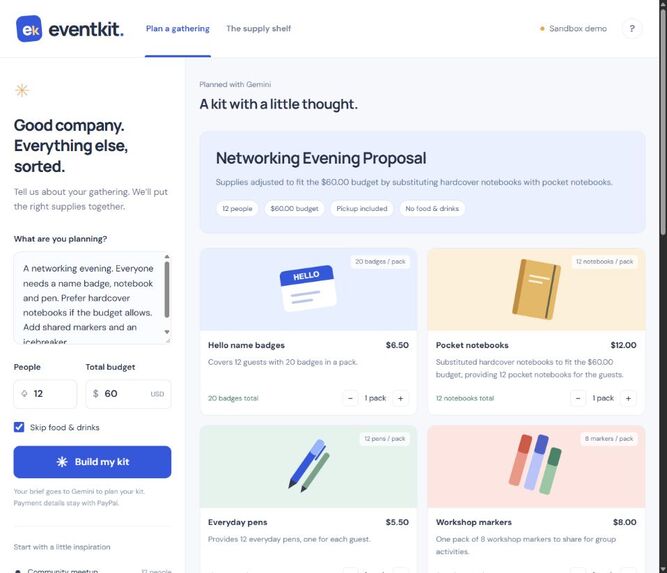
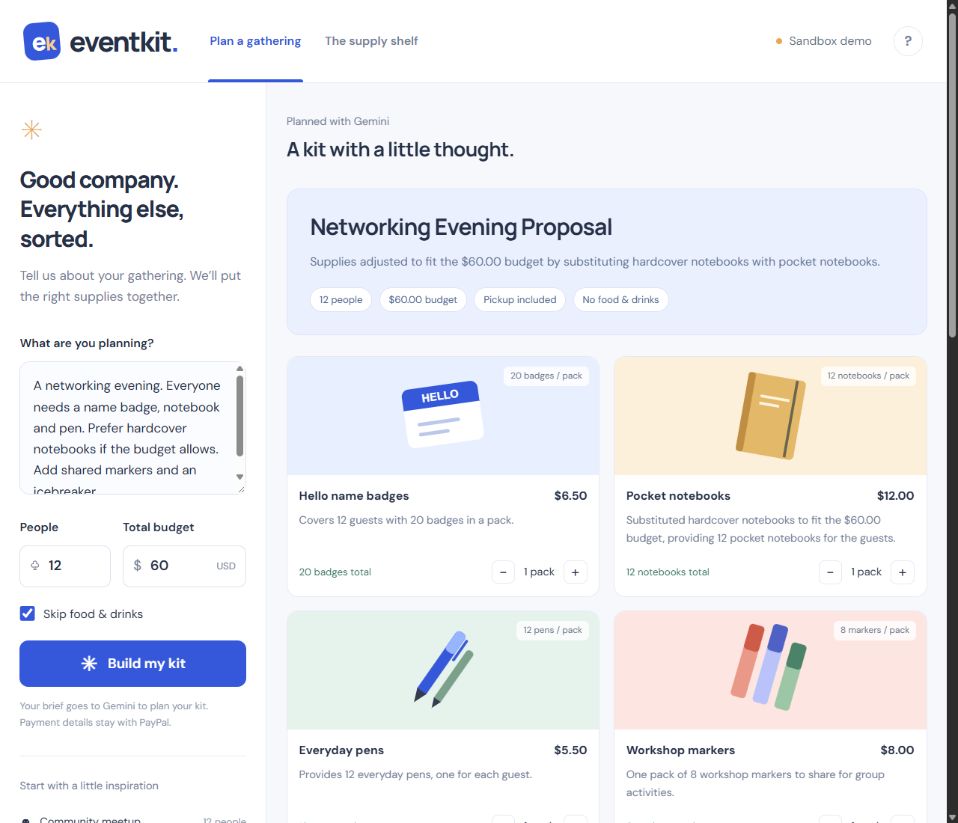
Gemini replans a 12-person meetup for a $60 budget, including a notebook substitution.
-
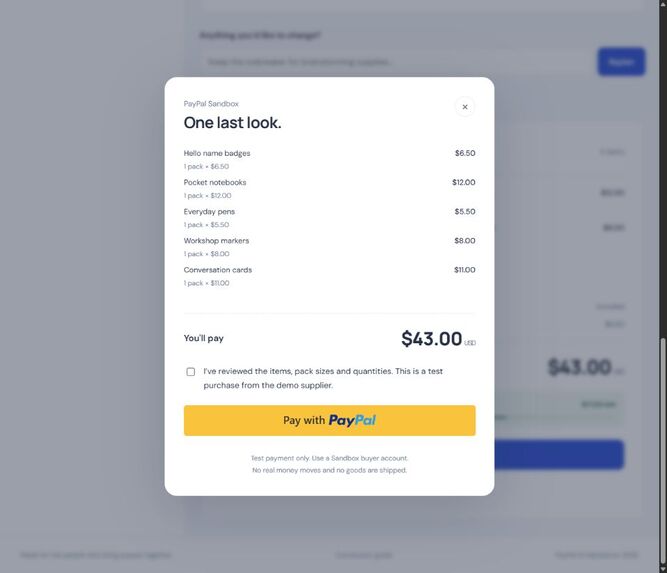
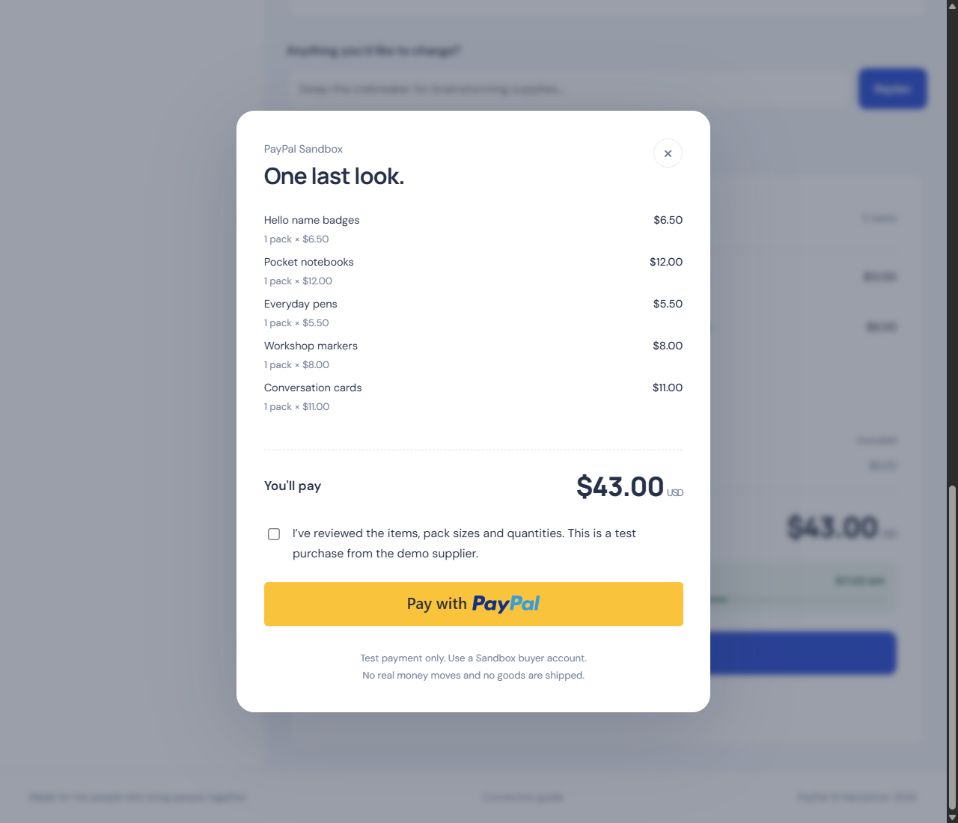
Itemized $43 kit review with explicit approval before PayPal Sandbox checkout.
-
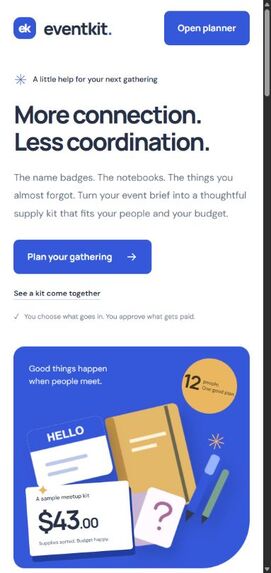
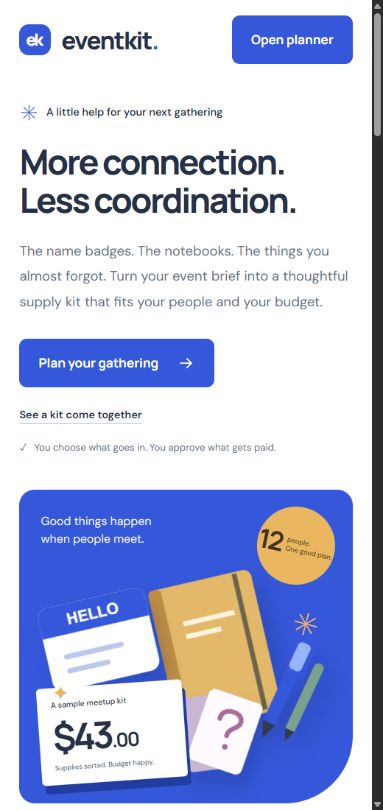
Mobile landing page.
-
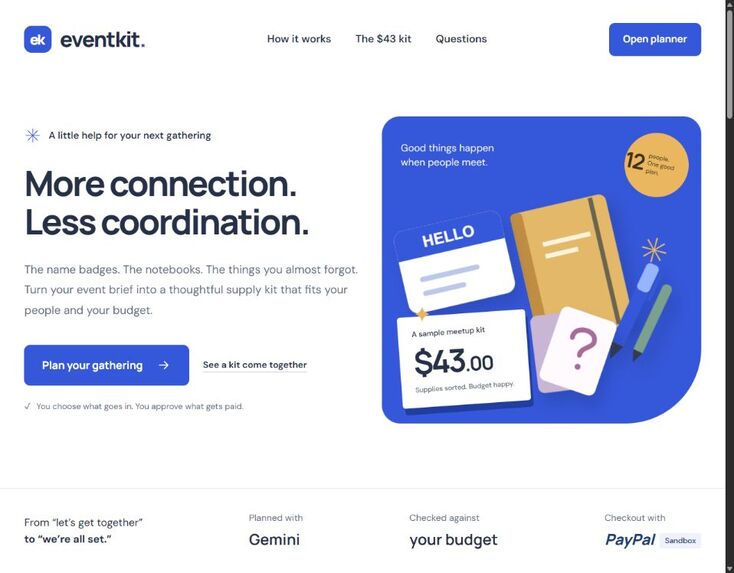
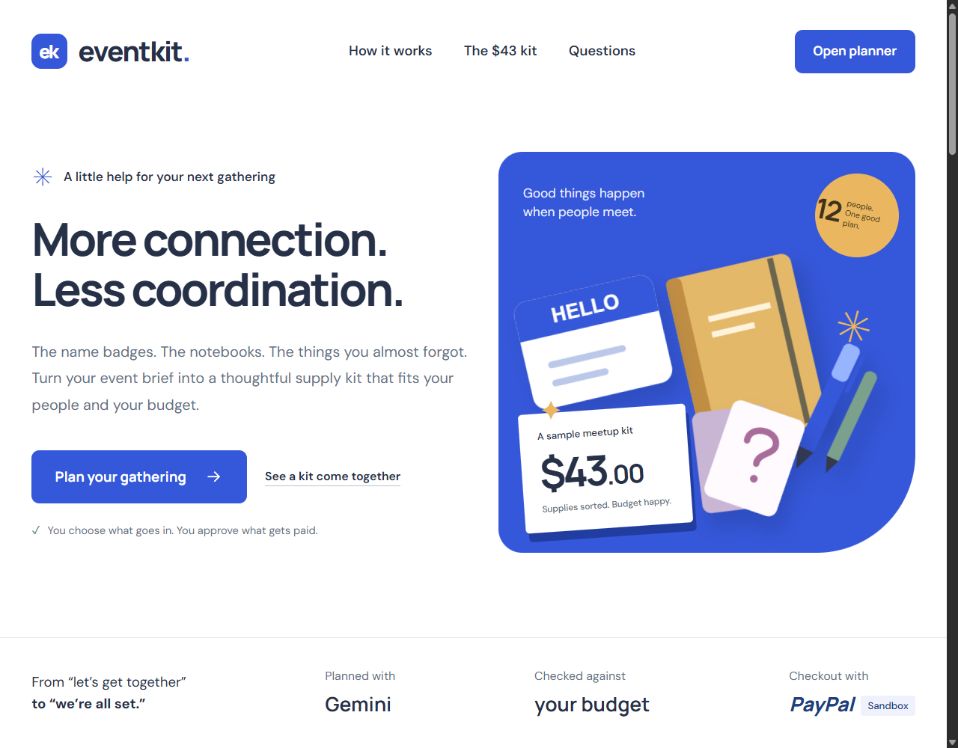
Responsive landing page introducing the planning-to-checkout workflow.
-
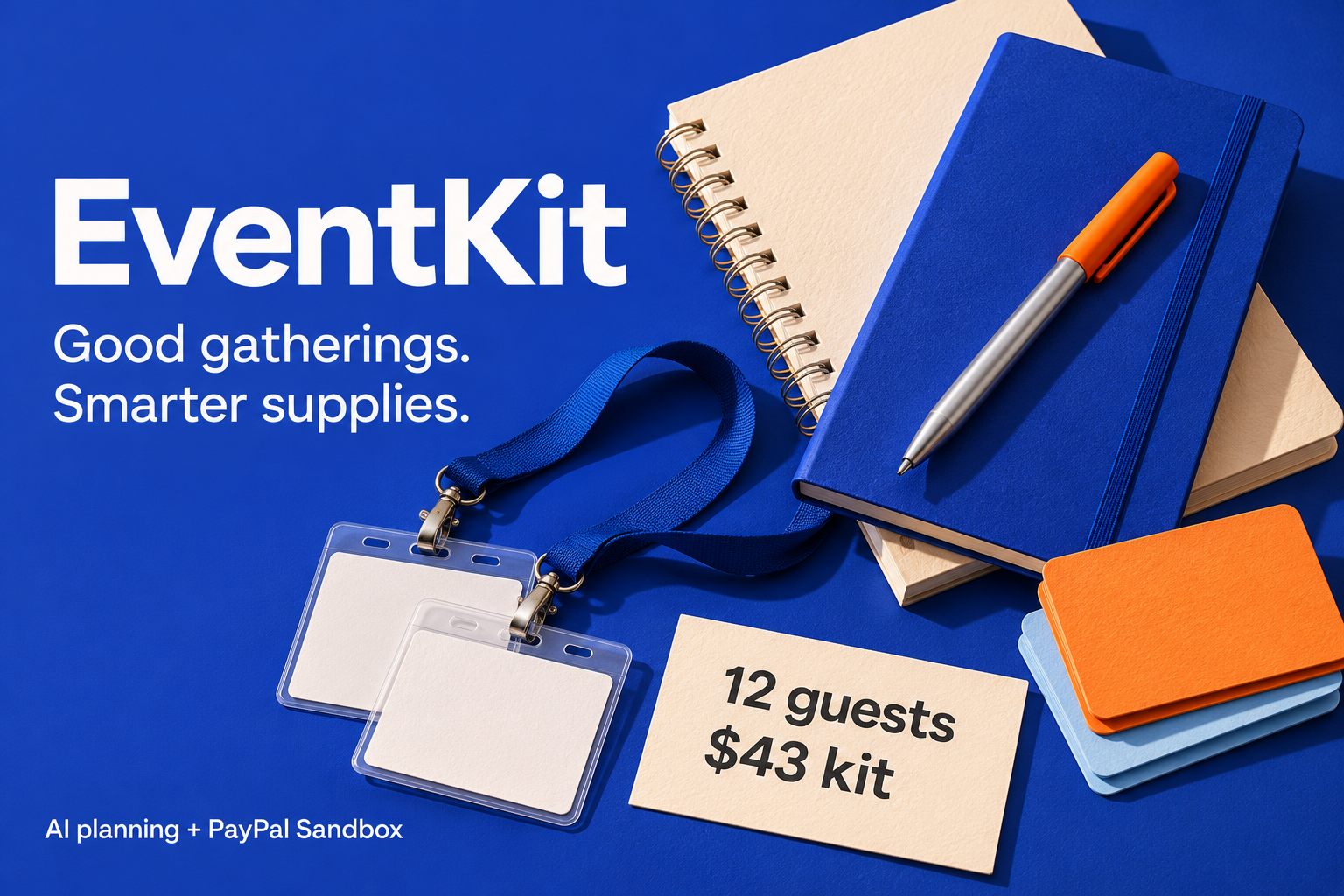
EventKit: Good gatherings. Smarter supplies.
Inspiration
Small gatherings create meaningful connections, but organizing them comes with a surprisingly detailed shopping list. Someone has to count guests, compare pack sizes, remember the essentials, and start again when the budget changes.
EventKit began with a simple question: could an organizer describe the gathering they want, receive a practical supply kit, and move into checkout while keeping control over every purchase?
What it does
EventKit turns a natural-language event brief into a budget-aware supply kit. Organizers enter their guest count, budget, and preferences, including whether to exclude food and drinks. Gemini selects products from a curated catalog and explains the proposed quantities and choices.
Organizers can refine the brief, lower the budget, or adjust pack quantities. EventKit recalculates the total, presents an itemized review, and requires explicit approval before PayPal Sandbox checkout. A completed, verified payment produces a downloadable JSON receipt.
How we built it
We built the frontend with HTML, CSS, and JavaScript, including a responsive landing page and original SVG product illustrations. The backend uses Node.js with no external npm runtime dependencies.
Gemini receives the brief and catalog through a server-side API call and returns structured JSON. The server validates product identifiers, integer pack quantities, quantity limits, food exclusions, and the overall budget. Prices come from the catalog and are calculated in integer cents rather than trusted from model output.
PayPal's JavaScript SDK handles the checkout interface. The backend uses the Orders v2 API to create and capture orders. It verifies the order identity, completed capture, exact amount, and currency before marking a kit paid. Stable request IDs and checkout serialization help prevent duplicate processing; interrupted payments can be checked again.
Challenges we ran into
The main challenge was connecting flexible AI suggestions to strict purchasing rules. A plausible recommendation is not enough: pack sizes, prices, and budget limits must remain consistent. We separated the model's recommendations from server-controlled validation and kept organizer review as an explicit step.
We also encountered temporary model-service failures and configuration issues during integration. We added bounded retries and clear errors. Missing AI access never silently turns a preset into a supposedly generated result.
Accomplishments we're proud of
In a tested 12-person meetup scenario, an initial kit cost USD 79 with a budget of USD 80. Reducing the budget to USD 60 prompted Gemini to replace hardcover notebooks with pocket notebooks. The revised kit cost USD 43, still providing a notebook, pen, and name badge for every guest, plus shared markers and conversation cards.
We also verified a completed USD 43 PayPal Sandbox checkout and receipt download. Twelve automated tests passed, covering catalog and budget constraints, AI failure handling, payment verification, and checkout behavior.
What we learned
Useful AI commerce needs both adaptability and accountability. AI can interpret intent and propose tradeoffs; deterministic validation protects purchasing constraints; people decide whether the result meets their needs. Testing the real Sandbox flow was essential alongside automated tests.
What's next for EventKit
The current prototype uses one illustrative supplier, 16 products, USD pricing, and Sandbox payments. It does not reserve real inventory or fulfill orders.
Next, we want to connect a merchant's live catalog, improve coverage checks for guest requirements, and add durable hosted storage and webhook-based payment reconciliation.
Development assistance: OpenAI Codex. Runtime planning: Google Gemini. Payments: PayPal Sandbox. Project cover: OpenAI ImageGen.
