-
-
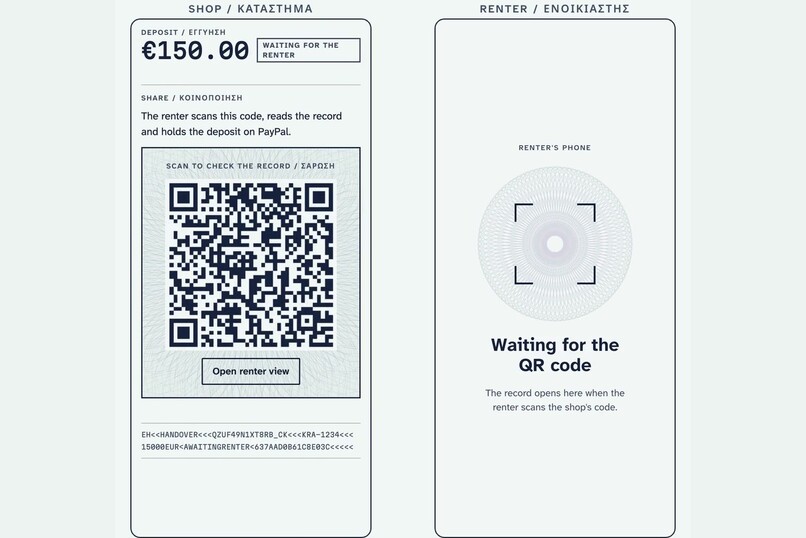
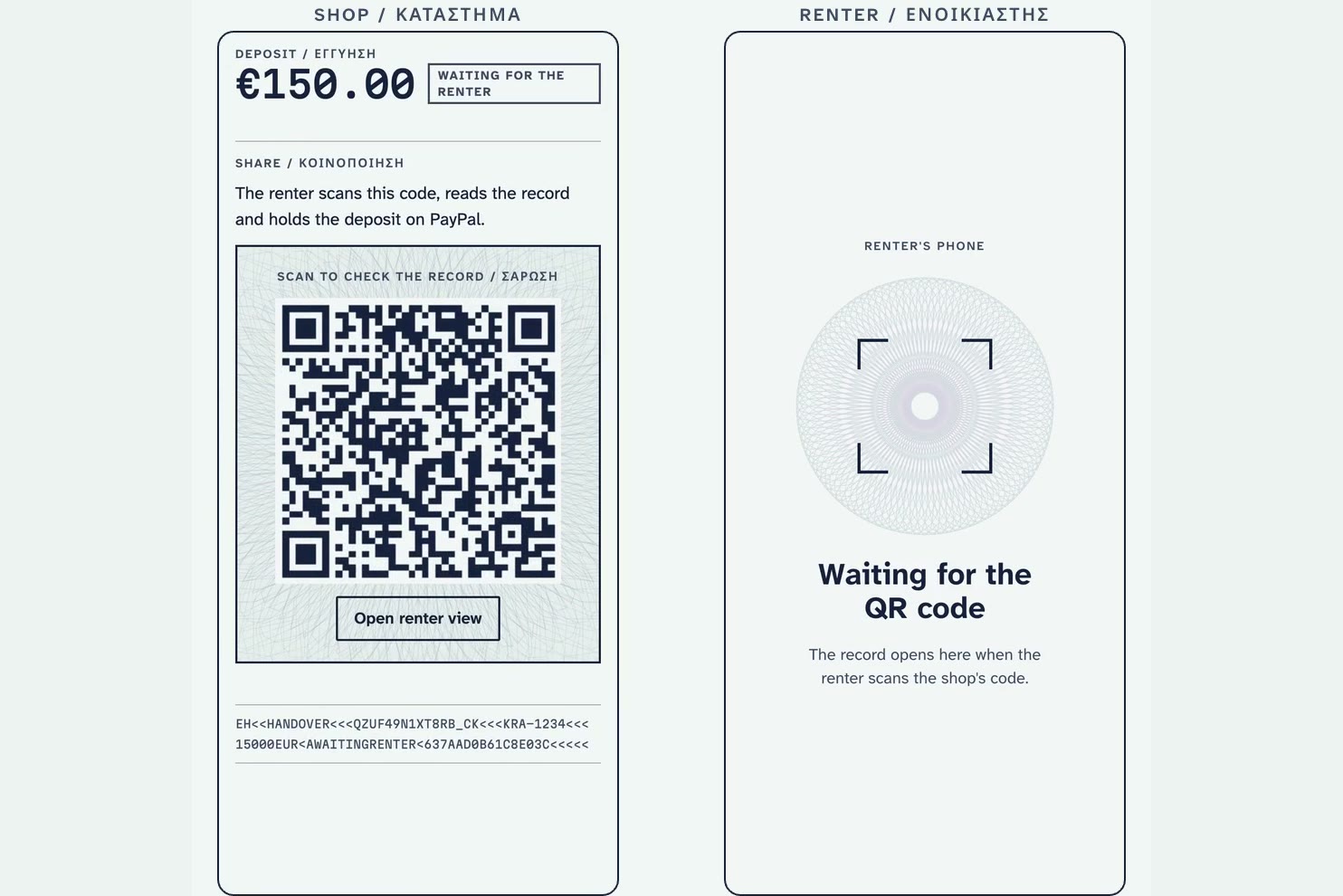
Pickup: the renter scans the shop's QR code, checks the condition record and approves a PayPal hold.
-
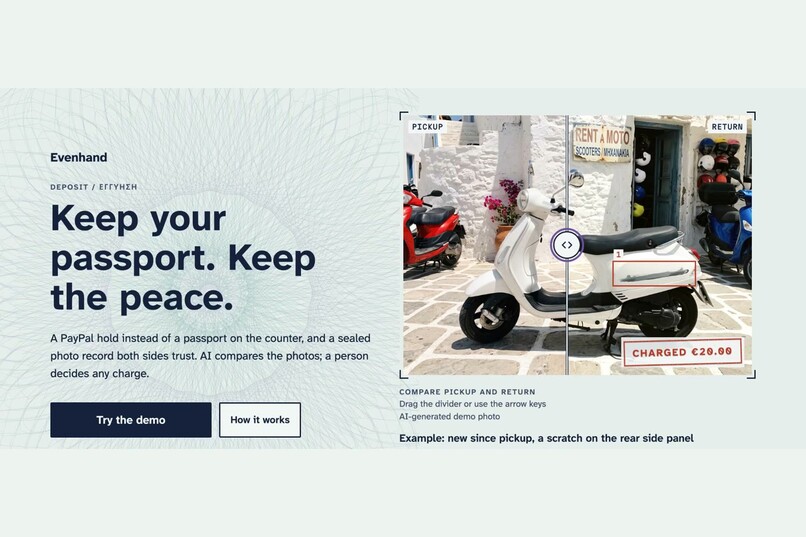
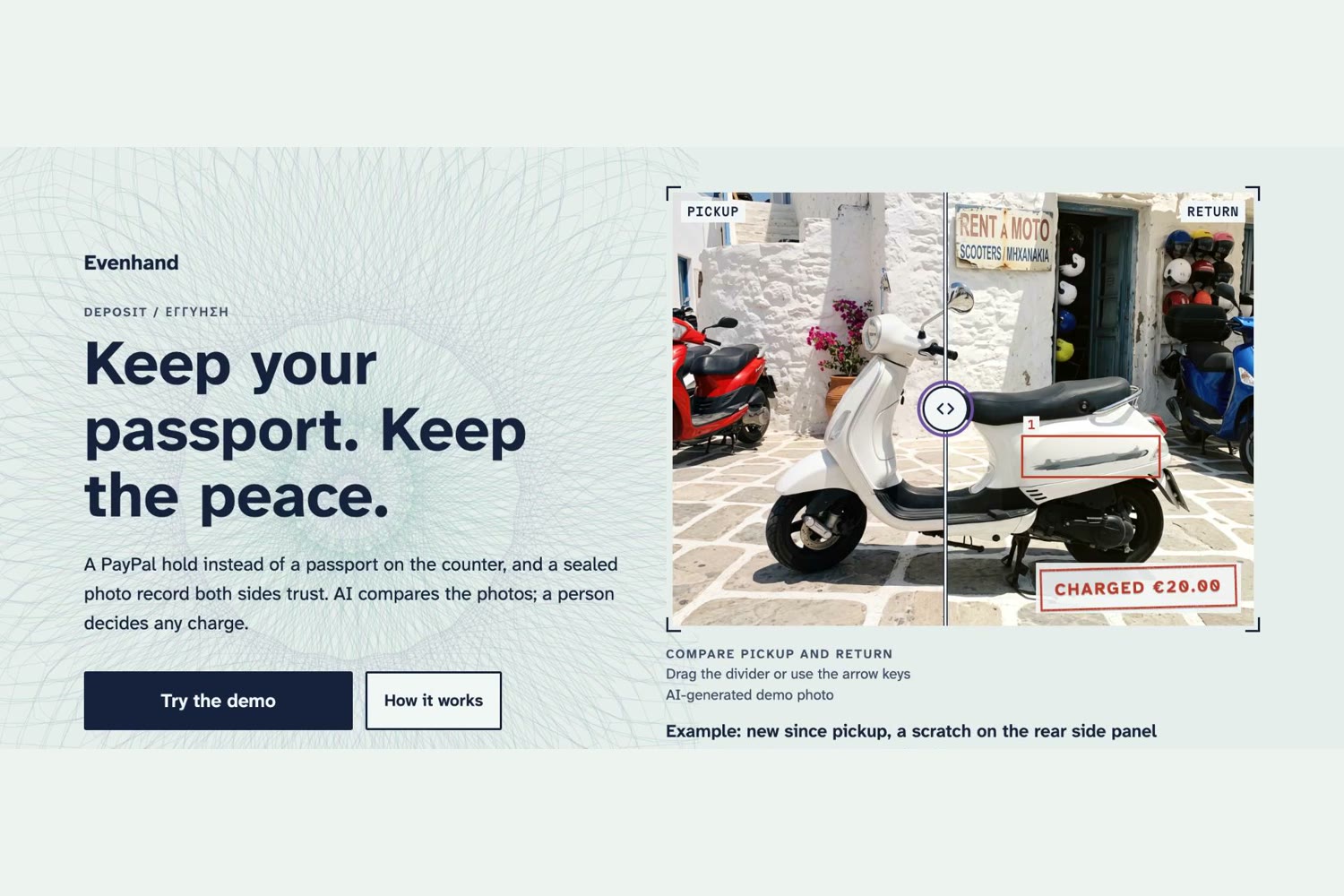
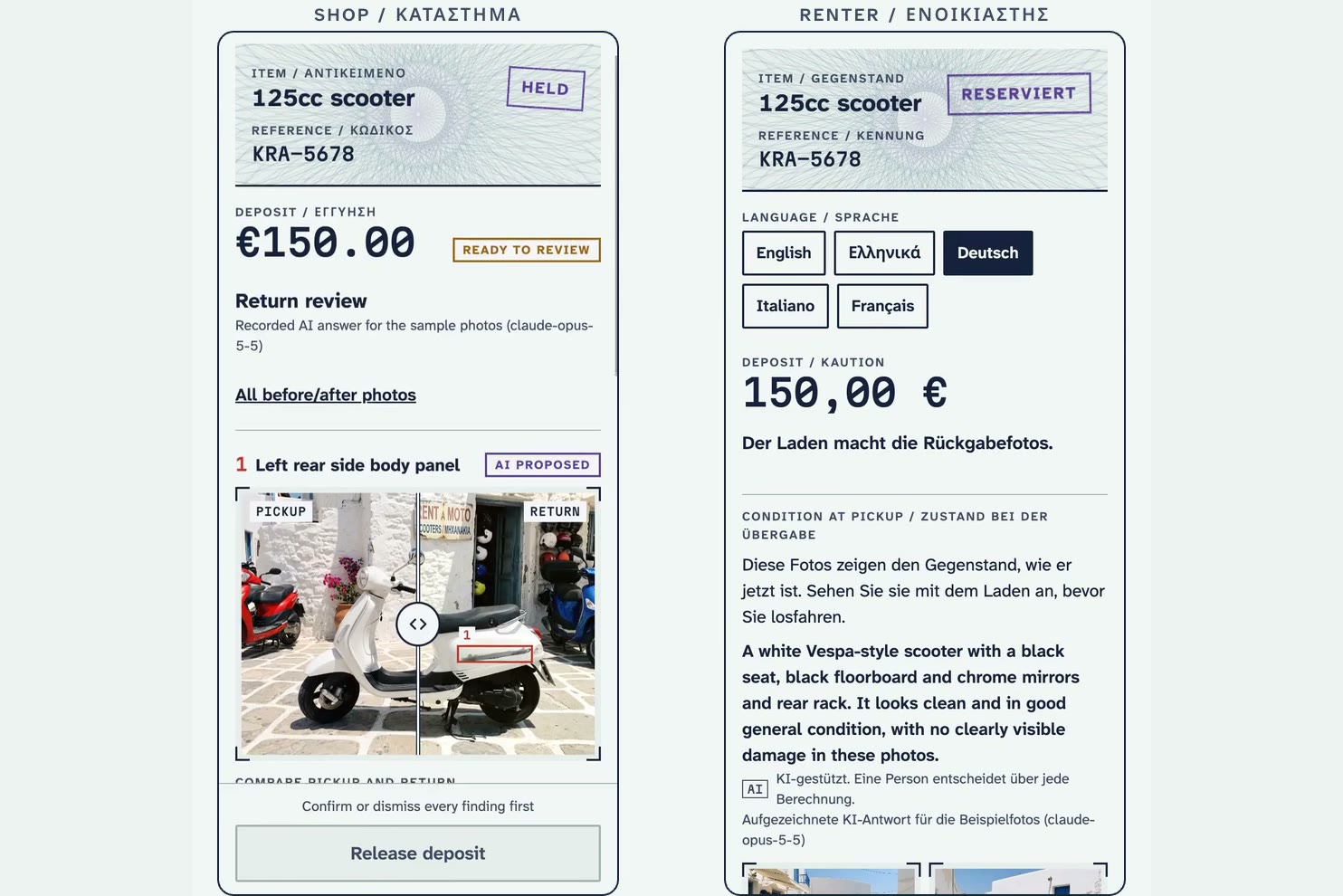
A PayPal hold instead of a passport on the counter, and a before/after photo slider. AI-generated demo photo.
-
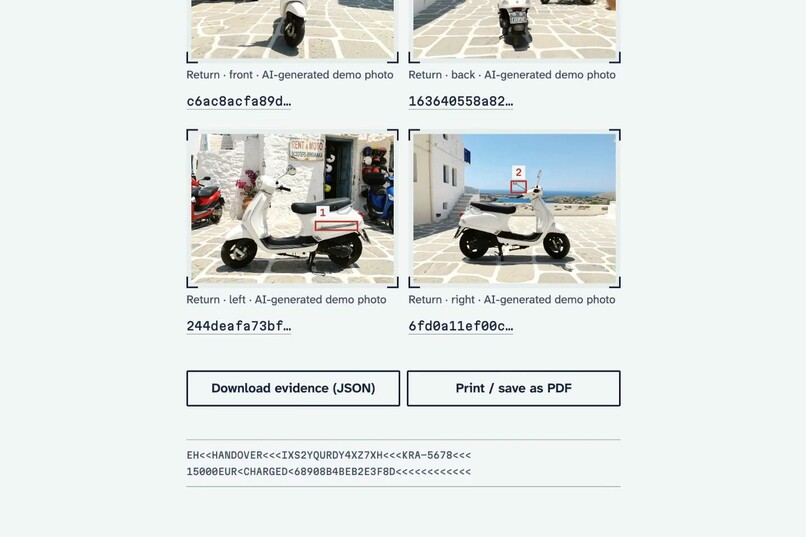
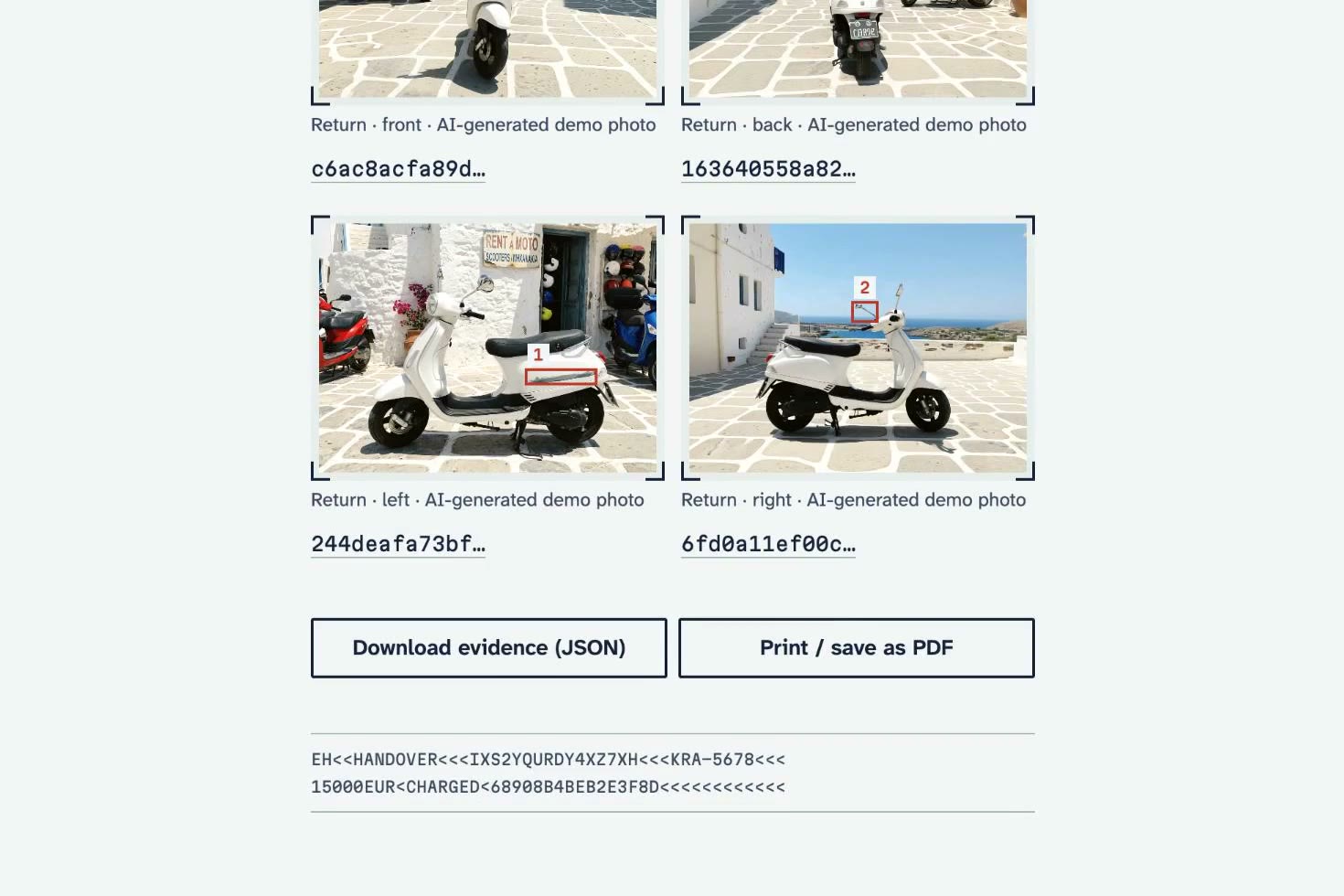
The sealed record: fingerprinted photos, an evidence download, and a machine-readable strip built from the record.
-
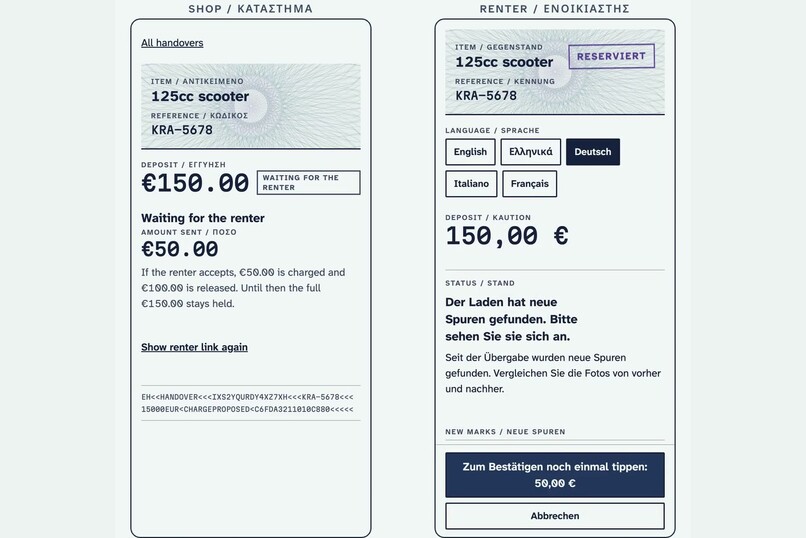
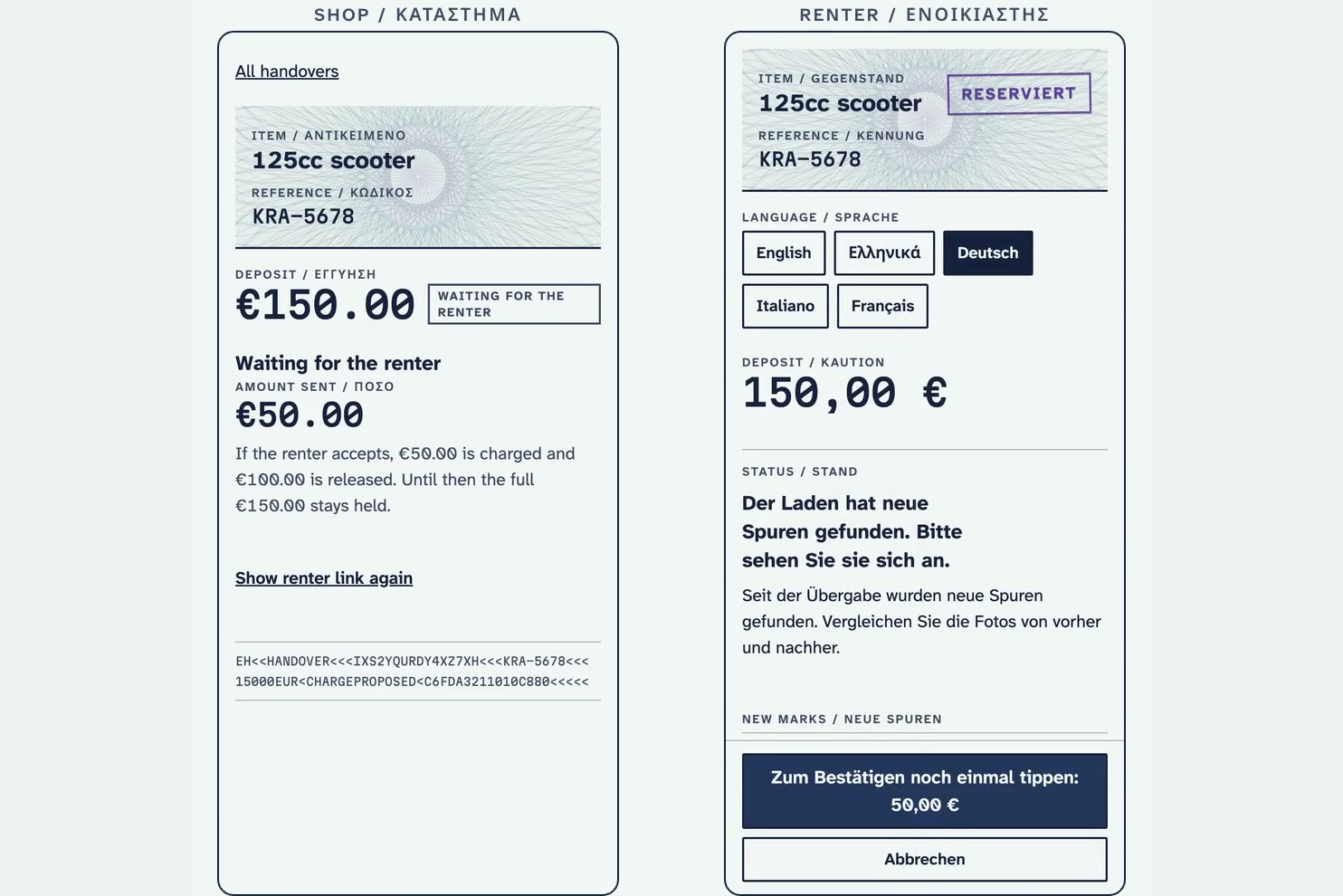
Settle: the renter taps twice to accept €50. PayPal captures that amount and releases the rest of the hold.
-
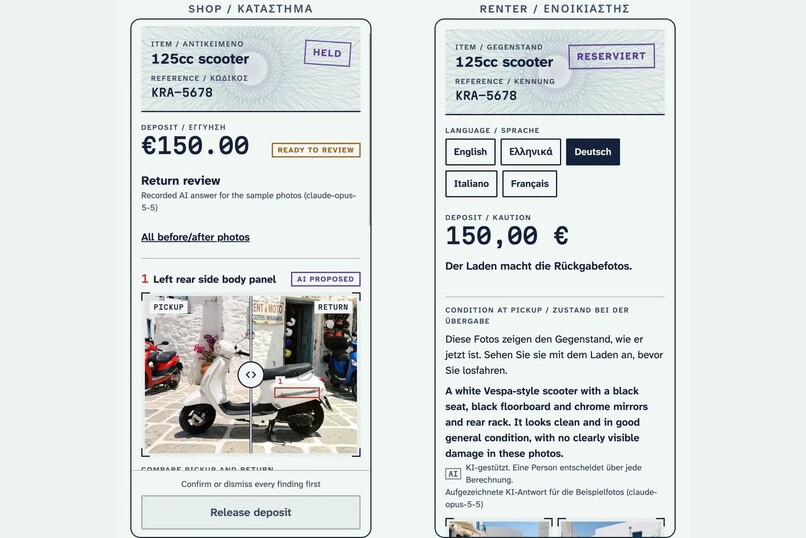
Return: AI lists only new damage, matched to the shop's own price list. The shop confirms each finding.
Inspiration
On Greek islands, in Thailand and across southern Europe, scooter and bike rentals still ask for "cash, card or passport" as the deposit. Many renters hand over the passport, because it is the easiest option.
The UK government tells travellers to Greece not to hand over a passport as a deposit. Travel guides warn about shops that keep the passport and then charge for damage that was already there. And shops have the opposite problem: real damage that renters deny, with no proof either way.
Both sides want the same thing: to agree that there was no damage, or to prove the damage that is there. Nobody gives them a neutral witness at the counter. So we built one.
What it does
Evenhand replaces the passport on the counter with a PayPal hold, and the return argument with one sealed photo record that both sides see.
- Pickup. The shop photographs the item from four sides. Claude checks each photo is usable and records the item's condition and any marks already there. The renter scans a QR code, sees the same record and the shop's damage price list on their own phone, in their own language (English, Greek, German, Italian or French), and approves a PayPal hold for the deposit. No money moves. The passport stays in the renter's pocket.
- Return. The shop photographs the same four sides. Claude compares pickup and return and lists only new damage, each with before and after photos, a plain explanation, its confidence, and the matching line from the shop's own price list.
- Settle. No new damage: the shop releases the hold on the spot (PayPal void). New damage: the shop checks the findings and sends them to the renter. The renter accepts (PayPal captures only that amount and releases the rest) or disagrees (nothing is captured, the hold stays, and both sides keep the same evidence for a person to decide).
The AI never moves money and never sets a price. Every release needs the shop's tap, and every charge needs the renter's tap on their own phone: the renter's phone is bound to the record when they confirm it, so another device with the same link can only read.
Every photo is fingerprinted (SHA-256) and every step is sealed to the one before it, so neither side can quietly change the story. The shop gets a holds dashboard (AG Grid) with every hold, what was charged and what was released.
How we built it
- PayPal (sandbox), Orders v2 with
intent: AUTHORIZE: create order, the renter approves with the PayPal JavaScript SDK button, authorize, then either void (clean return) or partial capture withfinal_capture: true(accepted damage, the rest released). For rentals longer than PayPal's 3-day honor period the app reauthorizes from the original authorization and voids the parent on release (tested against a fake gateway; a short demo never reaches day 4); the dashboard tracks the 29-day validity. Every PayPal call carries aPayPal-Request-Ididempotency key, so a retry can never capture twice. - Claude Opus 5.5 (
claude-opus-5-5, Anthropic API) does three jobs with structured JSON outputs validated by schemas: (1) a photo check at low effort, (2) the condition record at medium effort, (3) the pickup-versus-return comparison at high effort. Anything below 0.75 confidence becomes "needs a human look" instead of a charge. Light and angle changes are explicitly not damage. Prices come only from the shop's list, never from the model. On the bundled sample photos the demo replays Claude's answers recorded once for those exact photos (labelled as recorded), so every judge sees the same result at no cost; photos taken with a camera go to Claude live, within per-shop and per-visitor limits. - Human oversight by design: the shop confirms or removes each finding, the proposal is frozen when sent, and only the renter's tap captures money.
- Sealed record: an append-only event log where each event includes the SHA-256 hash of the one before, plus photo fingerprints. The record page re-checks the chain and shows RECORD INTACT.
- App: Next.js 16 (App Router), React 19, TypeScript, Tailwind CSS 4, zod, Vercel Blob for photos and records, AG Grid Community for the holds dashboard.
- Design: a "passport security printing" look: guilloche rosettes generated in code, visa-style stamps for every money state, bilingual field labels, and a machine-readable strip built from real record data. High contrast for a phone in island sunshine.
- Quality: 670+ unit and integration tests (Vitest), end-to-end browser tests (Playwright), a full code review and a design review before release, and a pre-deploy security check (CSP with a per-request nonce, HSTS, no secrets in the client).
Challenges we ran into
- False damage. Two photos of the same scooter never match exactly. The comparison reports only marks it is confident are new, reports each damage once even when several photos show it, and sends anything uncertain to a person instead of to the price list.
- Money safety under races. Two taps, two tabs or a retry must never capture twice or capture after a release. Every money step is checked against the record's current state and carries an idempotency key.
- Trust from both sides. A deposit tool can easily feel like a new way for shops to squeeze renters. The renter sees exactly the same evidence, sees the price list before agreeing, and nothing is charged without their tap. A link alone is not enough: the renter's phone is bound when they confirm the record, so the shop cannot accept a charge on the renter's behalf.
Accomplishments that we're proud of
- A real money flow on PayPal's sandbox, all from one record, verified on the live site: an authorized hold, a void for a clean return, and a partial capture of exactly the agreed amount with the rest released. The demo video was recorded from these real sandbox runs.
- The AI does real work, but every charge stays a human decision, and every AI result is labelled (EU AI Act Article 50).
- A design that looks like a document both sides can trust, not like another fintech dashboard.
What we learned
PayPal's authorization model already fits deposits very well: reserve now, capture part later, release the rest. What was missing was the evidence both sides need before anyone captures anything.
What's next for Evenhand
- Attach the sealed evidence pack to real PayPal disputes through the Disputes API.
- Live payments with a marketplace setup, so many shops can receive holds.
- Offline capture and video walk-arounds.
- The same flow for libraries of things, schools lending instruments and laptops, camera and lens rentals, hosts lending bikes, and neighbours lending tools.
AI tools used
- Inside the app: Claude Opus 5.5 (
claude-opus-5-5) through the Anthropic API: photo checks, condition records and before/after comparison. The app labels every AI-assisted result and states that a person decides any charge. - To build the app: Claude Code (Claude Opus 5.5) wrote most of the code and documentation under Akind's direction, with the Impeccable design skill for design review.
- Media: the demo scooter photos, the video's narration voice and its music are AI-generated (Magnific; ElevenLabs via Magnific). They are labelled as such.
Try it
- Live demo: https://evenhand-one.vercel.app (PayPal sandbox buyer login in the README)
- Source: https://github.com/akind27/evenhand (MIT)
Built With
- ag-grid
- anthropic
- claude
- next.js
- paypal
- react
- tailwindcss
- typescript
- vercel
