
Inspiration
Walking home late at night, waiting at a bus stop, or sending kids off to school, safety is always in the back of people’s minds. Yet the tools we rely on today are reactive. Registries exist, but they only help if you search them. Parents often worry about strangers, but most decisions are based on gut feelings that can be wrong. We wanted to flip the script. Instead of reacting after something happens, what if technology could quietly stand guard and warn us before danger strikes? That idea became EVADE.
What it does
EVADE is a personal guardian you wear on your face.
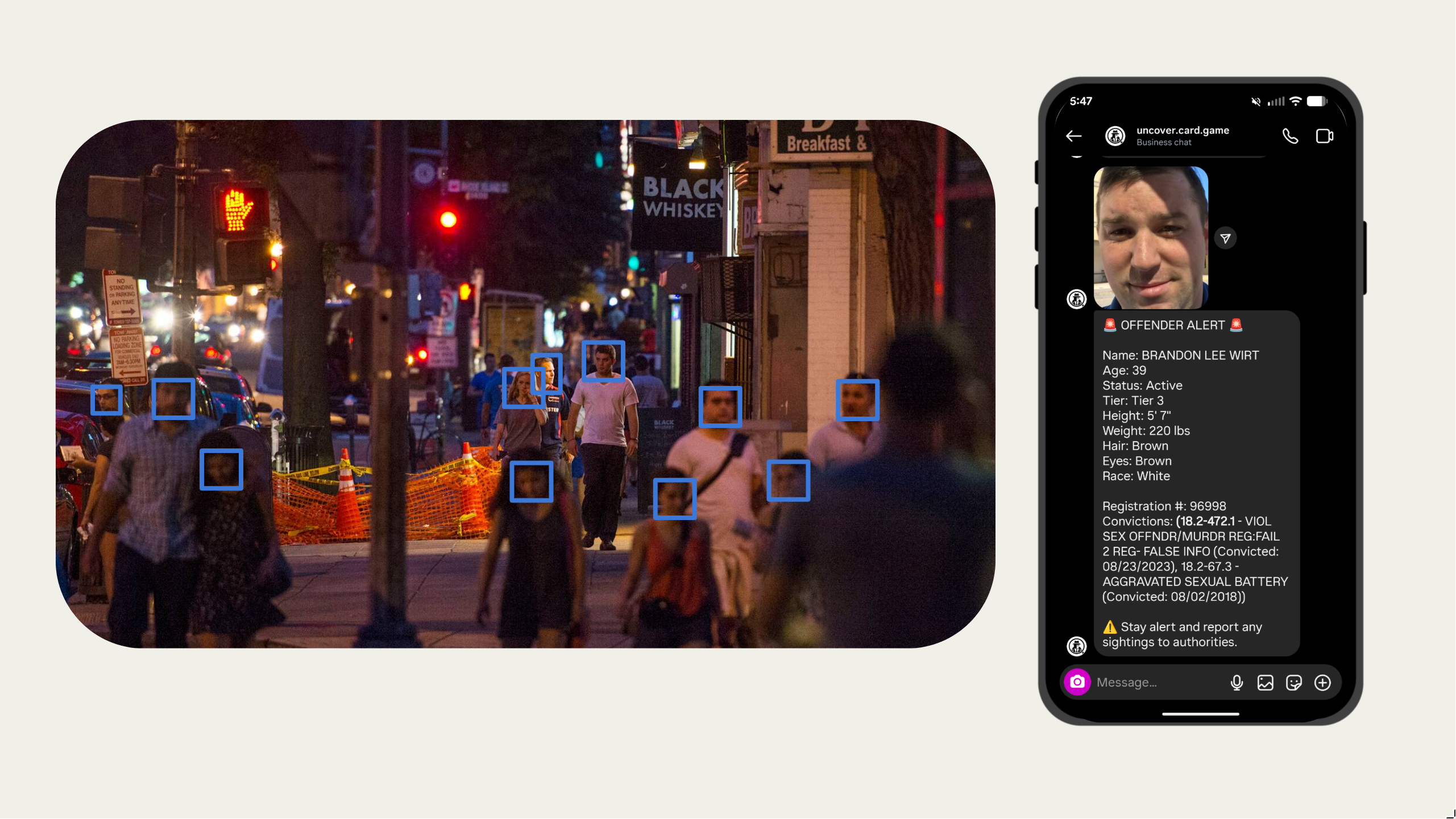
- Adult Mode: While wearing Meta smart glasses, EVADE scans the crowd around you. If someone matches a registered sex offender, you get an instant alert with their photo, conviction history, and risk level.
- Kid Mode: In addition to all the features from Adult Mode, EVADE listens to the last 30 seconds of conversation and looks for warning signs of danger or grooming. If something feels off, parents get a notification right away with context and location.
EVADE gives people peace of mind, replacing fear and bias with real information and creating a safety net.
How we built it
- Hardware: Meta Ray-Ban smart glasses capture live video and audio, acting as the eyes and ears of EVADE.
- Vision AI: We used Mediapipe for fast on-device face detection and ArcFace for recognition. To speed up matching, we pre-embedded the entire sex offender registry into vector space for instant similarity search instead of scanning raw images.
- Audio AI (Kid Mode): A lightweight NLP model analyzes the last 30 seconds of conversation, using semantic understanding to detect risky or predatory language patterns.
- Backend: A Python/Flask API powered by ONNXRuntime runs AI inference, keeps offender data updated, and coordinates alerts.
- Mobile App: Built as a React PWA, the app lets users configure modes, manage accounts, receive safety alerts, and share GPS location when needed.
- Notifications: Beyond standard push alerts, we integrated the Instagram API to deliver real-time direct messages, ensuring parents and guardians get notified immediately.
Challenges we ran into
- Making face recognition fast enough to run on wearable hardware.
- Prompt-engineering an AI model to catch danger in conversations without constant false alarms.
- Balancing privacy with safety — deciding what data stays on-device and what needs to be processed.
- Working with early, still-limited APIs for the smart glasses.
Accomplishments that we're proud of
- Built a working prototype that recognizes offenders in real time.
- Proved we could analyze live conversations and flag danger for kids.
- Designed an end-to-end system: glasses → AI → mobile app → instant alert.
- Took a bold idea of proactive personal safety and made it real.
What we learned
- Building for safety is different from building for convenience — every design choice has ethical weight, from how we store data to how we notify users.
- Optimization matters. Running AI models in real time on wearable hardware forced us to streamline everything, from vector search to NLP inference.
- The value of preprocessing. Pre-embedding offender registries into vectors cut search times dramatically and made the system usable.
- Integrating multiple platforms (smart glasses, backend APIs, React app, Instagram messaging) taught us how to connect very different ecosystems into one seamless flow.
What's next for EVADE
We want to make EVADE smarter and more protective:
- Broaden Kid Mode to detect grooming, manipulation, and distress signals.
- Integrate Amber Alerts so the community can help locate missing children faster.
- Refine on-device AI to make it quicker and more private.
- Pilot EVADE with parents and safety groups to get real-world feedback.
Built With
- arcface
- fastapi
- flask
- javascript
- mediapipe
- onnxrruntime
- pinecone
- python
- react
- typescript
- webscrapping


Log in or sign up for Devpost to join the conversation.