-
-
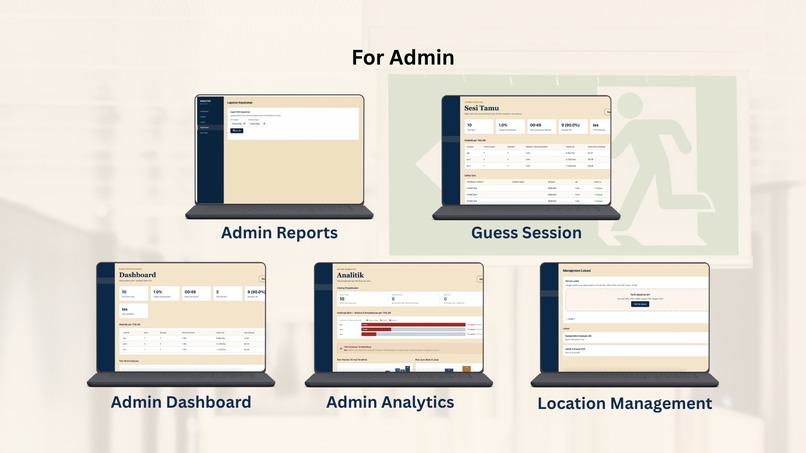
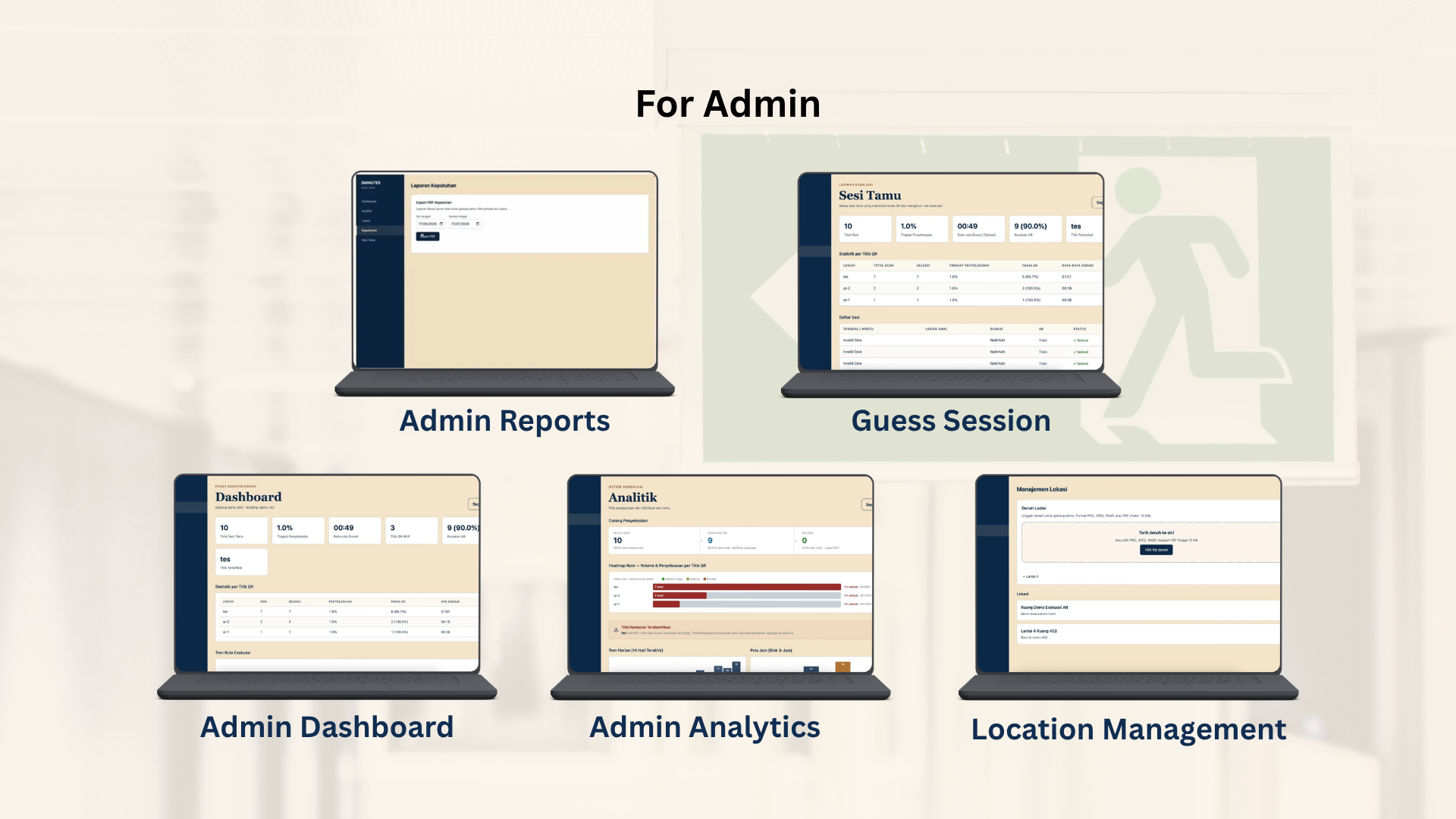
Administrator Web
-
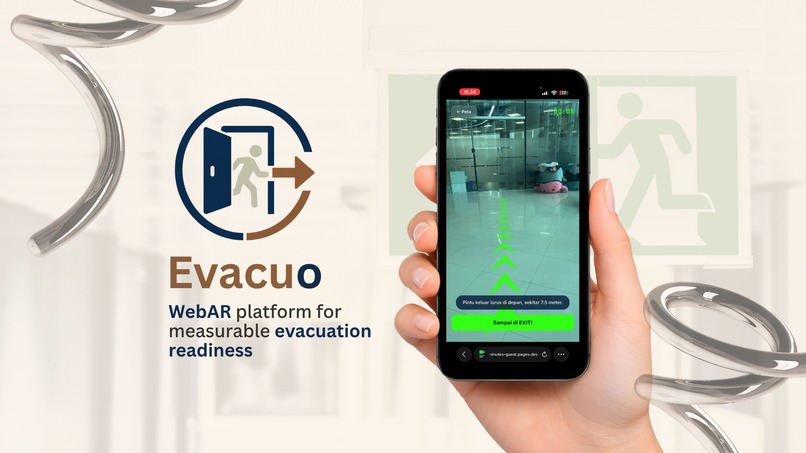
Thumbnail
-
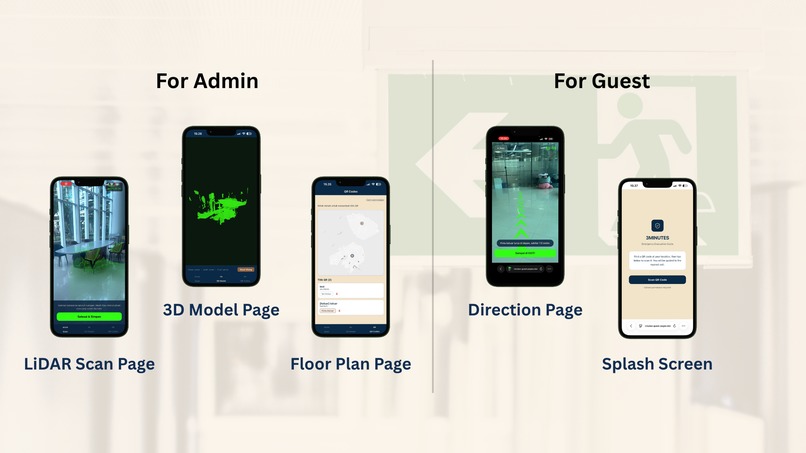
Administrator and Guest WebAR
Inspiration
Indonesia ranks as the third most disaster-prone country in the world according to the WorldRiskIndex 2022, highlighting the importance of effective emergency preparedness. During the Garuda Hacks Opening Ceremony, we watched safety induction videos about earthquakes, fires, and evacuation procedures. What caught our attention was not only the content itself, but also how many people were distracted, scrolling through their phones or paying little attention, despite the fact that these briefings could one day save their lives.
This observation encouraged us to explore how emergency preparedness is implemented in real organizations. Through interviews and research, we found that emergency preparedness practices vary significantly. Some companies conduct regular evacuation drills, while others rely solely on passive methods such as videos, presentations, or static evacuation maps. Although Indonesian regulations encourage organizations to implement occupational health and safety programs, evaluating whether employees are actually prepared to evacuate remains difficult and inconsistent.
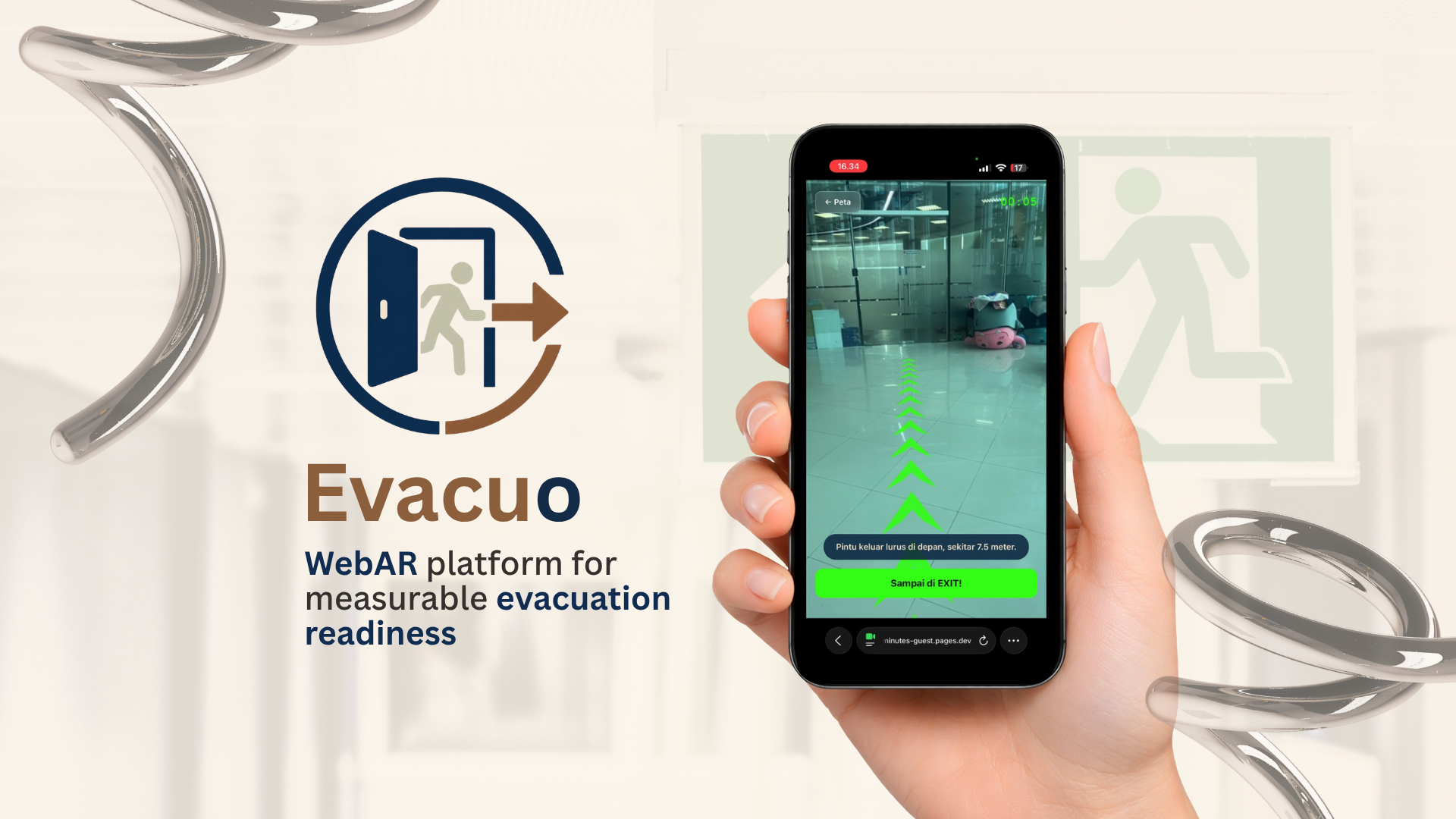
These findings inspired us to create Evacuo, a WebAR based evacuation readiness platform that transforms emergency preparedness into an interactive and measurable experience. While primarily designed for organizations and workplaces, Evacuo is also adaptable to other environments such as universities, hospitals, and public buildings where evacuation preparedness is equally critical.
What it does
Evacuo is a WebAR based evacuation readiness platform primarily designed for organizations and workplaces, with the flexibility to be adopted in other environments such as universities, hospitals, and public buildings. It combines interactive evacuation guidance with behavioral analytics to improve emergency preparedness.
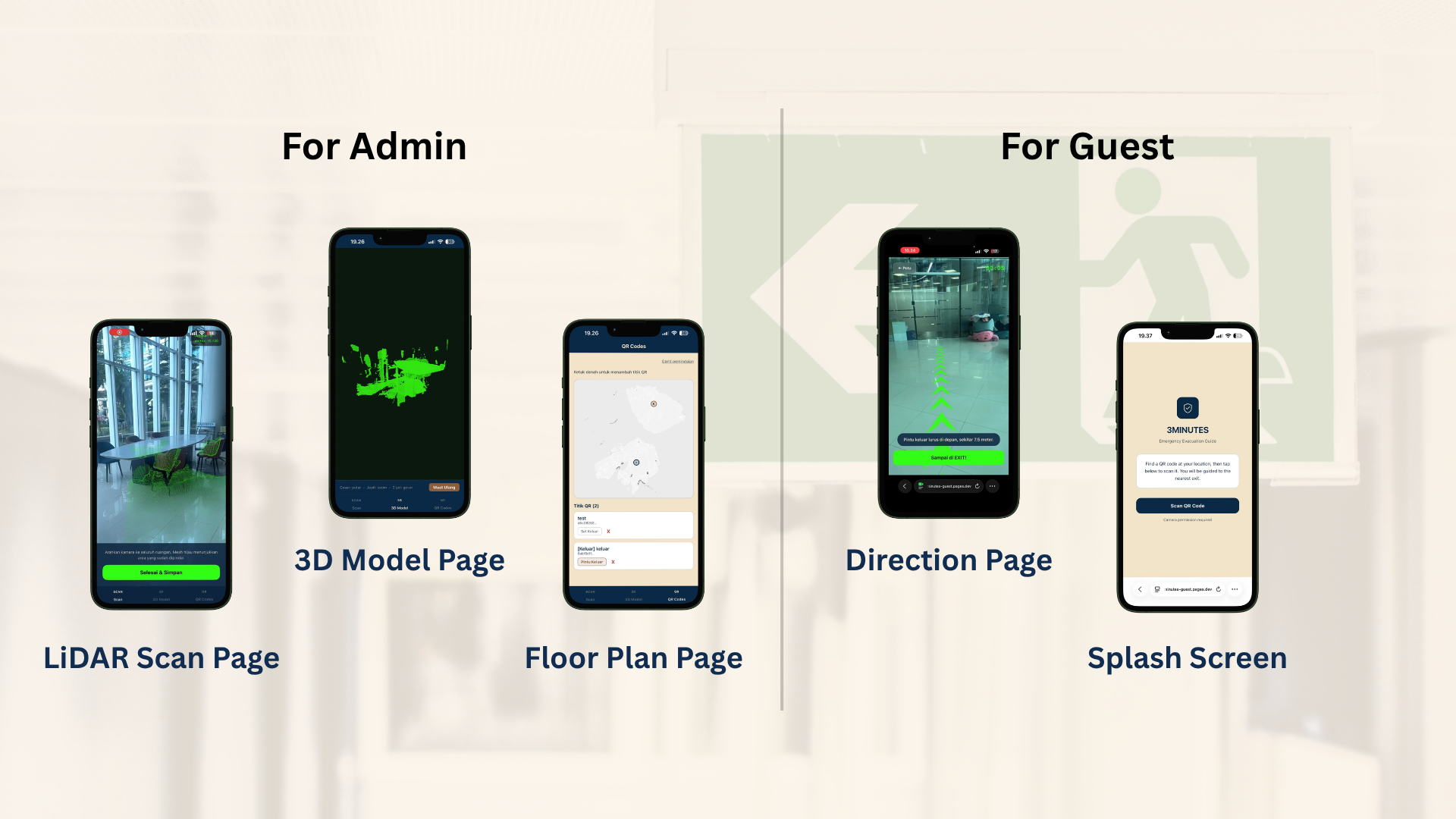
The system begins with an administrator scanning a building using LiDAR supported mapping technology to create a digital representation of evacuation routes, exits, and QR code locations. Administrators can then define evacuation paths, safe assembly points, and training checkpoints through an intuitive management dashboard.
Occupants simply scan nearby QR codes using their smartphones without installing any application. They can choose between two training modes.
Exploration Mode allows users to independently learn the nearest evacuation routes and become familiar with the building layout.
AR Guidance Mode overlays real time directional guidance through WebAR, helping users navigate toward the nearest safe exit during both training sessions and real emergencies.
Throughout every interaction, Evacuo records behavioral data such as navigation accuracy, completion time, wrong turns, guidance requests, and route preferences. These insights are visualized in an analytics dashboard that enables safety managers and Health, Safety, and Environment (HSE) teams to evaluate evacuation readiness, identify confusing areas, improve evacuation planning, and export reports to support internal documentation and regulatory reporting.
By making evacuation training interactive, measurable, and accessible through any mobile browser, Evacuo helps organizations improve workplace safety while reducing the operational costs associated with traditional evacuation training methods. At the same time, its flexible architecture allows the platform to be adapted to other facilities that require structured evacuation preparedness.
How we built it
We developed Evacuo using a Design Thinking approach to ensure that the solution addressed real challenges rather than assumptions.
During the Empathize stage, we interviewed employees from several companies across different industries. Their experiences revealed that emergency preparedness programs vary considerably. Some organizations conduct comprehensive evacuation drills, while others only provide passive learning materials, and some offer little to no evacuation training at all.
In the Define stage, we identified a common challenge. Organizations are able to provide emergency preparedness programs, but they lack objective ways to evaluate whether employees are truly prepared to evacuate. We also studied occupational safety regulations and emergency preparedness guidelines to better understand existing practices and identify opportunities for improvement.
During Ideation, we refined our concept through continuous mentoring sessions and discussions. Feedback from mentors helped us narrow our scope from a broad disaster preparedness platform into a focused B2B solution that addresses evacuation readiness inside buildings while remaining adaptable to other environments in the future.
The implementation combined several technologies, including WebAR, LiDAR based building mapping, a web based analytics dashboard, cloud services for data management and reporting, and AI assisted workflows that accelerated rapid prototyping, interface iteration, and feature exploration throughout the development process.
Although every major decision was made collaboratively, each team member took ownership of a specific domain. One focused on WebAR and LiDAR integration, another developed the analytics dashboard, another designed the overall user experience and interface, while another concentrated on business strategy, validation, and market positioning. We also leveraged AI tools throughout development to accelerate research, prototype iterations, and implementation, allowing us to spend more time validating ideas and refining the overall user experience rather than repetitive development tasks.
Challenges we ran into
One of our biggest challenges was defining the right product focus. Initially, we attempted to build solutions for multiple customer segments, including individual users, organizations, and government agencies. As a result, we were simultaneously developing multiple applications with different objectives, making it difficult to build a focused product.
Through mentoring, we realized that solving one problem exceptionally well would create more impact than trying to solve many problems at once. This insight led us to reposition Evacuo as a dedicated B2B evacuation readiness platform for organizations while ensuring the platform remains adaptable for other sectors in the future.
Another challenge was learning entirely new technologies. None of our team members had prior experience building WebAR applications or integrating spatial building mapping into a web platform. While AI tools accelerated our learning process and helped us explore unfamiliar technologies more efficiently, integrating those technologies into a reliable and usable product still required significant experimentation, testing, and iteration.
Finally, understanding the Health, Safety, and Environment domain required extensive research. Although we initially planned to interview HSE professionals, scheduling constraints prevented us from doing so during the hackathon. Instead, we interviewed employees from different companies to compare their emergency preparedness experiences and validate the inconsistencies we observed across organizations.
Accomplishments that we’re proud of
We are proud that Evacuo was built from a real problem rather than a technology driven idea. Starting from interviews and research, we transformed a common but often overlooked workplace issue into a practical solution that organizations can adopt.
We are also proud of successfully building a WebAR based evacuation platform despite having no previous experience with augmented reality technologies. Throughout the hackathon, we continuously learned, experimented, and adapted to transform our concept into a working prototype.
Beyond the technology itself, we focused on designing a solution that is practical, scalable, and inclusive. Because Evacuo runs directly from a web browser, users do not need to install an application, making adoption significantly easier across organizations while also enabling future deployment in other public facilities. We also designed the platform with future accessibility improvements in mind, ensuring that emergency preparedness can eventually benefit a wider range of users, including people with disabilities.
Most importantly, we believe Evacuo demonstrates how technology can improve workplace safety while providing organizations with measurable insights that were previously difficult to obtain.
What we learned
This project taught us far more than how to build software. We learned how to validate ideas through user research, transform qualitative feedback into product decisions, and balance technological innovation with real business value.
Technically, we explored WebAR, spatial mapping, and data visualization technologies that were completely new to our team. At the same time, we gained a much deeper understanding of occupational safety and emergency preparedness, an area we had previously overlooked despite its importance.
We also learned that building a meaningful product requires more than solving a technical problem. Through mentoring and continuous discussions, we realized that a successful solution must also be economically sustainable. Considering business models, operational feasibility, and long term adoption fundamentally changed the way we approach product development as future engineers.
Most importantly, this experience strengthened our collaboration as a team and reinforced our belief that technology should ultimately serve people by solving meaningful problems that improve everyday life.
What’s next for Evacuo
Our vision is for Evacuo to become a trusted evacuation readiness platform for organizations across Indonesia, helping create safer workplaces through continuous and measurable emergency preparedness.
Moving forward, we plan to expand the platform beyond earthquake evacuation by supporting additional emergency scenarios such as fires and other building emergencies. We also aim to strengthen the analytics dashboard with richer behavioral insights and standardized reporting that help organizations continuously improve their emergency preparedness programs.
Accessibility will remain one of our key priorities. We plan to introduce features such as text to speech guidance and voice assisted navigation to support visually impaired users, ensuring that emergency preparedness becomes more inclusive for everyone.
While our initial focus is helping organizations improve workplace safety, we envision Evacuo expanding to universities, hospitals, and other public facilities where effective evacuation preparedness is equally essential. Ultimately, we hope Evacuo can contribute to a future where buildings are not only compliant with safety regulations but are genuinely prepared to protect the people inside them through data driven evacuation planning, readiness evaluation, and continuous improvement.
Built With
- expo.io
- fastapi
- lidar
- postgresql
- python
- react
- react-native
- react-navigation
- sql-alchemy
- three.js
- typescript
- vite
- web-xr
- webgl

Log in or sign up for Devpost to join the conversation.