📌 Inspiration
In emergencies like fires, active shooters, or earthquakes, people often freeze, blindly follow others, or completely miss the nearest exit. Exit signs and drills frequently fail when panic sets in. That’s why we created an AI-powered evacuation assistant. This important tool guides people with real-time, personalized directions right when danger happens. It improves the capabilities of 911 by starting evacuation support immediately, even before emergency responders arrive. By turning every phone into a life-saving evacuation assistant, we help people escape when every second matters, and when finding the exit can mean the difference between life and death.
In major fire disasters like the Station Nightclub Fire, which resulted in 100 deaths, and the MGM Grand Hotel Fire, with 85 deaths, many victims died just feet from exits. They could not find their way out due to smoke, panic, and poor visibility. Many followed the crowd into bottlenecks while other exits remained unused. Case studies from NIST, NFPA, and FEMA show that confusion, not fire, is the main cause of death in these situations, especially when people encounter unfamiliar or blocked escape routes. Research indicates that over 70% of fire-related deaths happen during evacuation attempts. These real-world tragedies and research findings shaped our mission to create Evac AI, a real-time, voice-driven assistant that guides people to safety before first responders arrive.
🚀 What It Does
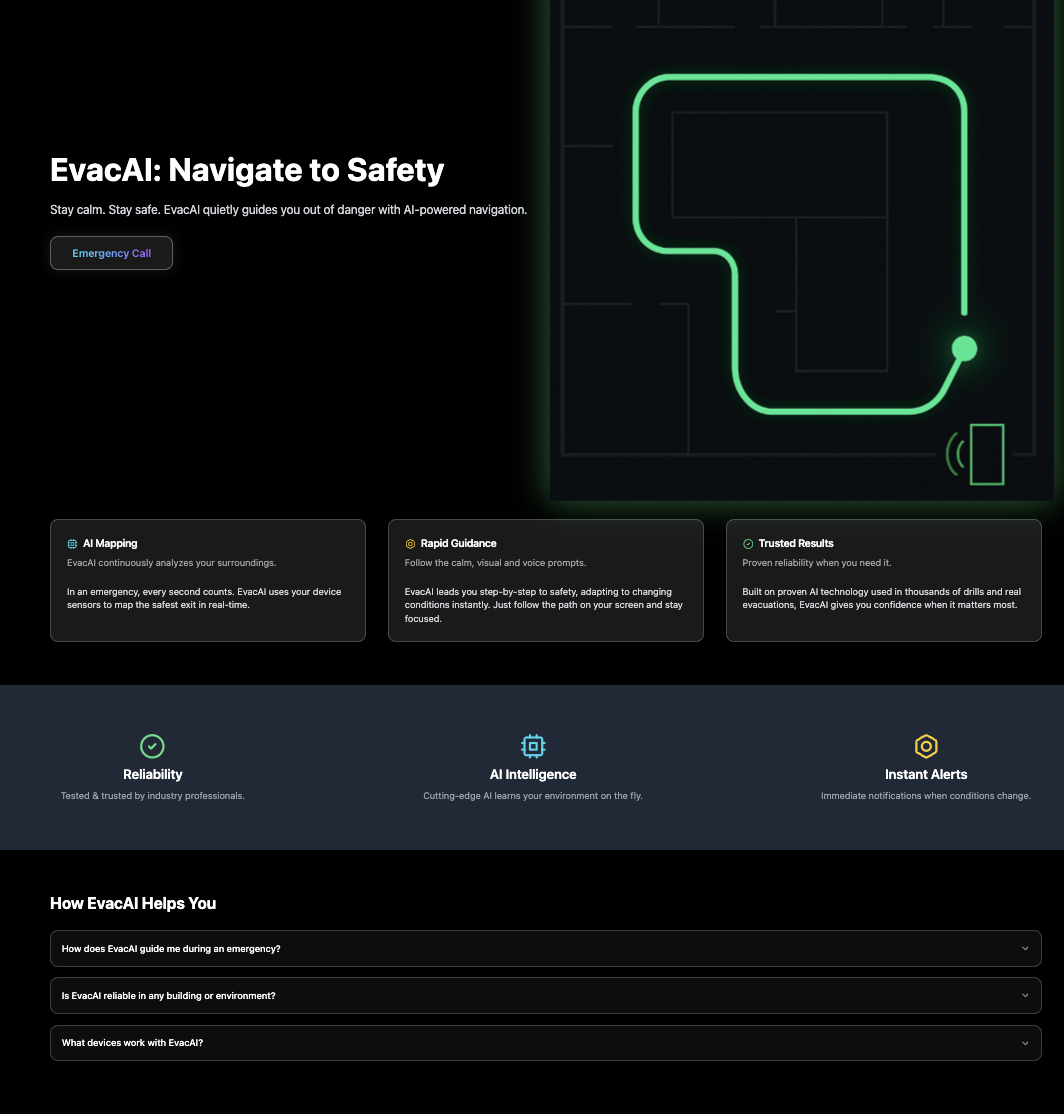
Evac AI is an AI-powered evacuation assistant that:
- Guides users to safety with real-time, turn-by-turn voice instructions.
- User can Talk to agent through call or web app.
- Calculates optimized paths based on indoor floor plans and updates them in real time.
- Communicates naturally with users using Vapi’s voice interface.
- Acts instantly — enhancing 911 by launching evacuation support before help arrives.
🛠️ How I Built It
- Frontend: Built using React for a unified web UI and backend.
- Styling: Tailwind CSS for a responsive, clean user interface.
- Backend/Agents: Python Fast API, Multi-agent coordination via CrewAI, defining roles for:
LayoutLoader– fetches building maps from SupabaseRoutePlanner– calculates safe routesThreatMonitor– listens for new hazards
- Database: Supabase for storing layout and threat data (in JSON).
- Voice Interface: Integrated Vapi for speech-to-text and TTS interaction.
- Pathfinding: Custom Dijkstra/DFS algorithm for node-to-node route calculation.
🧱 Challenges I Ran Into
- Coordinating real-time updates across voice, map, and backend logic.
- Mapping AI-calculated node paths to accurate visual floor coordinates.
- Handling conversational interruptions (e.g., a user reporting a new hazard mid-route).
- Simulating realistic emergency scenarios under a short hackathon timeframe.
🏆 Accomplishments That I'm Proud Of
- Built a voice-guided, map-aware evacuation assistant that works end-to-end.
- Created a rerouting mechanism triggered by live threat updates.
- Demonstrated how AI can take over in those critical minutes before 911 arrives.
- Combined advanced AI orchestration, real-time voice, and live map visualization in <2 hrs.
📚 What I Learned
- Learned how real-world disasters were exacerbated by poor evacuation awareness — not lack of exits.
- Gained deep insights from research on events like:
- Applied that research to engineer evacuation logic that addresses real behavioral patterns, like following crowds or freezing under stress.
- Learned to balance agent-based AI design (CrewAI) with reactive voice UX (Vapi) in a high-stakes context.
🔮 What’s Next for Evac AI
- Add multi-language and accessibility support (e.g., visual + haptic signals).
- Integrate with IoT sensors (fire alarms, CO detectors) for automated threat detection.
- Launch mobile-native apps with offline evacuation routing.
- Partner with emergency services to create a two-way bridge: responders send updates, Evac AI adjusts routes live.
- Conduct user testing in simulated drills to further validate behavioral models.
🔗 Demo & Access
- 🌐 Live Demo: evacai.vercel.app
- 📞 Voice Access (Vapi Integration): +1 (765) 234-1308
Call this number to experience Evac AI’s real-time voice-guided evacuation system in action.

Log in or sign up for Devpost to join the conversation.