Inspiration
Personal finance is one of the most common problems people face, yet most tools available today only show numbers—they don’t explain behavior or guide decisions. I realized that people don’t just need dashboards; they need intelligence and direction. At the same time, I had been learning about the rise of AI agents, DeFi, and autonomous systems, where software is evolving from passive tools into active decision-makers. This inspired me to rethink financial applications entirely: What if instead of tracking money, an AI could understand it and guide you daily like a personal advisor? This led to building an AI-powered financial assistant focused on behavior, insights, and actionable advice, starting with the simplest possible interaction: a chat.
What it does
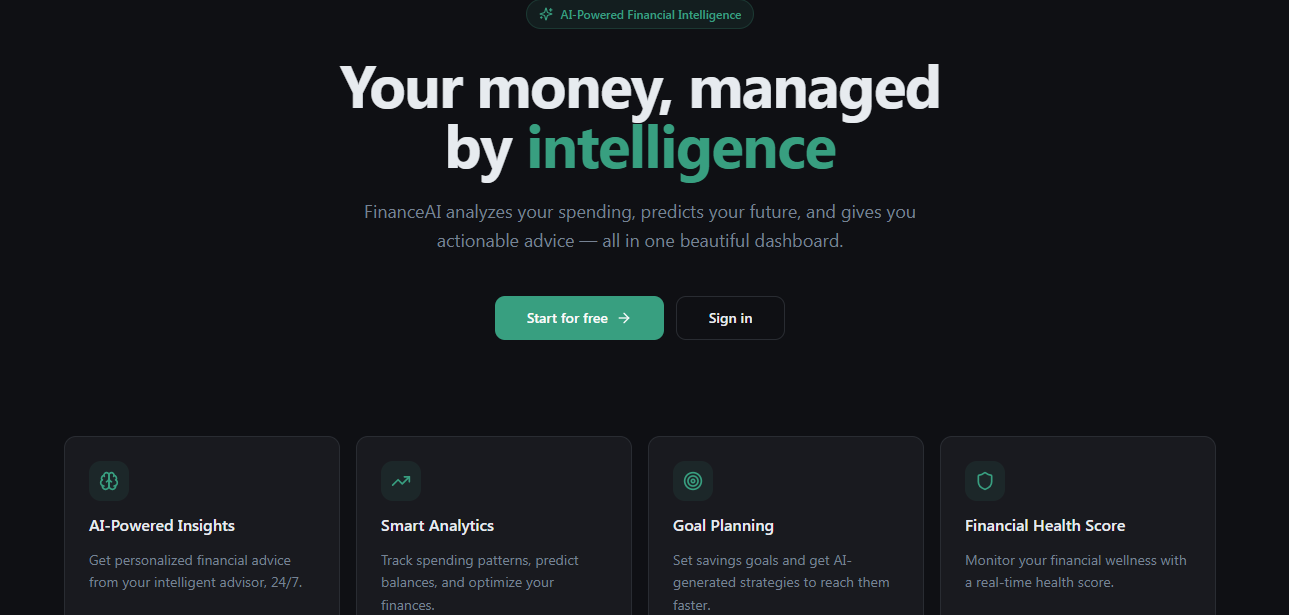
This project is an AI Financial Chat Advisor that helps users understand and improve their financial habits through simple daily interactions. Instead of connecting bank accounts (which requires trust and time), users can: Log daily spending in natural language Track subscriptions in one place Receive real-time insights and advice Get recommendations on what to cut, keep, or optimize Example: User input: “I spent $20 on food and $15 on transport today” AI response: “Food is your highest expense today. Reducing it slightly could improve your financial balance.”
How I built it
The project was built using a modern, scalable stack: Frontend: TypeScript-based interface for a smooth chat experience Backend: Cloud-based architecture for handling requests and logic Database: Supabase for storing user inputs and financial data AI Layer: Natural language processing for parsing and generating insights The system works in three main steps: Input Parsing → Converts natural language into structured financial data Analysis Engine → Detects patterns and spending behavior Advice Generation → Produces actionable recommendations
Challenges I ran into
- Making AI Advice Actually Useful It’s easy to generate generic responses, but much harder to produce practical, actionable insights. I had to refine prompts and logic to ensure the AI gives meaningful advice rather than obvious statements.
- Handling Unstructured Input Users describe spending in many different ways. Designing a system that reliably extracts categories and amounts from messy input was a key challenge.
- Balancing Simplicity and Intelligence I wanted the product to feel extremely simple (just chat), while still delivering deep insights. This required focusing heavily on core value instead of features.
- Trust & Adoption Since financial data is sensitive, I intentionally avoided bank integrations in the MVP. Instead, I focused on a manual, low-friction approach to build trust first.
Accomplishments that I am proud of
I am proud that I accomplished creating the MVP which does the baseic and core features: Key Features Conversational Finance Interface (chat-based UX) Natural Language Spending Input AI-Powered Expense Analysis Behavioral Pattern Detection Subscription Management + Optimization Smart Financial Advice & Recommendations Daily & Weekly Insights
What I learned
Simplicity is powerful—chat-based UX reduces friction significantly AI is only valuable if it leads to better decisions, not just outputs Financial behavior (habits) matters more than raw data Building trust is just as important as building features
What's next for eva
This project is the foundation of a much bigger idea: A Personal Financial Operating System powered by AI agents Future versions will include: Automated financial tracking Bank and wallet integrations Predictive financial modeling Autonomous financial agents capable of executing decisions
Built With
- cloud
- lovable
- supabase
- typescript

