The Problem our project solves
Domestic Violence (DV) increased considerably since the COVID-19 crisis. In France or Cyprus, reports of domestic violence have increased 30%. In countries such as Germany and Spain demands for emergency shelter have raisen.
- DV needs upstanders in order to be eradicated
- Bystanders do not always dare to intervene (because of suffering SOSH -reprisals, attacks, negative consequences). When they do intervene, they go from bystanders (someone who witnesses) to upstanders (someone who acts).
- Some upstanders become Second Order Victims (SOV) because of supporting victims. They are crucial, indeed, to uncover DV in confined situations. If there were no upstanders, victims would have enormous trouble to break the silence, as a number of evidence shows.
- Currently there is not legislation on SOSH. Bystanders need protection (social and legal protection) in order to intervene, to become upstanders.
The solution we bring to the table
Our solution is to develop a Model through which a SOCIAL CLAIM will become a LAW (the legal protection of those who suffer SOSH because of intervening).
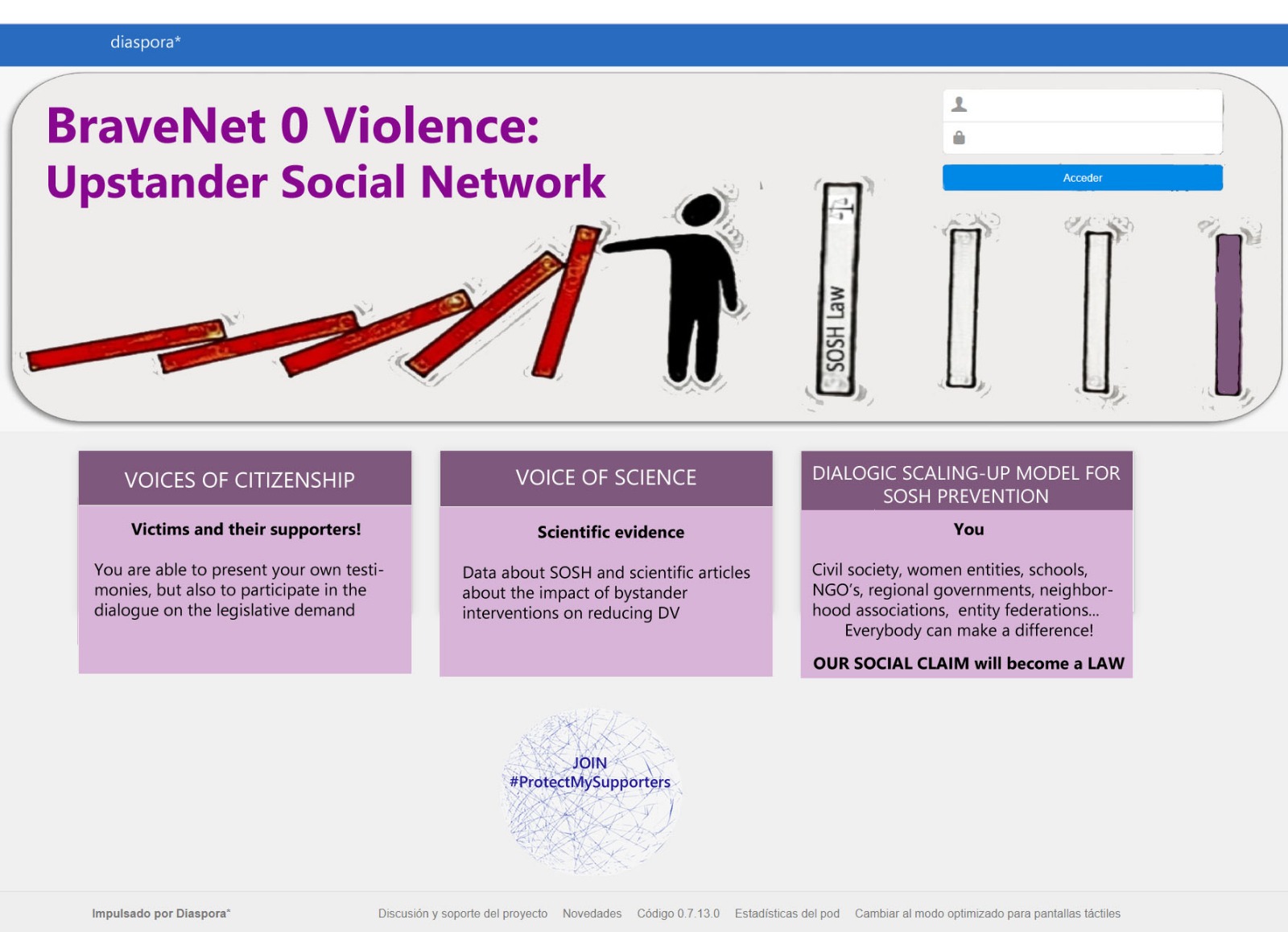
The model we have developed is called Dialogic Scaling-Up Model for SOSH Prevention. It will be incorporated into a Platform we will create called: BraveNet 0 violence: Upstander Social Network.
The MODEL, Dialogic Scaling-Up Model for SOSH Prevention, is a process that goes from Local to European Commission level and will be achieved through the Dialogic Decision-Making Process. This Model will aim at:
1) promoting social awareness on SOSH;
2) promoting social awareness on the need to socially and legally defend victims’ supporters in order to eradicate DV;
3) building up the process through which we would raise awareness at local, regional and EU level, through the steps developed below.
The Dialogic Scaling-Up Model for SOSH Prevention includes 4 development steps:
- 1st step LOCAL level: it involves civil society, women entities, neighbourhood associations... Professionals who assist women victims of DV, people who surround the victims (neighbours, relatives, people who may have some contact with them such as: bakers, pharmacists ...), people who are around the upstanders. Scientific evidence will be transferred to them.
- 2nd step REGIONAL level: it involves the transferability of their commitment and demand to other platforms, such as: NGOs, regional governments, entity federations, political parties, unions, national and European Ombudsman, schools, universities, companies…
- 3rd step EUROPEAN level with international support: European Women’s Lobby, WAVE (Women Against Violence Europe), UN Women, EWLA (European Women Lawyers Association), ambassadors committed to the cause...
- 4th step: POLICY WORKSHOPS: Drawing on the existing data on SOSH and the scientific evidence on how to prevent and eradicate this social problem, a set of evidence-based policy workshops will be organized to transfer this knowledge to policy makers and politicians. The foundations of these evidence-based workshops will be the approach followed in the EPTA’s network (European Parliament Technology Assessment) and the Policy Workshops organized by the Centre of Science and Policy of the University of Cambridge. Therefore, considering the above mentioned steps, these workshops will be organized taking these aspects into account: a) Place: European Parliament HeadQuarters; b) Duration: Two days meeting; c) Audience: researchers on SOSH and DV, Policy makers, stakeholders, MEP, end-users, members of civil society (women’s association, European women’s lobby); d) Methodology: Following EC’s report on Skills for evidence-informed policy making and the approach proposed by Marshall Ganz (PhD, Harvard) on Public Narratives, these workshops will be constructed on the framework of storytelling aimed at fostering policy change and sharing effective stories on protection of protectors.
The PLATFORM, BraveNet 0 violence: Upstander Social Network, will include:
1) the “voices of citizenships”; victims or their supporters will be able to present their own testimonies (like the me too hashtag which permitted thousands of survivors to break their silence), but also to participate in the dialogue on the legislative demand, and how to gradually add implications, to achieve social impact;
2) the “voice of science” will be included (data about SOSH ,scientific evidence on the impact of bystander interventions on reducing DV);
3) the Dialogic Scaling-up Model for SOSH Prevention.
What you have done during the weekend
We discussed, commented and agreed on the best product to solve our solution, opting for creating a Dialogic Scaling-up Model for SOSH Prevention, which we decided to incorporate in a platform, also created by us, BraveNet 0 Violence: Upstander Social Network.
We started on collecting previous analysis, elements that have achieved social impact on DV and SOSH, regarding the challenge that COVID-19 has raised on DV, we discussed quite long on this and decided to focus on that urgent idea that can have the greatest social impact. Hence, we deliberated on the most appropriate mechanisms for developing our Model. We spent all the time on some key points: involving stakeholders and end-users in the protection of victims' supporters with the final aim of creating legislation on SOSH; establishing a business plan model, considering its feasibility and societal value for victims.
All of this has been done along with many zoom meetings, slack conversations, hours and hours of typing, discussions with our Mentor. Above all, everything has been done with passion and commitment to help victims of DV during the COVID-19 crisis and beyond.
The solution’s impact to the crisis
Short term:
- To promote attitudes of support and an atmosphere of encouragement to all those who dare to support victims during COVID-19 and beyond.
- To build awareness among people, neighbours, etc., by creating an emerging movement as a trigger for social change, while promoting the “social opportunity” needed for a social claim to become a law.
- To enable women to find security contexts standing with them, so they can break the silence, increasing their own and their children’s security.
- To improve scientific evidence on SOSH, available to citizens, politicians and legislators, promoting social action and legal changes.
Medium term:
- To create a social context in favor of both victims and those who defend them.
- To provide an institutional and community resource to have access to in order to find solutions to DV and to define common strategies to eradicate it. In other words, a place to go to find the pulse and create joint solutions for the DV problem for the victims' surrounding.
- To increase the number of European citizens informed about this social claim and about the Dialogic Scaling-up Model for SOSH Prevention in order to be assumed in their contexts.
- To impact on legislation mechanisms to include SOSH across EU member states.
Long term:
- To legislate SOSH to eradicate DV deaths.
- To transfer this impact to other areas where Gender-Based Violence (GBV) is present, such as schools, universities, companies, etc., enabling SOSH to be legislated.
- To contribute to SDG 5: Achieve gender equality and empower women and girls.
- To foster a solidarity network at the European level against DV and SOSH to contribute to erasing any form of harassment and discrimination.
The necessities in order to continue the project
BraveNet 0 violence: Upstander Social Network will be developed in Diaspora software free open source.
Diaspora will serve us:
a) to create awareness among general citizenship.
b) to inform legislators about this problem, real testimonies and the latest scientific development.
c) to monitor the legal process: scaling up of SOSH law
d) as allow people, entities, and so on to connect among each other as a network. They would publicly show themselves as upstanders so that victims know the ones that are closest to them.
The strategy of exploitation-dissemination will consists on:
- Translating materials into different languages to reach more people across Europe
- Creating social networks for our “product”
- Spreading the word through social, personal, and professional networks (Facebook, Twitter, Instagram, YouTube, Linkedin) about this Model and the Diaspora platform
- Contrasting the information with all social entities
- Conducting activities of dissemination, teaming up with different stakeholders
- Launching campaigns to raise awareness
- Contacting ambassadors, key informants in each step of the process to teach them the model and the importance of SOSH so that they assume it and demand the law (each country will be encouraged to name someone as an ambassador or contact point between society and legislative bodies).
Everyone's commitment to demanding legislation that protects upstanders opens the way for it.
The value of our solution after the crisis
- Consideration of SOSH as part of the legislation on GBV and DV. Victims need support in order to go forward. Any upstander can become a victim of SOSH because of giving support.
- Building awareness among ALL social actors, communities, policymakers.
- Creating that point of social awareness, which generates a social movement, creating the political opportunity.
- Legislators taking seriously the issue of protecting not only direct victims, but also victims of SOSH
A society standing with upstanders. An open source channel available to everybody.
The URL to the pitchvideo (Required)
https://www.youtube.com/watch?v=H--P5cS5MQo&feature=youtu.be
Ethical considerations:
Confidentiality and ethical issues will be considered during all the processes of development and implementation of our tool. EUvsVirusSOSH will draw upon ethical procedures defined by the EU’s Charter of Fundamental Rights and the UNESCO Universal Declaration of Human Rights.
Built With
- legislations
- libraries





Log in or sign up for Devpost to join the conversation.