-
-
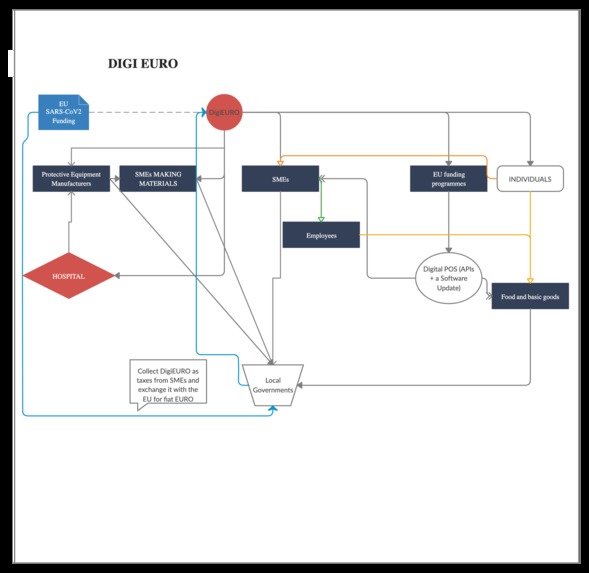
Diagram of how it can work.
-
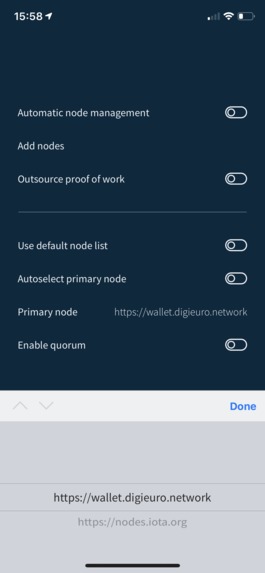
Selection of private network DigiEURO on iPhone wallet
Inspiration
The inspiration of this idea come from IOTA - https://www.iota.org/ "IOTA is a revolutionary new transactional settlement and data transfer layer for the Internet of Things. It’s based on a new distributed ledger, the Tangle, which overcomes the inefficiencies of current Blockchain designs and introduces a new way of reaching consensus in a decentralized peer-to-peer system."
Besides the technology itself, the Inspiration also come from the fact that inspite of making attempts - there is still no possibility to offier a quick, fast to remit payments across the European borders with the lowest to zero remittance fees.
Problem
Traditionally, international enterprises face high remittance fees and time delays due to physical distance and lack of quick-to-transfer means of funding. Especially now at the time of COVID-19 crisis, it is becoming more and more important to provide means of "instant remittance" across the European borders and worldwide. With the use of IOTA and topped with a smart secure solution, it will be easy to implement cross-border payments to send funds to the businesses instantly. This is topped by by offering added security, higher transfer speed, and zero conversion fees.
Solution
The solution is to Issue digital currency EURO that has 0 transaction fees - processed by another device in the network, when issuing a payment. It is meant to be backed by fiat Euro currency at a 1:1 ratio. Almost instant transaction confirmation with the inability of chargebacks. The European Union can use Digital EURO to send financing throughout its programs, without the need of 3rd parties anymore. It grants SMEs and private individuals access to E.U. funding right when they need it. It can be used to send funding to countries or individuals that are in need during covid crisis. After the pandemic is over, the European Union ca decide if it will either keep using it, or terminate it by allowing businesses to pay with it for taxes, while the EU will exchange EURO-D with EURO for the governments that collected said digital currency.
How it works
- The E.U. issues a wallet that acts as a vault, having all the digital money inside of it.
- Via eID processes and platform, individuals and SMEs alike can create an empty digital wallet.
- The E.U. with local governments help to identify individuals and SMEs that are in need, will send mass payments from the original issued wallet (vault).
- Individuals and SMEs in question will receive said DIGITAL EURO almost instantly.
- Individuals can use the digital currency to buy food and other necessities, while businesses will accept DIGITAL EURO and also pay with it to its own suppliers.
- APIs and EASY access to digital wallets will be provided.
- Shall the E.U. decide to revoke the DIGITAL EURO after the pandemic, businesses will continue to accept DIGITAL EURO in a process of collection. From this point, The E.U. can either: A. exchange the DIGITAL EURO with EURO via centralised banking systems (SMEs deliver DIGITAL EURO, while waiting with an IBAN to receive EURO) B. governments will collect said DIGITAL EURO on behalf of the E.U. and exchange it with EURO or local currency (e.g. RON in Romania), while the government will make the exchange with the E.U. for Euro, gradually, and fully or only partially.
Why IOTA and its Benefits
More businesses are utilising Internet of Things (IoT), devices for added efficiency and accuracy for their business operations. IOTA has the capability to work with IoT devices and in the future, we would like to also provide the possibility to track payment histories and automatically fulfil invoices and payments and overall improve the operations of Payment transfers between businesses and funding.
Benefits:
- Instant Transactions
- Zero Remittance fees
- No middle players involved
Open Challenges
Regulatory acceptance Security
What's next for EURO-D: Digital Euro
an MVP during hackathon and hopefully acceptance and implementation after.
Built With
- apis
- iota
- mobile-app




Log in or sign up for Devpost to join the conversation.