-
-
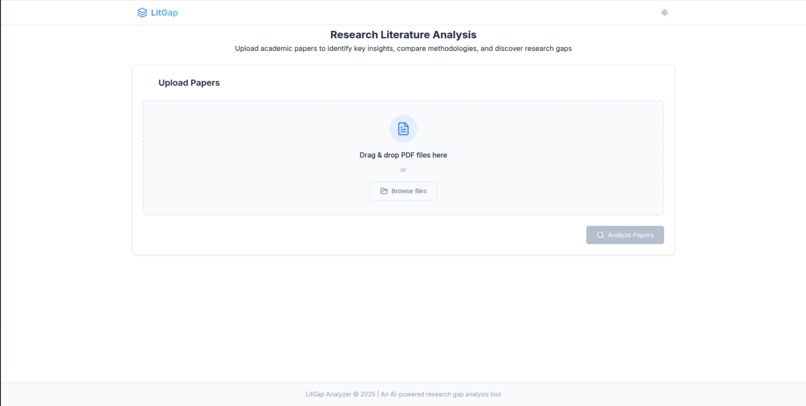
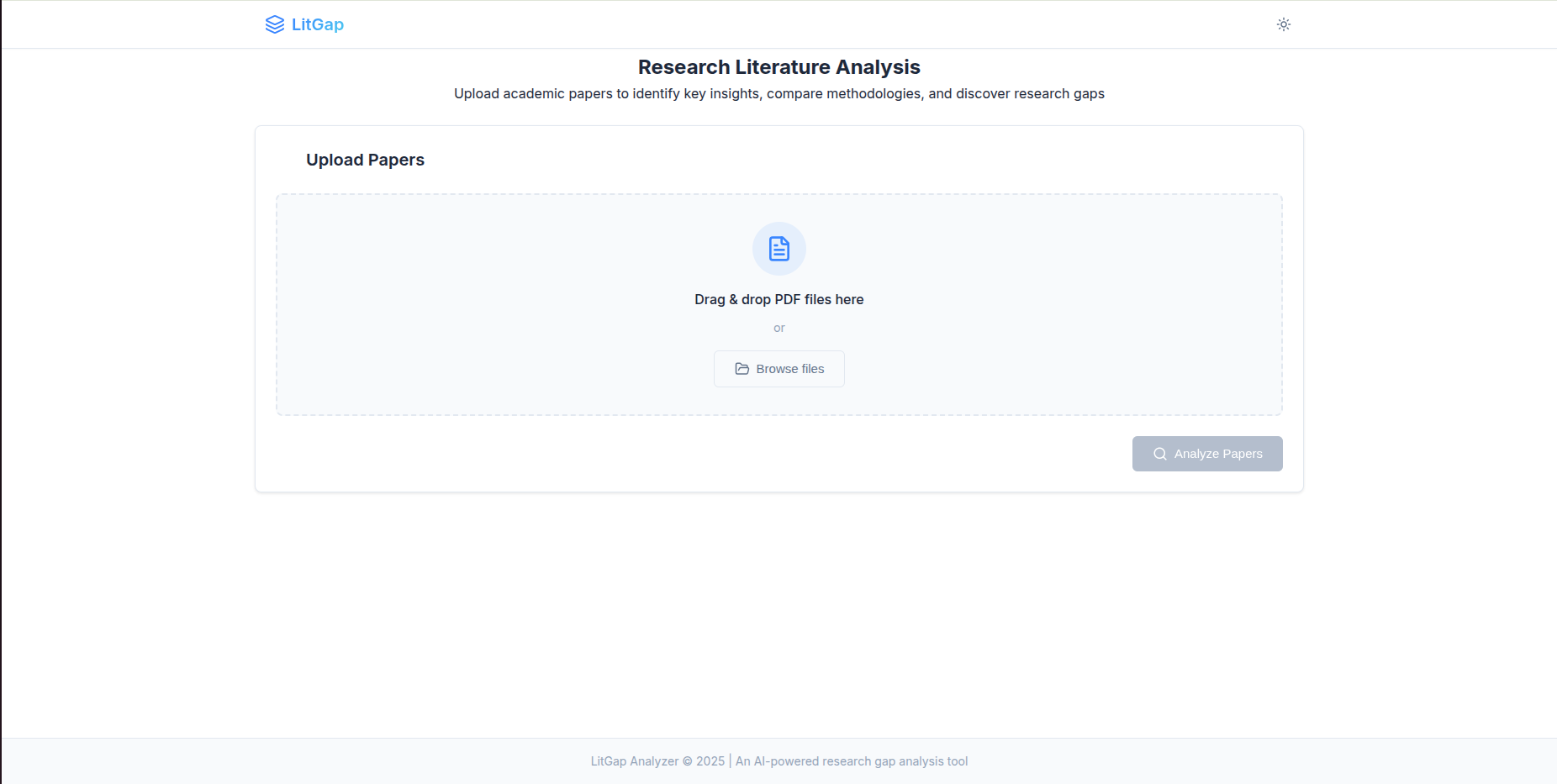
Homepage (Light Mode)
-
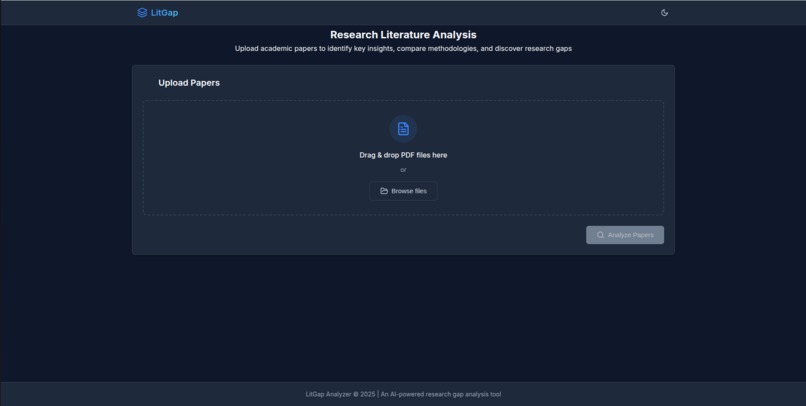
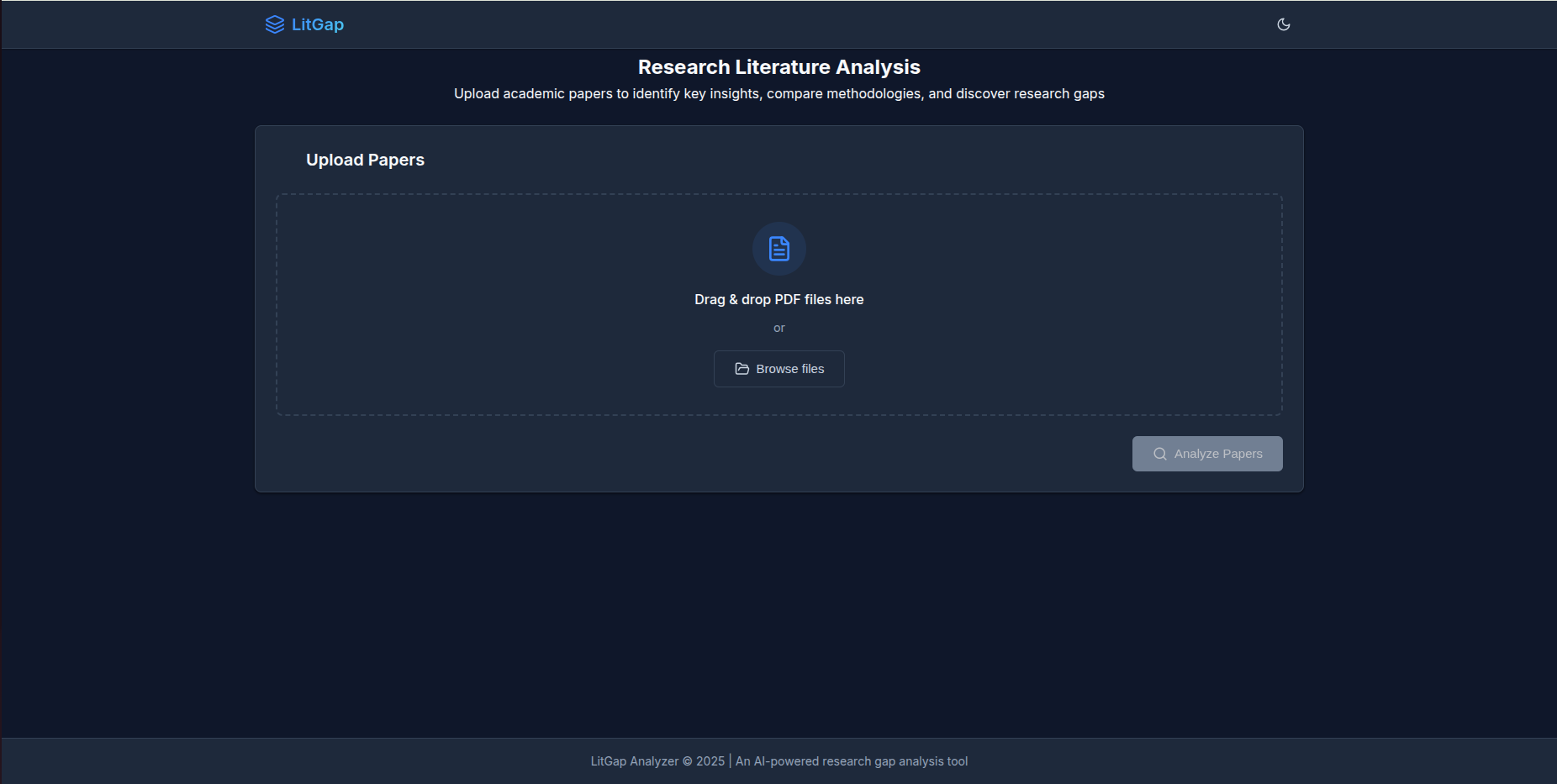
Homepage (Dark Mode)
-
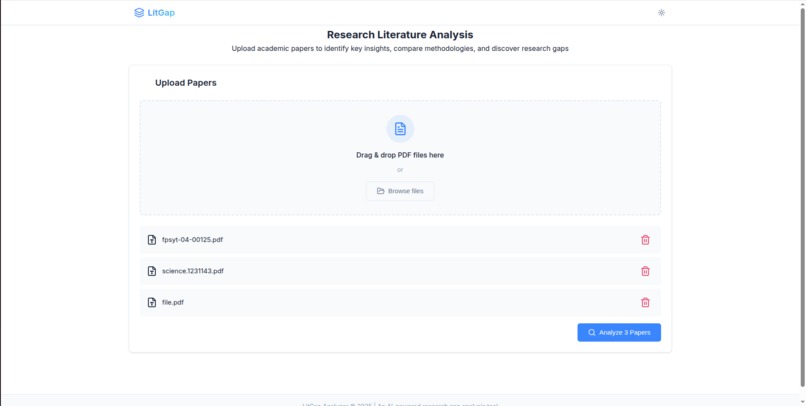
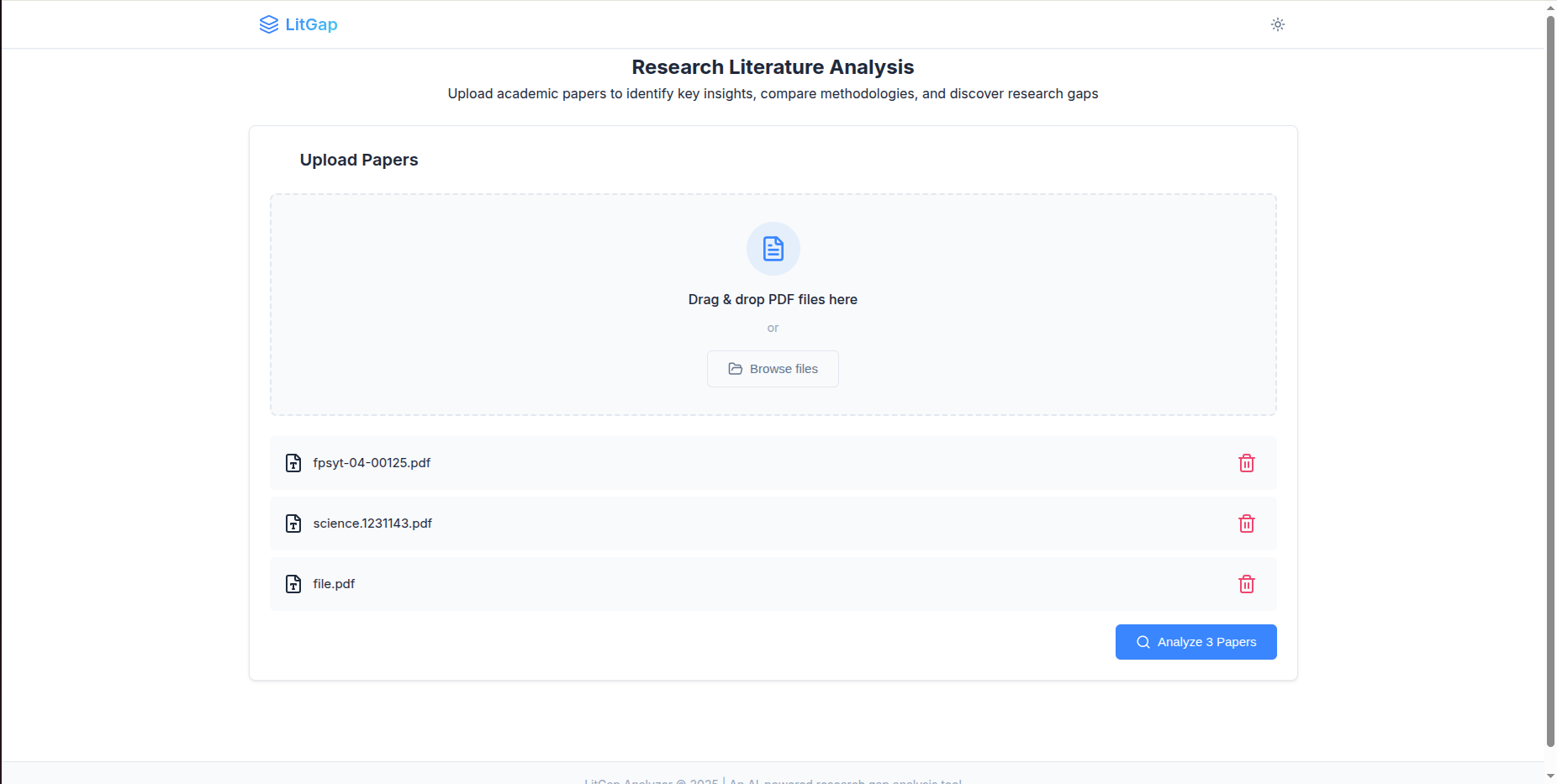
Paper Upload
-
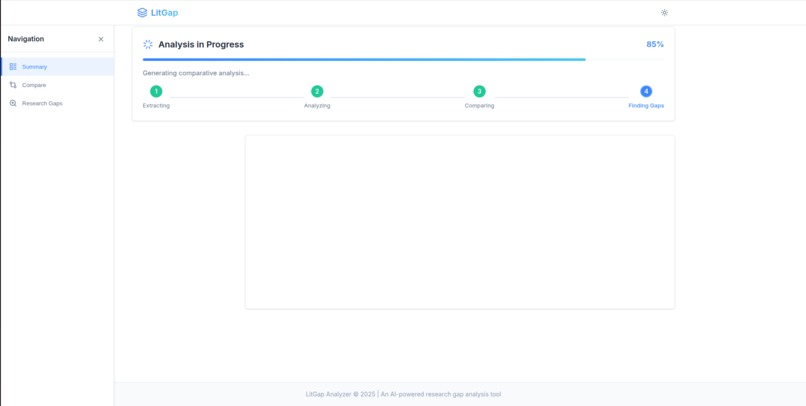
Analyzing Update Bar
-
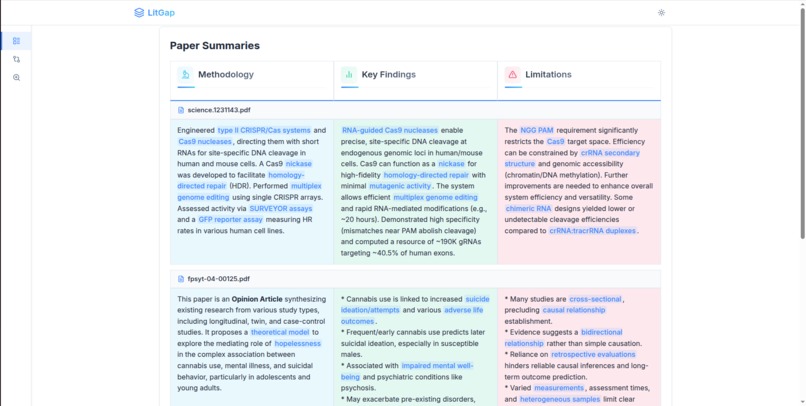
Paper Summaries (Methodology, Key Findings, Limitations)
-
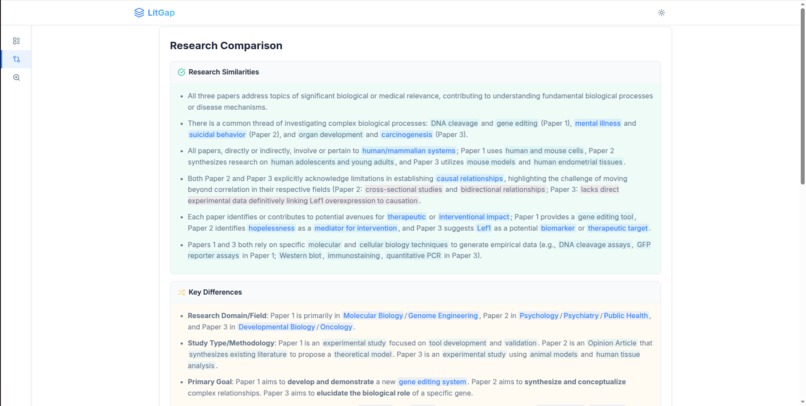
Research Comparison (Research Similarities)
-
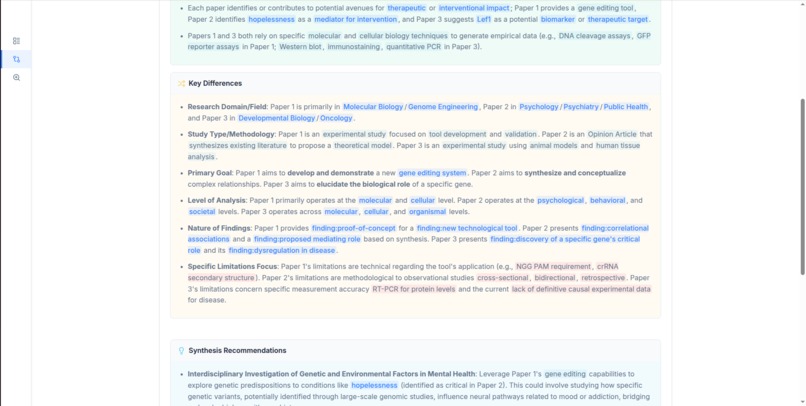
Research Comparison (Key Differences)
-
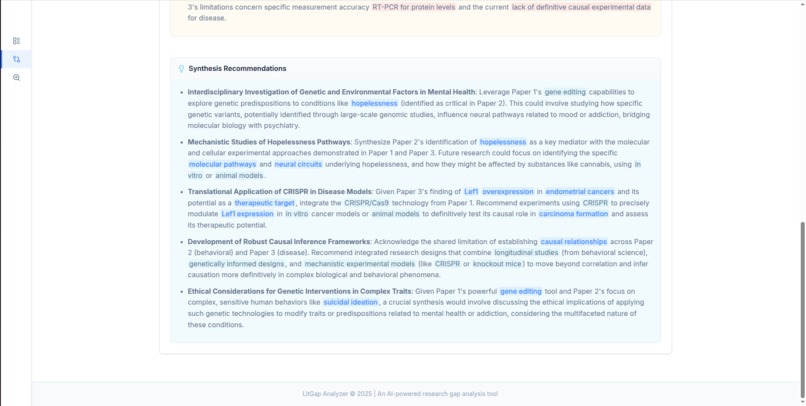
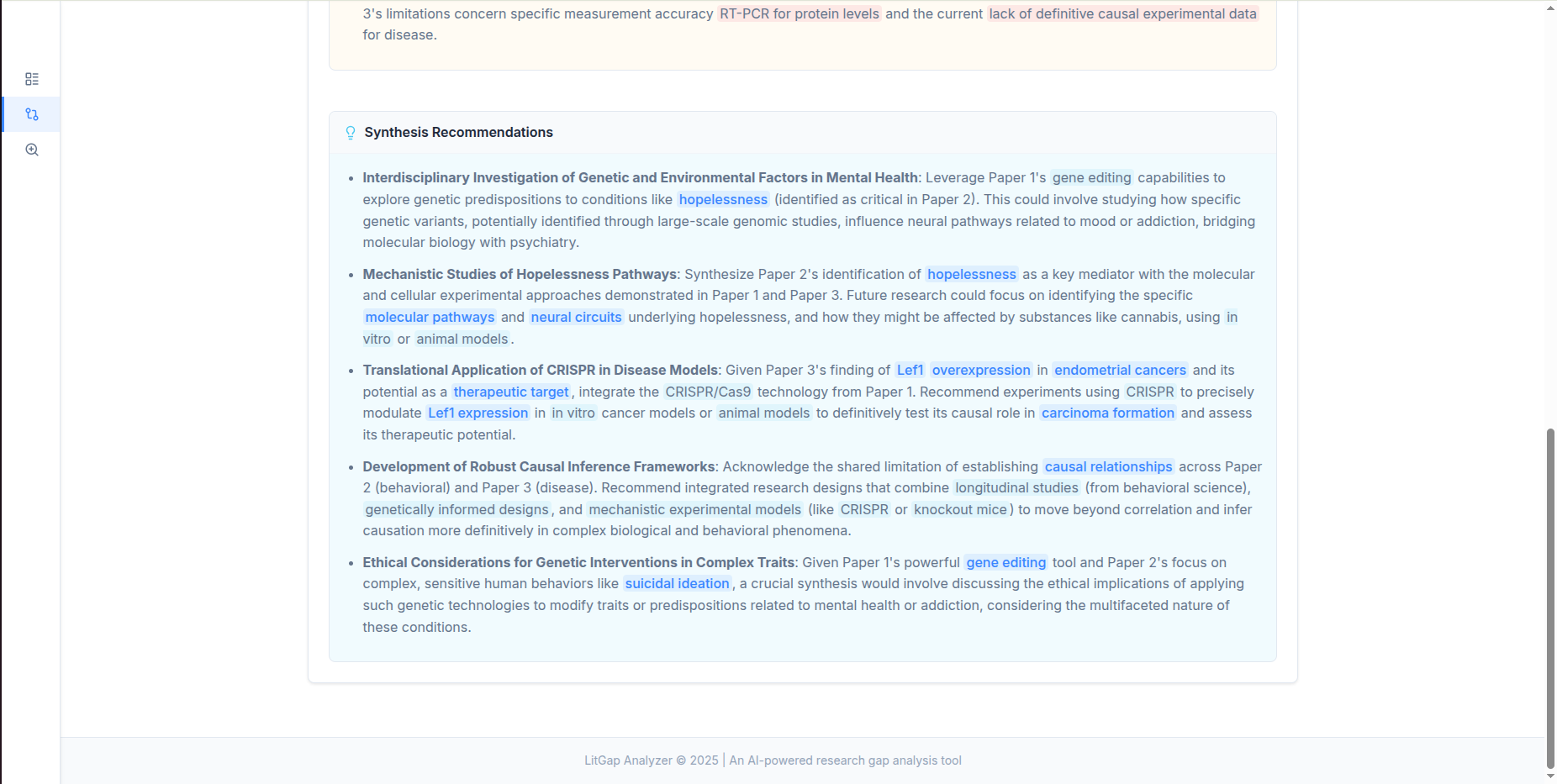
Research Comparison (Synthesis Recommendations)
-
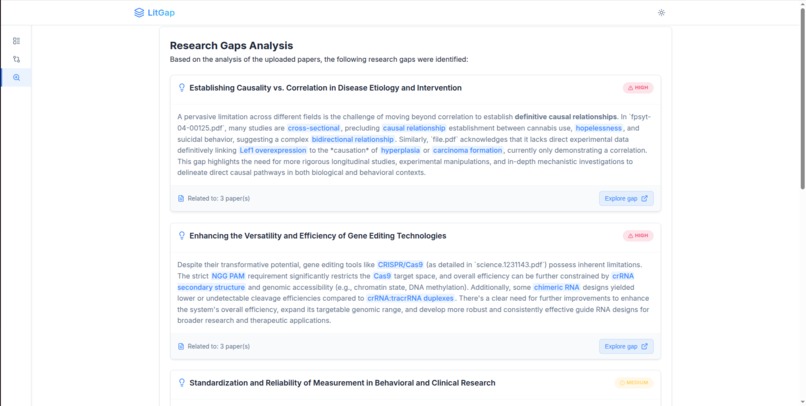
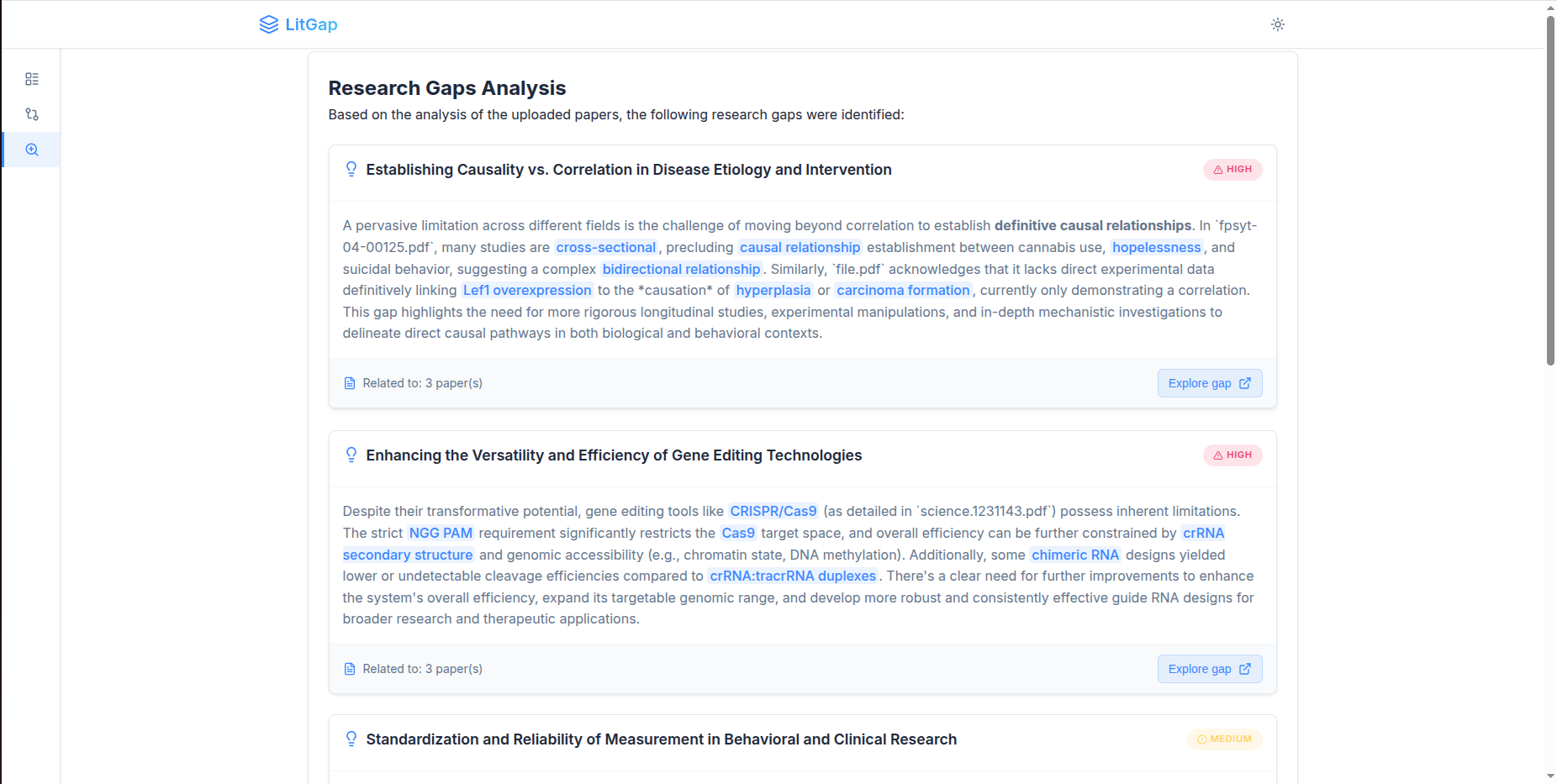
Research Gaps Analysis
-
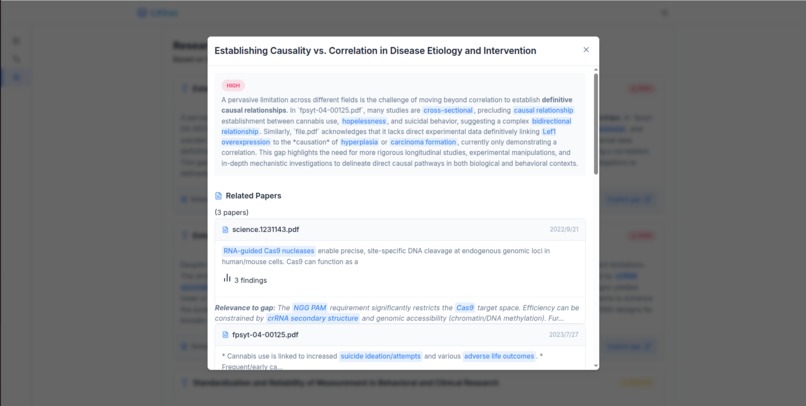
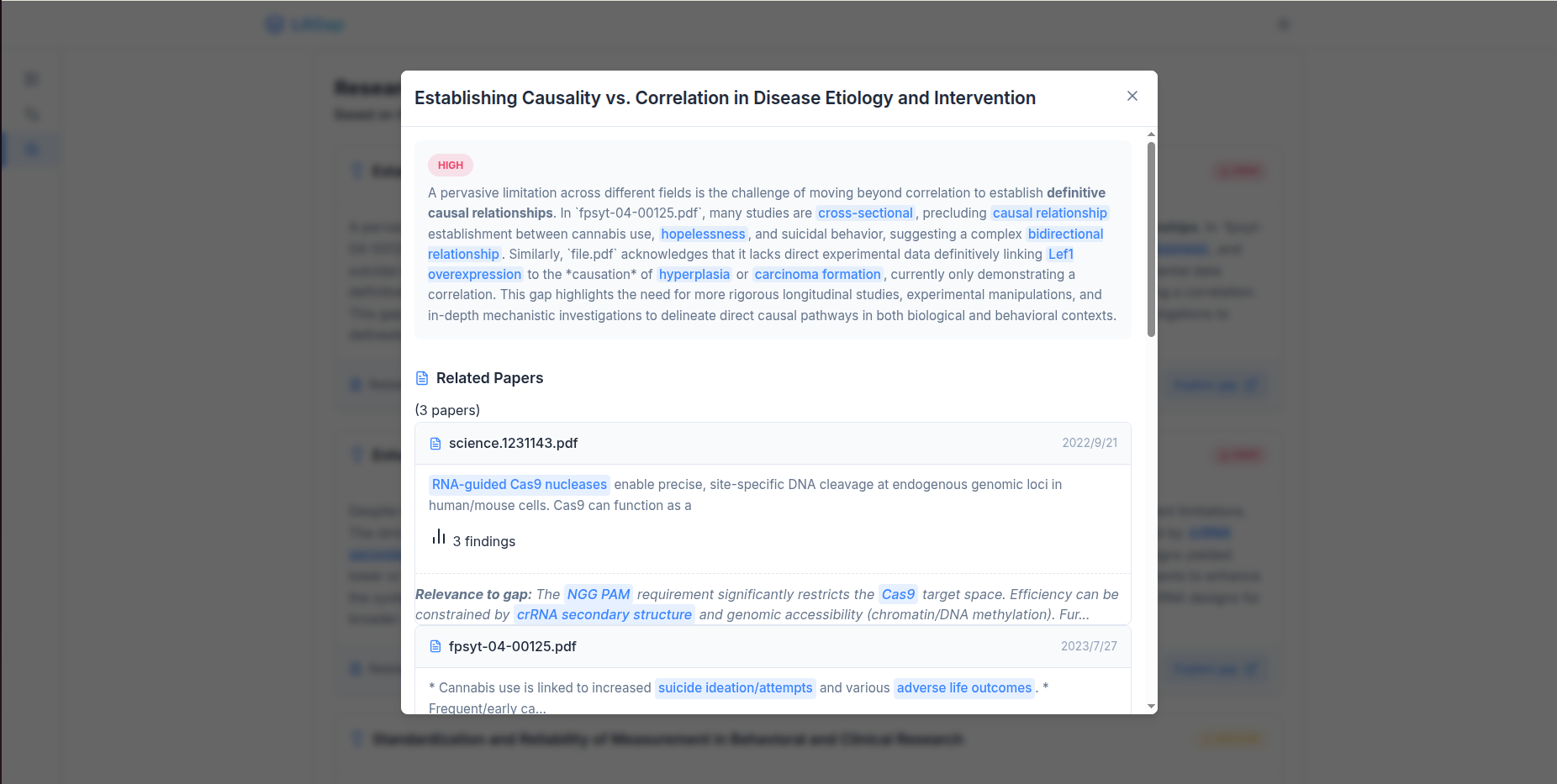
Research Gaps Analysis (Explore Gap)
-
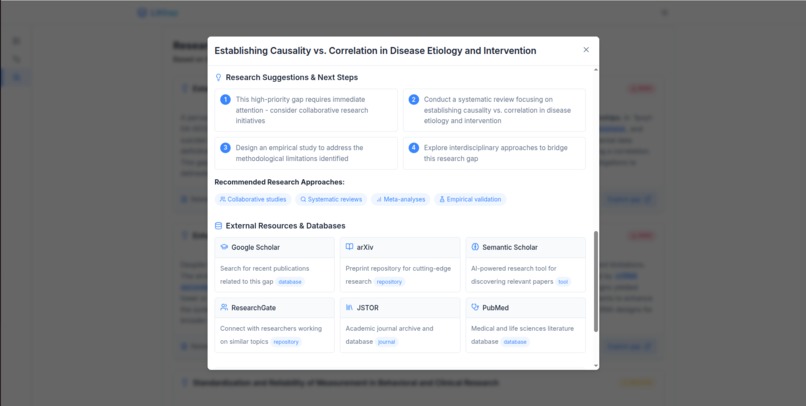
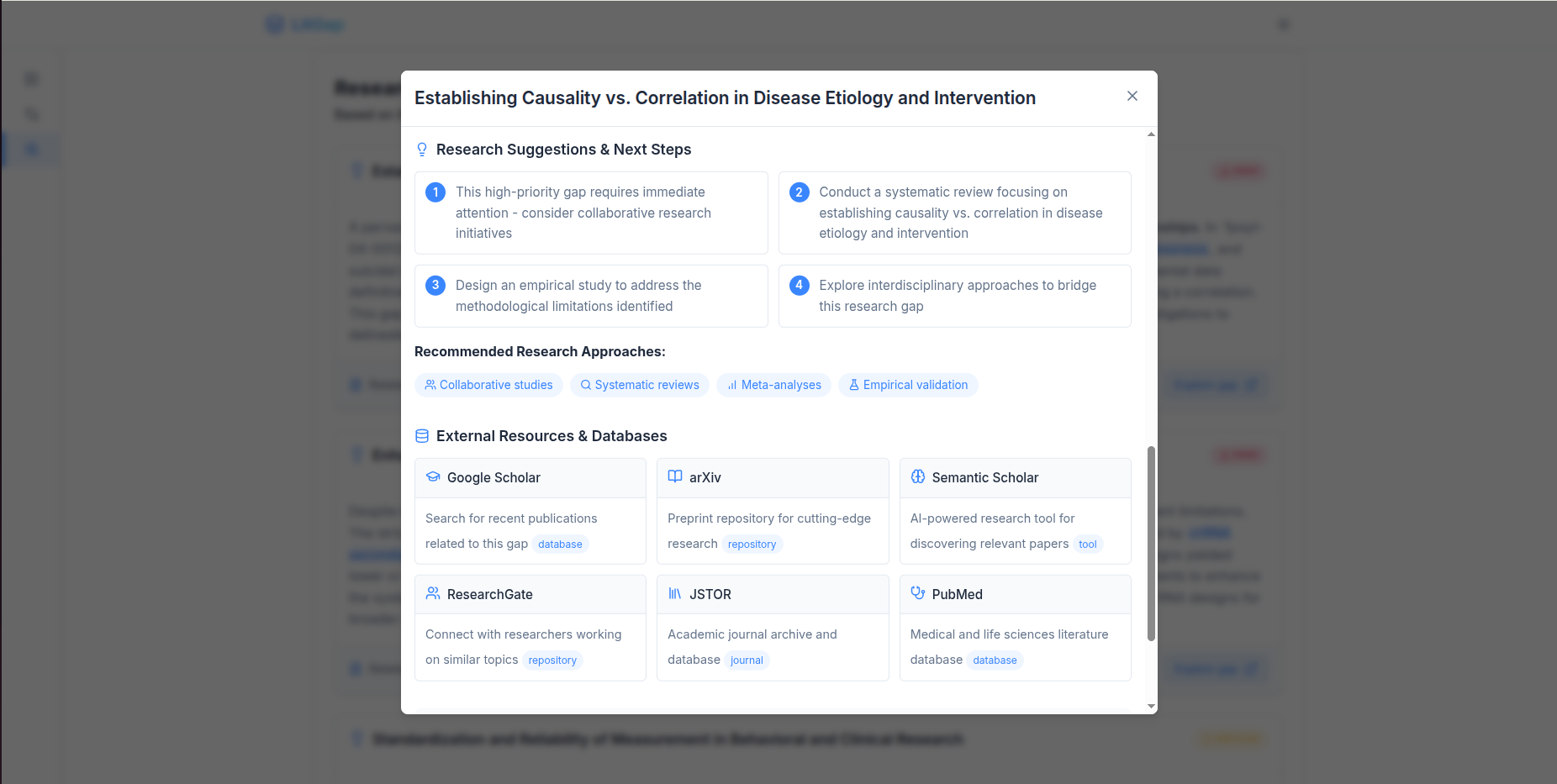
Research Gaps Analysis (Explore Gap: Research Suggestions & Next Steps, External Resources & Databases)


Inspiration
As university students, we've all felt the pain of burning through countless hours sifting through research papers, desperately searching for unique and novel ideas, only to realize afterwards that it's already been explored. This frustrating obstacle inspired LitGap, an app designed to streamline your research process. We wanted to transform that "Aha!" moment of finding a truly innovative research idea from that scarce event into a consistent reality.
What it does
LitGap acts as your own personal, intelligent research assistant, automatically reviewing all of the literature you task it with. It not only summarizes papers; it identifies unexplored research areas and contradictory findings, essentially highlighting the "gaps" in existing research. This means you can save countless hours of reading, quickly pinpoint potential topics for deeper investigation, and ensure that your work is truly original and impactful.
How we built it
Focusing on a robust, user-friendly, and efficient system, at the core of LitGap lies a smart PDF pipeline that, with user privacy and speed, enables fully client-side parsing of academic papers—this means that no sensitive documents ever need to be uploaded to a server. The pipeline is specifically engineered to extract structured texts even from messy layouts found in some uploaded documents, ensuring accurate input data for further analysis.
For analytical power, we integrated AI on demand. We utilized a Google Apps Script proxy to connect our app to an LLM, allowing us to process information. We crafted custom prompts, specially designed to extract deep insights and identify research gaps directly from the source content of uploaded academic papers.
We prioritized a seamless UX design, implementing features such as drag-and-drop uploads for document uploads. Users are able to receive real-time progress tracking regarding their analysis. Once insights are generated, intelligent keyword highlights and a clean interface with smooth transitions and responsive flow make navigating and understanding the results both easy and enjoyable for all users.
Challenges we ran into
In our development of LitGap, we ran into our share of technical hurdles, particularly concerning data processing. One significant challenge was the task of PDF text extractions. Getting PDF.js to behave consistently across the vast array of inconsistent PDF layouts while still accurately preserving the original structure of the document was complex. We dedicated considerable effort to fine-tune methods for extraction, ultimately cracking this crucial component to ensure reliable data intake.
The unpredictable outputs of LLMs mean that their outputs can at times be unexpected. Parsing these AI responses reliably required us to build error-handling mechanisms and fallback systems. This ensured that even when faced with unexpected outputs from the AI, our application still stands strong and stable, and continues to run smoothly and deliver consistent results to the user.
Accomplishments that we're proud of
We're incredibly proud of our Smart Research Gap Finder. We designed our app to do not only summarization, but also comparisons with academic papers that allow identification of overlooked gaps in methods, contextual information, or anything else that presents gaps for deeper exploration. These analyses allow the user to attend to pivotal points for potential research and gain a competitive edge.
We also put a lot of effort into designing a smooth and snappy user experience. We understand that researching takes up a lot of time, and as a result, many of our users would prioritize speed. To address this need, we implemented user-friendly features such as drag-and-drop uploads, live status updates for analyses, and a clean, intuitive UI that performs beautifully across devices.
Under the hood, we implemented a robust pipeline that allows for a full analysis of academic literature provided by the user. Once a PDF is uploaded, it generates insights via AI processing. This entire workflow is fully integrated in our app, built to ensure reliability and minimize disruptions. Our modular codebase further supports this, constructed to scale and adapt, with everything from file uploads to API integrations that are cleanly separated and reusable.
With these accomplishments, we make future research development efficient and straightforward.
What we learned
AI Interaction and Data Handling: Throughout this project, we learned the great impact of precise communication with LLMs while prompting them and tried various ways of improving our techniques. Furthermore, we built reliable fallbacks to manage messy JSON data. These experiences, coupled together, have made us more adept than when we started at extracting reliable and accurate information from complex AI systems.
What Academics Really Need: Beyond raw data, researchers prioritize visual clarity for complex information. This called for insights presented in an easily digestible format. Every UI choice we made is a response to real human needs. In our development process, we underscored, as one of our main goals, the critical importance of user-centric design, ensuring LitGap is not only a powerful tool but one that is truly intuitive and can be easily accommodated into a researcher's workflow.
What's next for LitGap: Your Next Breakthrough
We're excited to continue developing LitGap to make it even more powerful and indispensable for fellow researchers. Our next steps include:
- Interactive Visualization of Gaps: Imagine a dynamic map of your research, where all of the "gaps" are visually represented, allowing you to even more intuitively explore connections between literature and missing links. We aim to implement such interactive visualizations.
- Collaborative Features: We plan to enable users to share identified gaps and collaborate across a team directly within the app, fostering both team-based research and discovery.
- Integration with Existing Reference Managers: Seamlessly connect LitGap with well-known reference management tools (e.g., Zotero, Mendeley) to systematize your entire research workflow from discovery to citation.
Built With
- api
- css3
- html5
- javascript
- llm


Log in or sign up for Devpost to join the conversation.