-
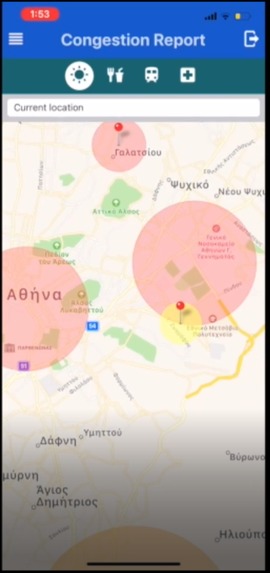
High and Mid congestion Zones in Athens
-
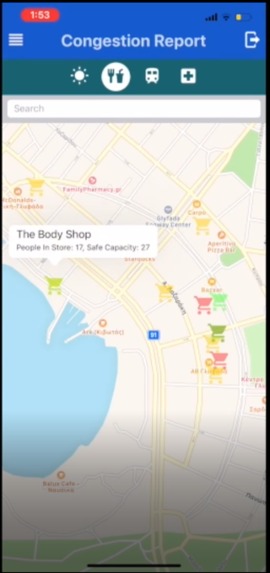
Shop Congestion in Glyfada
Problem we solve?
The coronavirus outbreak has changed life as we know it by introducing health and healthcare issues in need of rapid and effective tackling. Governments have managed to partially address these issues by introducing lockdown measures. Even though such measures have helped control the spread of the disease, they have led to disrupting business operations and overall placing severe obstacles in our communities. They have led European economies towards an unprecedented recession. Such emergency measures are not viable in the long term, yet reopening the economy must be done cautiously.
In particular, many shops have been forced to temporarily close down including bars, cafeterias and restaurants. Long queues are formed outside supermarkets since a safety threshold is placed on the number of people allowed in. Moreover public transport, which typically serves millions of people, is disrupted and may pose a major risk for spreading the disease.
The inevitable prospect of lifting Europe’s lockdown measures naturally comes with a question, shared both by governments and citizens; how and when will life get back to normal? A gradual suspension of government-imposed measures against the disease will place a heavy burden on citizens for self-regulation and in addition it is important to maintain the benefits of these measures.
It is our belief that technology can play a crucial role in this transitional period by rendering each individual’s effort into a collective success. Our solution helps to monitor congestion in open areas, roads, shops, public transport and to provide real time feedback to the public and authorities through our designed application or webpage. As such, we tackle all of the above mentioned problems by providing information to the public that helps them remain safe and avoid long queues and, also, by helping authorities impose targeted measures that reduce public health risks without restricting individuals too much. Furthemore, our solution will increase citizens’ sense of responsibility and make them feel like a part of the solution.
Solution
By observing the main challenges this new threat has posed on a global scale, and by scrutinising different crisis management mechanisms established by the member states’ governments, we have concluded that effectively monitoring congestion is key to effectively fighting the disease. In particular, effective monitoring of congestion allows authorities to avoid harsh measures when they are not necessary and to take targeted action if high congestion appears. In addition, by making this information available to the public, individuals will be able to select places to visit in a manner that serves both public health and their individual interests; congested shops and areas are likely to be avoided because of long queues and health concerns. Also, using gamification the user can collect badges if he avoids crowded spaces. There will be rewards for those in the top of the list, which will help motivate everyone to be part of the solution.
EuMedical proposes a solution that is targeted towards monitoring congestion and conveying this information to the public and authorities through an easy-to-use mobile application and webpage.
Our solution is cloud based in order to be accessible from everywhere. It is viewable through every mobile device by downloading the app, or even from their browser. We have integrated our application with Google Places service which we utilize in conjunction with information we are gathering through our app to produce useful analytics which help prevent the spread of the virus. This is achieved through privacy preserving machine learning algorithms. We now go on to describe our solution broken down into individual challenges that we address with different components. Congestion monitoring is broken down to four threads: open areas, shops, public transport and hospitals.
- Real-time monitoring congestion in open public areas.
To measure congestion in public areas, our backend utilizes privacy preserving machine learning techniques. This in turn is done in two layers. The first layer relies on collecting user location data and running rapid clustering algorithms to create zones which are rated by the amount of people in each and the corresponding (“surface”) area. As EuMedical values the rights and freedoms of natural persons, our designed algorithms process user data in compliance with the General Data Protection Regulation (GDPR), by utilizing differential privacy, secure multi-party computation and anonimization techniques designed to implement data-protection principles (pseudonymisation and encryption of personal data, minimization of data, minimum storage period, processing of data only with respect to the particular purpose to which the data subject has consented) and to protect the rights of its users. The individual user locations are never stored unencrypted in any one device and each user has the option of choosing her own “privacy budget” which adjusts how much noise will be involved when processing her data.
The second layer relies on user reports which can be effortlessly sent though our web application via a few button clicks. User reports are cross-checked and analyzed for validity in real time.
The results are displayed on an elegant map view, in an entirely graphical manner that is easy and fast to read. Important zones are always displayed and a zone around the users location is always displayed. In addition, the user can select through search for pinpointing a zone and receive feedback on the particular location’s congestion. Temporal data for each zone, providing real time predictions for congestion in the next few hours, is also provided by tapping the respective bubble.
- Real-time monitoring congestion in shops, public transport and hospitals.
Reliably tracking congestion in shops can prove challenging. The current system of restrictions on business operations raises a number of issues in terms of safety, efficiency and sustainability. Our solution optimises monitoring techniques currently employed by businesses still open to the public, and offer an improved, digitalised solution to those that are yet to open, while simultaneously tackling the problem tracking congestion in stores.
Most stores in the EU control the amount of people inside at any one time by having personnel controlling the in-flow and out-flow. Typically, coordinating this action, especially in large stores with multiple entrances and exits, within each individual shop is slow and impractical relying on internal communication or paper ticketing systems. We thus propose a simple application that implements an automatic coordination system allowing shops to track in real-time the amount of people in the store, gather analytics which are readily accessible through our app and to make booking time slots in the shop available to users. In summary, we provide
An automatic counting system for stores, accessible through an phone/tablet application with a live visit data feature, analytics, wait time estimates and additional booking options.
In particular, our app could be deployed on a tablet or touch screen at the entrance and customers can click themselves for coming in and out. By deploying this application on many stores, we have real-time congestion feedback for our users who can view store congestion, wait time estimates e.t.c. in a simple map interface. They can further book time slots for desired destinations through a few clicks and receive a QR code which can be validated by the store personnel through our store-application. Booked slots can lead to reduced wait time and better tracking and predicting congestion.
Similar principles could be applied for public transport and hospitals. Our store-app could be used either in vehicles or stations for public transport. For hospital use deployment, we believe that more weight should be placed on the booking features of our solution. We provide a healthcare questionnaire in our user app that allows users to report their symptoms and desire to visit a hospital or doctor. These requests are forwarded to doctors who can access them by logging in to their “doctor” account in our webpage. If the doctor decides that an appointment should be made, this is registered in our system and an optimal scheduling algorithm is run which assigns the patient to a hospital/doctor in a manner that minimizes congestion.
EuMedical’s success lies in the fact that the system is easy to adopt, user-friendly and cost-efficient, taking into account that different member states have different needs, and the funds available to each business can vary, ensuring that no personnel training is required.
Progress during weeking?
We start working on our idea this weekend so everything we will present to you made during the weekend. We are researchers so we applied our research in this app in order to make something useful that uses novel algorithms in order to solve the lockdown problem. So, during the weekend we tuned and designed our user and store application and we also examined privacy concerns that we have to tackle for our solution’s development. This involved, apart from hacking, careful study of EU legislation and a literature review on appropriate mechanisms for ensuring privacy. Our mentor also provided us with important insights for making our solution more appealing and practical, which we integrated in our application design and logic. Furthemore, we implement our back end system and we integrate with open data(https://data.europa.eu/), Google Places API, Google Traffic Layer, Facebook API, Twitter API.
Solution’s impact on the crisis?
As discussed in the description of the problem we tackle, our platform can have a major impact on the crisis. The benefits include reducing the disease spread risk while maintaining near-normal day-to-day routines, business operations and transportation. Our solution reduces the imminent risk of a new outbreak in the absence of lockdown measures by offering features that will help governments take action when necessary. With real-time monitoring congestion in public areas quality of life and healthcare will be improved.
The necessities in order to continue the project
Our platform is ready to go live, so we really need help in expanding fast and reach as many businesses as possible. The value of your solution(s) after the crisis The solution we offer however, can be equally important even after the complete passing of the coronavirus outbreak. The features that we have incorporated in our platform can solve the permanent problem of long queues, increased congestion in open public areas and overcrowding in shops, public transport and hospitals. More specifically, via our application, users can view the wait estimates, store congestions etc. on their mobile devices in the form of a map interface. They will also have the option of booking a time slot for their chosen destination. After they have booked an available time slot, they will receive a QR code which can be validated by the store employees through our store-application. By booking time slots, users will avoid long waiting times and overpopulation in certain stores. The same base will be practiced for public transportation and hospitals. Also, from the businesses point of view, by utilizing our platform, useful analytics will be given to the aforementioned organizations, which will help them plan their business and marketing strategy.
Slack Channel
team-c04-eumedical
Built With
- python
- react-native
- scale-mamba
- spring
- tensorflow





Log in or sign up for Devpost to join the conversation.