-
-
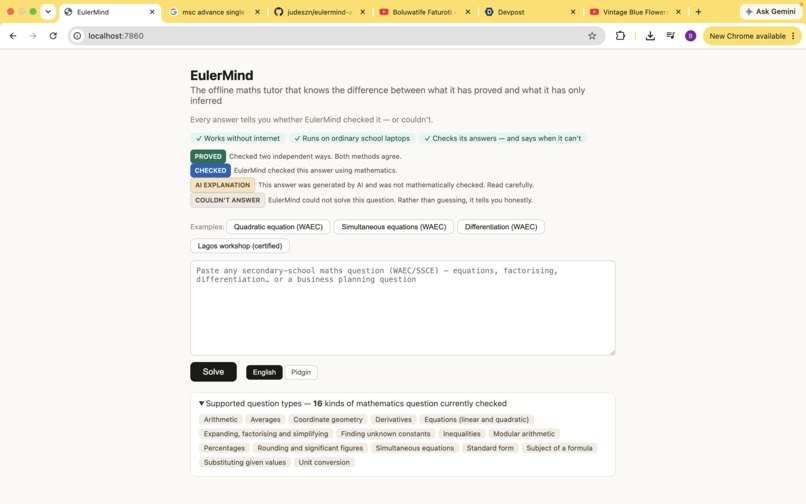
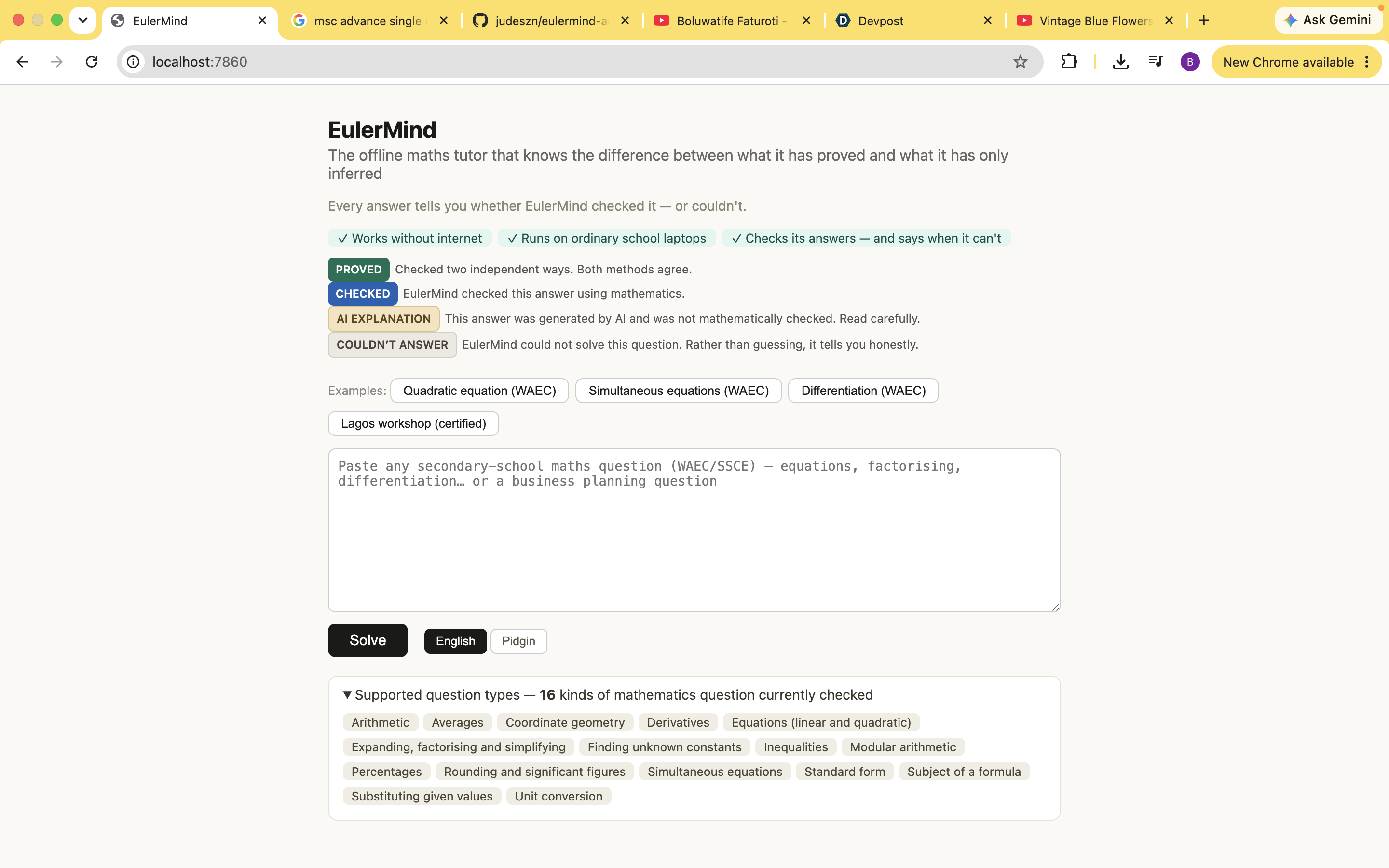
home page
-
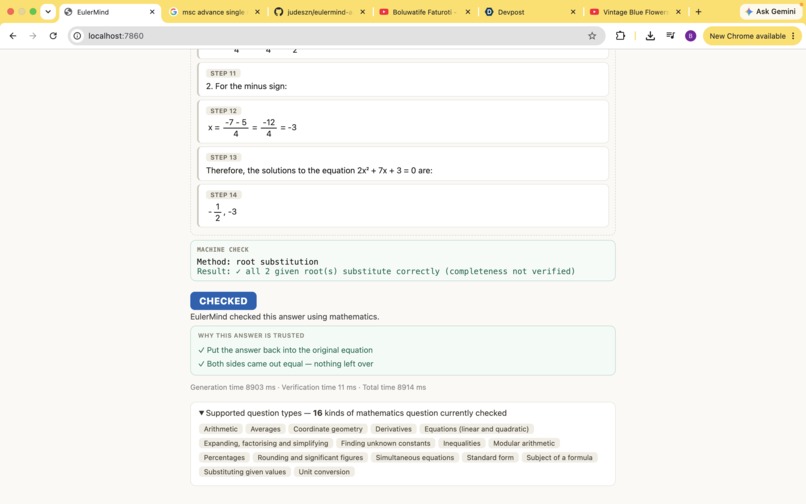
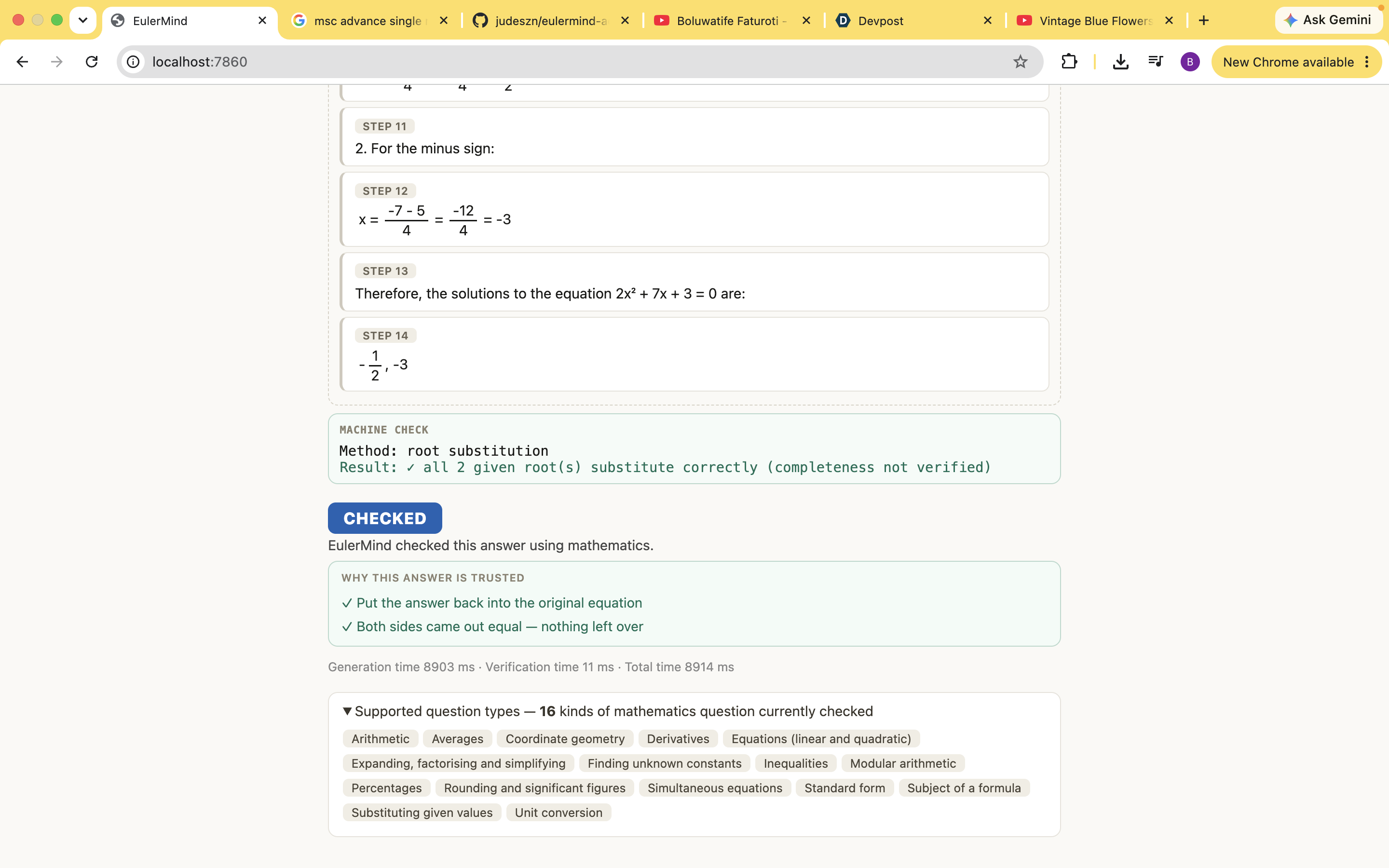
checked answer
-
-
EulerMind
Elevator Pitch
EulerMind is an offline mathematical reasoning assistant built for schools, libraries, and students who cannot always rely on internet access. It combines a local language model with deterministic mathematical verification so users not only receive an answer they also understand whether that answer has been independently checked or is simply an AI explanation.
Inspiration
I attended a public secondary school where internet access was not something students could really depend on. Today, AI has become an incredible learning tool, but for many students it only works when there is a reliable internet connection.
That made me ask a simple question:
Why should a student’s ability to learn mathematics depend on having mobile data or cloud access?
I believe every public school and public library should be able to provide students with an AI learning assistant that works even when the internet is unavailable.
EulerMind is my first step toward that vision.
I started with mathematics because it provides one of the best ways to measure reasoning objectively. If we can build a trustworthy offline mathematics tutor, the same approach can eventually expand into physics, chemistry and other science subjects.
What it does
EulerMind helps students solve mathematics problems entirely offline.
A student enters a mathematics question and EulerMind:
- Solves the problem using a local language model
- Attempts to independently verify the final answer
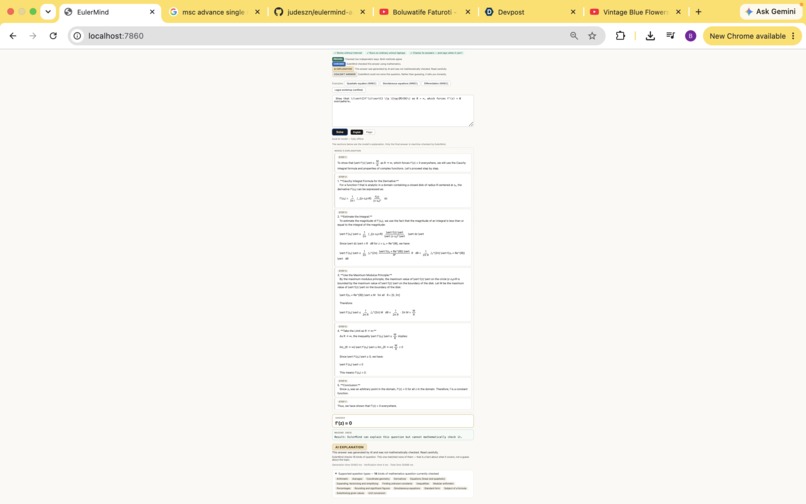
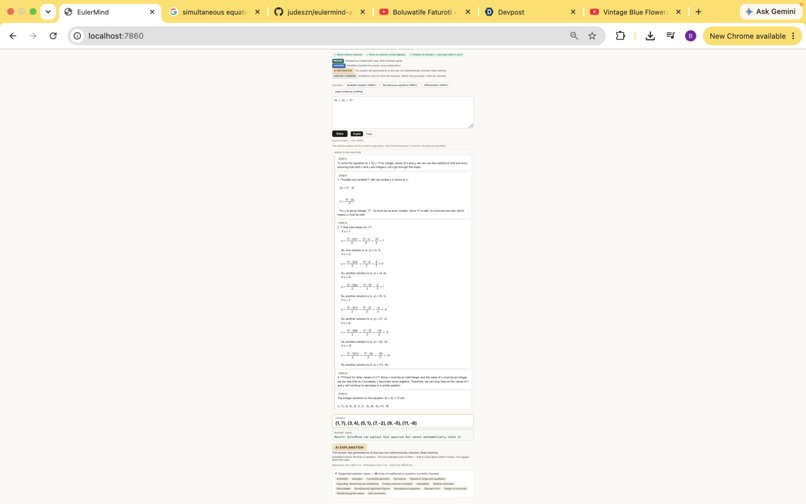
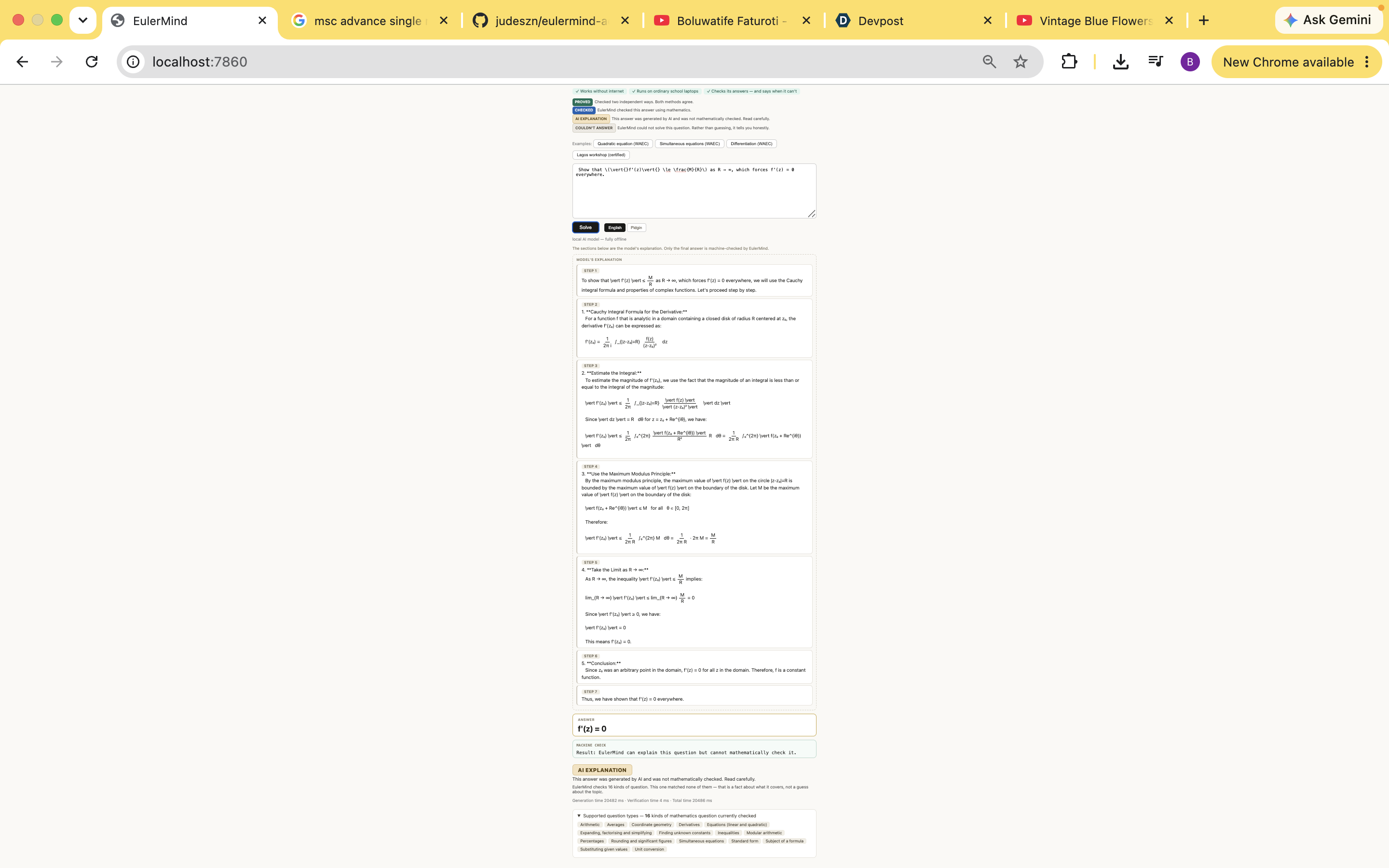
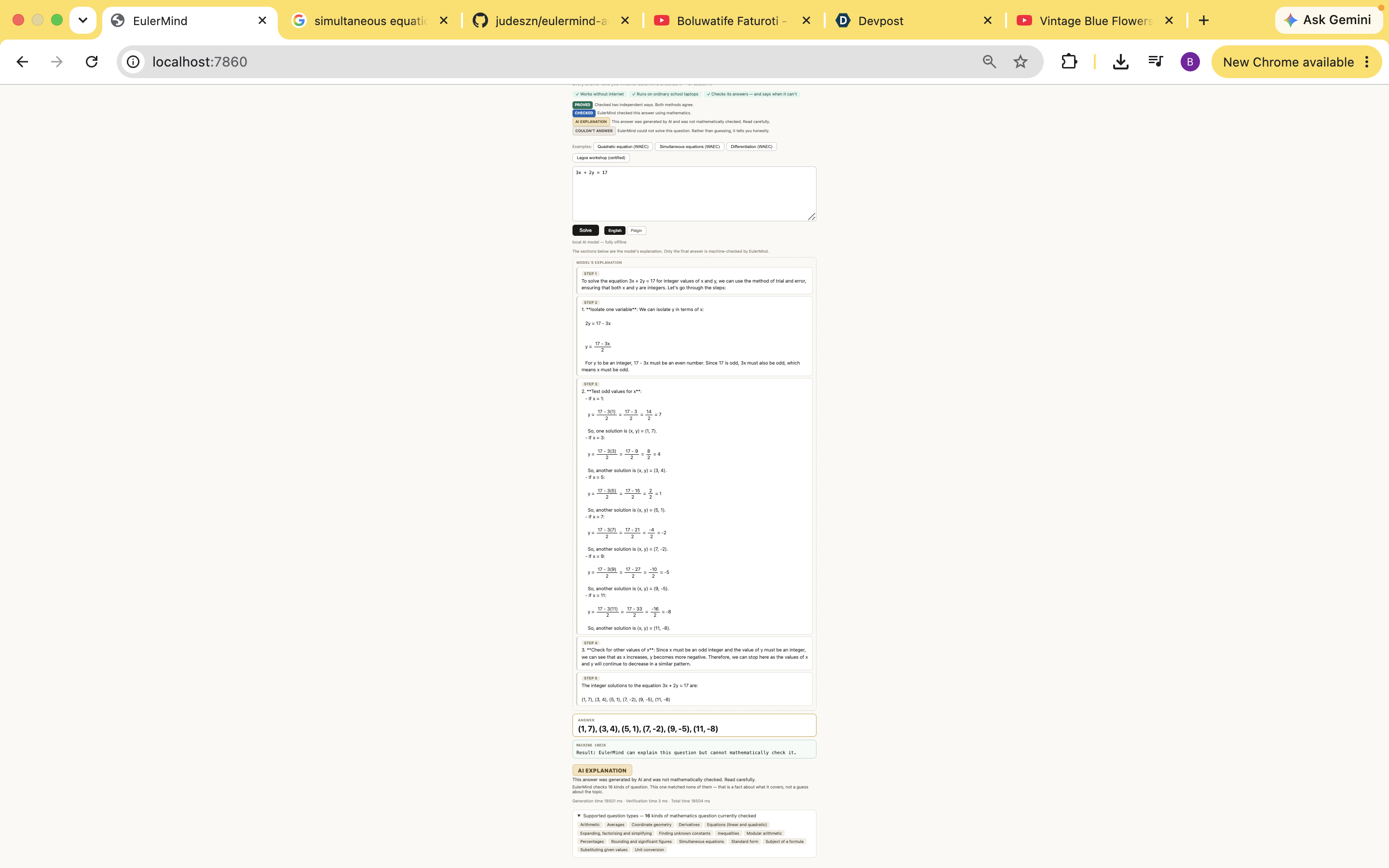
- Clearly explains whether the answer was machine-checked or is only an AI-generated explanation
- Continues working without an internet connection
Instead of presenting every answer with the same confidence, EulerMind explains why an answer should or should not be trusted.
How I built it
EulerMind combines local AI with deterministic mathematical verification.
The system runs a GGUF version of Qwen2.5-Math locally using llama.cpp before sending the model’s final answer into an independent verification pipeline.
Rather than trusting the language model, the verifier attempts to recompute the mathematics from the original question. When verification succeeds, EulerMind increases the confidence of the result. When verification is not possible, it tells the user honestly instead of pretending certainty.
Everything runs locally on ordinary laptops using only CPU resources.
Challenges I ran into
Building an offline AI system was only part of the challenge.
Choosing the right model required extensive testing. I evaluated multiple local models, including DeepSeek variants, but found that larger models increased latency and hardware requirements beyond what I considered practical for ordinary school laptops.
Qwen2.5-Math provided the best balance between mathematical reasoning quality, memory usage and response time.
The second challenge was trust. Language models often produce convincing explanations even when they are wrong. Designing a verification system that could independently check mathematical answers without trusting the model became the most difficult part of the project.
Accomplishments that I'm proud of
- Built a complete mathematical reasoning assistant that works entirely offline.
- Designed a verification layer that helps distinguish machine-checked mathematics from AI-generated explanations.
- Optimized the system to run on ordinary laptops instead of expensive hardware.
- Open-sourced the project so the implementation and evaluation can be reproduced.
- Turned a hackathon idea into a technology that can become part of my education platform.
What I learned
This project taught me much more than building an AI tutor.
I learned how to evaluate and deploy local language models, benchmark their performance, optimize them for resource-constrained hardware, and integrate deterministic verification into an AI workflow.
Those lessons extend far beyond EulerMind and will influence the future AI products I build for education.
Most importantly, I learned that trustworthy AI is not only about producing answers, it is also about being honest when those answers cannot be independently verified.
What’s next for EulerMind
EulerMind is intended to become part of my EdTech platform, where students can access AI-assisted learning without depending on cloud services.
The next phase includes:
- Deploying pilot versions in schools within my local community.
- Integrating EulerMind into InfoPro as an offline learning module.
- Expanding from mathematics into physics, chemistry and other STEM subjects.
- Increasing the number of mathematical topics that can be independently verified.
- Continuing classroom evaluations using real examination questions.
After the hackathon, I plan to pilot EulerMind in schools within my community before working with education partners and government to explore wider adoption. My long-term goal is to make offline AI-assisted learning part of Nigeria’s public education system, starting with mathematics and expanding into other STEM subjects
Built With
- Python
- llama.cpp
- GGUF
- Qwen2.5-Math
- Gradio
- GitHub
African Use Case
Many schools across Nigeria and other parts of Africa cannot assume that every student has reliable internet access or enough mobile data to use cloud AI every day.
EulerMind was designed for exactly those environments.
Imagine a public school library with a single ordinary laptop. Instead of requiring internet access, that computer can become a local mathematics learning assistant available to every student throughout the school day.
By starting with mathematics and eventually expanding into other STEM subjects, EulerMind aims to make scientific learning more accessible where cloud AI is either unavailable or unaffordable.
Technical Highlights
- Fully offline execution
- Runs on ordinary laptops
- CPU-only deployment
- Local GGUF inference using llama.cpp
- Deterministic mathematical verification
- Independent answer checking
- Transparent trust labels
- Open-source implementation


Log in or sign up for Devpost to join the conversation.