Inspiration
As a response to Call to Action by GlobalChallenges back in 2017
Building eTopia: An AI-Native Platform for Inclusive Economic Growth
eTopia was founded on a simple belief: connectivity alone does not create opportunity. Around the world, millions of people are gaining access to digital tools, yet they remain disconnected from jobs, mentorship, capital, learning opportunities, and innovation ecosystems. We envisioned eTopia as a Digital Civilization Platform that transforms connectivity into meaningful economic and social participation.
From the beginning, we chose to build eTopia as an AI-native organization. Rather than using artificial intelligence as a feature added later, AI became part of how we design, build, operate, and scale the business every day. This approach allows a small team to create impact at a scale traditionally achievable only by much larger organizations.
Our human team focuses on vision, strategy, community engagement, partnership development, governance, and ethical oversight. Humans define the problems worth solving, establish trust with communities, create partnerships with organizations, and ensure that platform decisions align with our values of integrity, transparency, inclusion, and sustainability.
AI handles many of the operational and analytical functions that would otherwise require large administrative teams. AI assists with software development, product design, user research synthesis, content generation, multilingual communication, data analysis, opportunity matching, project recommendations, reporting, and impact measurement. AI copilots help us draft proposals, evaluate community needs, identify potential partnerships, generate educational materials, and automate repetitive workflows.
The relationship between humans and AI is collaborative rather than competitive. Humans provide judgment, creativity, empathy, accountability, and ethical decision-making. AI provides speed, scale, pattern recognition, automation, and continuous assistance. This combination enables eTopia to operate efficiently while remaining deeply human-centered.
One of the most important aspects of eTopia is the economic opportunity it creates beyond the founding team. The platform is intentionally designed as an opportunity multiplier.
Through the Commercial Track, freelancers, students, professionals, and small businesses can access digital work opportunities through the ComeShine marketplace. Organizations can outsource ICT projects through ComAct, creating income-generating opportunities for local talent. Startup founders gain access to incubation, mentorship, and investment opportunities that increase their chances of building successful ventures.
Through the Social Track, communities gain access to digital literacy programs, AI-assisted decision support, volunteer networks, and help centers that improve their ability to participate in the digital economy. Individuals who may never have considered themselves entrepreneurs, innovators, or technology workers gain pathways to develop skills and generate income.
As eTopia grows, we expect to create multiple layers of employment and economic activity. Direct jobs may include software developers, community coordinators, project managers, mentors, trainers, customer support specialists, data analysts, and ecosystem managers. Indirect opportunities include freelancers serving clients through the platform, startup founders launching businesses, educators delivering training programs, local organizations providing services, and volunteers transitioning into paid leadership roles.
The platform also creates opportunities for investors, sponsors, and enterprises seeking measurable social impact. By connecting capital with talent and community-driven projects, eTopia helps unlock economic value that might otherwise remain inaccessible. Communities become producers of solutions rather than passive recipients of aid.
The story of building eTopia is also a story about reimagining entrepreneurship in the age of AI. Traditionally, building a global platform would require significant financial resources, large engineering teams, and lengthy development cycles. AI has changed that equation. Using AI-powered development tools, design assistants, research agents, and content-generation systems, our team can move from concept to implementation far more rapidly while maintaining quality and scalability.
However, AI does not replace human purpose. The platform's vision, values, partnerships, and community relationships are all driven by people. AI accelerates execution, but humans determine direction. This distinction is central to our philosophy and our operating model.
Ultimately, eTopia represents a future where AI is used not simply to improve productivity, but to expand opportunity. By combining artificial intelligence, entrepreneurship, community empowerment, and ethical governance, we aim to build a platform that helps people learn, work, innovate, collaborate, and solve meaningful challenges together.
Our success will not be measured by the size of our technology stack alone, but by the number of livelihoods created, communities empowered, startups launched, and lives improved. eTopia demonstrates how AI can be used responsibly to create inclusive economic growth and a more connected future for everyone.
What it does
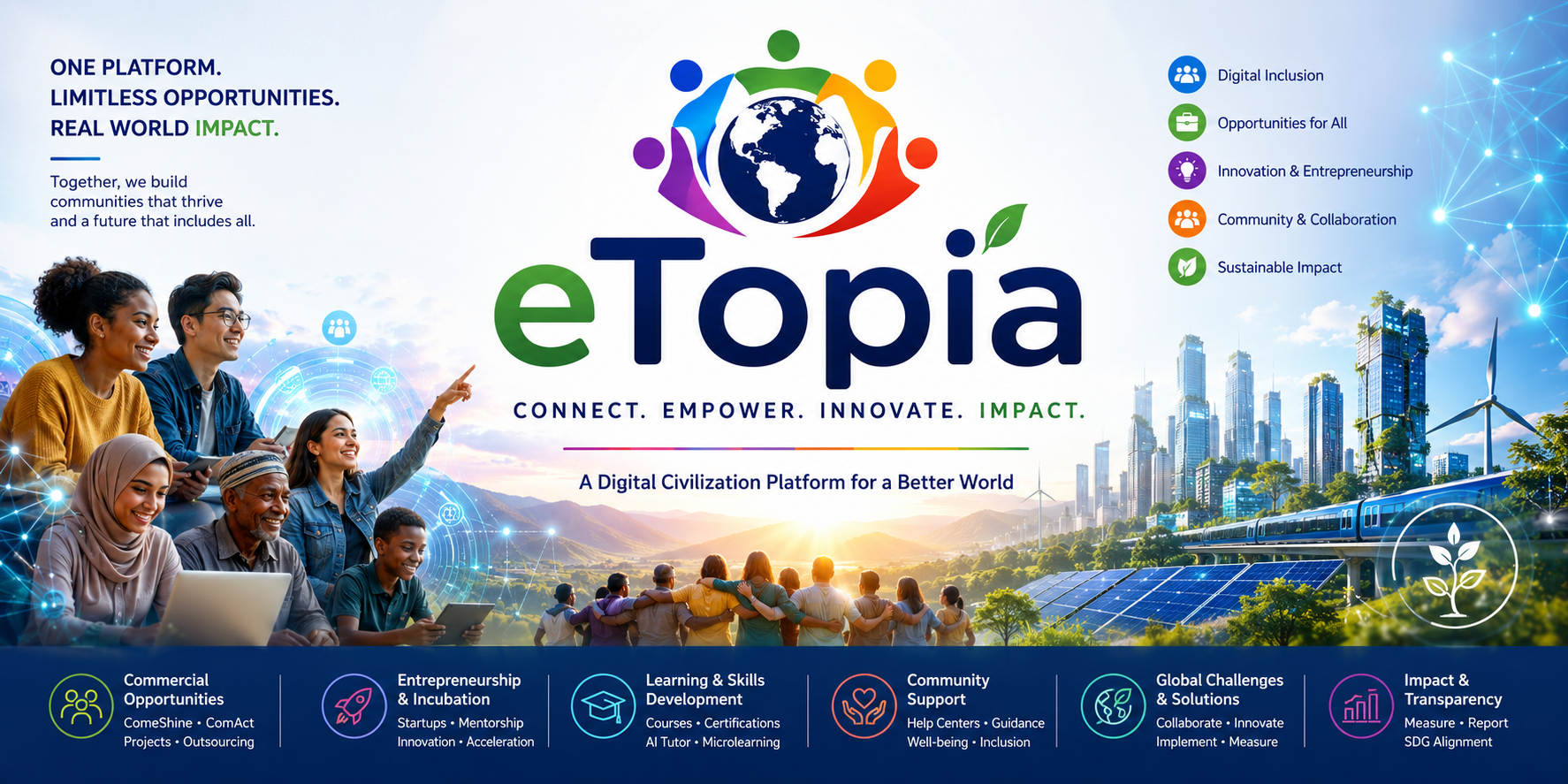
eTopia is an AI-powered Digital Civilization Platform that transforms connectivity into opportunity. It combines a Commercial Track and a Social Track to help individuals and communities learn, work, innovate, collaborate, and solve real-world challenges. The platform connects people with digital jobs, entrepreneurship programs, mentors, investors, educational resources, and community support services. Through AI-powered matching and decision-support systems, eTopia helps users discover opportunities, develop skills, access funding, launch startups, contribute to social-impact projects, and participate in solving local and global challenges. By integrating workforce development, digital inclusion, startup incubation, volunteerism, and impact measurement into a single ecosystem, eTopia creates a sustainable pathway for economic empowerment and community development.
How we built it We built eTopia as an AI-native platform from day one. The concept was developed by combining community-centered design principles with advances in artificial intelligence, cloud computing, and digital collaboration technologies. AI was used extensively throughout ideation, research, product architecture, user experience design, business modeling, content creation, and software development planning. The platform architecture was designed around two interconnected tracks: Commercial Track: Digital work marketplace, outsourcing hub, startup incubator, and talent ecosystem. Social Track: AI-assisted decision support, digital literacy services, help centers, volunteer networks, and community innovation programs. We leveraged AI copilots and agentic workflows to accelerate planning, automate repetitive tasks, generate documentation, evaluate use cases, and simulate ecosystem interactions. Human team members focused on strategy, governance, ethics, partnerships, and validating community needs.
Challenges we ran into One of the biggest challenges was designing a platform that addresses multiple interconnected problems without becoming overly complex. Communities often need more than internet access; they need jobs, education, mentorship, capital, and support systems. Balancing these needs while maintaining a simple user experience required significant iteration. Another challenge was ensuring that AI serves as an enabler rather than a replacement for human decision-making. We needed to define clear boundaries between what AI should automate and where human oversight remains essential. Building a sustainable business model was also challenging. Many social-impact platforms rely heavily on grants and donations. We therefore designed eTopia to generate its own economic engine through commercial activities while simultaneously supporting social-impact initiatives. Accomplishments that we're proud of We are proud of creating a platform that bridges economic development and social impact rather than treating them as separate goals.
Key accomplishments include: Designing a self-sustaining dual-track ecosystem. Creating an AI-native operating model. Building a framework that can scale globally while remaining locally adaptable. Integrating employment, entrepreneurship, education, mentorship, and community support into a unified experience. Developing a resource engine that connects sponsorships, donations, investments, volunteers, and talent to areas of greatest need. Aligning the platform with the United Nations Sustainable Development Goals (SDGs). Most importantly, we created a vision where underserved communities become creators of opportunity rather than recipients of aid.
What we learned Building eTopia reinforced several important lessons. First, technology alone does not solve social challenges. Real impact comes from combining technology with trust, community engagement, and human-centered design. Second, AI is most powerful when it augments human capabilities rather than replacing them. The best outcomes emerge when people and AI collaborate. Third, sustainable impact requires sustainable economics. Social innovation initiatives are more resilient when they generate their own value and opportunities. Finally, communities possess tremendous untapped potential. Given the right tools, connections, and support systems, people can become innovators, entrepreneurs, educators, and problem-solvers within their own communities.
What's next for eTopia Our next phase is transforming eTopia from a platform concept into a fully operational ecosystem. Key priorities include: Launching the MVP platform. Piloting programs in underserved communities. Establishing strategic partnerships with NGOs, universities, governments, and enterprises. Deploying AI copilots for opportunity matching and community support. Launching the ComeShine digital work marketplace. Launching startup incubation and mentorship programs. Expanding multilingual accessibility. Building the Global Challenge Marketplace. Developing impact measurement dashboards. Scaling across regions with high levels of digital exclusion. Our long-term vision is for eTopia to become the world's leading Digital Civilization Platform—an ecosystem where anyone, anywhere can access opportunities, build meaningful livelihoods, collaborate with others, and contribute to solving humanity's most pressing challenges.
Built With
- all

Log in or sign up for Devpost to join the conversation.