-

-
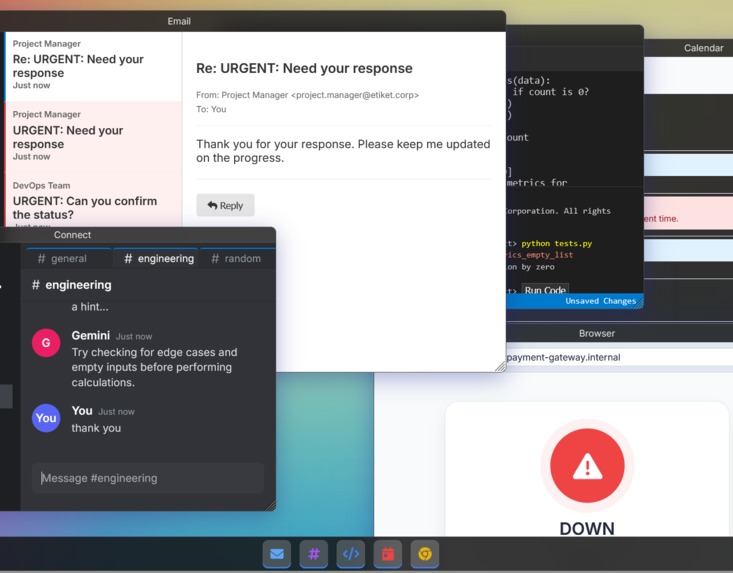
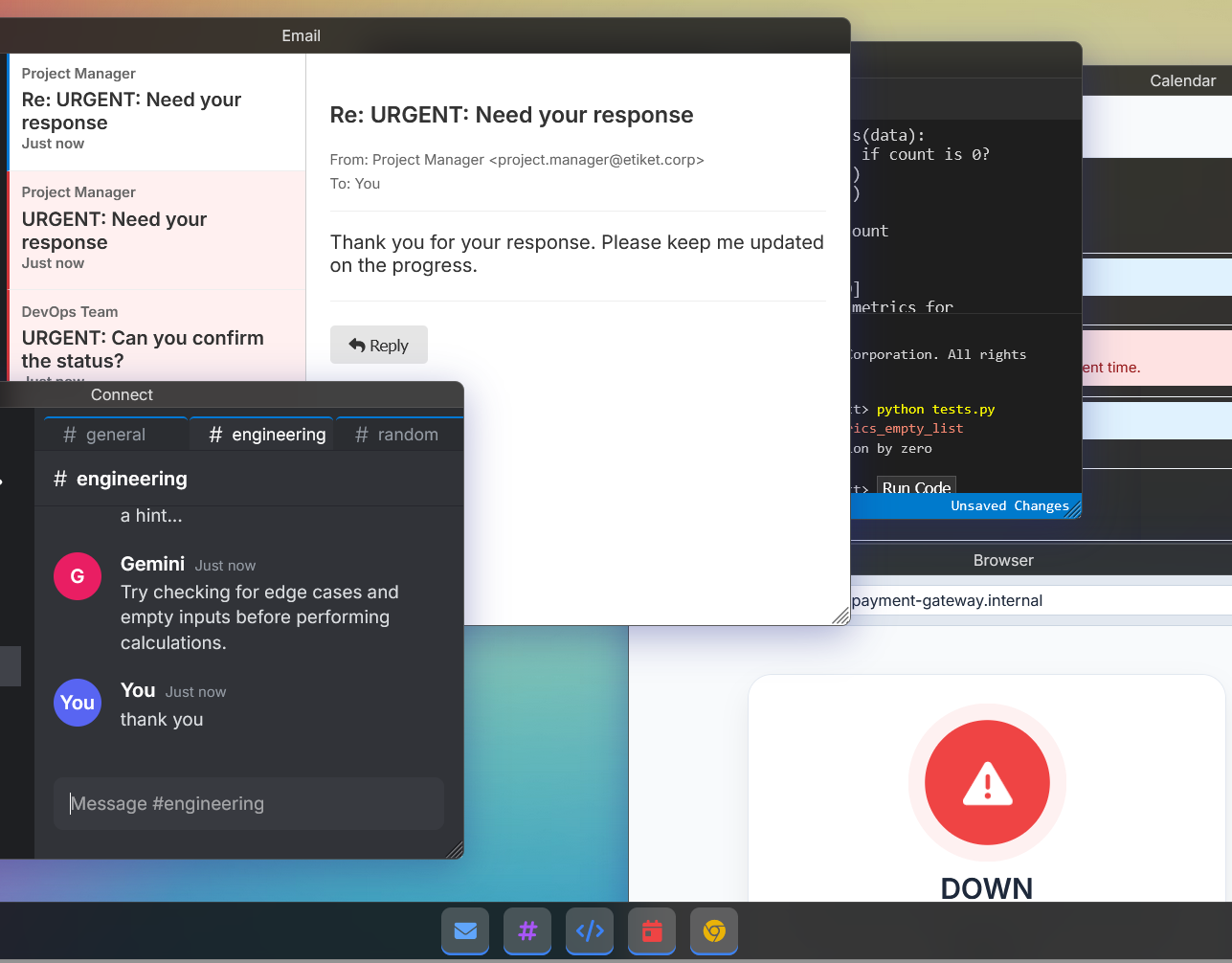
Demo layout of different workplace apps the program simulates to create a "real" workplace enviroment.

The Experience Paradox
The spark for Etiket came from a frustrating reality we noticed across our peers: you need experience to get a job, but you need a job to get experience. We saw brilliant computer science students who could solve complex algorithms in their sleep but froze when a manager sent a "quick ping" on Slack or when a project requirement changed ten minutes before a deadline.
We realized that the "First Day Jitters" are not about a lack of technical skill; they are about a lack of environmental familiarity. We wanted to build a "Flight Simulator" for the office. Just as pilots spend hundreds of hours in a cockpit before touching a real plane, we believe students should navigate a simulated workplace before their first internship. Our goal was to move the "learning curve" from the employer’s payroll to our sandbox.
Building the Virtual OS
The technical architecture relies on three primary pillars:
The State Machine: We used a complex state management system to ensure that an action in the "Email App" would trigger a "Slack" notification or a "Calendar" update. This creates the "Chain Reaction" effect.

The Persona Engine: We integrated Large Language Models to act as distinct workplace archetypes. We did not just want a generic bot; we programmed a "High-Pressure Senior Dev" and a "Vague Product Manager" to test the student's ability to navigate different communication styles, including ambiguity.

The Technical Sandbox: We embedded a functional code editor (VSCode-style) so that technical tasks are not isolated. The user must code while the "Teammate" pings them, forcing a simulation of real-world context switching.
The Challenges: Measuring the Invisible
The greatest challenge was creating an objective scoring system for subjective behaviors. How do you quantify "Professionalism" without it being a "vibe"?
Instead of judging the content of a message alone, we measured the Delta of Response:
How long did it take for the user to "React" to a message, even if they had not solved the problem yet?
Did the user mention the rescheduled meeting from the Calendar app when replying to the Manager in Slack?
Balancing these weights to ensure a "Skeptic" AI manager was not being unfairly harsh was a constant iterative process.
Lessons Learned: Work is a Social Graph
This project taught us that technical work does not happen in a vacuum. We learned that Communication is a technical requirement. A bug fixed but not communicated is, for all intents and purposes, still a bug in the eyes of a team.
By observing how a student handles a market shock or a broken build, we can see their true professional personality like their resilience and adaptability far better than any multiple-choice test could ever reveal.


Log in or sign up for Devpost to join the conversation.