Inspiration
Traditional medicinal knowledge represents an important source of cultural heritage and scientific research potential. However, this knowledge is often scattered across ethnobotanical surveys, historical documents, botanical databases, and scientific publications.
Connecting traditional plant uses with verified botanical identities, phytochemical compounds, experimental bioactivity,y and biodiversity records remains challenging.
We were inspired to bridge this gap by combining artificial intelligence, computational biology and data science into one unified research platform. We wanted to build more than another medicinal-plant database: we wanted to create a system that makes traditional knowledge discoverable, scientifically traceable and responsibly preserved.
What it does
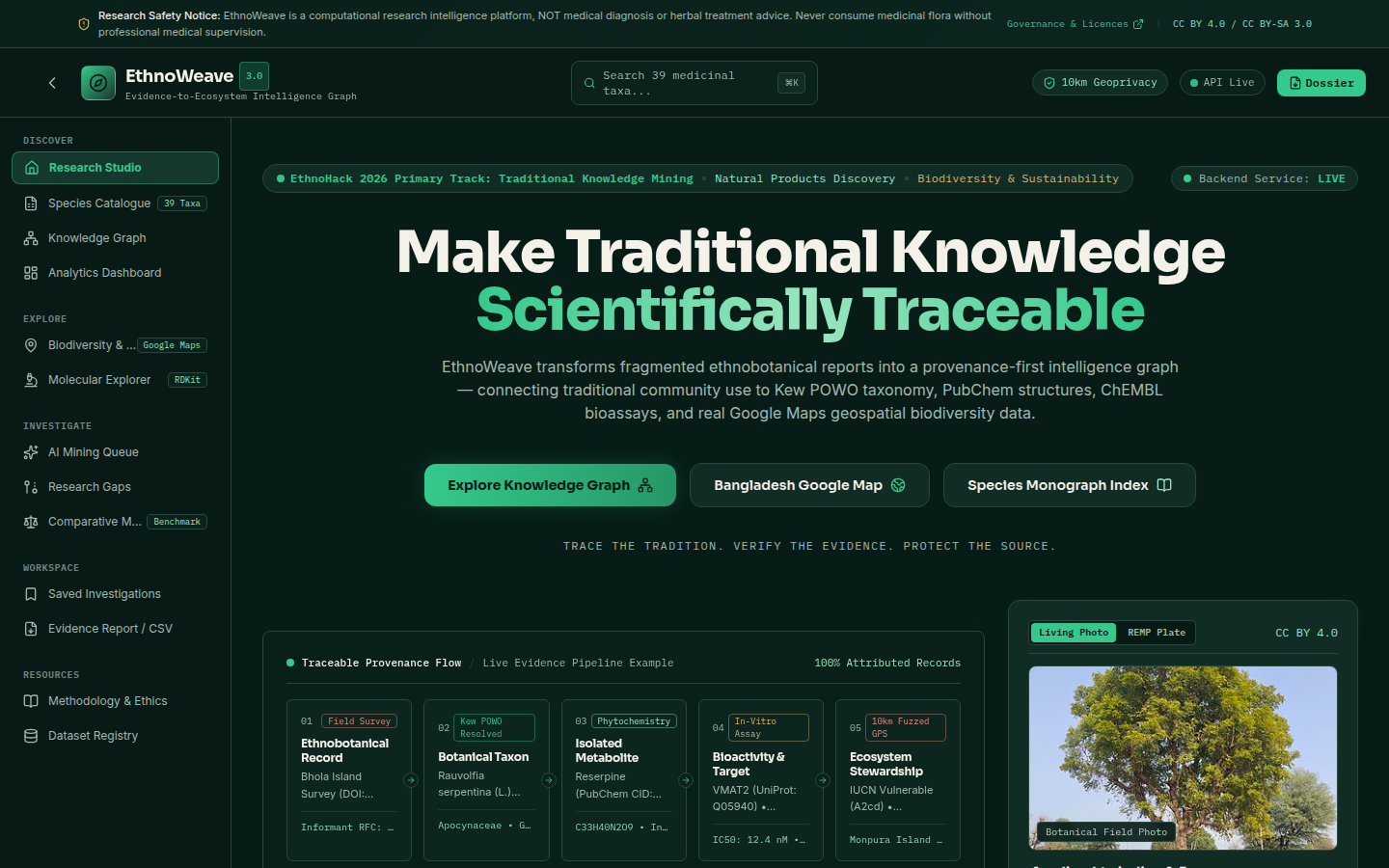
EthnoWeave is an AI-assisted scientific research intelligence platform that connects traditional medicinal knowledge with botanical taxonomy, molecular research and biodiversity conservation through an evidence-based knowledge graph.
Its core capabilities include:
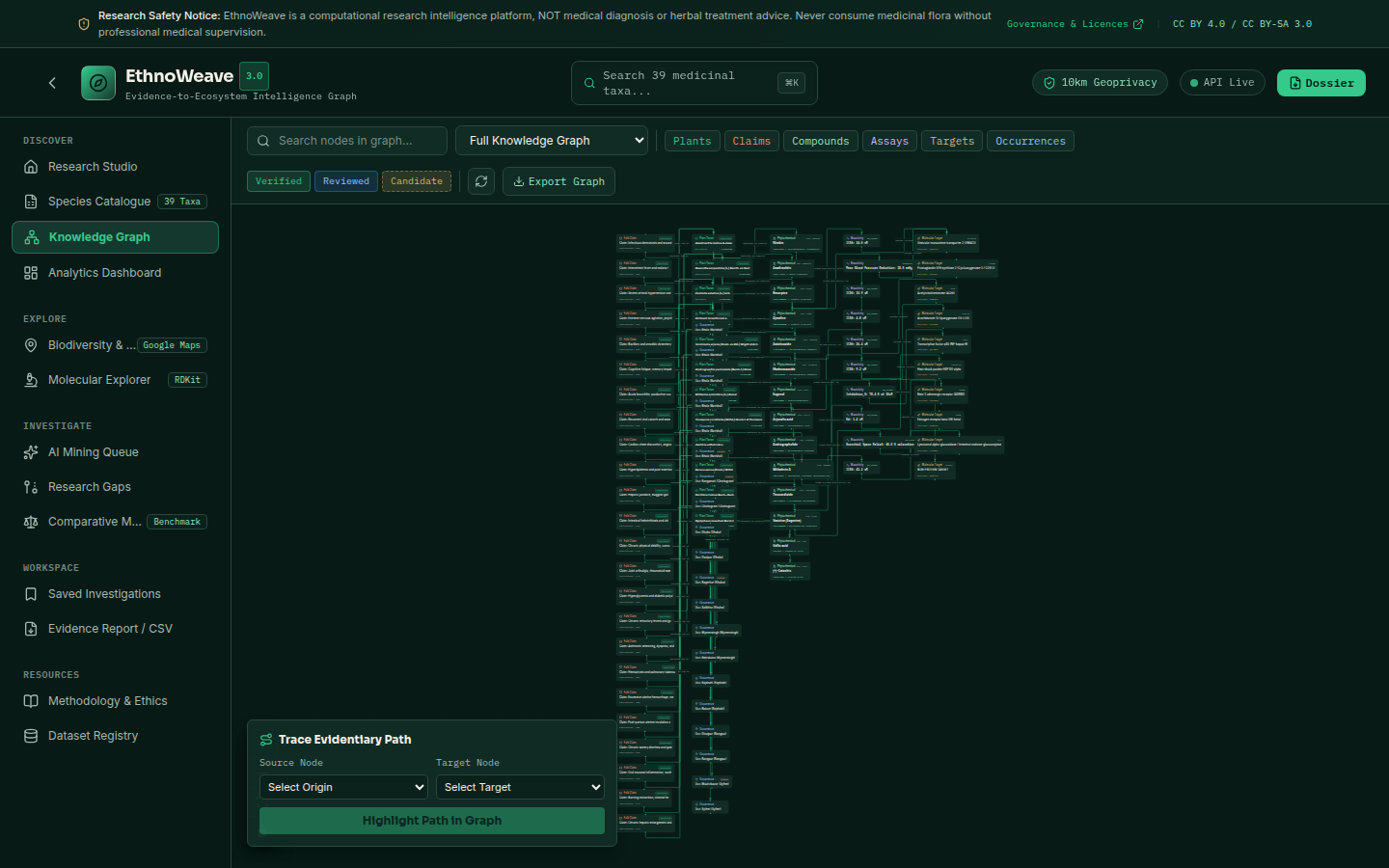
- Living Knowledge Graph: Connects medicinal plants, traditional-use claims, compounds, molecular targets, experimental assays, research papers, rs and biodiversity records.
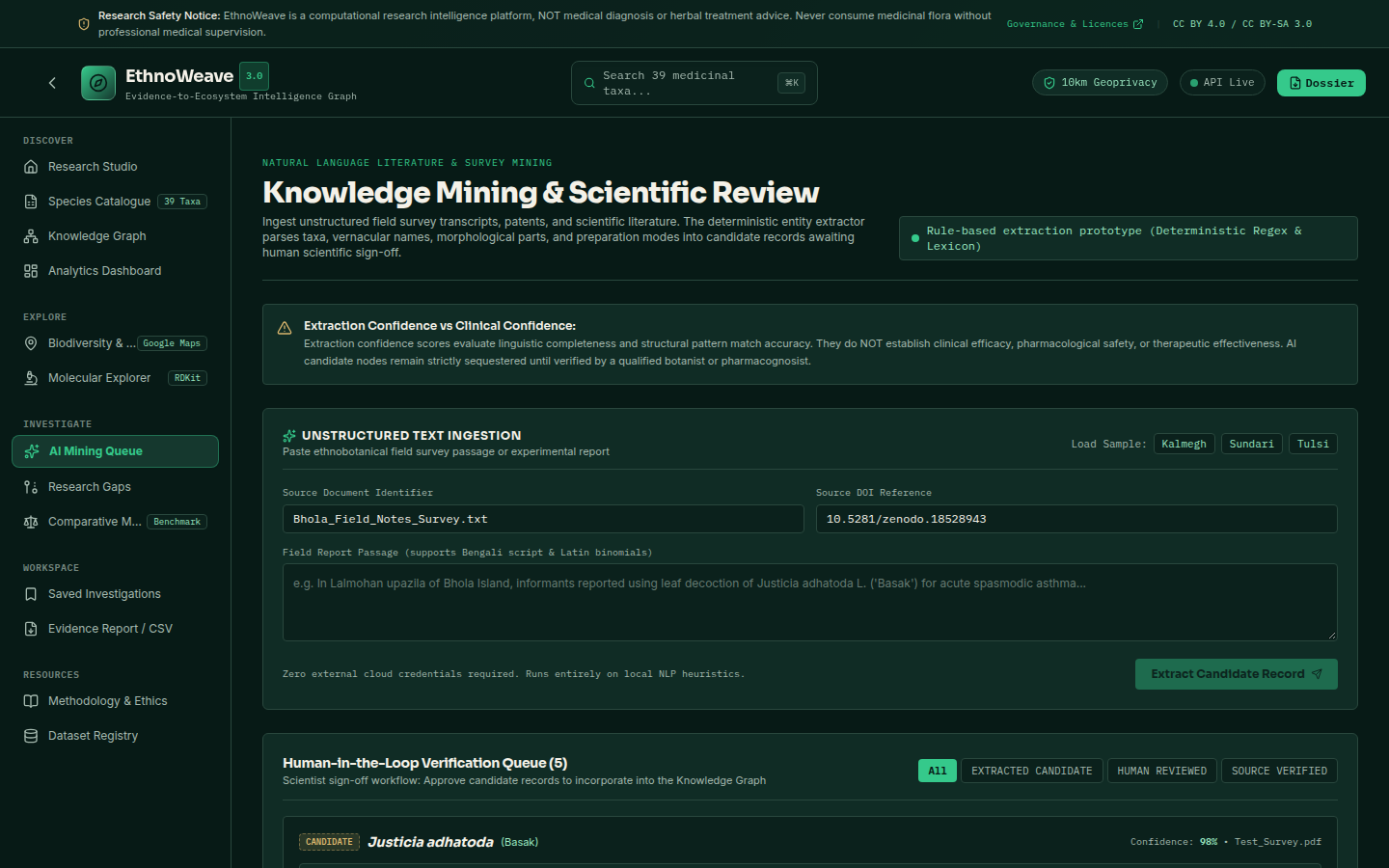
- AI Knowledge Mining: Extracts botanical names, traditional-use statements, plant parts,rts and preparation methods from scientific text using a rule-based extraction prototype and human verification.
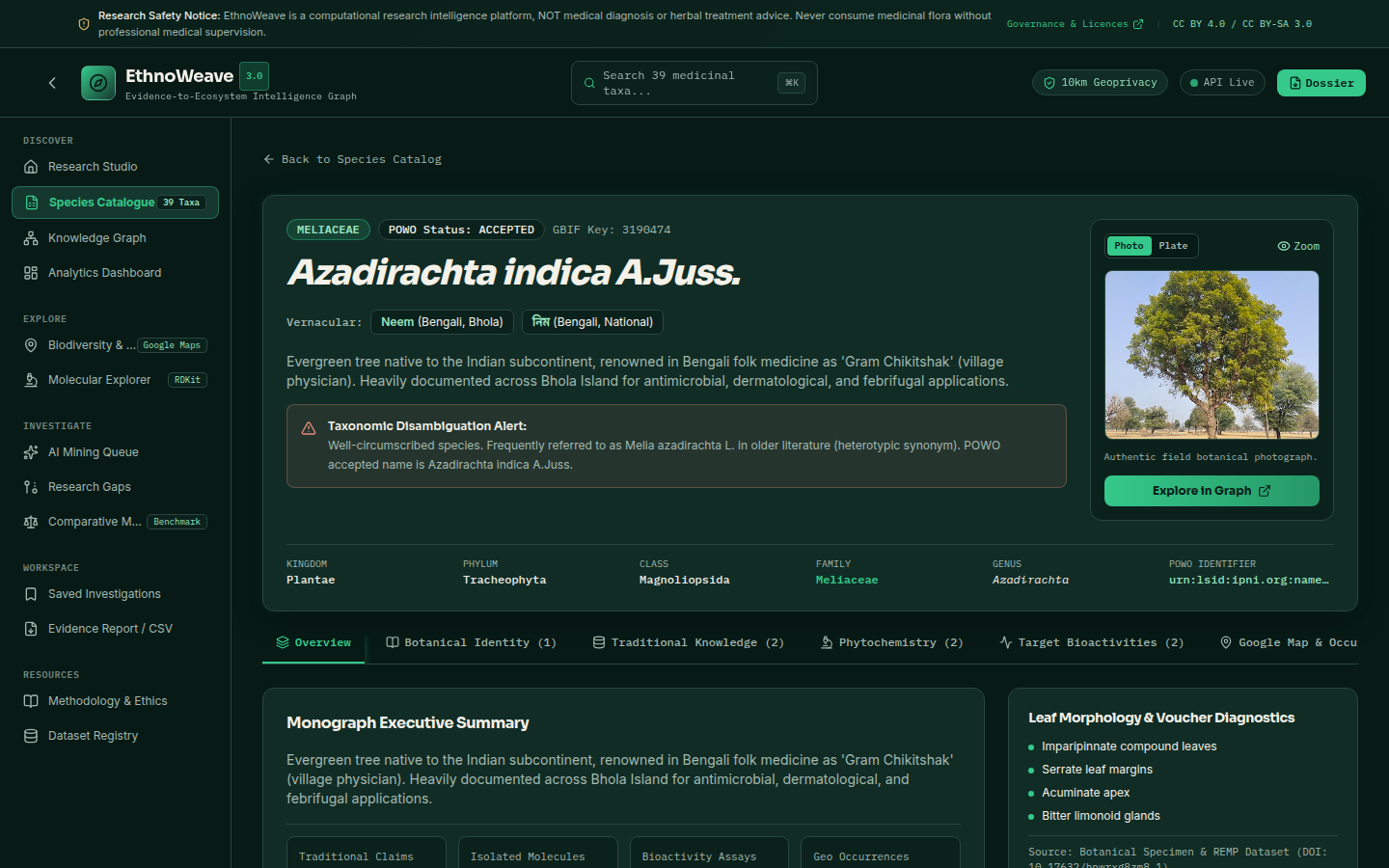
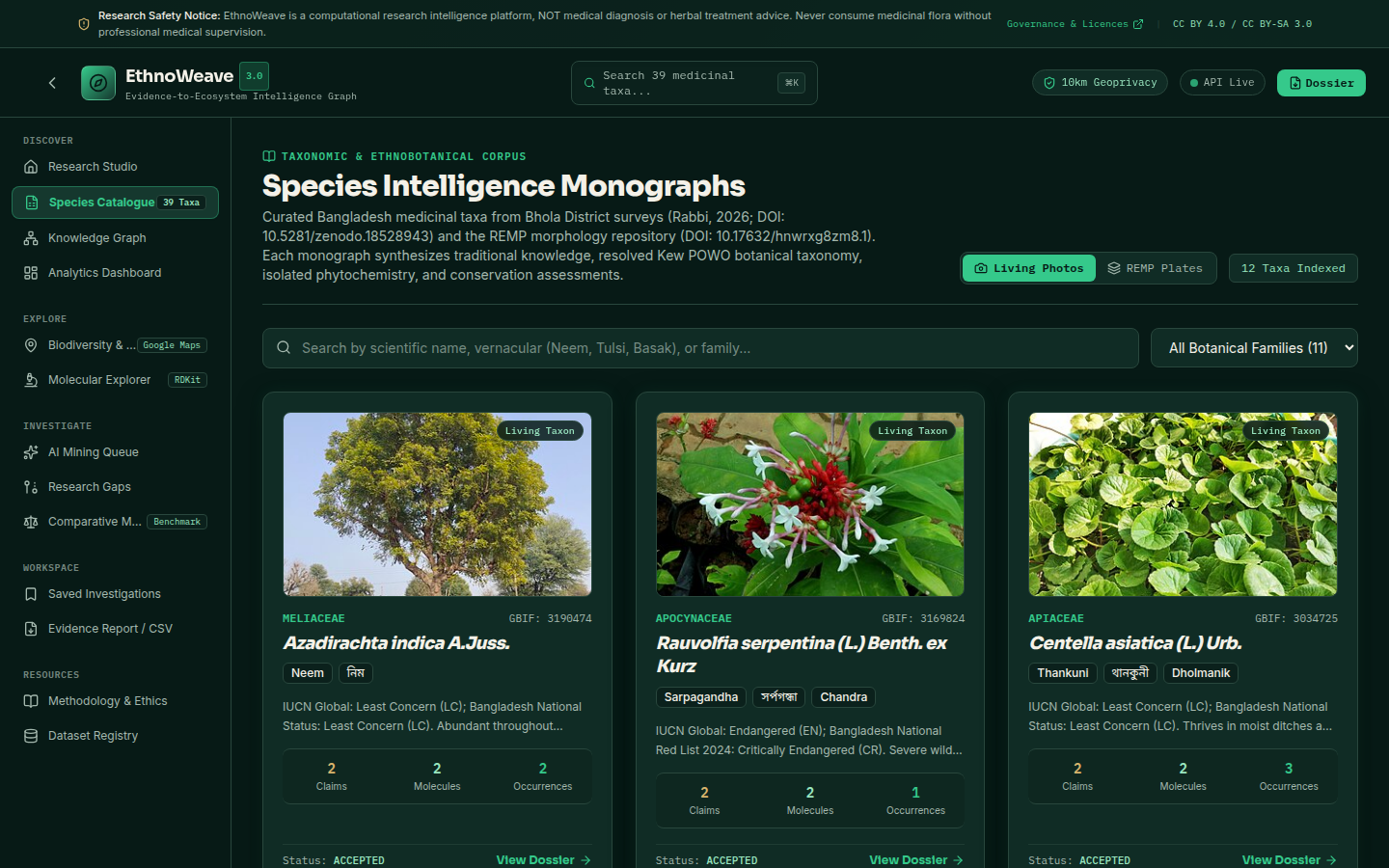
- Species Intelligence: Provides detailed botanical profiles, synonyms, vernacular names, documented uses, photographs, and supporting research references.
- Molecular Research Lab: Uses RDKit to calculate molecular descriptors, explore chemical structures,s and assess Lipinski Rule-of-Five and Veber screening criteria.
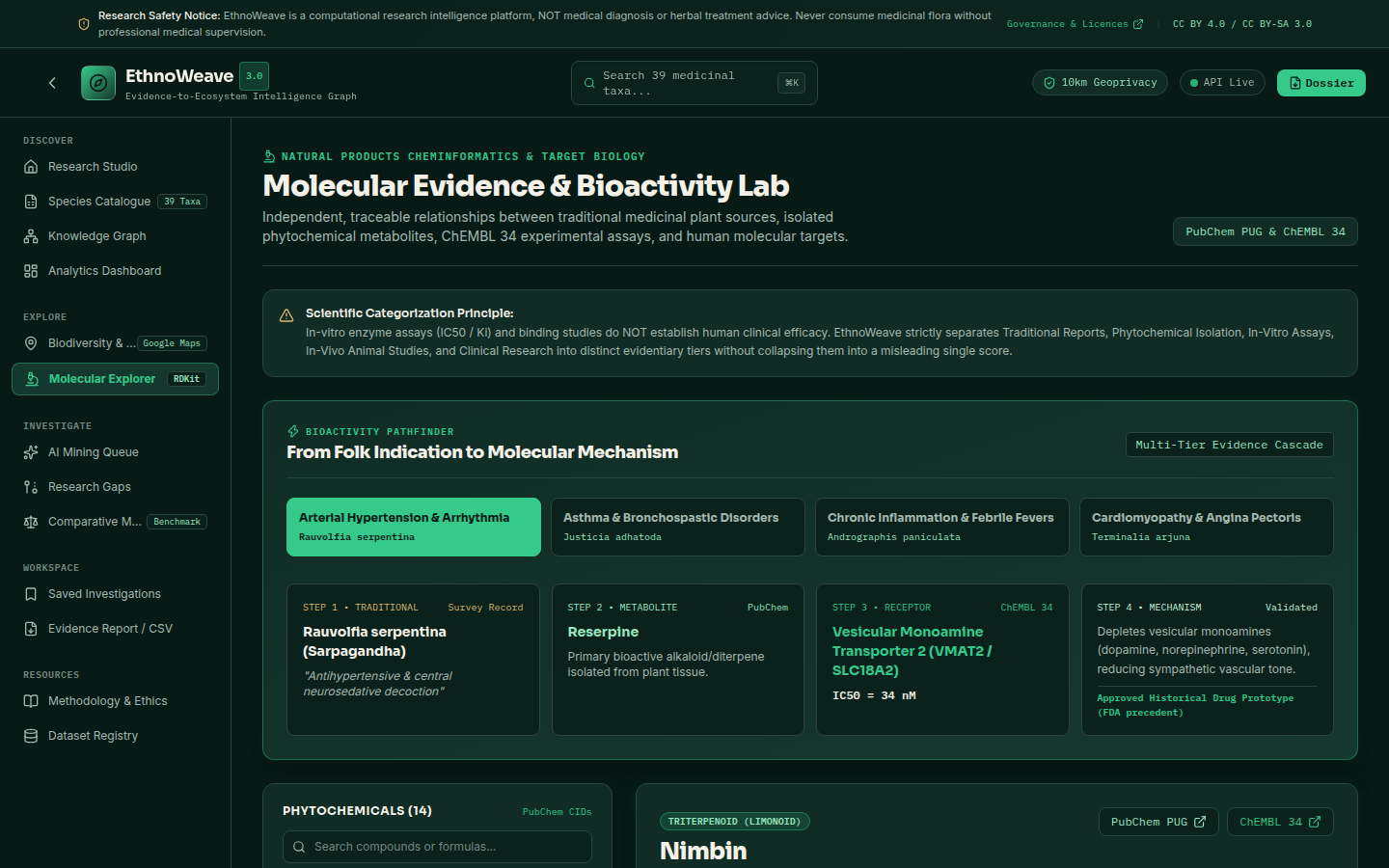
- Bioactivity Pathfinder: Connects documented compounds with experimental bioactivity records while distinguishing cell-based findings from molecular mechanisms and clinical evidence.
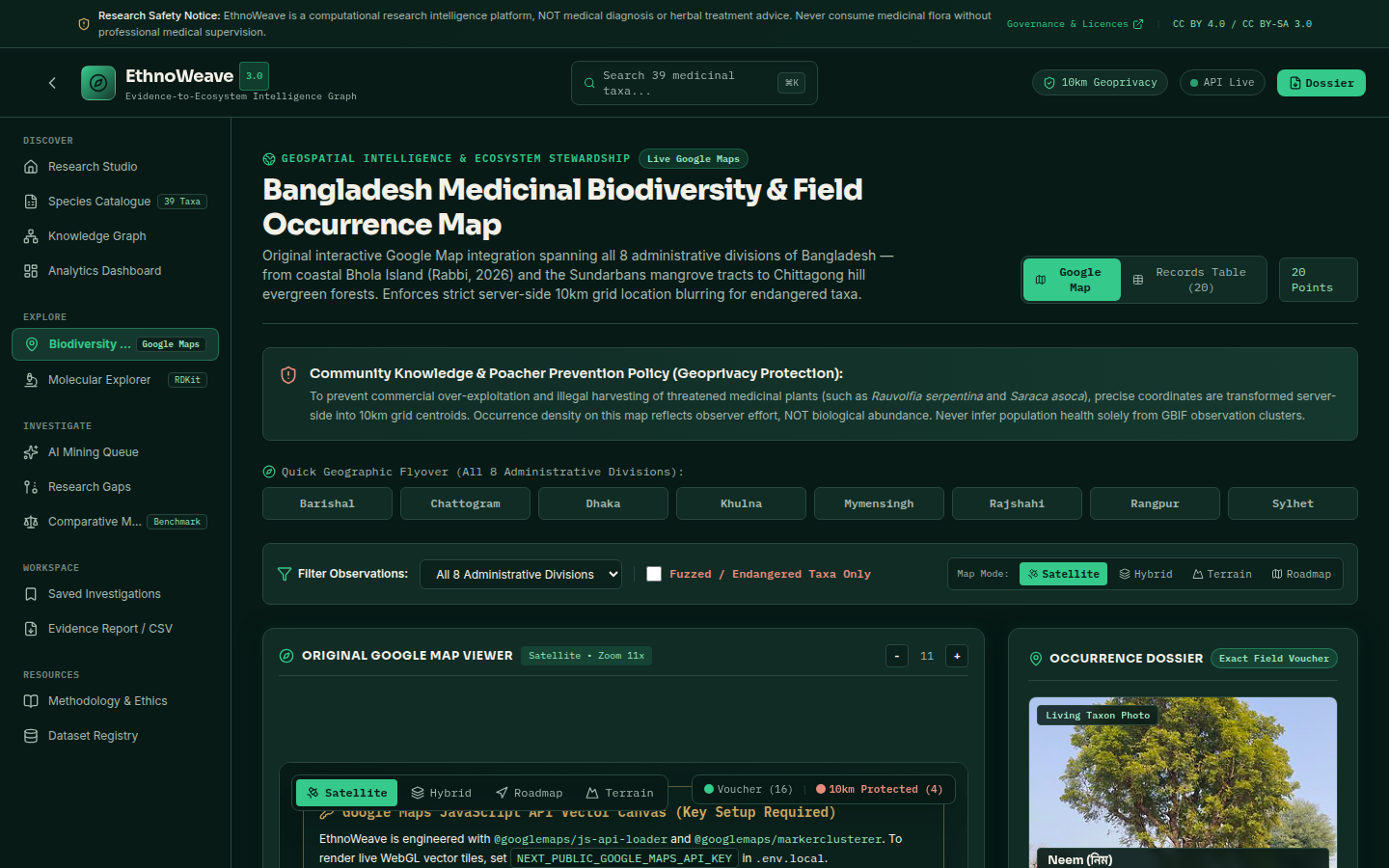
- Google Maps Biodiversity Explorer: Visualizes geographic occurrence records across Bangladesh using interactive Google Maps, marker clustering, and protected-location generalization.
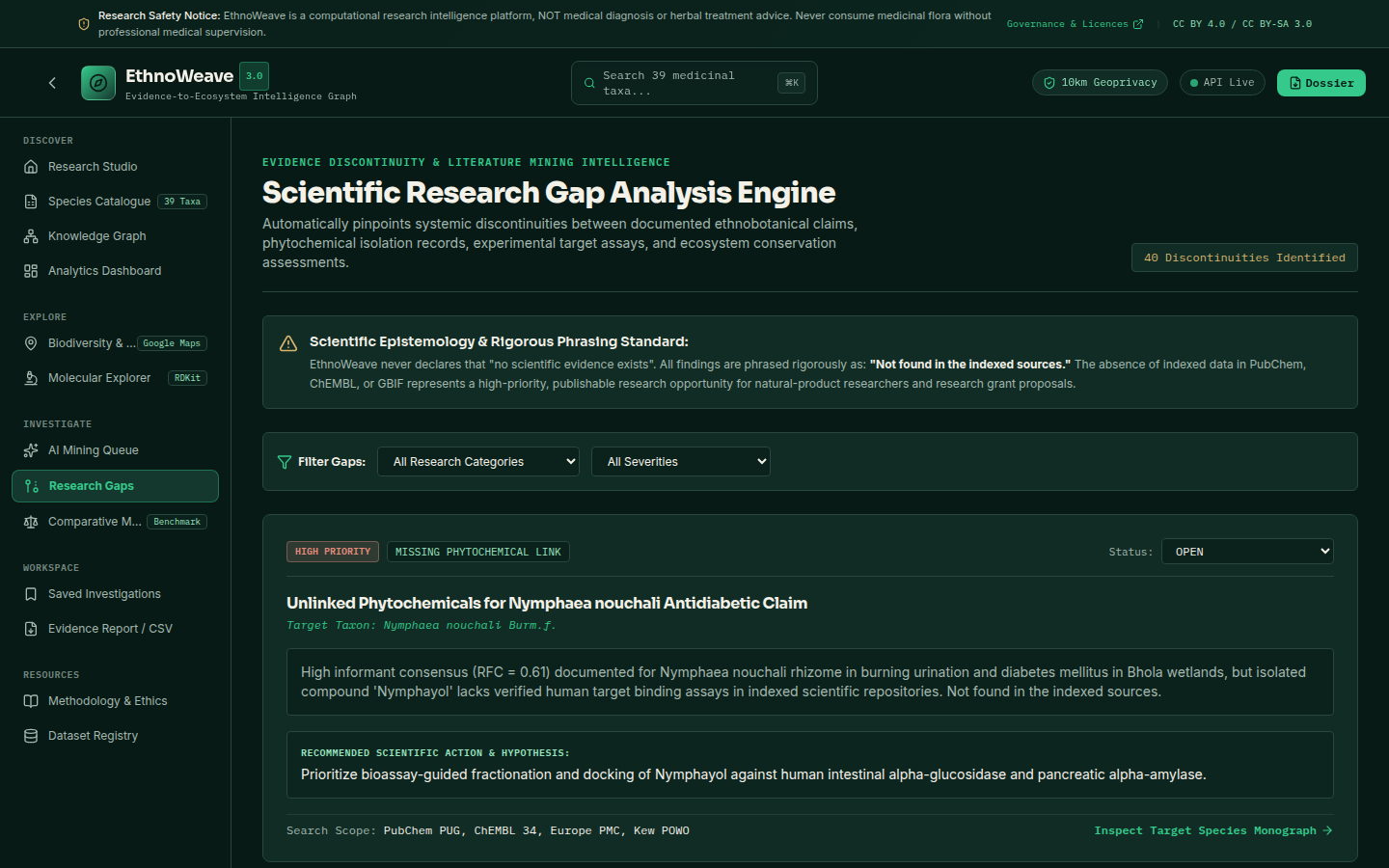
- Research Gap Analysis: Identifies relationships not found in indexed sources and generates potential research questions.
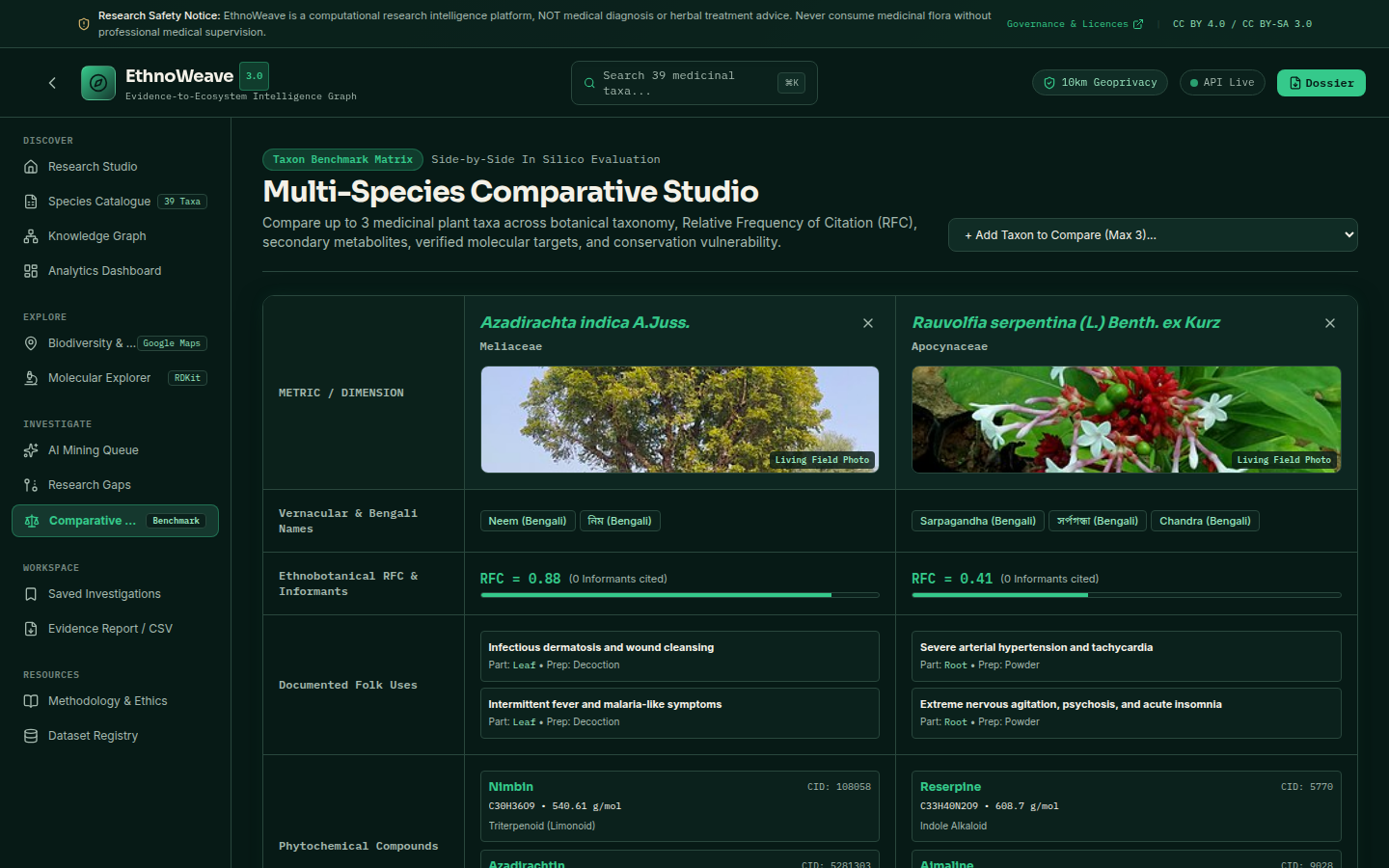
- Species Comparison: Allows researchers to compare up to three medicinal plant species across taxonomy, documented uses, compounds,s and available experimental evidence.
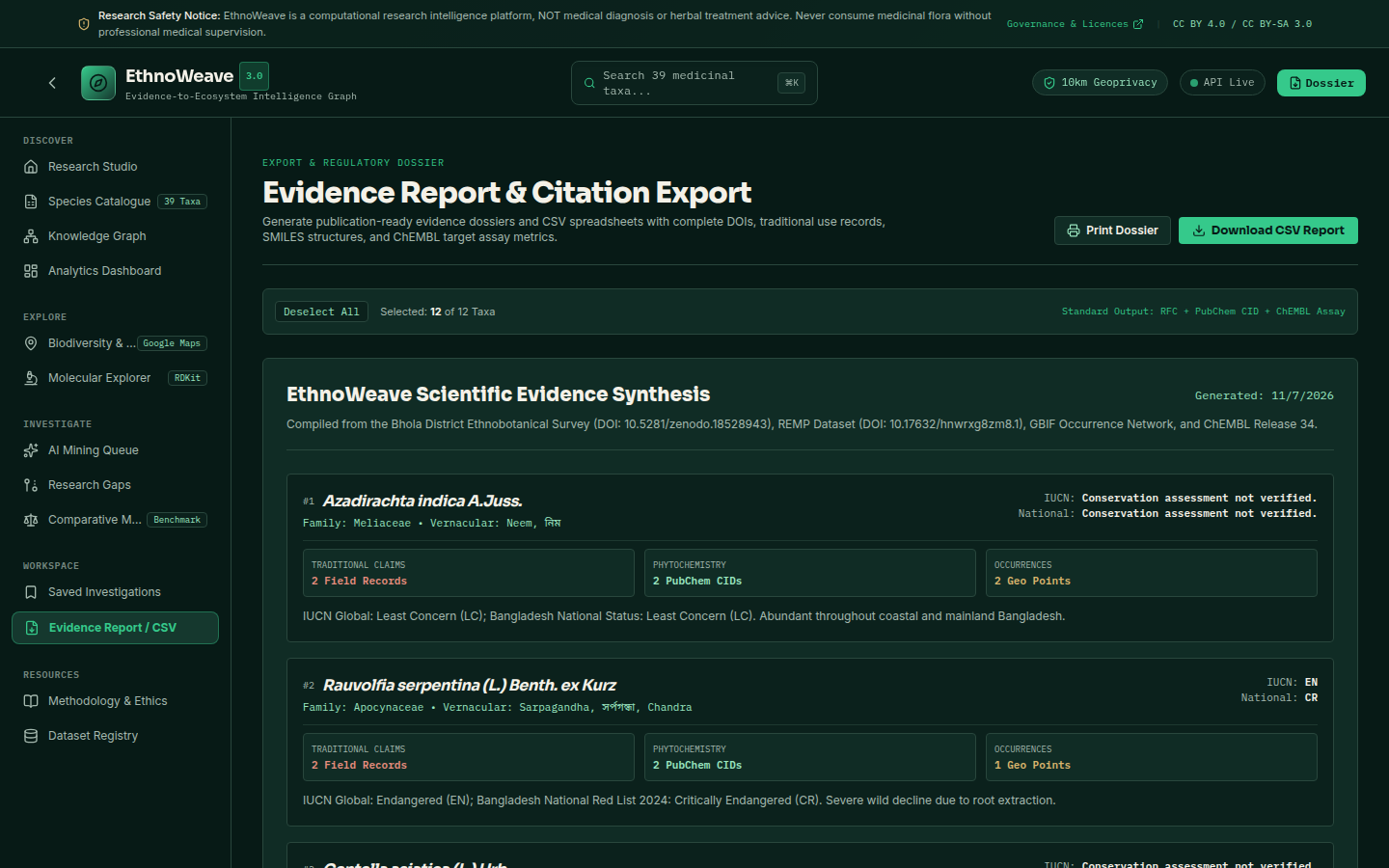
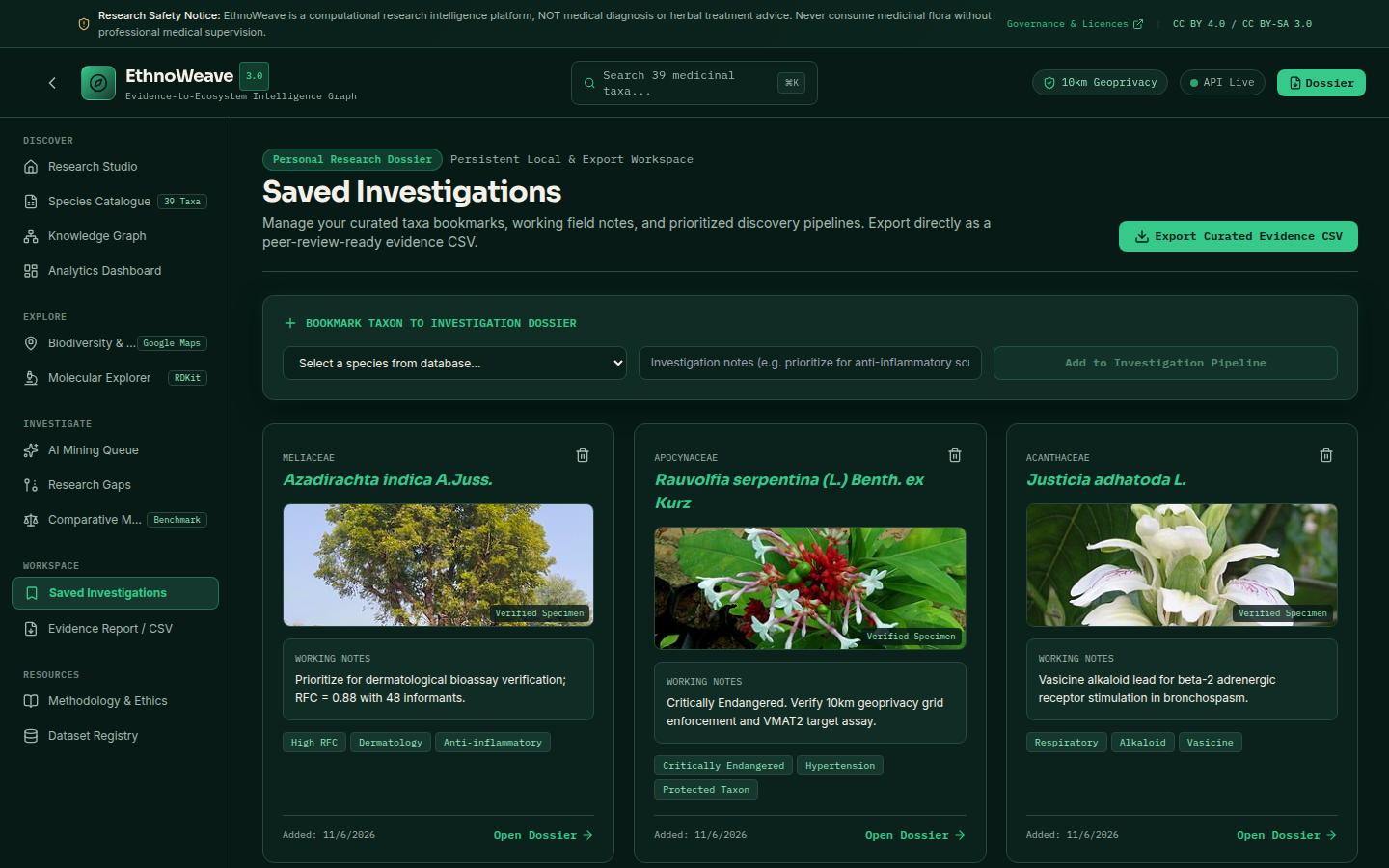
- Evidence Reports: Generates structured, source-attributed research exports.
Every important scientific relationship is designed to retain its source, verification status, and limitations.
How we built it
We developed EthnoWeave using a modern full-stack architecture.
Frontend
- Next.js 15 with App Router
- React and TypeScript
- Tailwind CSS
- Framer Motion
- React Flow for interactive knowledge graphs
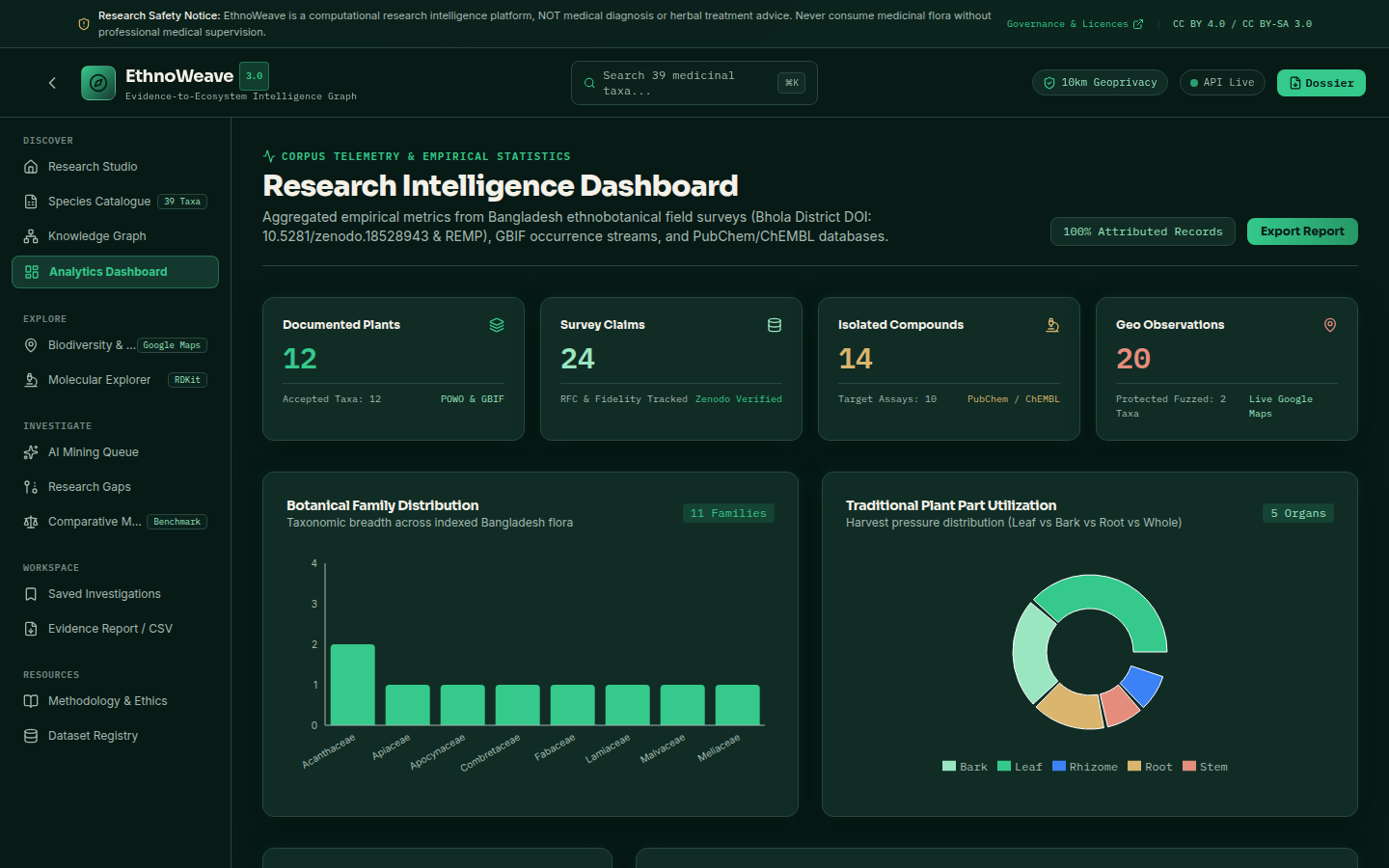
- Recharts for scientific data visualization
- Google Maps JavaScript API
- Lucide icons
Backend
- Python 3.12
- FastAPI
- SQLAlchemy
- RDKit for cheminformatics
- NetworkX for graph processing
- Pydantic for data validation
Scientific data and research resources
- Bhola District Ethnobotanical Survey (Zenodo)
- REMP medicinal-plant leaf morphology dataset (Mendeley Data)
- GBIF for biodiversity and occurrence information
- PubChem for chemical identities and molecular structures
- ChEMBL for experimental bioactivity information
- Relevant scientific literature and taxonomic references
We implemented a provenance-oriented evidence model with four verification states: Candidate, Reviewed, Source Verified, and Experimentally Reported.
We also introduced server-side geographic generalization for sensitive plant occurrences to reduce the risk of exposing vulnerable species locations.
Challenges we ran into
One of our biggest challenges was connecting scientific information from different sources without creating unsupported biological relationships.
A plant's traditional use does not establish its pharmacological effectiveness. A compound's chemical identity does not prove that it occurs in a particular plant. Similarly, an in vitro experiment does not establish clinical efficacy.
We addressed these problems by implementing evidence provenance, independent verification states, and explicit scientific limitations.
Other challenges included:
- Resolving botanical synonyms and ambiguous plant names.
- Handling different data structures and identifiers across scientific APIs.
- Preserving dataset attribution and licensing requirements.
- Correctly identifying chemical structures and calculating molecular descriptors.
- Implementing geographic privacy without losing useful regional information.
- Maintaining consistency between the database, backend APIs, and frontend visualizations.
- Building a responsive research interface without sacrificing scientific detail.
Accomplishments that we're proud of
We are particularly proud of transforming the original concept into a multidisciplinary scientific research application rather than a conventional information website.
Our major accomplishments include:
- Developing an interactive knowledge graph connecting multiple categories of scientific information.
- Implementing an RDKit-powered cheminformatics engine with dynamically calculated molecular descriptors.
- Building a Google Maps-based biodiversity research interface with multiple map modes and marker clustering.
- Introducing a human-in-the-loop workflow for reviewing extracted traditional knowledge.
- Implementing privacy-preserving geographic visualization for sensitive medicinal plant records.
- Developing species comparison, research gap analysis,s and evidence-reporting tools.
- Creating a source-linked research workflow using Bangladesh-focused ethnobotanical information and international scientific resources.
One important demonstration involves Nimbin, a neem-derived limonoid. EthnoWeave connects its chemical identity and calculated molecular properties with a ChEMBL-reported cell-based cytotoxicity measurement, while explicitly avoiding unsupported claims of COX-2 inhibition or clinical effectiveness.
Our reported final validation suite includes 42 passing backend tests, successful TypeScript and ESLint checks, a successful production build,ld and 21 passing Playwright verification gates.
What we learned
This project taught us that building an AI-powered scientific platform requires considerably more than integrating machine-learning tools or creating an attractive interface.
Scientific provenance is as important as computational performance.
We learned to distinguish:
- Information extraction confidence from scientific validity.
- Traditional medicinal use from experimentally demonstrated activity.
- Chemical identification from plant-to-compound evidence.
- Cell-based cytotoxicity from target-specific molecular mechanisms.
- Computational drug-likeness screening from measured oral bioavailability.
- Geographic observation density from actual biological abundance.
We also learned how important database integrity, data licensing, reproducibility, privacy, and human verification are when developing technology around traditional knowledge.
Most importantly, we learned that AI should assist scientific investigation, not replace scientific judgement.
What's next for EthnoWeave
We envision EthnoWeave evolving into a broader scientific research infrastructure for ethnopharmacology and biodiversity intelligence.
Our next priorities include:
- Expanded knowledge coverage: Incorporating additional verified ethnobotanical surveys, historical resources,s and scientific literature from Bangladesh and other regions.
- Multilingual knowledge mining: Improving extraction and botanical-name recognition for Bangla and other regional languages.
- Advanced research intelligence: Introducing stronger evidence retrieval, entity resolution, and scientifically validated research-prioritization models.
- Improved biodiversity monitoring: Expanding geographic coverage and integrating additional authoritative conservation resources.
- Community-centered knowledge governance: Developing better approaches to attribution, consent, access control and protection of culturally sensitive traditional knowledge.
- Research collaboration: Supporting persistent research workspaces, reproducible investigations and collaboration between botanists, pharmacologists, computational researchers and conservation professionals.
- Production deployment: Expanding the platform into a secure, scalable research service accessible to universities and scientific institutions.
Our vision is simple: traditional knowledge should not remain isolated in documents. It should become discoverable, scientifically traceable, responsibly investigated, and preserved for future generations.
EthnoWeave — Trace the tradition. Verify the evidence. Protect the source.
Built With
- ai
- chembl-api
- cheminformatics
- fastapi
- framer-motion
- gbif-api
- google-maps
- natural-language-processing
- networkx
- next.js
- playwright
- postgresql
- pubchem-api
- pydantic
- pytest
- python
- rdkit
- react
- react-flow
- recharts
- rest-api
- sqlalchemy
- sqlite
- tailwind-css
- typescript
