Inspiration
Traditional medicinal plant knowledge represents generations of observation and experience, yet understanding how it relates to modern scientific research remains surprisingly difficult.
A plant documented in an ethnobotanical account might appear in numerous experimental studies. However, studying the same species does not necessarily mean scientists have tested the same traditional use. Researchers may investigate different plant parts, extraction methods, biological outcomes, or experimental settings.
We were particularly interested in this problem in the context of Canadian Indigenous and settler ethnobotanical knowledge associated with blood-glucose regulation and diabetes-related symptoms.
Our guiding research question became:
How closely do experimental studies actually test documented Canadian traditional medicinal plant uses, and where are the gaps in the available evidence?
We created EthnoTrace to help answer this question by connecting traditional-use documentation with scientific literature in a transparent, structured, and reproducible way.
Rather than treating scientific evidence as simply confirming or disproving traditional knowledge, we wanted to build a tool that makes differences visible, preserves source attribution, and helps researchers identify what has and has not been experimentally investigated.
What it does
EthnoTrace is an interactive evidence-mapping and literature-retrieval tool that connects documented traditional medicinal plant uses with relevant experimental research.
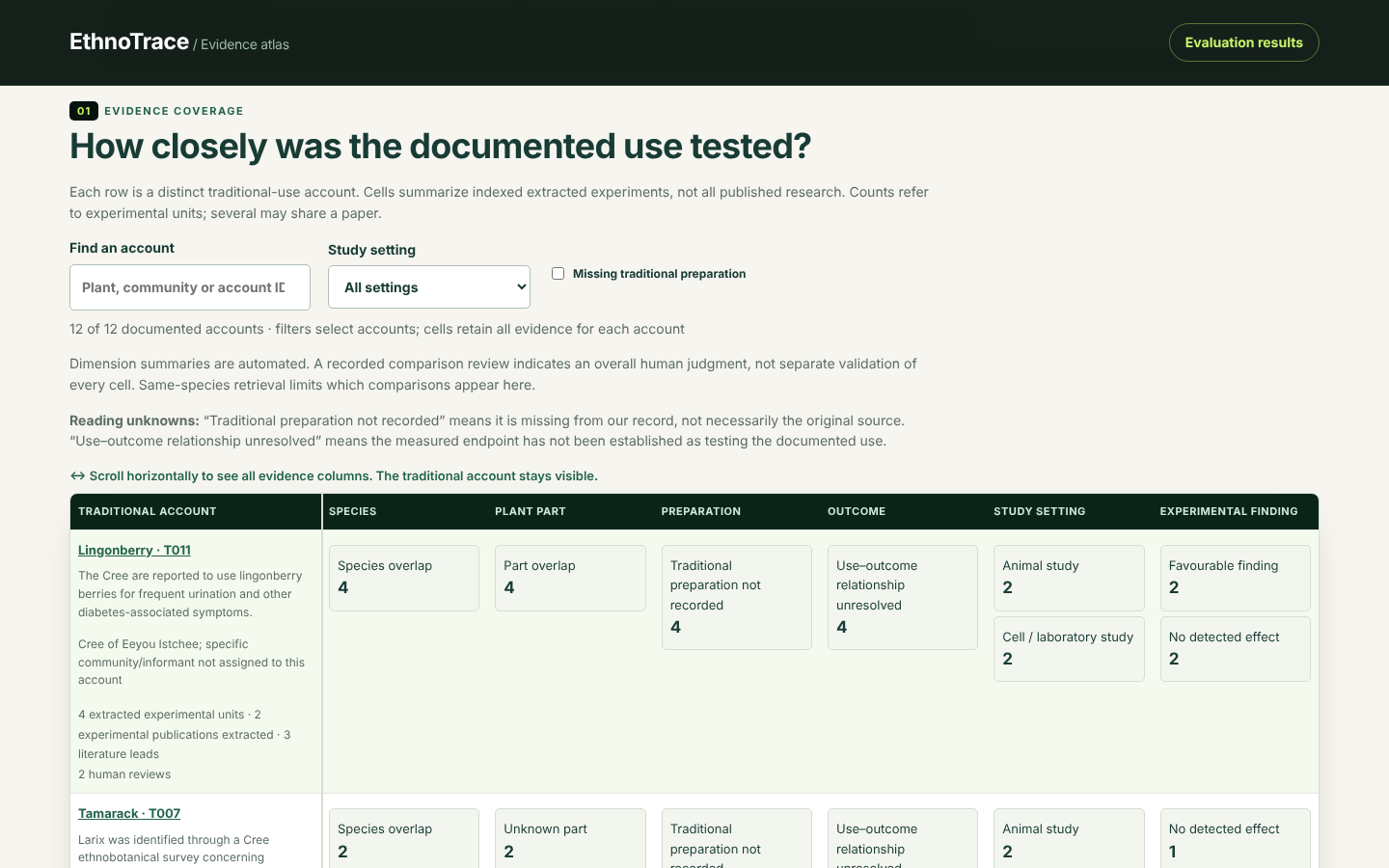
Its central feature is an Evidence Atlas, which organizes traditional-use accounts and scientific studies into an explorable comparison interface.
Users can:
- Explore traditional-use records: Examine plant species, traditional names, communities, plant parts, preparations, reported uses, and original sources.
- Discover relevant scientific literature: Retrieve potentially relevant experiments using lexical, semantic, or hybrid search methods.
- Compare traditional uses with experiments: Identify whether studies investigate the same species, plant part, preparation, and biological outcome.
- Distinguish findings from comparability: Separate what an experiment found from whether it actually tests the documented traditional use.
- Identify research gaps: Discover missing documentation, untested preparations, different experimental outcomes, and areas where evidence remains insufficient.
- Inspect citations and export reports: Trace comparisons to their sources and generate Markdown evidence summaries.
For example, a traditional account might document the use of pitcher plant leaves, while a laboratory experiment investigates a root extract and measures cell survival under high-glucose conditions.
Although both records concern the same species, they do not investigate the same preparation or outcome. EthnoTrace makes these differences explicit instead of presenting the experiment as straightforward validation.
The goal is not to recommend medical treatments or automatically determine whether traditional practices are effective. Instead, EthnoTrace helps researchers understand how closely the existing scientific literature addresses documented traditional knowledge.
How we built it
We developed EthnoTrace using Python, JavaScript, HTML, CSS, and natural-language processing, emphasizing reproducibility, interpretability, and scientific transparency.
1. Structuring the evidence
We began with an existing curated ethnobotanical dataset and developed a reproducible preprocessing pipeline to organize traditional-use accounts and experimental studies into standardized records.
Our dataset currently includes:
- 12 Canadian traditional-use accounts, covering nine identified species and two unresolved plant names.
- 12 extracted experimental evidence units from six scientific publications.
- 51 indexed scientific publications for literature discovery.
Each traditional-use record preserves information such as plant identity, community attribution, plant part, preparation, reported use, and source references.
Experimental records separately describe study settings, interventions, measured outcomes, findings, and supporting citations.
2. Developing the retrieval system
We implemented three approaches for identifying relevant scientific literature:
Lexical retrieval: A deterministic ranking algorithm that considers species identity, plant parts, preparations, and textual overlap.
Semantic retrieval: A pretrained Sentence Transformers model (all-MiniLM-L6-v2) that uses vector embeddings and cosine similarity to identify relationships between traditional-use descriptions and experimental literature.
Hybrid retrieval: A Reciprocal Rank Fusion approach combining lexical and semantic rankings.
All three methods use the same eligible candidate records, allowing us to compare their performance without changing the underlying scientific evidence.
3. Creating the Evidence Atlas
We built a responsive web interface using vanilla JavaScript, HTML, and CSS.
The Evidence Atlas displays traditional accounts alongside related experimental studies, highlighting similarities, differences, missing information, and evidence gaps.
Users can filter records, switch retrieval methods, inspect citations, explore individual comparison dimensions, and download evidence reports.
A key design decision was to separate experimental findings from claim comparability. An experiment might demonstrate a favourable biological effect while still being insufficiently comparable to the documented traditional practice.
4. Evaluation and testing
We developed automated tests, data-validation scripts, reproducible preprocessing, reviewer-reconciliation procedures, and retrieval-evaluation tools.
Our assisted development evaluation includes 33 account–candidate pairs across six traditional-use queries.
| Retrieval method | Precision@5 | Recall@5 |
|---|---|---|
| Lexical | 0.667 | 0.828 |
| Semantic | 0.733 | 0.889 |
| Hybrid | 0.733 | 0.903 |
These results are exploratory development measurements based on assisted relevance judgments, not independently blinded validation.
The application can run locally without API keys or external inference services. We also included automated Python and JavaScript tests to support reproducibility.
Challenges we ran into
Comparing fundamentally different kinds of evidence
Our biggest challenge was discovering that finding a scientific study involving the same plant was often much easier than determining whether the study actually investigated the documented traditional use.
Differences in plant parts, extraction methods, dosage, experimental settings, and biological outcomes made direct comparisons difficult.
We addressed this by developing a multidimensional comparison framework rather than relying on simplistic support-or-refutation labels.
Missing and ambiguous documentation
Historical ethnobotanical records frequently lack information about exact preparations, plant parts, or botanical identities.
Rather than inventing missing details, we designed our system to preserve uncertainty and explicitly identify documentation gaps. Where additional source-supported context was available, we recorded it separately without altering the original claims.
Distinguishing relevance from scientific support
A paper can be relevant to a traditional-use account even when its findings are negative, inconclusive, or not directly comparable.
Initially, this made classification difficult because a single label could not adequately describe both the experimental outcome and its relationship to the traditional claim.
We addressed this by separating literature relevance, experimental findings, and claim comparability into distinct assessments.
Evaluating machine-learning performance
Our dataset was relatively small, and several experimental records originated from the same publications. This created challenges for evaluating retrieval performance without overstating the significance of our results.
We implemented multiple evaluation methods, documented the limitations of assisted review, and preserved reproducible ranking outputs.
Responsible handling of traditional knowledge
We also had to consider how to represent Indigenous traditional knowledge without removing its cultural context or implying that laboratory findings automatically validate or invalidate traditional practices.
We prioritized source attribution, preservation of original descriptions, explicit uncertainty, and documentation of source-specific rights.
Accomplishments that we're proud of
Our biggest accomplishment was transforming a complex interdisciplinary research question into a functional, interactive research application.
We are particularly proud of developing an Evidence Atlas that allows users to explore not only where scientific studies align with traditional-use accounts, but also where important differences and gaps exist.
We successfully integrated three retrieval methods and evaluated their performance on our development collection. Our hybrid approach achieved 90.3% Recall@5, compared with 82.8% for our lexical baseline, although these results remain preliminary and require independent validation.
We also implemented a reproducible data-processing pipeline, source-linked comparisons, automated tests, review tracking, and downloadable evidence reports.
Another accomplishment was preserving negative and inconclusive experimental findings rather than focusing exclusively on studies reporting positive results.
Perhaps most importantly, we developed a framework in which a mismatch between traditional knowledge and experimental research is itself a meaningful finding.
Discovering that researchers have tested a different plant part, preparation, or biological outcome can help identify opportunities for more targeted future studies.
What we learned
Building EthnoTrace taught us that applying machine learning to scientific research involves much more than finding semantically similar documents.
We gained practical experience in information retrieval, vector embeddings, hybrid ranking algorithms, structured scientific datasets, reproducible data pipelines, and interactive web development.
We also learned how difficult it can be to evaluate retrieval systems when datasets are small, relevance is context-dependent, and multiple records share underlying publications.
From a scientific perspective, we developed a much deeper appreciation for the importance of experimental design, source provenance, and careful interpretation of research findings.
One of our most important lessons was that scientific relevance, experimental effectiveness, and support for a traditional claim are three different questions.
A study can be relevant without being directly comparable, and an experimentally observed effect does not necessarily establish that a traditional preparation produces the same outcome.
We also learned the importance of documenting uncertainty and AI-assisted development transparently, particularly when working with scientific literature and culturally significant knowledge.
Ultimately, this project reinforced our belief that computational tools are most useful when they support human interpretation rather than replace it.
What's next for EthnoTrace
Our next goal is to expand EthnoTrace beyond its initial Canadian diabetes-related research collection.
We would like to incorporate additional ethnobotanical accounts and experimental publications, improve the depth of source extraction, and expand the Evidence Atlas to cover more plant species and therapeutic research areas.
We also plan to investigate more specialized biomedical language models, passage-level retrieval, and improved methods for identifying relationships between traditional preparations and experimental interventions.
An important priority is conducting independent, blinded expert evaluations on new scientific literature to better understand how well our retrieval methods generalize beyond the development dataset.
In the longer term, we envision EthnoTrace as a broader research platform that helps ethnobotanists, pharmacologists, and other researchers systematically explore the relationship between documented traditional knowledge and experimental science.
Our ultimate goal is not to automate scientific conclusions, but to make the evidence behind them easier to discover, compare, and critically evaluate.
GitHub Repository: EthnoTrace — Traditional Knowledge Mining
Built for EthnoHack 2026 — Track 1: Traditional Knowledge Mining.
