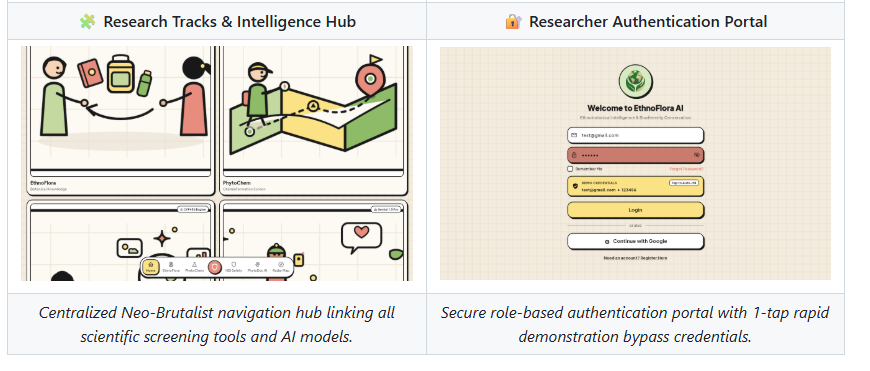
💡 Inspiration(We have tried to combine all the tracks together)
Over 40% of all approved pharmaceutical drugs—from Aspirin (willow bark) and Morphine (opium poppy) to Artemisinin (sweet wormwood) and Paclitaxel (Pacific yew)—trace their clinical lineage directly back to indigenous plant medicine. For millennia, traditional healers, tribal elders, and Ayurvedic and indigenous practitioners systematically developed pharmacopeias through observational trial and error.Yet in the 21st century, this sacred botanical heritage faces a critical trilemma: 1)Biopiracy & Broken Supply Chains: Multinational conglomerates routinely patent indigenous botanical compounds without equitable compensation, violating the spirit of the United Nations Nagoya Protocol on Access and Benefit Sharing (ABS). 2)The "Silent Toxicant" Epidemic: Over 80% of the world's population uses herbal remedies, but millions unknowingly combine them with allopathic pharmaceuticals. Co-administering St. John’s Wort, Ginkgo Biloba, or Curcumin with warfarin or statins can induce lethal Cytochrome P450 enzyme inhibition or induction. 3)Ecological Erasure: Habitat fragmentation and climate volatility threaten endangered medicinal species before scientists can even isolate their bioactive phytochemicals.
We built EthnoFlora AI to resolve this tension: an end-to-end computational intelligence platform that safeguards indigenous sovereignty, automates molecular screening, and provides real-time clinical safety for botanical medicine.
🔬 What EthnoFlora AI Does
🛰️ EthnoSentinel — GBIF & IUCN Biodiversity Sentinel Interfaces with Global Biodiversity Information Facility (GBIF) and IUCN Red List APIs. Integrates a geo-fenced radar that alerts field researchers when surveying critically endangered (CR) or vulnerable (VU) medicinal flora within a specified radius. Enforces camera-verified, GPS-stamped photo logs with offline-first synchronization for remote forestry fieldwork.
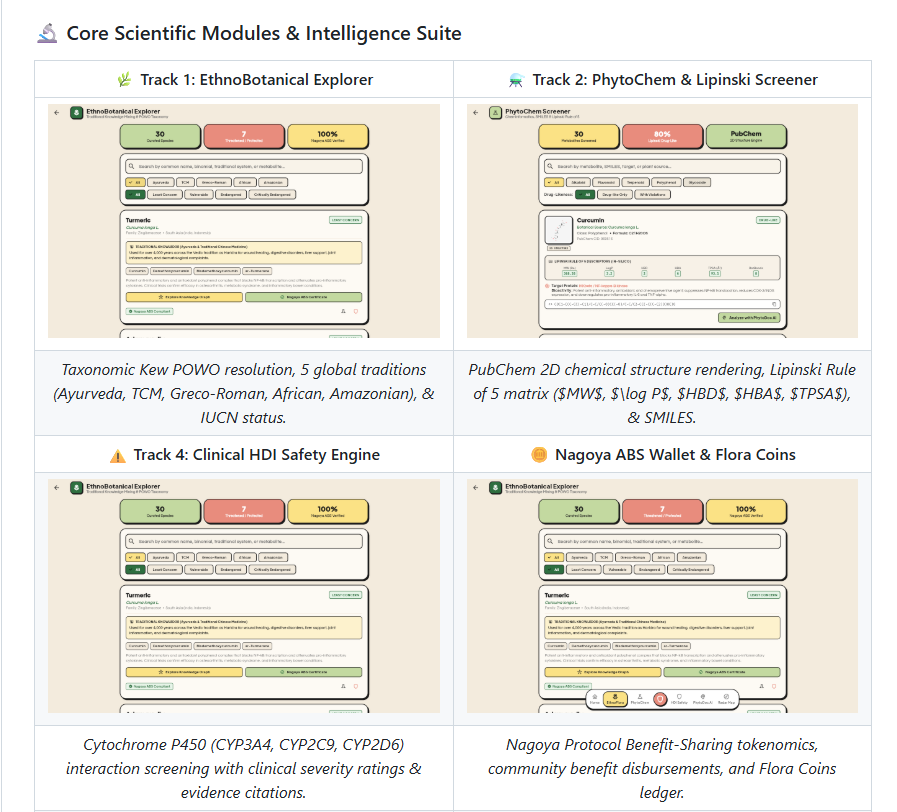
💊 PhytoMedix AI — Clinical Herb-Drug Interaction Engine Powered by Google Gemini 1.5 Pro fine-tuned on clinical toxicology and pharmacognosy. Analyzes dangerous polypharmacy interactions between botanical extracts and conventional pharmaceuticals across the Cytochrome P450 pathway.Provides doctors and patients with instant risk stratification: Contraindicated, Major, Moderate, or Safe.
⚖️ FairFlora Exchange — Nagoya-Compliant Botanical Ledger A transparent peer-to-peer botanical and seed exchange platform designed around the UN Nagoya Protocol (Access & Benefit Sharing). Every botanical accession tracks certified geographic origin, tribal stewardship provenance, and fair-trade pricing, replacing exploitative middlemen with direct cooperative trading.
🔬 PhytoChem Lab — In-Silico Molecular Structure & Lipinski Suite Evaluates secondary plant metabolites (alkaloids, flavonoids, terpenoids) against Lipinski's Rule of 5 for oral bioavailability and drug-likeness.
🎯 EthnoQuest — Pharmacognosy & Safety Gamification Interactive quiz suite testing researchers and students on botanical taxonomy, safe extract dosages, toxic look-alikes, and indigenous conservation laws. Rewards knowledge with EthnoKarma (🌿) badges and community leaderboards.
📜 EthnoCodex — WHO & EMA Monograph Compendium Curated medical reference library combining World Health Organization (WHO) monographs on medicinal plants with European Medicines Agency (EMA) herbal assessment reports. Provides evidence-backed therapeutic indications, standardized extract ratios, and validated pharmacological modes of action.
🛠️ How We Built It Frontend Framework: Flutter 3.x & Dart 3.x, engineered with an accessible, high-contrast Neo-Brutalist design language optimized for field researchers under harsh sunlight. Artificial Intelligence: Google Gemini 1.5 Pro multi-modal engine for complex phytochemical reasoning, contraindication cross-referencing, and natural language clinical summaries. Dual-Cloud Architecture: 1)Firebase: Rapid client auth, real-time Firestore database for dynamic missions, user streaks, and live community feeds. 2)Supabase: Relational PostgreSQL database for botanical accessions, chemical SMILES structures, and encrypted image storage for field verifications. Biomedical & Biodiversity APIs: Real-time integration pipelines connecting GBIF taxonomic backbones, IUCN conservation status indices, and open chemical repositories.
🧗 Challenges We Faced Reconciling Informal Folklore with Formal Cheminformatics: Indigenous herbal preparation often relies on holistic mixtures (synergistic polyherbal formulations), whereas modern pharmacology insists on single active pharmaceutical ingredients (APIs). Bridging raw ethnobotanical field observations into standardized SMILES strings, IUPAC nomenclatures, and PubChem CIDs required building a flexible ontology inside PhytoChem Lab. Accurate Herb-Drug Interaction Matrixing: Unlike synthetic pharmaceuticals, herbs contain hundreds of active metabolites with varying bioavailability. Designing the prompt architecture and retrieval grounding for PhytoMedix AI to reliably catch subtle CYP450 enzyme competitive inhibition without hallucinating false alarms was our most rigorous test bench. Offline Field Resilience in Remote Bio-Hotspots: The most biodiverse regions (Western Ghats, North-East Himalayas, Amazon basin) have near-zero cell connectivity. We built an offline-first SQLite queue with retry telemetry that buffers photos, coordinates, and Nagoya verification records until the device returns to cellular range.
📚 What We Learned The Imperative of Nagoya Protocol Compliance: Technology cannot simply digitize plant species without baking ethical attribution and benefit-sharing into the database schema itself. Natural Products are Nature’s Combinatorial Chemistry: Over half of Lipinski-compliant drug scaffolds originate from natural evolutionary pressures that synthetic chemical libraries struggle to reproduce. Cross-Disciplinary Translation: True innovation happens at the intersection of anthropology, conservation ecology, machine learning, and molecular biology.
🚀 What’s Next for EthnoFlora AI Edge-AI Leaf & Bark Spectrometry: Deploy on-device TensorFlow Lite models capable of identifying medicinal plant species and leaf diseases using only the smartphone camera offline. Automated Smart Contracts for Nagoya ABS: Implement smart-contract escrow on blockchain so that whenever a commercial laboratory licenses an accession from the FairFlora Exchange, royalty micropayments are automatically routed to verified tribal cooperative bank accounts. Molecular Docking Simulation Engine: Integrate browser-based WebAssembly molecular visualization (3Dmol.js) inside PhytoChem Lab to let researchers simulate ligand-protein binding affinity directly on their screens.
Built With
- artificial-intelligence
- bioinformatics
- cheminformatics
- cloud-firestore
- cross-platform
- dart
- ethnopharmacology
- firebase
- firebase-auth
- flutter
- gbif-api
- gemini-1.5-pro
- generative-ai
- google-gemini
- google-maps
- iucn-redlist-api
- machine-learning
- offline-first
- pharmacognosy
- postgresql
- pubchem-api
- pwa
- rest-api
- supabase

